Great Subways of the Great Society
Howdy, folks! Welcome back to Moving Policy! Today, we’re going to take a welcome break from all that depressing autocentric infrastructure…
Great Subways of the Great Society
Howdy, folks! Welcome back to Moving Policy! Today, we’re going to take a welcome break from all that depressing autocentric infrastructure we’ve been talking about over the last few weeks. Sure, autocentric thinking may be the default mode of thought for a lot of people out there, but there have also been times when that wasn’t the case. I’m of course referring to the subway systems constructed in the 1970s and early 1980s known collectively in (some very small and dorky) circles as the “Great Society Subways.” These are some of the finest systems in the U.S., and they represent one of the only concerted efforts to federally fund subway construction in American history.
But what makes these systems so different from other types of transit networks? Well, strap in because we’ve got some time traveling to do!
Railroading, Private Style
The first subway systems worldwide were built by a variety of contractors and operated by just as many. In the U.S., most of the old-style subways were given “franchise” of their networks thanks to local political ordinance. Philadelphia, for instance, would contract the Philadelphia Rapid Transit company to construct and operate an elevated subway line in 1901. In 1897, the Boston Elevated Railway (BERy) took over operations of the Tremont Street Subway, the first ever subway in the U.S. And of course no one can forget NYC, which gave the Interborough Rapid Transit (IRT) company a 50-year franchise to run its first subway in 1900.
The first thing that you should know about these subways is that they were legitimately and literally groundbreaking. The oldest subway in the world is located in London, and it didn’t break ground until 1863. This means that by and large, the people building the subway systems of Philadelphia, Boston, and New York City were flying by the seats of their train cars. Not only that, but many of these companies were using state of the art technology like third rail electrification. Finally, these companies were ultimately private actors that were in competition with other transit agencies as much as they were trying to provide accessible transit to their respective cities.
However, not every subway followed this pattern. In the west, San Francisco broke with her contemporaries when the city “municipalized” a portion of its streetcar network. Municipalization was not entirely new, but no city the size of San Francisco had ever attempted such a large takeover. Under the control of the San Francisco Municipal Transit Authority (SFMTA), the streetcar system was now publicly-funded and publicly-run.
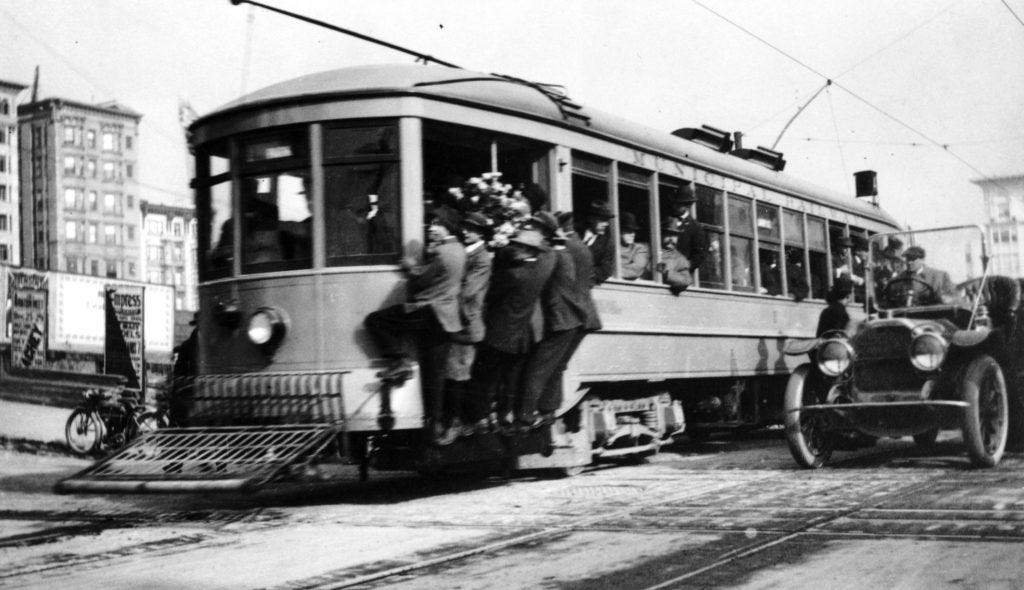
Moving at the Speed of San Francisco!
Municipalization came about for a few reasons. The first was that although private railroaders and streetcar operators provided plenty of service, that service was not always good. Operators duplicated existing services to tap into large concentrations of people. This might seem sensible, but it meant that some places became inundated with rapid transit access while others fell behind. Additionally, private ownership led to private abuses. People complained bitterly in San Francisco about the abuses of the United Railroads. The Tremont Street Subway in Boston was constructed in part to reduce the sheer volume of surface-level streetcar operations by any number of private companies.
Municipalization was not only done for the sake of streamlining streetcar services. They also played a hand in saving many of these organizations and operations from the scrapheap. As the car started to seriously eat into the passengers and profits of streetcar operations, operators either went bankrupt, initiated “bustitution,” or were bought out by public operators. In 1947, BERy was subsumed by the Massachusetts “Metropolitan Transit Authority.” NYC would see the same in 1940. The reasons were different but also the same: declining ridership turned transit into a thoroughly unprofitable exercise.
However, cities need transit to survive. New York City would cease to function without a way to ferry millions of people either over or underground. The same could be said for other cities like Boston, Philadelphia, Chicago, and San Francisco. Municipalization not only preserved surface transit, but also promised more regular funding and support for these systems than ever before.
As such, by the end of WWII a distinct pattern emerged regarding the first subway systems in the U.S. These privately-built and operated systems spread haphazardly throughout their cities and either saw eventual municipalization or went out of business. There’s a reason why MUNI (San Francisco’s transit operator) survives but the United Railways is dead. The survival of these systems prompted some Congressional officials to explore why transit survived in these areas. And by the end of the 1960s, they were ready to do something about it.
The Great Society
Lord Acton once said that “power corrupts, and absolute power corrupts absolutely.” Robert Caro thinks differently. Power doesn’t corrupt so much as it reveals. Reveals what, exactly? Character? Motives? Unseemly parts? In the case of Lyndon B. Johnson, it was a little bit of all three. When Johnson took office in 1963, he didn’t just do so to quell a nation in turmoil and upheaval. He did it with the intention of transforming American society. He labeled many of these collective initiatives “The Great Society.”

Behold! The Terrible Texan.
Many programs that we know and love today got their start with Johnson’s ambitious legislative proposals. Federal departments like the Department of Housing and Urban Development as well as Transportation got their starts thanks to Johnson. Programs like Medicare and Medicaid insured Americans like never before. And civil rights came to the forefront for the first time in American history. Under Johnson’s administration, the U.S. would pass its first civil rights bill since the 1860s. And unlike the CRA of 1866, Johnson intended this one to stick.
The momentous transformation of American society was not limited to housing and civil rights. It also extended to transit. Under Johnson, the newly-formed Department of Transportation would oversee and fund transportation expansion directly using hundreds of billions of federal dollars. A part of this new department was the Urban Mass Transportation Administration, or UMTA. UMTA quickly saw to the distribution of money in support of transit agencies around the country. In 1965, for instance, the UMTA provided Boston and the newly-minted Massachusetts Bay Transportation Authority (MBTA) funds to conduct the first major modernization projects that the agency had ever known. Since 1965, the federal government has provided at least $3.5 billion to the MBTA for improvement projects.

Among the renovations was the creation of the standard MBTA map.
Direct funding from the federal government for transit projects was a major departure from past federal, state, and local practices. Remember, for almost a century almost all forms of mass transportation, from intercity trains, interurbans, and streetcars, were entirely private endeavors. Even if they were “municipalized” like San Francisco, these efforts were all local or regional in nature.
Now, however, cities and states could count on federal dollars not only to maintain their systems, but to upgrade them as well. And some cities went right ahead with their efforts, to great effect. The subsequent Great Society Subways all had different characteristics that suited their regions, but they all shared some common traits. What were they? Well let’s read on below!
What Makes A Great Society Subway?
San Francisco is, believe it or not, just a part of a large region of California usually referred to as the “Bay Area.” San Francisco is home to around 650,000–700,000 people, but the region itself is populated by over 7 million. Almost all of these people work around, in, or near the city proper. As a result, finding the most efficient way to move these folks was paramount for regional planners in the 1960s and 1970s. MUNI, however impressive and satisfactory to the city of San Francisco proper, simply couldn’t meet the demands of the rest of the region.
Regional planners came together in the 1950s and 1960s to design a new transit system for the entire Bay Area that would fulfill its modern purposes. That system would eventually be known as BART — or the Bay Area Rapid Transit system. BART was state of the art in the mid-20th century, featuring specially designed rails, large, spacious stations, and even completely automated trains. It was a sincerely impressive endeavour and was also only possible with federal support. What do I mean by that? Well, for one, 64 percent of BART’s first 450-car fleet was funded by the federal government.

BART’s general outline, showcasing the unique geography of the Bay Area.
But the Great Society subways weren’t just for cities that had existing transit dreams. They were also for cities that had never seriously built any heavy rail transit at all. For instance, two Great Society systems are located in Miami, FL, and Atlanta, GA.
In Atlanta, almost all regional transit operations were overseen by MARTA, or the Metropolitan Atlanta Transit Authority. MARTA began its operational history as a bus service provider, ensuring the millions of residents that reside in the Atlanta region bus access to their employment and recreational centers. However, rail was considered an option for the region as early as 1965. Multiple failed referendums finally led to a breakthrough in 1971, when a ballot measure to fund 50 miles of rapid transit finally passed.
And thanks to a simultaneous failure of a similar ballot measure in Seattle, WA, Atlanta could now take full advantage of federal benefits. Starting in 1975, MARTA received over $800 million from the federal government to construct its rail system. The final system would reach a number of counties throughout the Atlanta region — except for the few that opted out, which hampers the MARTA system to this day.

MARTA: Now in Technicolor!
However, perhaps the greatest success story for the Great Society subways was in LBJ’s own backyard. I am of course referring to the DC Metro, or the Washington Metropolitan Transit Authority. WMATA fittingly began operations on March 27, 1976, WMATA was the direct creation of LBJ’s administration. LBJ himself signed WMATA into existence on November 6, 1966.
Riding in Style (And With No Aqautic Car)
WMATA is a special subway for many reasons. For one, it is in many ways designed in direct contrast to the New York City subway system. Instead of tight, cramped, and varied stations, almost all WMATA stations are large, spacious, and uniform. Not only that, but WMATA received direct federal oversight and millions in federal support, fitting for the transit system of the nation’s capital.

42nd Street Station in NYC compared to…

Metro Center, in Washington, D.C.
All told, UMTA funded over 200 miles of subway construction in a number of American cities. But it wasn’t to last.
The Legacy of the Great Society
The last two “Great Society Subways” started their operations in the late 1980s and early 1990s. Miami, after decades of rampant growth, finally inaugurated a transit system in 1989. Los Angeles would achieve similar results in 1993 with the opening of the Red Line in North Hollywood. However, these two systems would be the last examples of this kind of subway project. But what makes the Great Society Systems so distinct?
For one, these systems were characterized by generous federal support. Not only that, but these subway systems were distinctly regional in character. Finally, many of their designs were deliberately designed to contrast with existing subway networks, like NYC.
However, in the 1980s and 1990s, cities were no longer interested in building expensive and costly heavy rail. Instead, they were turning to a new type of technology: light rail.
메타데이터
- post_id
- 47df5b59e788
- slug
- great-subways-of-the-great-society-47df5b59e788
- url
- https://medium.com/@jonhammondiii/great-subways-of-the-great-society-47df5b59e788
- canonical_url
- https://medium.com/@jonhammondiii/great-subways-of-the-great-society-47df5b59e788
- author_url
- https://medium.com/@jonhammondiii
- status
- ok
- fetched_at
- 2026-07-14 12:48:22


