The Friday column: Who I am not voting for
Real (ex-inflation) median Alaska household income has declined since 2015. PFD cuts are a big part. I will not vote for any candidate who…
The Friday column: Who I am not voting for
Real (ex-inflation) median Alaska household income has declined since 2015. PFD cuts are a big part. I will not vote for any candidate who fails realistically to prioritize restoring it.
A recent post by one of the candidates running on a statewide ticket crystallized something that has been rolling around in the back of my mind for the last several weeks.
The post was touting the rating for their ticket by the National Rifle Association (NRA). But at the end of it, and unrelated to the NRA rating, the candidate added these sentences: “Any candidate promising you a statutory PFD [Permanent Fund Dividend] with no new taxes is either uninformed about the state’s fiscal reality, or dishonest. Neither of which are traits we should support in the CEO of our state.”
The realization that crystallized in my mind is that I am not voting for any ticket that, as part of their campaign, does not prioritize developing a realistic pathway to restoring a full statutory PFD.
The reason is that restoring the PFD is an important — indeed, critical — part of improving the overall economic health of most Alaska households, something that is deteriorating not only relative to the rest of the US, but also in absolute numbers.
Using data from the Federal Reserve Bank of St. Louis’ FRED database, here is a comparison of real (after inflation) median Alaska household and personal income to that for the US in general since 2015, the last year before Alaska started using PFD cuts to fund the government. Median household income and personal income are the most widely tracked income statistics for gauging U.S. households’ economic circumstances. Real (after inflation) income eliminates the impact of inflation on the numbers.
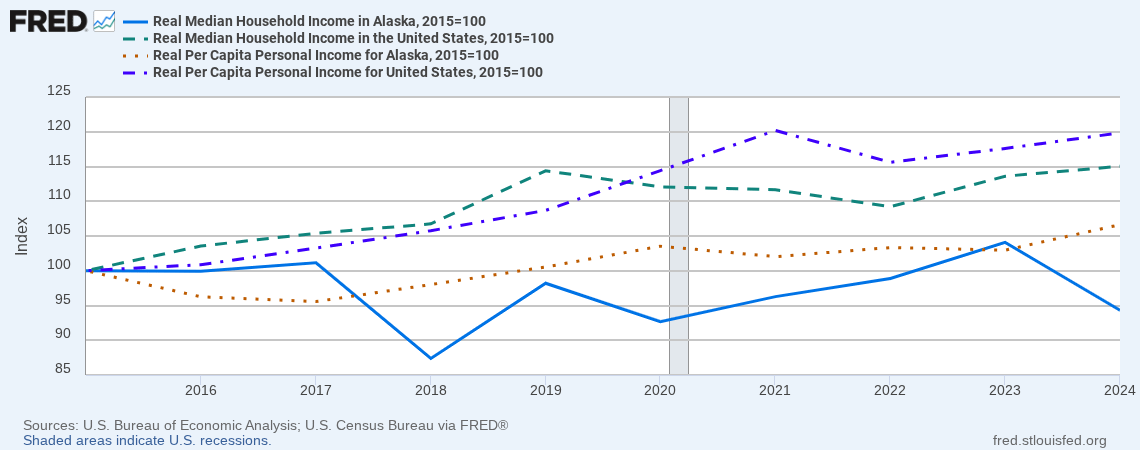
As the chart shows, while both national real median household and per capita personal income have grown since 2015, Alaska’s real median household and per capita personal income have largely stagnated. Comparing apples to apples, while national real median household income has grown over the period by 15%, Alaska’s has declined over the same period by over 5%.
And while national real per capita personal income has grown over the period by 20%, a compound real growth rate of over 2%, Alaska’s has grown over the same period by only a little over 6%, a compound real growth rate of less than 0.8%.
The slight difference between the trajectory of Alaska’s real median household income and per capita personal income is due to how they are calculated. Real median household income is the median; there are as many households above the number as below. It reflects the true middle-income Alaska household.
On the other hand, per capita personal income is the average. The average is pulled upward by the impact of those with significantly higher incomes. It more reflects those in the upper-middle income bracket.
For most purposes, real median household income is a better measure of how middle-income Alaska families are faring.
But regardless of the measure, the overall result is largely the same. While once Alaskans held a significant advantage in both categories over the US generally, these changes have largely eliminated Alaska’s position.
Looking over the full span of the available data, 40 years ago, Alaska’s median household income was more than 40% higher on a real basis than the national median household income: $87,220 to $60,420. Now, it’s less than 9%: $91,260 to $83,730. And since 2015, it has declined in real terms, from $96,750 to $91,260.
In 2008, Alaska’s real per capita personal income was nearly 13% higher than the national number: $51,647 to $45,816. Now, it’s less than 2%: $60,272 to $59,195. Indeed, in 2021, Alaska’s real per capita personal income was less than the national number.
The use of PFD cuts has contributed significantly to these results. Since being initiated in 2016, PFD cuts have averaged around $1,900 annually per recipient. Adjusting Alaska’s real median household income for that amount would have reduced the decline from 2015 to 2024 by nearly 80%. Adjusting Alaska’s real per capita personal income over the period would have increased the change from a little over 6% to more than 10%.
While Alaska would still be losing ground compared to the national numbers, the losses would be less significant. And real median household income would not have slid backward.
These numbers also represent the tip of the iceberg. As Professor Matthew Berman of the University of Alaska — Anchorage’s Institute of Social and Economic Research (ISER) has pointed out, PFD cuts are hugely regressive, reducing the incomes of middle and lower-income households — which together are 80% of Alaskans — on a percentage basis (i.e., the effective tax rate) much more than they do the incomes of those in the upper-income brackets. Indeed, according to Professor Berman, they are the “most regressive tax ever proposed.”
As a consequence, as a share of income, using PFD cuts to raise revenue has had a much greater adverse impact over the period on the real personal income and household income of those in the lower-income brackets than even on those in the middle-income brackets. Conversely, it has had a disproportionately lighter — indeed, trivial — impact on the personal income and household income of those in the upper-income brackets.
Put another way, solely as a result of using PFD cuts, those in Alaska’s upper-income brackets have maintained much higher levels of personal and household income than those in Alaska’s middle-income bracket, while those in Alaska’s lower-income brackets have fared even worse.
A more broad-based, less regressive approach would have raised the income of middle-income Alaska families relative to the impact of PFD cuts, reducing their economic decline.
Some argue that in the absence of PFD cuts, Alaska would be required to raise revenues in other ways to pay for the costs of state government, and that those other ways would also have some impact on the personal and household income of those in Alaska’s middle-income bracket.
That may be, but as both the ISER 2016 and 2026 studies of Alaska’s fiscal options demonstrate, by significantly broadening the tax base and flattening the regressivity curve, any of the other approaches would significantly reduce the adverse impact on those in Alaska’s middle-income bracket compared to the use of PFD cuts.
Put another way, the 60% of Alaskans falling in the state’s middle-income brackets would be better off — Alaska’s real median household and per capita personal income would be higher — using one of those other approaches than they are continuing with PFD cuts.
Others argue that redirecting PFDs to infrastructure or other spending or incentive programs will result in economic growth, ultimately trickling down as improvements in household and personal income.
The data do not support that argument, however. As the following chart shows, while real Alaska GDP has grown by nearly 50% over the last 25 years (2000–2025), it has had very little impact on real Alaska median household and per capita personal incomes. The benefits of that growth have largely been captured elsewhere, such as by those located outside Alaska or those in the upper-income brackets.

But even if there is some “trickle-down” relationship, it does not follow that it should come from PFD cuts. As both the ISER 2016 and 2026 reports note, there are other, much less burdensome ways on middle-income Alaskans for the state to raise the revenues it may need to support whatever infrastructure or other spending or incentive programs it believes will result in beneficial economic growth.
Using PFD cuts is, at best, a one-step-forward (maybe), three-steps-backward approach. Even if it generates some “trickle-down” effects, the regressive impact of using PFD cuts has a much larger adverse impact on real median household and per capita personal income than if the necessary funds had been raised by less regressive means.
Still others argue that any taxes on individual Alaskans, through PFD cuts or otherwise, are unnecessary. In their view, Alaska’s budget can be balanced entirely through cuts in government spending or, alternatively, through revenues raised through taxes entirely on oil and other resource companies.
But as we have explained in previous columns, those claims are unrealistic. At current law deficits of nearly $2 billion per year, Alaska’s budget gap is simply too large to be resolved either through “spending cuts only” or “oil and other resource taxes only.” As they already are through PFD cuts, individual Alaskans will need to make some contribution toward the costs of their own government to close the state’s ongoing deficits.
The question is not whether taxes can be avoided entirely. They are already here in the form of PFD cuts and are substantial. The real question is which approach has the least impact on, or differently put, creates the best overall economic outlook for the vast majority of Alaska households.
PFD cuts have the worst. Because of their adverse impact on middle-income Alaska households, the heartbeat of any economy, I am not voting for any ticket that fails to recognize that and, as part of their campaign, does not prioritize developing a realistic pathway to restoring PFDs by replacing the cuts in them with other, lower-impact revenue approaches going forward.
Especially given the outmigration the state is experiencing among working-class, working-age Alaskans, reversing the decline in the economic health of Alaska households should be priority one. Restoring the PFD by substituting other, lower-impact means of raising government revenues is a key part of achieving that objective.
메타데이터
- post_id
- 47e664caa569
- slug
- the-friday-column-who-i-am-not-voting-for-47e664caa569
- url
- https://medium.com/alaskans-for-sustainable-budgets/the-friday-column-who-i-am-not-voting-for-47e664caa569
- canonical_url
- https://medium.com/alaskans-for-sustainable-budgets/the-friday-column-who-i-am-not-voting-for-47e664caa569
- author_url
- https://medium.com/@bgkeithley
- status
- ok
- fetched_at
- 2026-08-12 11:07:36