Space Microbiology: How Microgravity Alters Bacterial Growth, Survival, and Virulence
Outline & Essay
Space Microbiology: How Microgravity Alters Bacterial Growth, Survival, and Virulence
Outline & Essay
Outline
I. Introduction A. Space is an extreme environment characterized by microgravity, radiation, and isolation. B. Microorganisms inevitably travel with astronauts and can affect both health and spacecraft systems. C. Thesis: Microgravity and space conditions significantly alter bacterial growth, gene expression, biofilm formation, and virulence, making space microbiology critical for long-term space exploration.
II. Space Environment and Microbial Stress A. Microgravity reduces normal fluid movement and changes nutrient/waste distribution around cells. B. Increased radiation and confined habitats create additional stress for microbes. C. These conditions force microorganisms to adapt at cellular and molecular levels.
III. Effects on Bacterial Growth and Physiology A. Some bacteria show altered or enhanced growth rates in microgravity. B. Metabolic pathways shift due to changed environmental conditions. C. Cells adapt by modifying membrane transport and stress-response systems.
IV. Gene Expression and Cellular Adaptation A. Microgravity triggers changes in gene regulation linked to stress and survival. B. Pathways involved in metabolism, virulence, and repair are affected. C. These changes demonstrate strong environmental control over microbial behavior.
V. Biofilms and Increased Resistance A. Biofilms are structured microbial communities enclosed in a protective matrix. B. In space, biofilms often become thicker and more resilient. C. This increases resistance to cleaning, antibiotics, and environmental stress.
VI. Virulence and Health Risks A. Some bacteria show increased disease-causing potential in space conditions. B. Enhanced adaptability may also support antibiotic resistance development. C. This poses risks for astronaut health during long missions.
VII. Conclusion A. Microgravity significantly reshapes microbial behavior at structural and genetic levels. B. These changes affect health, safety, and spacecraft systems. C. Space microbiology is essential for safe long-duration missions and future planetary exploration.
Essay
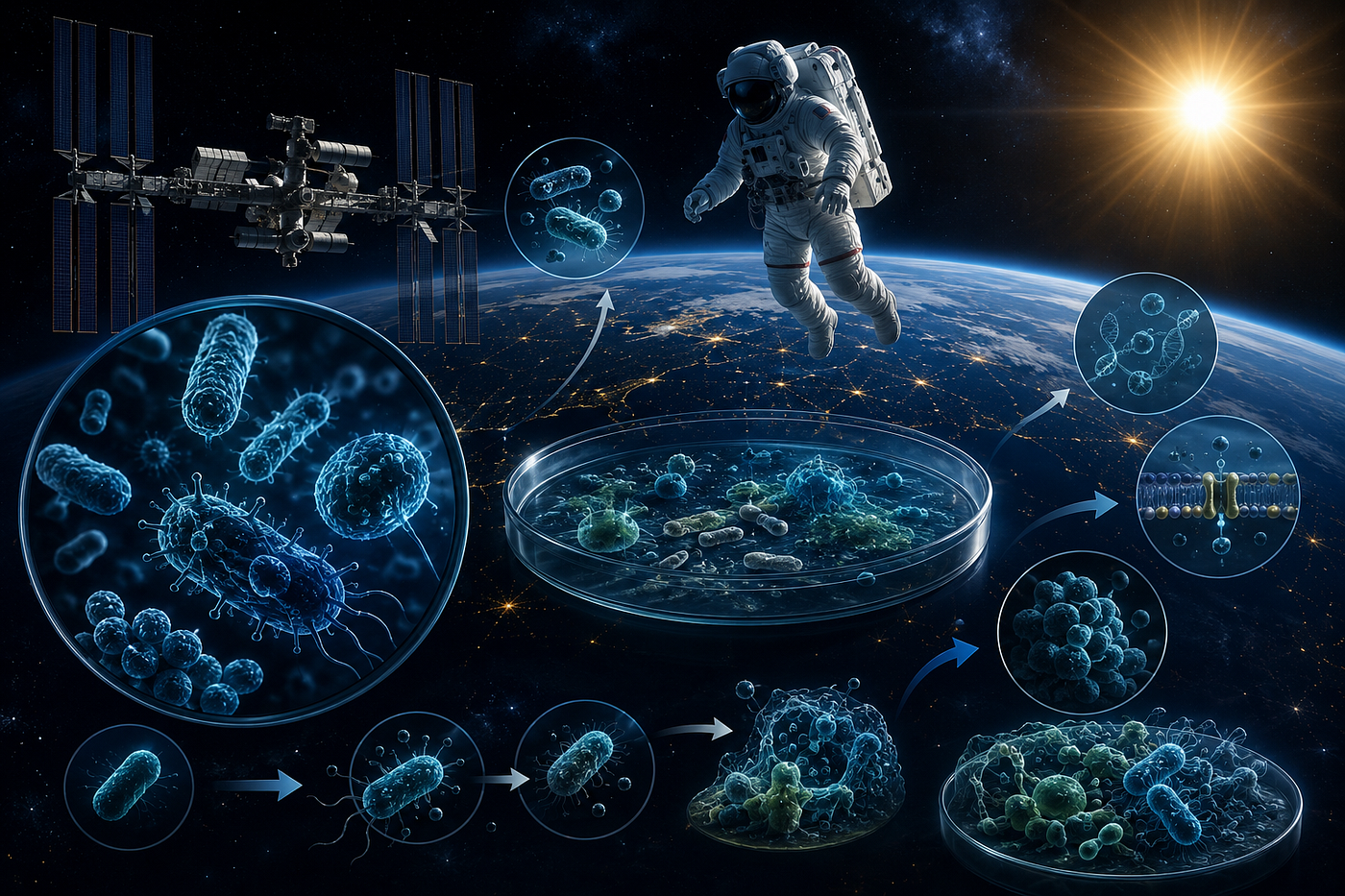
Space microbiology examines how microorganisms respond to the space environment, where microgravity, radiation, and confinement create conditions very different from those on Earth. In the context of Space Microbiology and how Microgravity Alters Bacterial Growth, Survival, and Virulence, the central question is how bacteria and other microbes adjust their biology when gravity no longer acts in the usual way. NASA describes spaceflight as an environment that can alter microbial growth, physiology, and survival, making microorganisms a serious subject of study in long-duration missions.
Microgravity changes the physical conditions surrounding microbial cells. On Earth, gravity supports normal fluid movement, mixing, and transport of nutrients and waste products. In space, those patterns change, so the cell experiences a different environment at the surface level and inside its metabolic systems. Under these conditions, microbes do not simply remain the same organism in a new location; they adjust their cellular processes in response to altered surroundings. That is why the topic can be best understood as a study of biological adaptation under stress.
The effect of space is not limited to survival alone; it also changes how bacteria grow and function. Studies of simulated microgravity have reported increased growth rates in some bacteria, along with shifts in metabolism, motility, and biofilm formation. Reviews of microgravity research show that the main pathways affected often include bacterial metabolism, cell-wall and membrane function, and transcription, while NASA studies on Salmonella found altered stress-response behavior under low-shear microgravity. In simple terms, microgravity pushes bacterial cells to reorganize membrane transport and stress-response systems so they can keep functioning in a very different environment.
One of the clearest responses seen in space is altered gene expression. NASA’s Microbe experiment aboard the International Space Station studied microorganisms including Salmonella typhimurium, Pseudomonas aeruginosa, and Candida albicans. In the case of Salmonella typhimurium, 167 genes were expressed differently in flight compared with ground controls. Such findings show that microgravity can reprogram microbial behavior at the molecular level, affecting how the organism grows, repairs itself, and responds to stress. Gene expression becomes one of the strongest examples of how space conditions reshape microbial life.
Biofilm formation is another major aspect. A biofilm is a community of microorganisms attached to a surface and surrounded by a protective matrix. NASA has studied biofilms on materials relevant to the International Space Station, including stainless steel, because microbial communities can persist on spacecraft surfaces, resist cleaning agents, and interfere with equipment. In microgravity, biofilms may develop differently than they do on Earth, often becoming more difficult to control. That makes them a central concern in closed environments where both machinery and human health depend on microbial management.
The same space conditions can also influence microbial virulence, which refers to the ability of a microorganism to cause disease. NASA has reported that some microbes show increased virulence after exposure to spaceflight conditions, along with broad changes in gene expression and morphology. At the same time, astronauts may experience changes in immune function during space missions, creating a setting in which ordinarily familiar microbes can become more problematic. For that reason, not only growth and survival, but also the possibility of increased pathogenic behavior in closed spacecraft environments needs to be studied.
In conclusion, Space Microbiology provides a focused way to study how life at the microscopic level responds to an extreme environment. Microgravity alters microbial growth, shifts gene expression, supports biofilm formation, and can influence virulence. These changes show that bacteria are highly adaptable organisms whose behavior changes when the physical environment changes. The topic combines microbiology, cell biology, and space science in a way that is scientifically strong and conceptually clear.
메타데이터
- post_id
- 47e67f4243d4
- slug
- space-microbiology-how-microgravity-alters-bacterial-growth-survival-and-virulence-47e67f4243d4
- url
- https://medium.com/@zznaqvee/space-microbiology-how-microgravity-alters-bacterial-growth-survival-and-virulence-47e67f4243d4
- canonical_url
- https://medium.com/@zznaqvee/space-microbiology-how-microgravity-alters-bacterial-growth-survival-and-virulence-47e67f4243d4
- author_url
- https://medium.com/@zznaqvee
- status
- ok
- fetched_at
- 2026-07-11 22:06:18