Why Hotel Security Requires a Different Approach
A look at the unique challenges hotels face and what effective security in hospitality looks like.
Why Hotel Security Requires a Different Approach
A look at the unique challenges hotels face and what effective security in hospitality looks like.
Walk into most hotels, and the last thing you want to feel is like you’re being watched. That’s by design. Hotels are built around welcome, comfort, and ease. The experience matters as much as anything else.
Behind that managed atmosphere sits a complex security environment. Open access, high footfall, round the clock operation, and a constant flow of guests, staff, contractors, and visitors all create a set of hotel security challenges that are quite different from those faced by a typical commercial building or workplace.
Getting security right in a hotel means solving a problem that most environments don’t have. How do you keep people safe without making them feel like they’re in a secure facility?
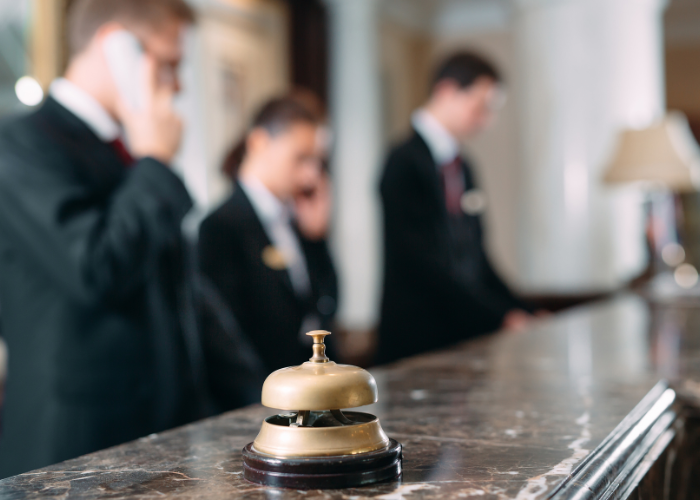
From the front desk to the back of house — effective hotel safety and security requires every part of the team to play a role.
Why Hotels Carry a Wider Duty of Care
It’s easy to think of hotel security in terms of preventing theft or dealing with disruptive behaviour. Those things matter. But the risks and responsibilities run deeper than that.
Hotels have a duty of care to every person on the premises. That includes guests sleeping in their rooms, staff working late shifts, contractors on site during maintenance, and visitors passing through the reception. Each of these groups has different needs, different levels of access, and different vulnerabilities.
A security incident in a hotel doesn’t just affect the individual involved. It affects reputation, guest confidence, and the ability to operate. In hospitality, trust is everything. Once it’s damaged it takes a long time to rebuild.
Hotel Security Risks Are Shaped by the Environment Itself
Most buildings can control who comes in. For hotels, that’s much harder to do. That’s one of the things that makes them distinct.
The vulnerabilities tend to emerge from the very features that make hotels attractive to guests. Multiple entry points. Lifts and corridors accessible to anyone with a key card. Bars and restaurants open to the public. Car parks that are rarely monitored around the clock. Conference facilities with their own separate flow of attendees.
Unlike a workplace where familiar faces are the norm, a hotel environment means staff are regularly dealing with people they have never seen before and may never see again. Spotting something that doesn’t look right requires a different kind of awareness than in a more controlled setting.
Getting the Tone of Security Right
This is the central challenge in hospitality security. It’s one that requires genuine thought rather than a standard template.
Balancing guest experience and security means making considered decisions about where visible security is appropriate and where a lighter touch is more suitable. A security officer standing at the entrance to a luxury hotel needs to carry themselves differently to one managing access at a construction site. The role requires professionalism, awareness, and strong people skills alongside a thorough knowledge of security.
It also means thinking about where security measures are placed. Bag checks, ID verification, and access restrictions all have their place. The question is how they’re implemented so that guests feel looked after rather than suspected.
The hotels that get this right tend to be the ones where security is embedded into the hospitality experience rather than bolted on top of it.
Hotel Visitor Management and Access Control
One of the most common hotel security challenges is knowing who is on the premises at any given time.
Effective visitor control covers more than just guests checking in at reception. It includes managing contractors coming in to carry out maintenance, monitoring access to back of house areas, overseeing deliveries, and ensuring that public areas like bars and restaurants don’t become easy routes into restricted parts of the building.
Hotel access control systems play a key role here. Key card systems, monitored entry points, and clear protocols for contractor access all reduce the window of opportunity for something to go wrong. But systems alone aren’t enough. They need to be supported by staff who understand the procedures and apply them consistently.
Hotel reception security is often the first and most visible line of that control. A well-briefed reception team that knows what to look for and how to escalate concerns can make a major difference to how effectively the whole operation runs.
Hotel Safety and Security Across Every Shift
Hotels don’t close. That creates a security challenge that many businesses simply don’t face.
Security across every shift has to function just as effectively at 3am as it does at midday. The risks don’t disappear when things quieten down. In some cases they increase. Late night arrivals, guests returning from a night out, reduced staffing levels, and quieter corridors all create conditions that require careful management.
Overnight security coverage needs to be planned with that in mind. Patrol routes, communication between team members, and clear escalation procedures all matter more when there are fewer people around to notice if something goes wrong.
What Effective Hotel Security Looks Like in Practice
Good hospitality security at its best is almost invisible to guests. They feel safe and well looked after without being able to point to exactly why.
That requires hotel security guards who understand the environment they’re working in. Who can hold a conversation with a guest while remaining aware of what’s happening around them. Who know the layout of the building, the access protocols, and how to handle a difficult situation calmly and discreetly.
It also requires guest safety and security to be built into how the whole team operates, not just the dedicated security personnel. Receptionists, concierge staff, and housekeeping all play a role in maintaining a safe environment. Security often works best in hotels when it’s a shared responsibility rather than something left entirely to one team.
Why a Tailored Approach Makes the Difference
A generic security solution rarely works well in a hotel environment. The combination of open access, public-facing spaces, overnight operation, and the expectation of a positive guest experience means that the approach needs to be built around the property and the specific risks it faces.
Hotel security systems and physical measures form part of the picture. However, the human element matters just as much. Trained, experienced personnel who understand hospitality as well as security are what turn a plan into something that holds up when it matters.
The goal is simple. Every guest leaves feeling safe, well looked after, and entirely unaware of the work that went into making that possible.
메타데이터
- post_id
- 47eb445d3242
- slug
- why-hotel-security-requires-a-different-approach-47eb445d3242
- url
- https://medium.com/@Ari_RegionSecurityGuarding/why-hotel-security-requires-a-different-approach-47eb445d3242
- canonical_url
- https://medium.com/@Ari_RegionSecurityGuarding/why-hotel-security-requires-a-different-approach-47eb445d3242
- author_url
- https://medium.com/@Ari_RegionSecurityGuarding
- status
- ok
- fetched_at
- 2026-06-27 08:06:00