The Sumerian Gods of the Planetary Star: Archetypes, Planets, and Natal Chart Reading
The six-pointed planetary star is not merely symbolic geometry — it is an inner pantheon. Each point represents a planet, and each planet…
The Sumerian Gods of the Planetary Star: Archetypes, Planets, and Natal Chart Reading — Part 2
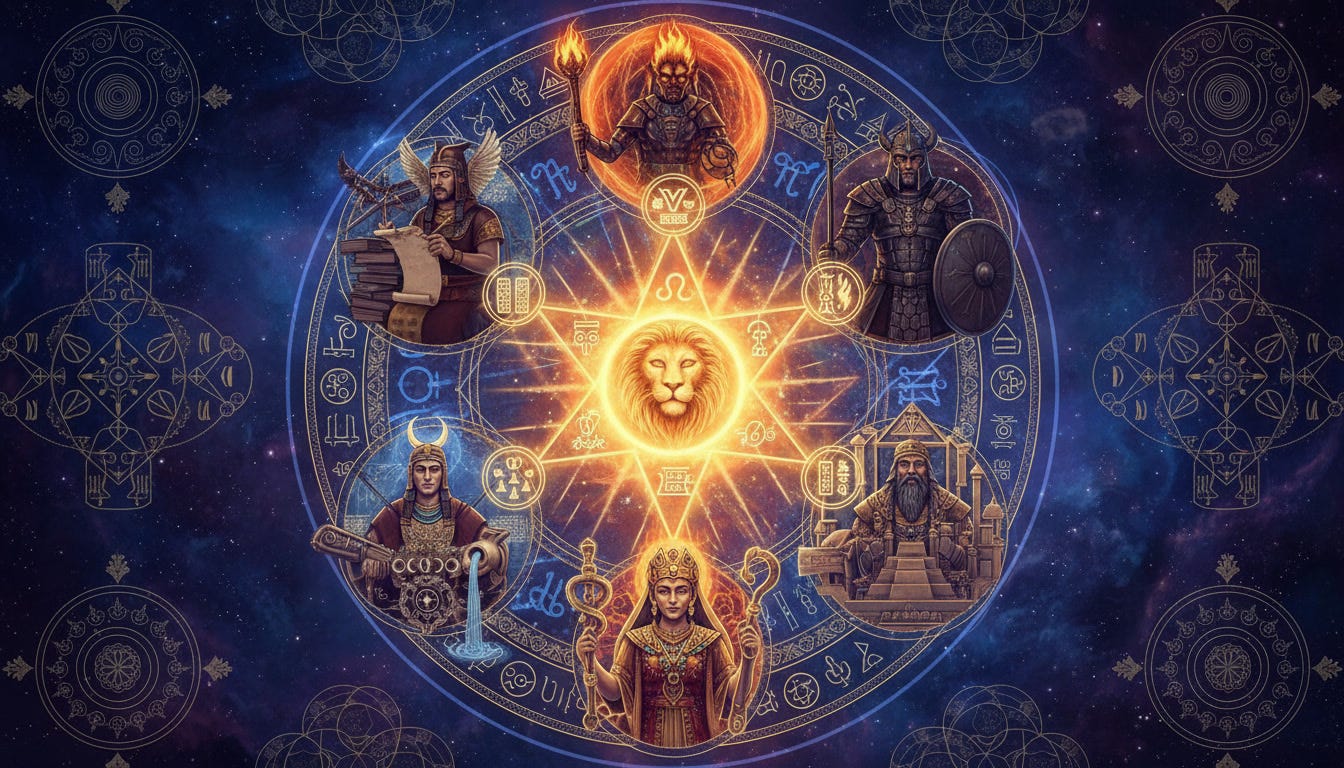
The six-pointed planetary star is not merely symbolic geometry — it is an inner pantheon. Each point represents a planet, and each planet can be read as a living Sumerian deity, with will, desire, conflict, and a specific function within the psyche.
Approaching the natal chart from this perspective is not about labeling personality traits, but about recognizing which gods govern your inner system, how they act, where they express themselves, and which myth they are reenacting.
In this post, we explore the Sumerian gods corresponding to the six points of the planetary star, with the Sun as its central axis, and how identifying their planetary placement allows for a deeper, more precise archetypal work.
The planetary star as an inner pantheon
In this framework:
- Each planet = a god
- Each sign = the style, temperament, and language of that god
- Each house = the territory where the god exercises power
- Aspects = alliances or wars between gods
The natal chart becomes a personal mythological map.
☀︎ The Sun — Utu / Shamash (Center of the Star)
Archetype of the god
Utu (Shamash in Akkadian) is the god of the Sun, justice, truth, and conscious awareness. He is not a romantic or purely creative solar force — he is the Sun that reveals reality as it is. Nothing can be hidden from his light.
Utu is judge, witness, and guarantor of moral order. His light not only gives life — it exposes.
In the psyche
- Conscious identity
- Inner authority
- Personal truth
- Capacity to lead with clarity and ethics
The Sun shows who governs the inner system and from which values.
How to read Utu in the chart
- Sun sign: how consciousness and authority are expressed
- Solar house: where you are called to lead, decide, and illuminate
- Aspects: coherence or conflict between identity and action
When Utu is integrated, there is direction, coherence, and ethical clarity. When weakened, life is ruled by confusion, guilt, or externally imposed authority.
☾ The Moon — Nanna / Sin
Archetype of the god
Nanna, god of the Moon, governs time, cycles, memory, and ancestral wisdom. He is ancient, observant, and silent. He does not act impulsively — he remembers.
In the psyche
- Emotional world
- Need for safety and belonging
- Relationship with the mother and lineage
- Inner rhythms
How to read Nanna in the chart
- Moon sign: how you feel and emotionally process life
- Lunar house: where you seek refuge and emotional security
- Aspects: whether the emotional world is protected or threatened
Working with Nanna means working with emotional memory and repetitive cycles.
☿ Mercury — Nabu
Archetype of the god
Nabu is the god of writing, wisdom, and communication. He functions as the divine messenger, recording and transmitting knowledge across realms.
In the psyche
- Thought processes
- Language and communication
- Symbolic understanding
- Ability to translate unconscious impulses into conscious expression
How to read Nabu in the chart
- Mercury sign: how you think and communicate
- House: where speaking, learning, or teaching is essential
- Aspects: mental fluidity or blockage
Here we see whether the messenger can move freely between inner and outer worlds — or becomes constrained.
♀ Venus — Inanna / Ishtar
Archetype of the goddess
Inanna is Venus: desire, magnetism, erotic power, but also ambition and war. She is not only love — she is value and sovereignty.
In the psyche
- Ways of loving
- Self-worth
- Attraction and repulsion
- Relationship with pleasure and power
How to read Inanna in the chart
- Venus sign: how you desire and what you value
- House: where you seek pleasure, recognition, or dominance
- Aspects: conflicts between desire and control
Working with Inanna means reconciling pleasure and power without denying either.
♂ Mars — Nergal
Archetype of the god
Nergal is the god of war, extreme heat, and destruction. His action is direct, unapologetic, and instinctual. When repressed, he turns destructive.
In the psyche
- Drive and impulse
- Anger
- Instinctual sexuality
- Ability to defend boundaries
How to read Nergal in the chart
- Mars sign: how you fight and act
- House: where aggression or desire is discharged
- Aspects: internal violence or conscious courage
Nergal demands channeling, not censorship.
♃ Jupiter — Marduk
Archetype of the god
Marduk is the god of order, expansion, and law. He defeats chaos (Tiamat) and establishes a new cosmos.
In the psyche
- Sense of purpose
- Belief systems
- Moral authority
- Capacity to grow and lead
How to read Marduk in the chart
- Jupiter sign: how you expand meaning and vision
- House: where you seek legitimacy and growth
- Aspects: excess, dogma, or integrated wisdom
Here we see whether inner order is fertile or tyrannical.
♄ Saturn — Ninurta
Archetype of the god
Ninurta is the god of discipline, agriculture, and strategic warfare. He represents effort sustained over time, mastery of matter, and victory through structure and responsibility.
This is Saturn, not as punishment, but as forging.
In the psyche
- Responsibility
- Discipline
- Work ethic
- Long-term construction
How to read Ninurta in the chart
- Saturn sign: how you exercise discipline and authority
- House: where you are called to build something solid
- Aspects: rigidity, fear of failure, or earned mastery
When Ninurta is denied, there is procrastination or harsh self-judgment. When integrated, there is quiet authority and inner solidity.
Integrating the gods: personal archetypal work
Reading the natal chart through Sumerian gods allows you to:
- Name inner forces without pathologizing them
- Understand conflicts as active myths
- Work consciously with each archetype
The planetary star does not tell you who you are.
It reveals who governs.
When you see your chart as a pantheon, you stop fighting yourself and begin negotiating with your gods.
And that ancient, honest dialogue is the true work of inner transformation.
메타데이터
- post_id
- 47f87943ea45
- slug
- the-sumerian-gods-of-the-planetary-star-archetypes-planets-and-natal-chart-reading-47f87943ea45
- url
- https://medium.com/@elproyectoartemis/the-sumerian-gods-of-the-planetary-star-archetypes-planets-and-natal-chart-reading-47f87943ea45
- canonical_url
- https://medium.com/@elproyectoartemis/the-sumerian-gods-of-the-planetary-star-archetypes-planets-and-natal-chart-reading-47f87943ea45
- author_url
- https://medium.com/@elproyectoartemis
- status
- ok
- fetched_at
- 2026-06-14 11:28:49