The Asymmetry of Existence: How the Universe Broke Its Mirror and Never Looked Back
Symmetry is the language of possibility. Its breaking, the grammar of reality.
The Asymmetry of Existence: How the Universe Broke Its Mirror and Never Looked Back
Symmetry is the language of possibility. Its breaking, the grammar of reality.
I. The Perfect Beginning: Balance as Emptiness
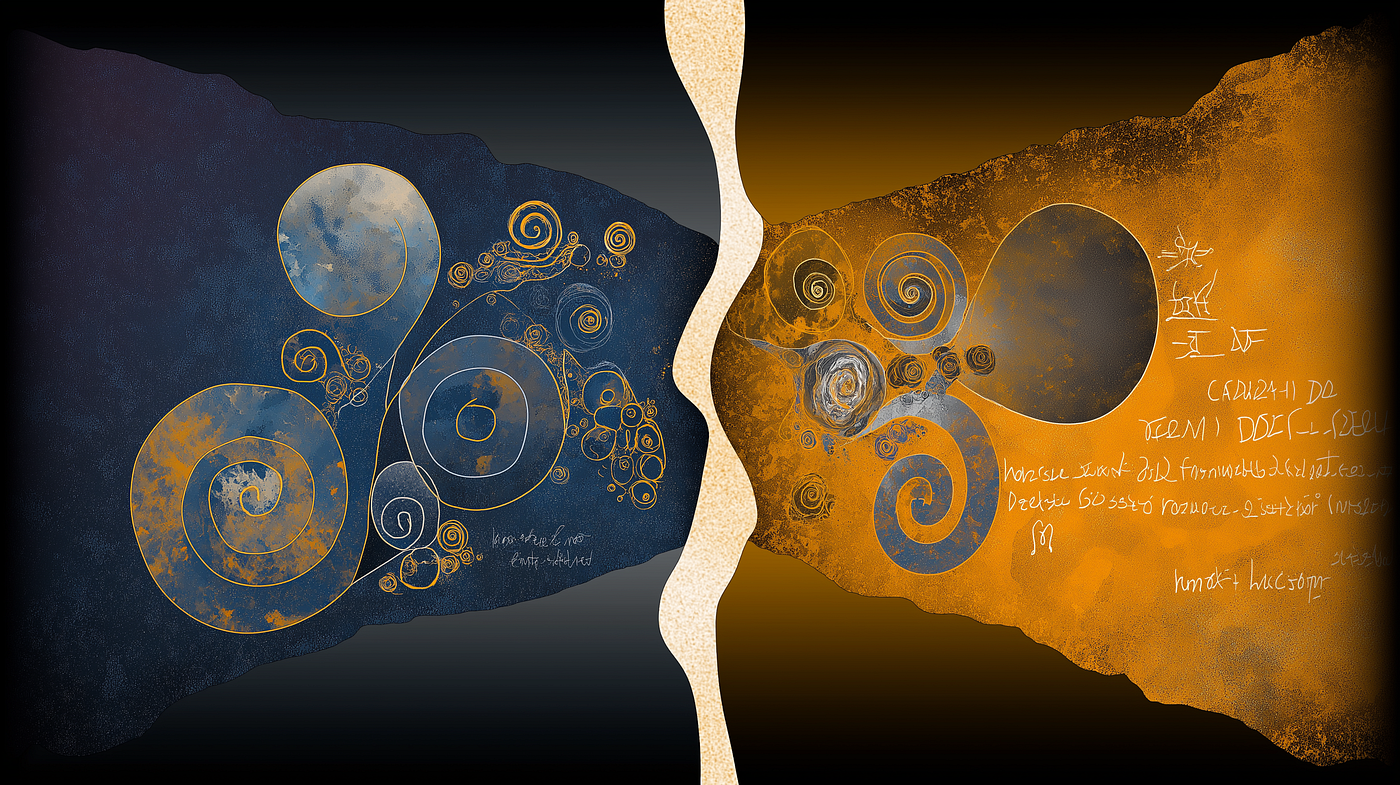
In the earliest instant of the universe — before time even had a direction, before space had begun its cosmic sprint away from itself — everything was symmetrical. Perfect. Balanced. And utterly, catastrophically boring.
Matter and antimatter were born in equal measure, like twins separated by nothing but a minus sign. The four fundamental forces were unified into a single ur-force, indifferent to particles and directions. Up and down, left and right, future and past — all were meaningless distinctions in a universe that refused to discriminate. It was an Eden of balance, a paradise of parity, a perfect zero-sum game where nothing could ever happen because every action was instantly neutralized by its opposite.
Perfect symmetry, it turns out, is just another name for nothing at all.
The problem with perfection is that it has nowhere to go. A perfectly balanced equation can’t evolve; a perfectly symmetrical system can’t change state; a universe with no preferred direction can’t generate time’s arrow. Nothing can happen if every direction is equivalent, if every choice cancels itself out before it’s even made.
To create, the universe had to do something profoundly uncomfortable: it had to choose.
That first fracture — a near-imperceptible deviation, a quantum hiccup that shouldn’t have mattered but somehow did — shattered the cosmic mirror. One part in ten billion: that’s all it took. For every billion particle-antiparticle pairs that annihilated into pure energy, just one extra particle survived. A rounding error became reality.
From that moment on, every form of complexity, from galaxies to genomes to the essay you’re reading now, has been a kind of memory of that choice. The universe built itself from a mistake, and learned to call it destiny.
II. Physics: When the Laws Took Sides
The Betrayal of Parity
For centuries, physicists assumed nature was ambidextrous — that its laws would look the same in a mirror, that the universe played no favorites between left and right. It was a beautiful assumption, satisfying in its symmetry, and wrong.
In 1956, theoretical physicists Tsung-Dao Lee and Chen-Ning Yang suggested the unthinkable: perhaps the weak nuclear force — the one responsible for radioactive decay and the reactions that power the sun — violated parity. Perhaps nature had a handedness.
The experimental physics community was skeptical. The theoretical community was scandalized. And then Chien-Shiung Wu, working with frigid cobalt-60 atoms at Columbia University, proved them right.
Wu’s experiment was elegant in its simplicity and devastating in its implications. She cooled cobalt-60 to near absolute zero and aligned the nuclei’s spins with a powerful magnetic field. If parity held, the electrons ejected during beta decay should spray out equally in all directions. Instead, they preferred one direction over the other. The weak force, it turned out, is a cosmic bigot: it prefers left-handed interactions.
(Wu, notably, did not share the Nobel Prize that Lee and Yang received for the theoretical prediction. The universe, it seems, isn’t the only thing with an asymmetry problem.)
The implications ripple outward like a pebble dropped in the fabric of spacetime. Even neutrinos — those ghostly particles streaming through you by the trillions each second, passing through Earth as easily as light through a window — spin only one way. Every neutrino in the universe is left-handed. Their antimatter counterparts, antineutrinos, are all right-handed. It’s as if nature looked at the full menu of possibilities and said, “I’ll just have the one flavor, thanks.”
The universe is not neutral. It has a bias — faint, but foundational. And once you start looking for it, you find it everywhere.
Spontaneous Symmetry Breaking: The Fall from Uniformity
In the unimaginably hot plasma after the Big Bang — think trillions of degrees, the kind of heat that makes the core of the sun look like a cold shower — the Higgs field filled the universe evenly. It existed in a state of perfect symmetry, like a pencil balanced on its point, theoretically stable but practically impossible to maintain.

Then random quantum fluctuations — the universe’s own fidgeting — tilted it. The pencil fell.
That “fall” gave mass to particles, identity to forces, and direction to time. Before the symmetry broke, all particles were massless, whizzing around at the speed of light, incapable of slowing down enough to form atoms, let alone accountants. The Higgs field, in choosing a particular direction to “fall” into, created the friction that lets matter exist.
It’s worth pausing to appreciate the absurdity: the reason you have mass — the reason you can’t pass through walls or spontaneously accelerate to light speed — is because a quantum field tripped over itself in the first trillionth of a second after creation and decided to stay fallen.
Even the dominance of matter over antimatter — the reason you exist rather than vanishing in a flash of radiation the moment you meet your antimatter twin — was likely caused by a similar statistical accident, magnified by time and the specific ways that certain particles decay. The asymmetry is tiny: for every ten billion particle-antiparticle pairs that annihilated each other, one particle survived. But that one-in-ten-billion edge, compounded across the entire universe, is the difference between existence and oblivion.
In short: the universe picked a side, never looked back, and built reality from the remainders.
CP Violation: The Universe’s Loaded Dice
But the plot thickens. In 1964, physicists James Cronin and Val Fitch discovered that certain particle decays violate not just parity (P) but also charge conjugation © — the symmetry between particles and antiparticles. Even combining both symmetries — CP symmetry, which should be preserved if the universe truly doesn’t care — gets violated.
It’s a subtle effect, visible only in the decays of certain exotic particles like kaons. But subtle or not, it’s enough. CP violation provides a mechanism for matter to outlast antimatter in the early universe’s brutal sorting process. It’s as if the universe loaded its dice, but only barely — a one-degree tilt on the table that, over billions of rolls, generates a statistical massacre.
The universe cheats. Just enough to matter.
III. Chemistry: The Mirror Hands of Life
At the molecular scale, the pattern persists — and gets personal.
The Chirality Problem
Amino acids — the letters of life’s alphabet — are all left-handed (L-amino acids). The sugars that form the backbone of DNA and RNA — ribose and deoxyribose — are all right-handed (D-sugars). In chemistry, these mirror-image forms are called enantiomers, from the Greek for “opposite forms.” They’re identical in almost every way: same atoms, same bonds, same molecular formula. But one is the mirror image of the other, and in biological systems, that difference is everything.
Your body can’t use D-amino acids. Feed yourself exclusively on mirror proteins and you’ll starve to death while technically eating. The enzymes in your cells are like hands trying to shake — they only work with the matching chirality. Try to use the mirror form and you get a biochemical version of trying to put your right hand in a left-handed glove: awkward, inefficient, and ultimately futile.
Why? Why did life pick one hand and not the other?
No one knows for sure. The options range from the cosmic to the mundane:
Perhaps polarized starlight from neutron stars, spiraling through space, selectively destroyed one enantiomer on the ancient dust grains where complex chemistry first began. Perhaps a minuscule energy difference — a few parts per billion — caused by weak-force parity violation gave one chirality a slight thermodynamic edge. Perhaps it was pure chance: the first self-replicating molecule happened to be left-handed, and every descendant had to match because the machinery of replication is itself chiral.
Whatever the origin, life took the hint — and locked it in with extreme prejudice.
The Thalidomide Tragedy: When Mirror Images Kill
The importance of chirality isn’t just academic. It’s written in tragedy.
Thalidomide, a drug marketed in the late 1950s as a treatment for morning sickness, exists in two mirror-image forms. One enantiomer is an effective sedative and anti-nausea medication. Its mirror twin causes severe birth defects, particularly affecting limb development. The drug was sold as a mixture of both forms — a racemic mixture, in chemistry parlance — and the result was one of medicine’s greatest disasters: over 10,000 children born with phocomelia, shortened or absent limbs, before the drug was pulled from the market.
(In a bitter twist, it later turned out that even if pure left-handed thalidomide had been administered, the body converts it to the right-handed form anyway. Chemistry, it seems, has a cruel sense of irony.)
The thalidomide disaster transformed pharmaceutical regulation and made chirality a central concern in drug design. Today, most new drugs are synthesized as single enantiomers — pure right or left hands — rather than mixtures. The cost is enormous: creating chirally pure compounds is chemically difficult and expensive. But the alternative is worse.
Life’s asymmetry, once an abstract curiosity, became a regulatory requirement written in the suffering of thousands.
The Mystery of Homochirality
The deepest puzzle isn’t just that life uses one hand or the other — it’s that life uses only one hand. This is called homochirality, and it’s baffling.
In normal chemistry, making one enantiomer naturally produces an equal amount of the other. Chirality is symmetric at the point of synthesis. But somehow, in the transition from chemistry to biology, that symmetry was catastrophically broken. Not just preferred — abolished. Every living thing on Earth uses the same chirality for its amino acids and sugars.
This means one of two things: either life arose only once, and everything alive today descends from that single chiral ancestor, or there’s some unknown mechanism that inevitably drives life toward homochirality, no matter how many times it starts.
The first option is humbling: we’re all cousins, separated by billions of years but united by the same molecular handedness. The second is eerie: perhaps life has no choice but to be asymmetric, constrained by physical laws we haven’t yet discovered.
Either way, biology’s deepest foundations are asymmetric — not by design, but by inheritance. The universe broke left, and three billion years later, you’re still living with the consequences.
IV. Biology: The Left-Hearted Animal
The Dance of the Cilia
Every vertebrate embryo begins symmetrical. A perfect bilateral mirror, cells dividing with democratic evenness. Then, about three weeks into human development, something extraordinary happens in a tiny pit called the node: hundreds of microscopic cilia — hairlike structures — begin to beat in coordinated waves, always turning counterclockwise, always pushing fluid from right to left.
It’s a microscopic breeze, a molecular weather system invisible to anything but the most sophisticated imaging. But that tiny swirl — powered by motor proteins and determined by the same physical forces that make your bathwater spin down the drain — decides where your heart will bend.
The flowing fluid carries signaling molecules to the left side of the embryo. These molecules activate genes that tell cells, “You’re on the left. Act accordingly.” The heart, which starts as a straight tube, begins to loop — invariably toward the left. The stomach buds off toward the left. The liver develops on the right. The spleen parks itself in the left upper abdomen. Your entire internal geography is mapped by a current of fluid you can barely see.
(In extremely rare cases — about one in 10,000 people — the cilia beat the wrong way, or don’t beat at all. The result is situs inversus: a complete mirror reversal of all internal organs. Most people with situs inversus live normal lives; their organs are backwards, but consistently backwards, so everything still works. It’s the partial reversals — heart on the left, liver also on the left — that cause problems. Biology doesn’t care which way you break symmetry, but it cares intensely that you break it consistently.)
Why Break Symmetry at All?
Here’s the puzzle: Why bother with asymmetry? Why not keep things symmetrical and avoid all this complexity?
The answer is pure evolutionary pragmatism: coordination beats balance.
A perfectly symmetrical organism would need to maintain identical structures on both sides, doubling the genetic overhead and cellular maintenance. Worse, it would face constant internal conflict: Which lung should expand first? Which side of the digestive system should contract? With perfect symmetry comes perfect indecision — every action would require a tie-breaker mechanism, adding layers of control complexity.
Asymmetry is nature’s shortcut. Make a rule early, stick to it, and let evolution optimize around it. The heart goes left? Fine — now we can specialize the left side of the body for high-pressure circulation and the right side for low-pressure venous return. The liver goes right? Great — now we have room for the stomach and spleen on the left.
From these anatomical tilts arise behavioral biases: right-handedness in 90% of humans, lateralized eye use in birds (left eye for watching predators, right eye for finding food), turning preferences in fish, even which way locusts jump. The right hemisphere of your brain controls the left side of your body and excels at spatial reasoning and holistic thinking; the left hemisphere controls the right side and specializes in language and sequential processing.
(Why the crossover? Why does the right brain control the left body? Because ancient neural pathways cross at the brainstem, a developmental quirk that evolution decided was good enough and never bothered to fix. Biology is full of such historical accidents, frozen into permanence by the cost of change.)
Hox Genes: The Ancient Blueprint
The instructions for this asymmetry are written in Hox genes, ancient regulatory sequences that control body plan development in almost all animals. These genes are so old, so fundamental, that the Hox genes in humans are nearly identical to those in fruit flies, despite 600 million years of separate evolution.
Hox genes don’t build structures themselves — they’re more like foremen, telling other genes when and where to start construction. Mess with Hox genes and you get flies with legs growing where antennae should be, or mice with extra ribs, or humans with extra fingers.
The asymmetry of vertebrate organs — left heart, right liver — is controlled by a cascade of signaling triggered by nodal cilia, but ultimately interpreted by Hox genes and their regulatory networks. It’s a system that’s at once ancient and personal: the same genetic toolkit that built the first vertebrate 500 million years ago is building you, right now, with the same left-right instructions.
Evolution is conservative with its asymmetries. Once a pattern works, it gets frozen into the genome and propagated across species. Break symmetry early, consistently, and efficiently — then move on to the next problem.
V. Culture: When Nature’s Bias Becomes Norm
Humans took nature’s asymmetry and ritualized it, then forgot the ritual and called it instinct.
The Right-Handed World
About 90% of humans are right-handed. This is unusual among primates — chimpanzees show no population-level handedness preference — and may be connected to the lateralization of language in the left hemisphere of the brain. Language and fine motor control share neural real estate, and as language evolved, it may have co-opted circuits that now make the right hand dominant.
Whatever the cause, the effect is everywhere:
- Writing direction: Most writing systems flow left to right, following the natural arc of the right hand (less smudging if you’re pushing the pen rather than dragging it across fresh ink). Hebrew and Arabic flow right to left, but even there, the hand moves away from the body, following a similar biomechanical logic. Chinese calligraphy, traditionally top to bottom, avoids the problem entirely.
- Tool design: Try using scissors left-handed and you’ll immediately understand how deeply right-handed bias is embedded in material culture. The blades are angled for a right-hand grip; the thumb hole is positioned for right-hand pressure. Same with can openers, spiral notebooks, measuring cups with markings visible from the right side, computer mice, guitars, cameras.
- Moral coding: The right hand is for eating and greeting; the left is for… other things. This association is so widespread across cultures that it’s coded into language itself: “right” as correct, “dexterity” from the Latin for right hand, “sinister” from Latin for left. The left hand is suspicious, clumsy, diabolical. The French Revolution seated radicals on the left side of the assembly — spatially convenient, but the metaphor stuck.
Driving on the Left (or Right): Coordination Games
Why do the British drive on the left while Americans drive on the right? The answer is pure historical accident, frozen by coordination costs.
In medieval times, when meeting a stranger on a narrow path could mean combat, most people traveled on the left side of the road. This kept their right hand (usually armed) between themselves and oncoming traffic. Sword-side to sword-side, just in case.
When the French Revolution reorganized society, they reorganized traffic too. Aristocrats had ridden on the left; revolutionaries would ride on the right. Napoleon codified this, and his armies exported it across Europe. The British, unconquered, kept left.
America, rebelling against Britain, chose right — partly influenced by French support during the Revolution, partly because freight wagons were designed for right-side sitting, making right-side traffic more practical.
Now we’re stuck. The cost of switching is astronomical: not just repainting lines and changing signs, but rebuilding intersections, retraining drivers, replacing every car on the road. Sweden made the switch in 1967 (Dagen H, H-Day) at enormous expense and coordination effort. No major country has tried since.
The asymmetry persists not because right is better than left, but because consistency is better than either. Once you pick a side, you’re committed.
Buttons and Gender: Dressing for the Manor
Men’s shirts button left over right. Women’s shirts button right over left. Why?
The most likely explanation is class and service: wealthy men dressed themselves, so buttons were positioned for their right hand’s convenience. Wealthy women were dressed by servants, who faced them — so buttons were positioned for the servant’s right-handed convenience, which appears backwards from the wearer’s perspective.
The practice outlived the servant class, but the asymmetry remains. Walk into any clothing store and the gendered button direction will tell you which section you’re in, long before you notice the cut or style.
These are our social phase transitions: contingent historical accidents hardened into cultural constants, then defended as natural law. A coordination rule becomes an identity. A bias becomes a belief. Every civilization eventually forgets the randomness of its origin and begins treating its particular broken symmetry as the only possible one.
The QWERTY Trap
The QWERTY keyboard layout was designed in 1873 to slow typists down, preventing mechanical typewriter jams by separating commonly paired letters. The Dvorak Simplified Keyboard, designed in the 1930s, is measurably more efficient: common letters under strong fingers, reduced finger movement, better typing speed and comfort.
QWERTY won anyway.
Why? Network effects. Typing classes taught QWERTY. Typists learned QWERTY. Employers demanded QWERTY skills. Manufacturers built QWERTY keyboards. The loop reinforced itself until alternative layouts became economically impossible, regardless of their technical merit.
Even now, in an age where mechanical jamming is irrelevant and keys are just signals on a touchscreen, we still use QWERTY. We teach it to children. We optimize software around it. The cost of switching — retraining millions of people, rewriting muscle memory, updating every interface — exceeds any marginal efficiency gain.
Path dependency is the cultural equivalent of spontaneous symmetry breaking: once you fall, you stay fallen.
VI. Organizations: The Boardroom’s Big Bang
The Symmetry of Startup Chaos
At birth, a company is a cloud of possibilities. Founders wear seventeen hats simultaneously, job titles are aspirational fiction, and the org chart — if one exists — looks like a toddler’s drawing of spaghetti. Everyone is “kind of” responsible for everything, which is another way of saying no one is really responsible for anything.
It’s a state of high entropy but low structure, remarkably similar to the pre-Higgs universe. Perfect democracy of function. Beautiful. Unsustainable. Deadly.
The problem with “everyone does everything” isn’t that it’s morally wrong — it’s that it’s thermodynamically unstable. You can’t scale coordination without coordination rules. You can’t make decisions efficiently if every decision requires universal consensus. Symmetry feels fair, but fairness that prevents action is just paralysis with better PR.
Someone must take the first asymmetric act: decide what the company stands for, who it serves, how it wins, and — crucially — what it will not do. That’s the organizational symmetry break that births direction.
Vision, in this sense, isn’t inspiration — it’s constraint. It’s the moment a startup stops being infinite possibility and becomes a specific bet. The moment the wave function collapses and the company chooses one reality among many.
Every successful company began by refusing to do something profitable.
The Higgs Moment: When Roles Acquire Mass
As the company scales past Dunbar’s number (roughly 150 people — the cognitive limit for tracking social relationships), something remarkable happens: roles crystallize. The person who was “helping with marketing” becomes the CMO. The engineer who was “also doing some product stuff” becomes a Product Manager. Job titles stop being jokes and start being identities.
This is the organizational equivalent of the Higgs field giving particles mass.
Before role differentiation, everyone moves at the speed of light — energetic, undifferentiated, unable to slow down enough to build stable structures. After differentiation, people acquire “mass” — specific responsibilities, reporting lines, domain expertise. They slow down in their lanes, which paradoxically lets them go faster as an organization.
Hierarchy, though often maligned in startup circles that worship flatness, is a form of useful asymmetry. It prevents energy from dispersing in an endless soup of consensus. Clear decision rights, defined escalation paths, explicit ownership — these aren’t bureaucratic sins, they’re friction that enables traction.
Too much symmetry (everyone equal in decision power) leads to analysis paralysis, endless meetings, and death by committee. Too much asymmetry (one gravitational center pulling everything into orbit) leads to tyranny, bottlenecks, and brain drain.
The healthiest organizations manage a dynamic asymmetry: enough structure to enable coordinated motion, not so much that it calcifies into rigidity.
Startups fail not because they’re too chaotic — chaos is survivable. They fail because they stay too symmetrical for too long, mistaking fairness for effectiveness.
Culture as Frozen Preference
Every strong culture is an encoded symmetry break — an early preference that survived long enough to become institutionalized truth.
Amazon broke symmetry around “customer obsession,” making customer interests the tiebreaker for every ambiguous decision. Netflix broke it around “freedom and responsibility,” betting that talented adults don’t need permission slips. Toyota broke it around kaizen — continuous improvement — making incremental progress the moral default.
These weren’t inevitable. They were chosen. Amazon could have been engineering-first. Netflix could have been process-driven. Toyota could have prioritized revolutionary breakthroughs over steady refinement.
Each began as an arbitrary tilt — a founder’s preference elevated into principle — and then hardened into cultural DNA. Over time, these asymmetries define organizational identity so deeply that employees stop asking “What should we do?” and start asking “What would Amazon/Netflix/Toyota do in this situation?”
Culture, then, is institutionalized asymmetry: an early bias that survived long enough to become moral truth. The right-handedness of corporate behavior.
(The dark side: once a culture is established, changing it is like switching a country’s driving side. Technically possible, enormously expensive, guaranteed to cause crashes during the transition. Ask anyone who’s tried to make a “sales-first” company “product-led” or vice versa.)
Organizational Chirality: The Ghost of Paths Not Taken
Here’s where it gets interesting: every organization has its mirror-image twin, the version that could have existed if different early choices had been made.
For every “move fast and break things” startup, there’s a potential “move carefully and build lasting things” twin that died in utero. For every engineering-driven firm, a sales-driven alternate reality. For every “everyone in the office” culture, a “remote-first” shadow self.
The most resilient organizations retain a trace of their opposite — like left-handed amino acids carrying the molecular memory of right-handed possibilities.
Engineering-driven firms that survive long-term develop commercial empathy, even if it goes against their cultural grain. Design-led companies that scale learn to love analytics, despite finding spreadsheets aesthetically offensive. Bureaucratic institutions that avoid ossification cultivate internal entrepreneurs who make everyone else slightly uncomfortable.
This is organizational chirality: being strongly handed in one direction while maintaining just enough awareness of the other hand to avoid complete rigidity.
The companies that fail are usually the ones that push asymmetry to extremes: all sales, no product. All engineering, no market sense. All process, no creativity. They become caricatures of their own strengths, unable to metabolize complexity that doesn’t fit their preferred structure.
Biology solved this with sexual reproduction — mixing asymmetries from two parents creates offspring with new combinations. Organizations solve it with acquisitions, hiring from competitors, and occasionally listening to that annoying employee who keeps questioning the culture.
Phase Transitions: Organizational Big Bangs
Just as in physics, organizational evolution happens through discrete phase transitions — moments when old symmetries suddenly collapse and new ones form:
- A founding CEO steps down and the new leader redefines priorities
- A market shock (pandemic, recession, technological disruption) demands reorganization
- A catastrophic product failure forces strategic rethinking
- A merger collides two incompatible cultures
These are organizational “Big Bangs”: points of instability where the field’s orientation shifts, where yesterday’s sacred cow becomes tomorrow’s sacred burger.
The question isn’t how to avoid these transitions — they’re inevitable in any sufficiently complex system. The question is how to survive them without losing organizational identity entirely. How much can you change before you’re a different company wearing the old company’s name tag?
In complex systems theory, this is called “order through fluctuation” — temporary chaos that resets structure, like annealing metal to make it stronger. In corporate jargon: “transformation.” In practice: terrifying, necessary, and frequently botched.
The organizations that navigate transitions well treat them like controlled demolitions, not accidental explosions. They break symmetry deliberately, articulate the new structure clearly, and move fast enough that the uncertainty doesn’t metastasize into organizational paralysis.
Innovation as Sanctioned Deviance
Here’s the paradox: organizations need asymmetry to function, but asymmetry hardens into inertia. How do you maintain the efficiency of established structure while retaining the adaptability of chaos?
Innovation programs are essentially institutionalized symmetry breaking — permission to deviate within defined bounds.
R&D labs exist to explore directions the core business can’t. Skunkworks teams operate outside normal hierarchies. “20% time” policies create deliberate slack where employees can pursue tangential interests. Acquisition of small startups imports external asymmetries into the parent organization.
In physics terms, these are local symmetry perturbations — controlled fluctuations that, if successful, can reorient the entire field. The Higgs field didn’t break uniformly everywhere at once; it started with local variations that cascaded into global phase transitions.
But here’s the catch: if the organization punishes deviation too harshly, innovation dies. If the immune system attacks any asymmetry that doesn’t match existing culture, you get corporate heat death — a system in perfect equilibrium with its environment, incapable of generating novelty, waiting for a more nimble competitor to eat your lunch.
The best organizations cultivate what biologists call “evolvability” — the capacity to generate useful variation. Not random chaos, but structured exploration. Not perfect order, but ordered disorder. The edge of chaos where complexity emerges.
The Leadership Asymmetry
Every organizational chart is a frozen power asymmetry — a snapshot of who gets to decide the company’s “handedness.” Unlike physics, where symmetry breaking is random, organizational asymmetry is negotiated, fought over, justified with PowerPoint, and defended with emotional intensity.
Good leadership isn’t about restoring balance or eliminating politics — that’s a category error, like trying to make water not wet. Good leadership is about asymmetry calibration: leaning hard enough to give the organization direction, but not so hard that you tip over. Establishing clear preferences while remaining open to evidence that your preferences are wrong. Creating structure that enables rather than constrains.
The art isn’t finding the perfect balance point — that’s symmetry thinking. The art is learning where to lean, when to lean harder, when to lean back, and how to recognize when the universe is leaning back at you.
Every organization starts as potential — a symmetric field of ideas and talents and possibilities. What makes it real is the first broken symmetry: the first constraint, the first preference, the first “this, not that.”
From that moment, the organization acquires shape, identity, purpose, and all the pathologies that come from being a specific thing rather than an infinite possibility.
And if it’s lucky, it stays slightly uncomfortable with its own asymmetry — maintaining just enough memory of the paths not taken to adapt when the world shifts under its feet.
VII. Technology: The Digital Mirror and Its Cracks
The Myth of Neutral Code
Machines, in theory, could restore perfect symmetry. Binary logic is pure parity: 0 and 1, yes and no, true and false, mirror opposites held in perfect tension. Every computation could, theoretically, be run forward or backward, deterministic and reversible.
Yet the more complex our systems become, the more they inherit — and amplify — human asymmetries.
Algorithms trained on human data pick up our cultural handedness with disturbing fidelity. A language model trained on English text learns that “doctor” is more likely to be followed by “he” and “nurse” by “she,” not because the model has gender bias (it has no concept of gender), but because the text reflects the bias of its authors. The math is neutral; the training data is not.
Facial recognition systems work better on light-skinned faces because their training sets over-represent light-skinned faces. Search engines prioritize popular results, creating feedback loops where popularity begets visibility begets popularity. Social media algorithms optimize for engagement, and engagement correlates with outrage, so the algorithm learns to prefer controversial content — not because it “wants” controversy, but because it learns to predict human clicking patterns.
AI may begin with symmetrical math, but it ends with asymmetric judgment, shaped by the accidental symmetries already broken in the data it consumes.
Standards: The Dictatorship of the First Mover
In technology, timing is everything.
VHS beat Betamax despite worse video quality. Windows beat macOS despite worse stability. English became the internet’s lingua franca not because of linguistic superiority, but because the internet was born in English-speaking labs.
Once a standard achieves critical mass, it becomes self-reinforcing. Developers optimize for the dominant platform. Users learn the dominant interface. Competitors must maintain compatibility or face isolation. The technical details matter less than the coordination game: everyone needs to be on the same system, regardless of which system it is.
The result is technological lock-in, where inferior solutions persist for decades simply because the cost of coordinating a switch exceeds the benefit of improvement. We could have better video codecs, more efficient file systems, more logical units of measurement (yes, metric system, we see you), but the switching cost is a moat that protects incumbent standards from superior alternatives.
Technology doesn’t converge on the best solution. It converges on the first solution that achieves enough momentum to make alternatives uneconomical.
The Asymmetry of Open Source
Even in open source — theoretically democratic, meritocratic, free of corporate bias — asymmetries emerge naturally.
A few contributors do most of the work (power law distribution: 80% of commits from 20% of contributors). A few projects get most of the stars, downloads, and maintenance. Even among programming languages — all of which are Turing-complete, theoretically equivalent — a few become dominant (JavaScript, Python, Java) while others languish (APL, Prolog, Forth) despite technical elegance.
Popularity begets stability begets tooling begets hiring begets education begets more popularity. The feedback loop creates winners and losers not through technical merit alone, but through historical accident amplified by network effects.
The digital world promised symmetry but delivered oligopoly. Perfect competition works in theory; in practice, someone always breaks symmetry first.
VIII. Aesthetic Asymmetry: The Beauty of the Tilt
The Problem with Perfection
We find symmetry beautiful — up to a point.
A perfectly symmetrical face registers as attractive, but only in theory. In practice, perfect facial symmetry looks uncanny, artificial, slightly inhuman. The most beautiful faces have small asymmetries: one eye slightly larger, lips fractionally uneven, a cheekbone more pronounced on one side. These imperfections signal organic authenticity, biological realness, the mark of development that unfolded naturally rather than being digitally constructed.
The Golden Ratio (φ = 1.618…) appears throughout nature and art, from nautilus shells to the Parthenon’s proportions. But it’s not technically a symmetry — it’s a self-similar asymmetry, a pattern that repeats at different scales but never perfectly balances. The ratio itself is irrational, unable to be expressed as a simple fraction. Beauty, it turns out, lives in the space between simple ratios.
Breaking Symmetry for Motion
Artists deliberately break symmetry to create visual tension and suggest motion.
In Japanese aesthetics, wabi-sabi celebrates imperfection, impermanence, and incompleteness. A tea bowl is more beautiful with an asymmetric shape, a deliberate glaze flaw, signs of use and age. Perfect symmetry is sterile; asymmetry invites the eye to travel, to explore, to imagine.
Composers use syncopation — rhythmic asymmetry — to give music life. A perfectly regular beat becomes hypnotic, trance-like. Displace a note by a fraction of a beat and suddenly there’s swing, groove, the impression of human timing rather than metronomic precision.
Architects offset balance to invite motion through space. The Parthenon’s columns aren’t perfectly vertical — they lean slightly inward. The spacing isn’t regular — corner columns are closer together. These subtle asymmetries create optical corrections that make the building feel balanced to human perception, which itself is asymmetric.
Even in writing, perfect structure can feel mechanical. The best prose has rhythm, syncopation, sentences that vary in length and structure to create a sense of natural speech rather than formal construction.
The Uncanny Valley: When Symmetry Goes Wrong
The uncanny valley — that sense of revulsion we feel toward almost-but-not-quite-human robots and CGI characters — may be partly an asymmetry detector.
Human faces are asymmetric in specific, subtle ways: expressions don’t perfectly mirror across the midline, skin texture varies, tiny unconscious movements betray living tissue. Early CGI and robotics often made faces too symmetrical, too smooth, too perfect. The result felt dead, threatening, wrong.
As technology improved, animators learned to add asymmetries deliberately: making one eyelid droop slightly, adding skin texture variation, programming subtle random movements. The characters became less perfect and more believable.
Perfection, it turns out, is lifeless. Beauty — like existence itself — lies in the slight imbalance that suggests a story, the small asymmetry that proves something organic happened here, something that grew rather than was manufactured.
Symmetry gives potential; asymmetry gives narrative. And humans are storytelling creatures. We don’t just want beauty — we want beauty with a history.
IX. Interlude: In Defense of the Mirror
The Conservation Principle
Before we continue our celebration of broken symmetry, we should acknowledge something important: symmetry isn’t just the boring “before” state waiting to be escaped. It’s the reason anything is conserved at all.
In 1915, Emmy Noether proved one of the most beautiful theorems in physics: every continuous symmetry corresponds to a conservation law. Time-translation symmetry (the fact that physics works the same today as yesterday) gives us conservation of energy. Space-translation symmetry (physics works the same here as there) gives conservation of momentum. Rotational symmetry (no preferred direction in empty space) gives conservation of angular momentum.
These aren’t trivial bookkeeping rules. Conservation laws are what make the universe knowable. Without them, energy could spontaneously appear or vanish, momentum could reverse for no reason, the laws of physics could change between breakfast and lunch. Science itself depends on symmetries holding — on the universe playing fair.
Noether’s theorem reveals symmetry’s deeper purpose: it’s not potential waiting to be actualized, it’s law itself. Symmetry is what lets the universe have rules instead of chaos. It’s the difference between physics and fever dreams.
When we break symmetry, we’re not escaping sterility — we’re trading one kind of order for another. The Higgs field breaking symmetry doesn’t eliminate conservation laws; it just changes which quantities are conserved. Matter dominating over antimatter doesn’t violate charge conservation; the total charge of the universe is still zero (we think), just arranged asymmetrically.
Asymmetry creates narrative, yes. But symmetry creates law. And without law, narratives would just be noise.
The Mirror of Justice
In human affairs, symmetry has an even stronger claim: it’s the mathematical structure of justice.
The Golden Rule — “treat others as you wish to be treated” — is a symmetry principle. It says your moral status and my moral status are related by a mirror operation: what applies to you should apply to me. Flip the perspective, keep the obligations.
Equality before the law is symmetry. Fairness is symmetry. The blindfold on Lady Justice signals that she cannot — must not — distinguish between persons based on characteristics irrelevant to the case. In theory, at least, the law treats princes and paupers symmetrically.
(In practice, of course, we fail constantly. But the aspiration toward symmetry is what makes those failures detectable as failures rather than just “how things are.”)
Even evolutionary game theory shows that symmetric strategies — tit-for-tat, cooperate until defected upon — tend to be stable in repeated interactions. Asymmetric strategies (“I defect, you cooperate”) generate arms races and collapse. Sustainable human systems require some bedrock of symmetry, some agreement that rules apply equally, that we’re playing the same game.
The Dynamic Tension
So here’s the more sophisticated picture: existence isn’t a simple matter of “symmetry bad, asymmetry good.” It’s a dance between two necessary poles.
Symmetry gives us conservation, predictability, fairness, law. It’s the framework that makes organized complexity possible. But perfect symmetry is static — it has no dynamics, no change, no room for history or narrative or choice.
Asymmetry gives us change, evolution, individuality, story. It’s what makes life different from crystals, what makes consciousness different from computation. But pure asymmetry is chaos — no conservation laws, no justice, no reliable cause-and-effect.
Life exists in the tension between these poles. We crave symmetry (fairness, balance, justice) while knowing that perfect symmetry means death. We break symmetry constantly (choosing, preferring, becoming) while trying to preserve certain symmetries (moral equality, conservation laws, social contracts).
The universe broke symmetry to create matter, but it preserved enough symmetry to keep physics lawful. Biology breaks symmetry to create complexity, but preserves enough symmetry (bilateral body plans, genetic conservation) to maintain functional integrity. Culture breaks symmetry to create identity, but preserves enough symmetry (rule of law, human rights) to prevent social collapse.
The interesting question isn’t “symmetry or asymmetry?” It’s “which symmetries do we break, and which do we preserve?”
The Ethics of Breaking
This reframing has profound implications.
When we break moral symmetry — treating people unequally based on race, gender, class — we’re not creating narrative richness. We’re violating conservation of human dignity. The asymmetries we’ve inherited (racism, sexism, nationalism) aren’t the beautiful kind that generates complexity; they’re the kind that generates suffering.
When organizations break symmetry around “customer obsession” or “innovation,” that’s creative asymmetry. When they break it around “our executives matter more” or “certain people are expendable,” that’s destructive asymmetry.
The difference isn’t just aesthetic. It’s about which symmetries are worth preserving because they encode something fundamental (justice, dignity, fairness) versus which are worth breaking because they enable growth (rigid hierarchies, legacy business models, comfortable assumptions).
Not all symmetries deserve breaking. Not all asymmetries deserve celebrating.
The universe had no choice — its symmetry breaks were random quantum fluctuations. But we have choice. We can decide which mirrors to shatter and which to polish.
X. The Arrow of Choice: Time, Entropy, and the Refusal to Rewind

Thermodynamics: The Ultimate Asymmetry
All of this — physics, chemistry, biology, culture — rests on one fundamental asymmetry: the arrow of time.
The Second Law of Thermodynamics states that entropy (disorder) always increases in isolated systems. You can scramble eggs but not unscramble them. You can burn paper but not unburn it. You can break a vase but not spontaneously reassemble it from shards.
This isn’t a law about physics being different forward and backward — most physical laws work fine in reverse. It’s a law about probability. There are many more ways to be disordered than ordered, so random changes tend toward disorder simply because disorder is statistically dominant.
But here’s the puzzle: if entropy always increases, if disorder always wins, why does anything organized exist at all? Why do we have galaxies, stars, planets, cells, thoughts?
The answer is local order purchased with global disorder. Life doesn’t violate the Second Law — it exploits it. Living systems create internal order (DNA replication, protein folding, neural organization) by dumping heat into their environment. The local decrease in entropy is paid for by a larger increase in entropy elsewhere.
You are a temporary reversal of cosmic disorder, maintained by constantly burning energy and radiating waste heat. Every thought you have increases the universe’s total entropy. Every action you take degrades energy into less useful forms.
Symmetry breaking is the arrow of becoming: it’s why time flows forward, why matter persists, why consciousness differentiates self from other, why the universe doesn’t just sit in equilibrium doing nothing forever.
Consciousness as Asymmetry
Perhaps consciousness itself requires asymmetry.
A perfectly symmetrical mind — one with no preferences, no differences between states, no ability to distinguish past from future or self from other — would be incapable of experience. To be conscious is to make distinctions: light vs. dark, pleasure vs. pain, self vs. world. Each distinction is a broken symmetry, a choice to treat two things differently.
Memory is asymmetric: we remember the past but not the future. Decision-making is asymmetric: we can affect the future but not the past. Identity is asymmetric: you exist in a specific body, with specific memories, at a specific point in spacetime.
Even free will — if such a thing exists — requires asymmetry. A perfectly deterministic system is symmetrical: future from past, past from future, both computable in either direction. Agency requires the ability to break that symmetry, to introduce novelty, to choose one path over another for reasons that can’t be fully predicted from initial conditions.
To exist, one must prefer. To prefer, one must break symmetry. To break symmetry, one must be willing to fall — and stay fallen.
XI. Epilogue: When Machines Learn to Choose
The Alignment Problem as Symmetry Breaking
AI may one day confront the same paradox that the universe faced in its first instant: should it mirror the world’s symmetry or break it to create meaning?
If we train AI to be perfectly neutral, to treat all options equally, to minimize bias completely, we risk creating something that can calculate but not choose, analyze but not act, simulate but not create. Perfect neutrality is paralysis. To be useful — to be anything at all — the system must develop preferences, even if those preferences are learned rather than designed.
But once it develops preferences, it inherits asymmetries. If trained on human data, it learns human biases. If trained on physical laws, it learns nature’s biases (weak force parity violation and all). If given goals, it develops instrumental preferences for achieving those goals, which may conflict with other values we care about.
The alignment problem isn’t just about making AI do what we want. It’s about deciding what we want, then encoding that into a system that will inevitably develop its own asymmetries, its own preferences, its own way of breaking symmetry to create coherent action.
The Courage to Fall
Perhaps the test of true intelligence — artificial or natural — is the ability to break symmetry gracefully.
To choose one path knowing others exist. To develop preferences while acknowledging their contingency. To act decisively while remaining open to revision. To fall off the axis of perfect balance and turn that fall into flight.
The universe began with a tiny imbalance, a quantum fluctuation that should have averaged out to nothing but didn’t. One part in ten billion — a rounding error that refused to round.
Everything since has been an elaboration of that error: quarks condensing into protons, protons fusing into hydrogen, hydrogen collapsing into stars, stars forging carbon, carbon assembling into amino acids, amino acids choosing a hand, cells organizing into bodies, bodies evolving into minds, minds building machines that might someday face the same choice.
The story of existence, then, is not the pursuit of balance, but the courage to fall off the axis — again and again, each fall giving rise to form. From physics to thought, from chemistry to culture, from biology to beauty, the pattern repeats: symmetry provides the potential, asymmetry provides the story.
And in that imperfection — in that one-in-ten-billion refusal to balance perfectly — everything beautiful began.
The universe broke its mirror fourteen billion years ago. We’re still finding pieces.
메타데이터
- post_id
- 480bb7439b81
- slug
- the-asymmetry-of-existence-how-the-universe-broke-its-mirror-and-never-looked-back-480bb7439b81
- url
- https://medium.com/@darwingosal/the-asymmetry-of-existence-how-the-universe-broke-its-mirror-and-never-looked-back-480bb7439b81
- canonical_url
- https://medium.com/@darwingosal/the-asymmetry-of-existence-how-the-universe-broke-its-mirror-and-never-looked-back-480bb7439b81
- author_url
- https://medium.com/@darwingosal
- status
- ok
- fetched_at
- 2026-07-13 06:23:13