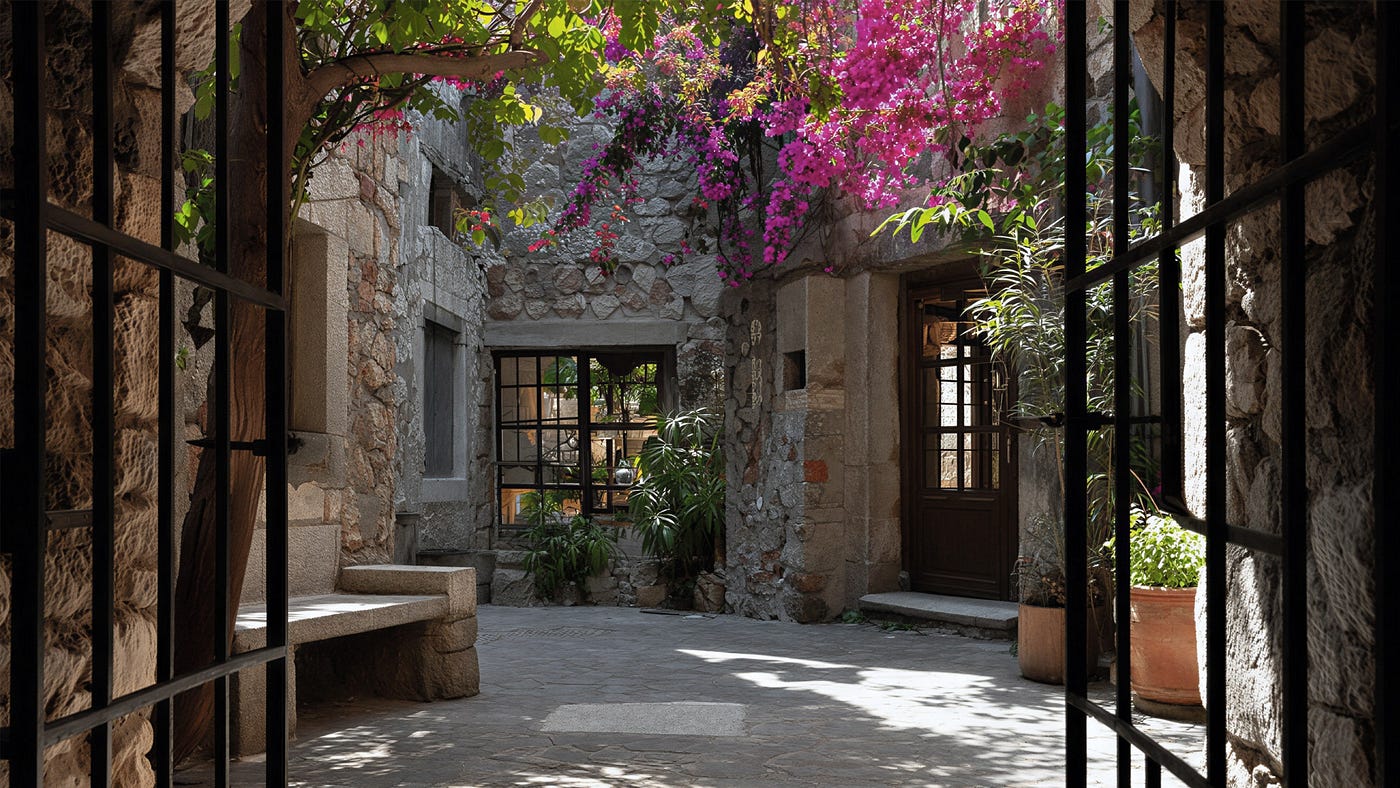
Cities We Love.
Architectura Temporis Urbanism: why we forgot how to build them — and how to start again
Cities We Love.
Architectura Temporis Urbanism: why we forgot how to build them — and how to start again
There is one simple question that architects almost never ask at the very beginning of a project.
Usually the questions are different: “How much can we sell this for? Will it pass the daylight regulations? Or at the very least — does it look good?”
But the real question is something else entirely: “What will this place feel like in fifty years?”
The silence around this question is not accidental. It is built into the industry. And right now, that silence is quietly and invisibly destroying our cities.
Two failures, one mistake
Walk through any modern neighborhoods in Europe. You will see two extremes — and both will be immediately familiar.
— The first is the modernist blank slate. Glass towers, concrete boxes, a master plan optimized for traffic flow and square footage. Technically flawless. But inside — total spatial emptiness. You can function in such an environment, but you cannot feel it.
— The second extreme is the panicked reaction to the first: pseudo-historical kitsch. Developers instinctively sense that people want something “with history”, something rooted. But instead of providing that, they build scenery: importing Tuscan roof tiles, slapping stone cladding on facades that has no connection to any local quarry, erecting arcades that were never part of this place. This plastic world is designed to look old on opening day.
Both the modernists and the pseudo-classicists share the same fatal mistake: they treat the city as a disposable product. As a static object to be designed, built, photographed for a portfolio, and handed over. Full stop.
But think of the cities we truly love. Kotor, Siena, Porto. They were never “finished”. Each generation carefully added its own layer without erasing what came before. Their magic has nothing to do with architectural style. It is about time. It is the accumulated weight of decades that you can touch — in the texture of stone, in noble patina, in the curve of a street.
And this is not sentimental nostalgia. It is plain physics.
The one percent problem
Let’s look at the numbers honestly. At the moment the construction fence comes down, the renders are approved, and the developer is counting the returns — what we call T₀ — the building has lived through roughly 1% of its actual life.
The remaining 99% will unfold without us. Yet the paradox is that 99% of all design decisions are made for the sake of that first one percent. For the pretty picture in the brochure.
The philosopher Julian Barbour once described time as a “block universe” — where past, present, and future all exist simultaneously and carry equal weight. Translated into the language of architecture, this means that every building already exists across all of its ages at the moment of the first sketch. The only question is whether the architect has the courage to see it.
Those who see it design in a completely different way:
— They choose materials that ripen beautifully over time rather than degrading ungracefully.
— They establish a spatial logic that will still be relevant half a century from now.
— They think not about social media likes, but about how a person will feel here when the trees have grown tall, the walls have darkened in the rain, and the first residents have grown old alongside the place.
The ability to think across the full span from T₀ to T+50 is precisely what contemporary urbanism has completely lost.
How does the new lens work?
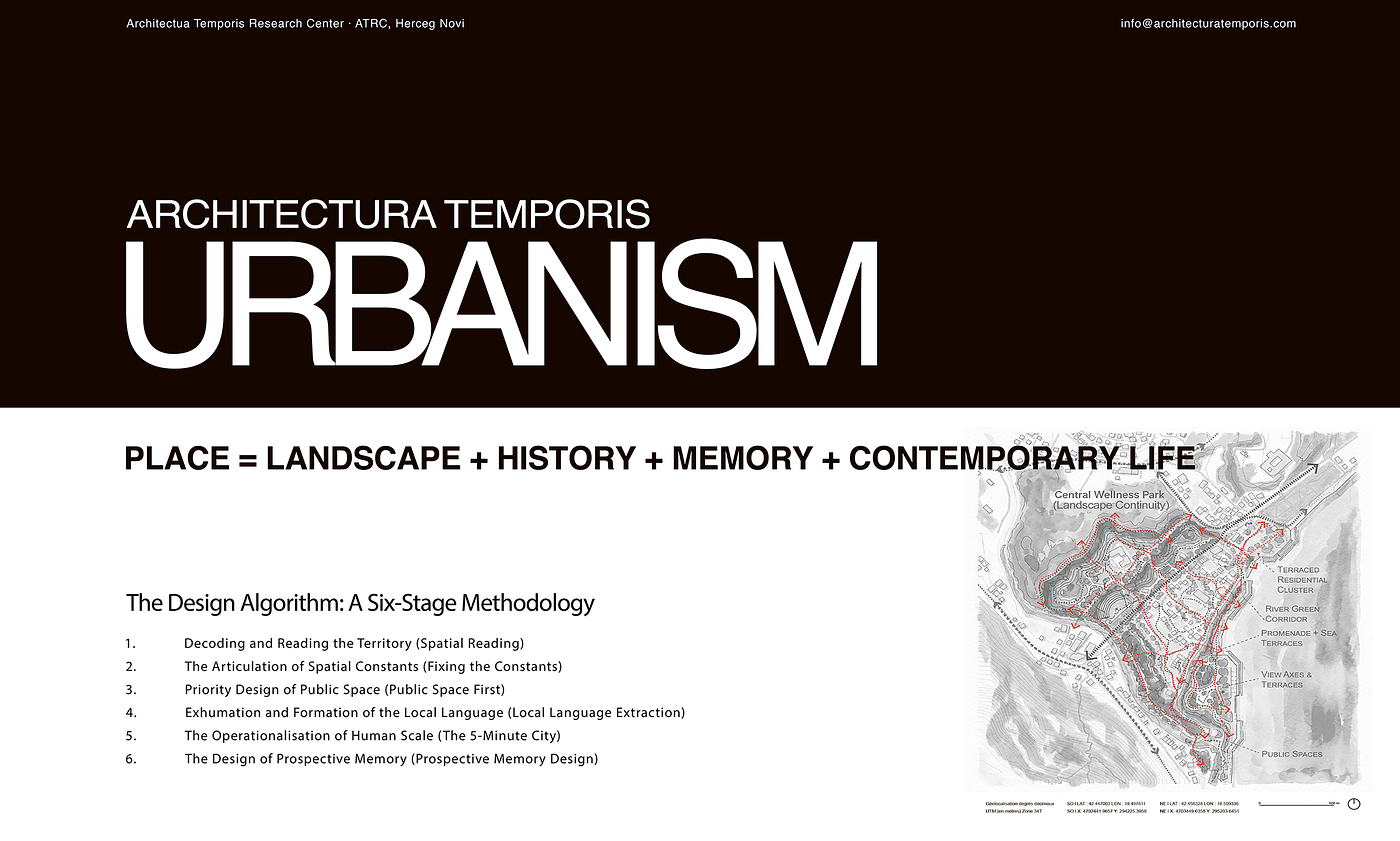
The methodology of Architectura Temporis Urbanism (ATU) is an attempt to restore time to its rightful place as the primary building material. We have reassembled this logic into a system that works equally for a single house and for an entire urban district.
It all begins with a deceptively simple formula:
Place = Landscape + History + Memory + Contemporary Life
Conventional development is fixated on the last term only: “What does the market want right now and how do we stay within budget?” ATU keeps all four elements in focus simultaneously. The landscape and memory of a place are not inconvenient constraints — they are the foundation of the project.
Our fundamental requirement is this: the architect must first “read” the territory, and only then pick up the pencil.
Every piece of land has its own genetic code: ancient pathways that followed the logic of the terrain, dry-stone boundary walls that encoded generations of land use, view axes communities navigated by, water sources that determined where people settled. When a bulldozer erases these layers in the name of a level site, it does not create a blank slate. It inflicts a wound on the space. Such a place will remain alien and arbitrary forever.
But when those layers are decoded and carefully continued into the present, new development immediately feels like it belongs. Not because it pretends to be old. Because it organically continues a conversation that was already underway before it arrived.
14 principles: from code to space
The ATU methodology is not a building code — it is more like a checklist of the right questions to ask a project at every stage.
— Temporal continuity. A project must be the honest next sentence in the history of a place — not its negation or its counterfeit imitation.
— Landscape primacy. Topography, water, trees, and view axes dictate the architecture. The house adapts to the hill — the hill does not get demolished for the house.
— Layered identity. All historical eras are equal. The task is to write your own layer without inking over the ones before it.
— Spatial memory. Ancient roads and old terraces are ready-made structural armature for the new project.
— Cultural resonance. We are looking for the tectonic code of tradition, not copying its decorative surface. We need a “Montenegrin code” — not a theatrical “Montenegrin façade”.
— The logic of living material. Stone and timber know how to age with dignity. Synthetic composites do not — they simply crack and stain.
— Human scale. Blocks of 300–500 meters and 10-minute walking distance to everything essential. This is not romanticism — it is human anatomy, unchanged for thousands of years.
— Street before building. First we design the voids — streets, squares, parks. Then we fill them with built volumes. The famous Piazza del Campo in Siena is magnificent for exactly this reason.
— Incremental growth. A city must be capable of growing block by block. An unfinished project is not a failure — it is the natural condition of a living urban organism.
— Future heritage. Simply ask yourself honestly over the drawing: “Will people want to protect what I’m designing right now as architectural heritage in a hundred years?”
— Authentic continuity. New architecture in a historic context must be open about the fact that it was built in the twenty-first century. Architectural mimicry creates Disneyland. Honesty creates genuine history.
— Social memory. A city is not only walls — it is habitual routes, morning markets, and evening rituals. Space must provoke these scenarios.
— Adaptive evolution. There is no need to preserve forms and “freeze” the city. Protect the principles — and let the forms evolve freely.
— Belonging. The primary marker of a good neighborhood is not capitalization or building density. It is the moment when a passing stranger catches themselves thinking: “I’m home. This is my place.”
This is a story about the future
The most common mistake is to hear these ideas as conservatism. As architects once again calling for a return to the past and waging war against the modern world.
It is precisely the opposite.
The most radical and avant-garde thing an architect can do today is to design a space that, fifty years from now, will have acquired that same astonishing temporal quality for which we love old cities. Not by imitating their appearance — but by cracking the secret of their mechanics. And deploying the full toolkit of contemporary technologies, materials, and artificial intelligence to do it.
— Medellin installed ultramodern cable cars and futuristic public libraries into the fabric of working-class neighborhoods — and the city did not lose itself. On the contrary, its identity deepened. Those buildings became local not because of their style, but because of an extreme attentiveness to context.
— In Oaxaca, for four consecutive centuries, builders used the same local green volcanic stone — Cantera. The city has everything: from heavy baroque to light modernism. The buildings are entirely different, but the city is stitched together by a single thread. The material became the DNA of the place — without any repressive decree from above.
From philosophy to numbers
Let’s be direct: ATU is not another sprawling concept about “ecology and sustainable development” of the kind that fills the shelves of architecture schools.
It is an attempt to give the industry a new instrument. Today we simply do not have a professional language or the metrics to make a rigorous argument about time in architecture.
We created that language and backed it with a concrete instrument — the Chronity Index (CI). This index does not try to measure the intangible “spirit of place”. It translates the physical parameters of an environment — material types, the integrity of historical layers, levels of visual noise — into clear, verifiable numbers. If two independent experts take measurements of the same building using our protocol, their results will match. That is science, not taste.
For new projects, the index functions as a simulator of the future. We can calculate the life trajectory of a district and demonstrate to a developer that in 25 years their asset will retain its value — while a standard commercial block on the same site will have turned to rubble and will require billions in renovation.
Right now we are stress-testing this system on a live site — in Herceg Novi and in the UNESCO buffer zone of the Bay of Kotor. Several measurement points have already been fully completed. This data will become a baseline: a solid scientific benchmark that municipalities and architects can use to quantify the impact of any new construction intervention on the historic environment.
The question that changes everything
In 1923, Le Corbusier dropped the line that turned the world upside down: “A house is a machine for living in.” He was right — but only partially. A house is also a machine for ageing. And how exactly it will live through its 99% of life is decided on our laptop screens before the first concrete mixer rolls onto the site.
The cities we fall in love with — Siena, Kotor, Porto — are beautiful precisely because they age honestly. They do not hide their wrinkles: they carry their history openly in the texture of walls, in worn steps, in the way the evening light catches in a narrow lane. They feel inevitable. As if they simply could not have been built anywhere else, or any other way.
And there is nothing mystical about this quality. It is the reproducible result of a particular way of thinking about design — one that places time at the center, not the margins.
Each time we begin a project, we face a choice about which question to answer. We must decide: are we simply placing another object in space — or are we continuing the unbroken flow of time?
Sergei Tatarnikov
Founder, Architectura Temporis Research Centre (ATRC), Herceg Novi, Montenegro.
The ATRC team develops the AT methodology, the Chronity Index (CI), and ACAP — an AI platform that turns temporal quality of the built environment into a measurable, predictable, and investable parameter.
The full ATU doctrine paper will be presented at the EAAE international conference in Cagliari, August 2026.
architecturatemporis.com · info@architecturatemporis.com · ORCID 0009–0004–4519–8572
메타데이터
- post_id
- 480e7c438add
- slug
- cities-we-love-480e7c438add
- url
- https://medium.com/@xtarkdesign/cities-we-love-480e7c438add
- canonical_url
- https://medium.com/@xtarkdesign/cities-we-love-480e7c438add
- author_url
- https://medium.com/@xtarkdesign
- status
- ok
- fetched_at
- 2026-07-09 09:18:05