Meeting The Real King Julien
Seeing Madagascar’s Most Iconic Animal
Meeting The Real King Julien
Seeing Madagascar’s Most Iconic Animal
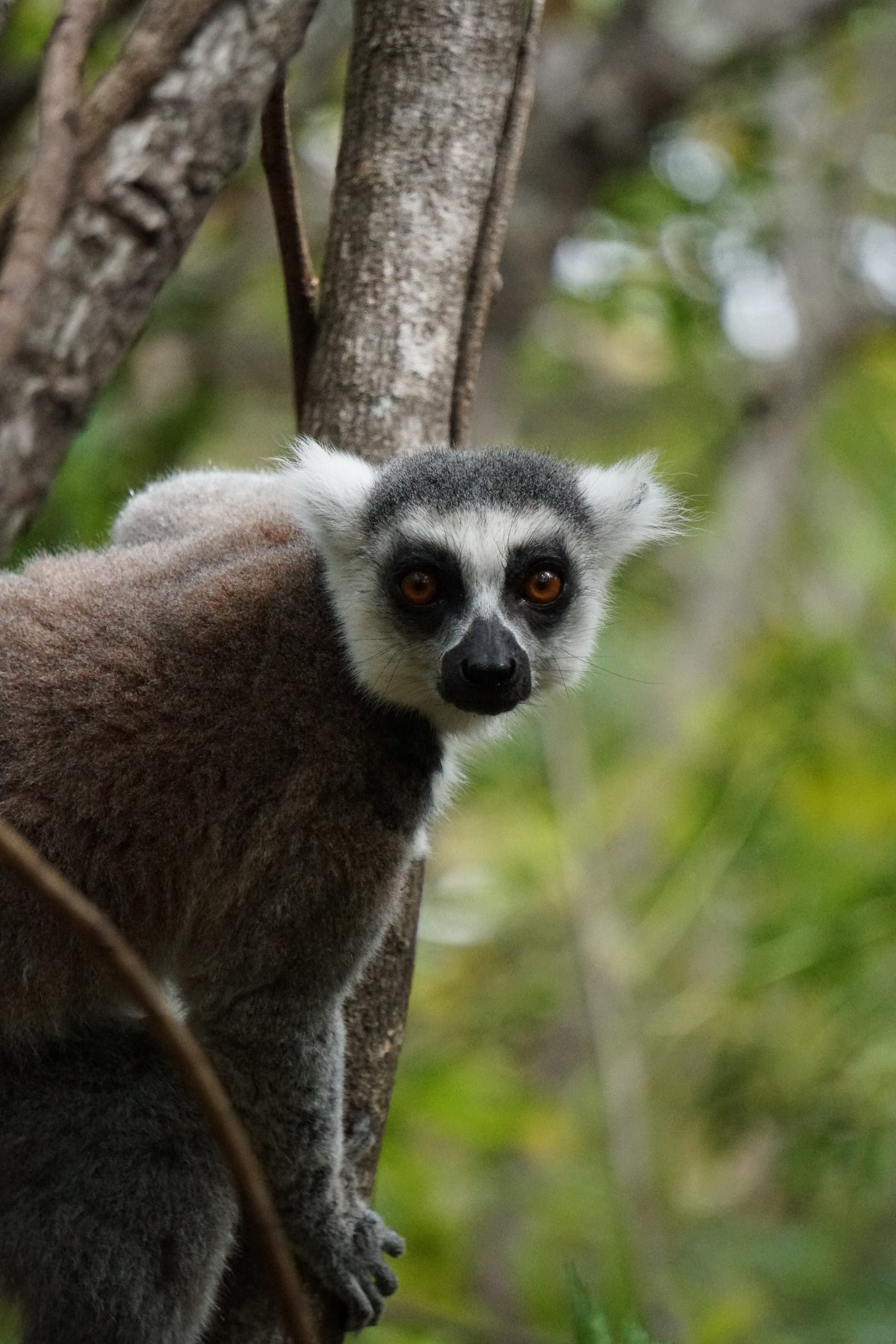
Ring-tailed Lemur (Lemur catta) in Anja Reserve, Madagascar
One of the highlights of my trip to Madagascar was our 9-day cross country trip, where we traveled from our home base in Ranomafana National Park, all the way to the Toliara reef along the Mozambique channel on the western coast of the island. This trip was designed for us to experience as many different ecosystems as possible, so each day was a totally new experience. We stopped at Anja Reserve, a rocky, mountainous area with deciduous forest; Isalo National Park, a huge expanse of grasslands and canyons; Zombitse National Park, a dry forest; Reniala Reserve, which contains Madagascar’s unique spiny forest ecosystem; and finally Toliara reef, one of the largest coral reefs in the world.

Our cross-country route!
Our first stop, Anja Reserve, is what I’ll be talking about today. It was here that we were finally able to see Madagascar’s most iconic animal: the Ring-tailed lemur. As I hope is the case with many of you reading this, I have fond memories of watching King Julien in the Madagascar movies as a kid, so seeing this animal in the wild was as fascinating as it was hilarious. The other study abroad kids and I referenced it so much, in fact, that we had to explain the movie to one of our guides, which was both funny and embarrassing.

Landscape of Anja Reserve, including a group of Pied Crows (Corvus albus).
Just like most of the places I visited during my time in Madagascar, the landscape of Anja Reserve was unlike anywhere I had ever been before. At first glance, the terrain is barren and mountainous, full of enormous boulders that can be as smooth as a pebble or sharply angled as if cut by machinery. Hidden within this rocky expanse, though, was a deciduous forest that concealed a remarkable number of creatures. The forest was full of short, skinny trees, with a thick tangle of wooden vines hanging down nearly to the forest floor. The way the forest grew around the rocks was so interesting, some trees had roots and trunks that winded in several different directions to get around boulders and reach the sun. During our hike through the park, we spent equally as much time wandering through the forest as we did scaling steep rock faces and avoiding pitfalls between boulders. Some of the boulders are so large, in fact, that caves have been created in the space between stones that were large enough for our entire group to walk through.

Trees growing up from underneath a boulder
It did not take long for us to find the lemurs: within about 15 minutes of stepping foot in the forest we were enveloped by a group of them. The forest’s short trees created a low canopy, bringing the lemurs closer to us. Just like the lemurs we had seen in Ranomafana, these individuals have grown up inside a protected reserve, meaning they have no fear of humans. They were extremely active, constantly eating, jumping from tree to tree, and communicating with each other. They were very curious about us, coming very close and looking us up and down, as if they were sizing us up.

The trees were so short that at many times, the lemurs were at eye level with us. Being in the center of this group as they moved all around us was such a unique experience, and was very different from what I had seen already in Ranomafana. In that park, most of my observations were from afar, or in the cases where I had gotten close it would be with just one or two individuals. This time, we were surrounded by lemurs, as if someone had placed us right in the middle of a nature documentary.


Ring-tailed lemurs are also much more active than others I had seen so far. They were so fun to watch as they moved around and interacted with each other, and the group was much bigger (10–15 individuals) than groups I had seen up to this point (more like 2–5). This interaction allowed me to get some of my favorite photos I took on the entire trip.


After following the group through the forest for a while, they moved out into a clearing and climbed down from the trees onto the ground. This was actually my first time seeing a lemur on the ground, up until this point they were always up in the trees. Ring-tailed lemurs are the most terrestrial of all lemurs, spending up to half their day on the ground according to the Duke Lemur Center. Seeing them on the ground may not seem much different from seeing them in the trees, but there was something so unique about sharing the same plane without any barrier. Seeing them walk around and interact with each other on the ground also made them seem so much more human, in a way. We were able to get within a few feet of them, and they would walk past us within a few inches. At one point, I was standing still and a pair of lemurs walked so close to me that they nearly stepped on my boots. In the pictures above, you can see their proximity to a tourist group we ran into, as well as my own shoes in the foreground!

Ring-tailed lemurs are undoubtedly the most famous lemur, and they are also the most common. They are less sensitive to human disturbance than some other species, and they are uniquely able to adapt to a wide range of climates and habitats. Their range extends across the southern part of Madagascar, encompassing everything from dry forests, to cold mountains, and even a recently discovered population living in a rainforest.
Like most lemurs, they are listed as endangered by the IUCN, with their numbers decreasing. The primary reason for this is habitat loss, as even though they can live in a wide variety of places, these habitats are severely fragmented due to urban expansion and clearing of forests for agriculture. Climate change is also a significant threat, as much of their habitat is very dry and has limited water availability, so continued warming will make it even more difficult to live there than it already is.

Thank you so much for reading! I hope you all enjoyed seeing a more recognizable animal this week. Now that I am halfway through my planned posts, feel free to comment down below which has been your favorite.
메타데이터
- post_id
- 481e552dce93
- slug
- meeting-the-real-king-julien-481e552dce93
- url
- https://medium.com/@aragone2/meeting-the-real-king-julien-481e552dce93
- canonical_url
- https://medium.com/@aragone2/meeting-the-real-king-julien-481e552dce93
- author_url
- https://medium.com/@aragone2
- status
- ok
- fetched_at
- 2026-06-25 07:00:49