Legos, Lies, and Larceny
Legos, Lies, and Larceny
A Multi-Part Exposé on How a Consignment Theft Scandal Exposed the Normalization of America’s Corporate-Owned Militarized Police State and Its Parallel Connections to Genocidal Land Theft in the Levant
Journalistic Disclaimer & Safe Harbor Notice: The following investigative essay is an analytical commentary utilizing public court filings, corporate press disclosures, open public records requests (FOIA), and published media reports as of June 2026. All conclusions regarding systemic power structures, corporate overreach, and institutional parallels represent the protected editorial opinions of the author based on the verified public record.
Part I: The Toy Heist & the thin Blue line
Nothing is more daunting than facing mortality, whether it is your own or that of a loved one. The sound of a patient monitor beeping to a failing heartbeat is a soul-crushing rhythm. When Ed Mansell’s health began declining around 2023, he and his son Brian had the kind of anxiety-ridden conversation no son ever wants to have with his father. A conversation about legacy, and what is left behind.
Ed Mansell had spent almost three decades meticulously collecting Lego sets. Deeply enamored with the Star Wars universe, his collection was oriented entirely around the Lucasfilm empire. Knowing his time was running short, Ed wanted something meaningful to come of the massive investments of time, effort, and capital he had poured into his plastic kingdom. He decided the collection should fund a college education for his grandchildren.
Ed instructed Brian to liquidate the sets as quickly as possible so the trust funds could be established. Brian did his research. His due diligence led him to BAM Franchising Inc., a corporate business operating hundreds of locations under the name Bricks & Minifigs. It seemed like the perfect solution.
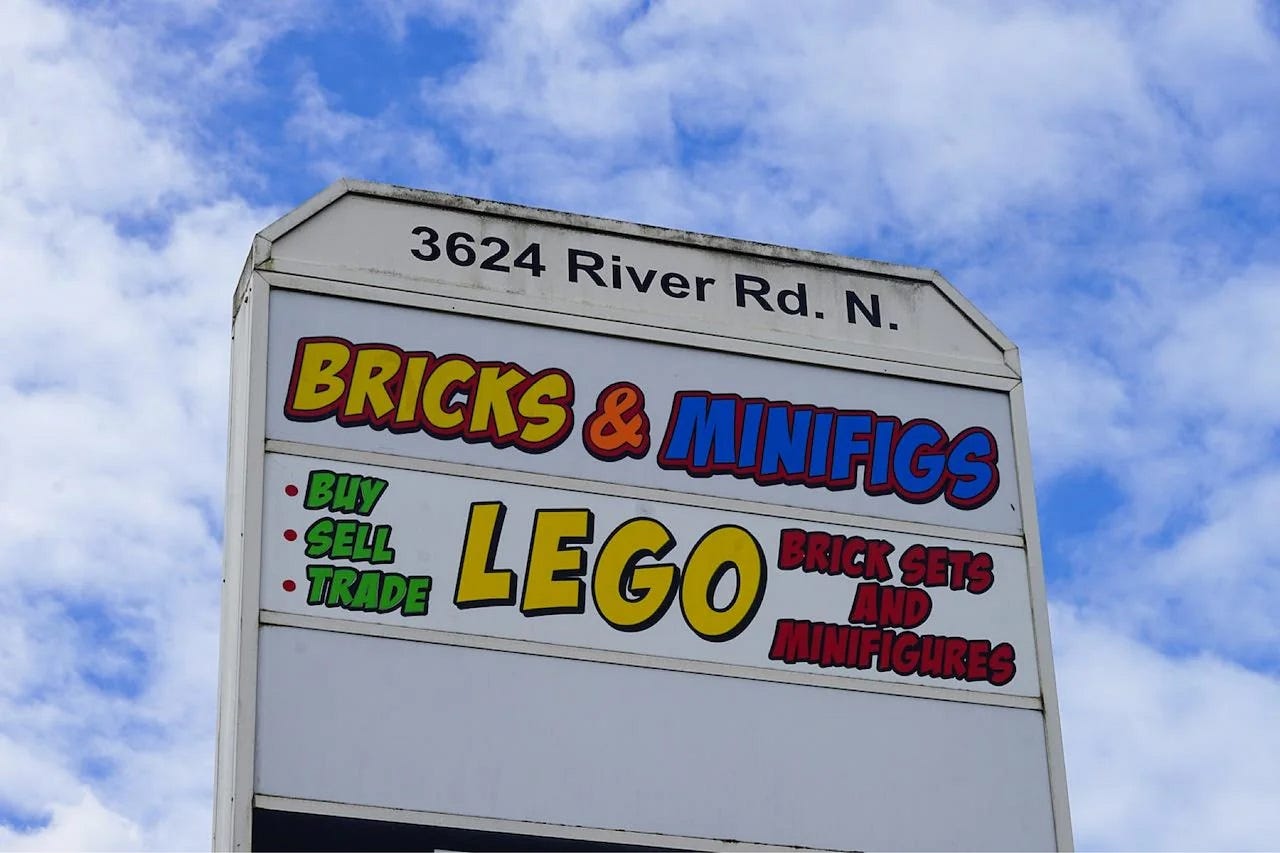
Brian made contact with Chrystal Law-Gorman, owner of the Bricks & Minifigs franchise on River Road North in Keizer, Oregon — a quiet suburb right outside Salem, famous for hosting the annual Keizer Iris Festival where crowds gather every May to celebrate the blooming of the iris flower.
Chrystal and Brian drafted a meticulous consignment contract detailing the inventory. Initially, Brian brought in only a small portion, moving the rest into a storage unit. Eventually, the entire collection was transferred into Chrystal’s possession. In their own social media posts, Bricks & Minifigs corporate would later describe it as the largest, most valuable privately held Star Wars Lego collection ever seen, valued anywhere from $95,000 to $250,000.
It was an action the Mansell family would come to deeply regret.
The Architecture of Intimidation
Sometime around the fall of 2024, Chrystal informed Brian that she and her husband, Benjamin Gorman, were selling the franchise and moving abroad. Benjamin operated a publishing company that produced The Antifa Lit Journal. Given the incoming administration’s open hostility toward antifascist advocates, an opportunity to relocate overseas was an understandable, if difficult, decision.
Brian was assured by Chrystal, and by the thorough nature of their signed contract, that the incoming owner would honor the consignment. For a year, the arrangement had worked perfectly. Brian walked in monthly, checked his receipts, and collected his share of the proceeds as his father’s legacy slowly found homes with enthusiastic collectors. He had no reason to doubt the system.
But behind the scenes, corporate headquarters had a vastly different blueprint for this inventory. What followed was straight intimidation.
When the Gormans pushed back against what amounted to a predatory takeover of their storefront, a corporate functionary for BAM got on a recorded phone call with them. They made it abundantly clear that corporate had no intention of negotiating in good faith. As detailed in the later civil complaint Chrystal Law, Benjamin Gorman, et al. v. BAM Franchising Inc., corporate personnel systematically dismantled the franchise agreement under heavy-handed tactics. The Gormans were told plainly that pursuing legal recourse would be a ruinous, extremely expensive battle, and that they had very few options.
When Benjamin Gorman asked directly if corporate had spoken with Chrystal regarding the asset seizure, the functionary didn’t flinch. They admitted they had spoken at her, as if she were a child being informed of a decision already handed down by her superiors.
The corporate representative then punctuated the call with a naked threat:
“If you fight this, then you are putting yourself into a whole lot of shit… It sounds like a threat, and I can acknowledge that, because in a way it is.”
The reality of that call is stunning. A corporation with a massive national footprint, helmed by brothers Ammon McNeff (CEO) and Matt McNeff (COO), had dispatched an employee to inform a franchise owner that the business she built and kept afloat was no longer hers. Not through arbitration. Not through mediation. Through a one-directional notification. If they didn’t like it, they could drown in legal fees trying to prove otherwise. The corporate version of a partnership came in the form of structural theft.
Enforcing the Silence
By November 2024, the Gormans were out. When Brian Mansell returned to the Keizer store to check on his family’s property, the professional courtesy he expected was met with immediate hostility.
The new management, operating under an entity called Baker Bricks LLC (registered just months prior in May 2024), claimed absolute ignorance. The pristine Star Wars sets Ed Mansell had spent years preserving? The new owners claimed they had no idea what Brian was talking about. They told him the property wasn’t his, refused to return a single box, and had him criminally trespassed from the location.
It was a flat-out lie, and there was a paper trail. Surveillance camera footage from the night of the corporate takeover explicitly captured Brandon Best, business partner of the incoming owner, Joshua Johnson, arriving at the store to demand the keys. On that same footage, Chrystal can be seen handing Best the signed Mansell consignment agreement and explaining the situation. Best’s response, captured on camera, was a clear verbal assurance: they would “take care of all of it.”
They knew. They promised to handle it. Then they chose to wipe the record clean.
To test if the store was actively trafficking his stolen property, a purchase was arranged at the storefront after the store had been served with a formal written notice to cease all sales. When the item was successfully bought right off the shelf and the results were relayed back to Brian, it confirmed his worst fears. This wasn’t a gray area or a logistical mix-up. It was larceny with a digital receipt.
When Brian reached out to get answers, he was hit with the exact same script given to the Gormans: This will be too expensive for you to fight. Management made a cold, mathematical calculation. They gambled that the legal bills required to fight a multi-million-dollar franchise operation would quickly outpace the value of the collection, forcing a working-class family to absorb the loss and disappear quietly.
The Blue Shield and the Structural Blueprint
What the establishment failed to realize is that this calculation relies entirely on keeping the machinery in the dark. This is not a localized story about plastic bricks, independent retail contracts, or internet drama. It is a miniature ecosystem, a textbook microcosm, of a much larger, structural blueprint in American life.
It is an environment where institutional law enforcement operates not as a public protector, but as a weaponized, blue-clad shield protecting capital, corporate property, and connected insiders.
When Brian and his allies attempted to demand their property back, the local police didn’t investigate the documented theft or look at the paper trail. Instead, they acted as private security for Baker Bricks LLC, executing criminal trespass orders to ensure the victim could no longer stand on the property to look at his own stolen goods.
This immediate inversion of justice, where the state uses its monopoly on violence to protect the entities holding the capital while criminalizing the dispossessed, is the exact same political mechanic that has repeated itself throughout history. It is the same asymmetry found in the corporate-owned coal towns of the early 20th century, where the state militia was deployed to break the bones of striking workers at the behest of industrial barons. Historical registries preserved by the West Virginia State Archives regarding the Battle of Blair Mountain (1921), and accounts of the Ludlow Massacre (1914), prove that law enforcement has long functioned as an enforcement arm for private balance sheets.
More deeply, it utilizes the exact same tools of enforced silence, aggressive prior restraint, and weaponized legal boundaries that we see play out across history. Consider the domestic architecture of the American drug war. As published in Harper’s Magazine, the infamous John Ehrlichman confession transcripts exposed how the Nixon administration manufactured structural enforcement entirely to criminalize and disrupt political enemies. Ehrlichman’s families disputed his most damning quotes but the diaries of H.R. Haldeman reiterated the idea that Nixon used drug prohibition to go after groups he perceived to be threats to his political power. This philosophy of using state institutions to protect structural hierarchies mirrors older territorial displacements, such as the operational decrees of the provisional Utah Territorial Militia under Brigham Young during the early days of Western settlement.
In every theater of asymmetric power, the playbook remains identical: shield the insider, exhaust the victim’s resources, use the legal apparatus to enforce a blackout, and rely on the calculation that the little guy will eventually run out of money and go away.
But they made one critical error in their math. They calculated that Brian Mansell was entirely alone. They had no idea he was about to cross paths with an investigative force that had absolutely no intention of staying quiet.
메타데이터
- post_id
- 48823c4e0145
- slug
- legos-lies-and-larceny-48823c4e0145
- url
- https://medium.com/@djlvsgodzilla/legos-lies-and-larceny-48823c4e0145
- canonical_url
- https://medium.com/@djlvsgodzilla/legos-lies-and-larceny-48823c4e0145
- author_url
- https://medium.com/@djlvsgodzilla
- status
- ok
- fetched_at
- 2026-06-18 07:02:39