The Death of Idols: Reconnecting with Divine Reality
On Truth and Representation
The Death of Idols: Reconnecting with Divine Reality
On Truth and Representation
None of this is an argument against truth, reason, doctrine, or theology themselves. Nor is it a claim that reality is purely subjective or endlessly unknowable. The issue is not that truth does not exist, but that human beings repeatedly mistake their grasp of truth for truth in its fullness. Our concepts, doctrines, and systems matter deeply — they are necessary ways of participating in and speaking about reality. But they remain representations rather than total possession. The danger begins when humility gives way to mastery, when analogy hardens into absolutism, and when the living mystery of God is reduced to something fully containable by the human mind. Authentic faith does not abandon truth; it abandons the illusion that truth can be completely owned.
From Illusion to Authentic Being: The Death of Idols and the Discovery of God
Core Thesis
Humanity continually reduces reality into manageable representations in order to preserve psychological stability, yet an authentic encounter with truth — and ultimately with God — only becomes possible when those representations collapse.

Introduction: Truth as Perception
We like to think we live in reality. But the truth is, we mostly live in what we perceive reality to be. We instinctively reshape the world into something livable, something predictable, something that offers us safety and inclusion rather than something that demands we confront uncomfortable or mysterious truths. Our brains are hardwired for familiarity; we rely on the known because it feels safe.
But what we call “reality” is often not reality itself. It is a view forced upon us — shaped by the norms of our time, or the inherited thoughts of those who came before. It is a collective narrative telling us how to think and what to believe. For practical things — driving a car, understanding laws — this works perfectly well. But when we move into the realms of existence, faith, and God, this habit becomes profoundly dangerous.
I learned this first-hand through experiences in prison and within rigid institutional structures. I saw clearly: a thing does not need to be true in order to become socially real. It only needs enough people willing to participate in the perception. Collective narratives possess enormous power — and they can crowd out truth entirely.
Part I: The Crowd and the Construction of Reality
There is a deep, pragmatic pessimism in human nature: we default to what is known. We accept what is presented to us rather than actively testing truth for ourselves. This is not necessarily a conscious choice; it is a deep-seated need to feel stable and intact.
Philosophers have long recognised this. Arthur Schopenhauer described how we mistake our mental representations for the underlying reality. He spoke of a blind, striving Will as the fundamental nature of existence — something vast and ungraspable — while the world we actually experience is only Representation: the filtered, shaped version we can understand and control.
This reinforces our core problem: we do not see things as they are; we see them as we are. And when enough of us agree on the same representation, it becomes “the truth” — what I call the crowd as untruth. When we belong to the crowd, we trade authentic seeing for belonging. We trade reality for stability.
Part II: “Beings” and Be[-ing] — The Root of Idolatry
The German philosopher Martin Heidegger made a distinction that cuts right to the heart of this. He distinguished between ‘beings’ and Be[-ing].
‘Beings’ are the things that are — objects, concepts, definitions, ideas, gods we can describe. They are concrete, graspable, definable. They give us something to hold onto.
Be[-ing], however, is not a thing at all. It is the very event, truth, or “is-ness” itself — the ground that allows anything to exist, rather than an object existing upon that ground.
Put simply: we cling to things we can define because definition gives us psychological stability. But ultimate reality — and especially God — refuses to become an object we can fully contain.
This is where our deepest error lies, and where true idolatry begins. We are not just guilty of worshipping statues or false gods. We commit a far more subtle and profound form of idolatry: ontological reductionism.
Uncomfortable with mystery, and desperate for God to make sense to us, we commit this act:
“We grab God from His eternal, mysterious throne and force Him into a small, enclosed room — be it a chapel, a temple, or a conceptual box of our own making. We say to Him, ‘Be this, as I need you to be, so I can feel safe.’”
We take the infinite, mysterious Be[-ing] and turn Him into just another ‘being’ — the highest being, perhaps, but still something we can define, categorise, and control. We reduce the transcendent to a manageable conceptual object.
The Bible itself speaks directly to this. In Colossians 1:15–20, Paul describes Christ not merely as the highest being among others, but as the very principle of cohesion — the ground holding all existence together. Heidegger speaks of Be[-ing] as the abstract condition of reality; Paul speaks of Christ as the personal, active principle of that reality.
Doctrine, dogma, and theology are not useless — they are helpful representations. They are maps, not the territory. But the moment we mistake the map for the land, we build our house on illusion.

Part III: The Collapse of Illusion — The Death of the Projected God
Sooner or later, every illusion meets its limit. The comfortable structures we build — our beliefs, our systems, our definitions of God — eventually fail to hold the weight we place upon them. This is what I experienced when institutional reality clashed with lived truth: the system insisted it was real, but its unreality became undeniable.
This brings us to the provocative idea: “God is dead.”
Let me be absolutely clear here:
“The death I speak of is not the death of transcendence itself, but the death of the idol we constructed in transcendence’s place.”
When we reduce God down to a defined, manageable ‘being’, we arrive at a critical mass of simplicity. Such a god is dead. Not because God has vanished, but because this god was never real in the first place. It was nothing more than a shadow of human projectionism — a reflection of our insecurities, our need for control, and our limited understanding.
We should be mindful not to find ourselves in that position where the God we defend is merely a shadow, a projection of our own limitations. When we cling to our idols, we kill the very divine presence we seek to control, leaving us with an empty shell.
This collapse is painful, but it is necessary. It is not the end of faith; it is the stripping away of illusion so that authentic being can emerge. Collapse is not tragedy — it is revelation.
Part IV: Divine Self-Disclosure — The Way of Incarnation
If we cannot define God, and if our projections are dead shadows, how then do we know Him?

We come face to face with a profound truth: God cannot be known by us pulling Him down to our level. We cannot discover Him like archaeologists scratching at the surface until we find what we want. We cannot dissect the divine.
When we approach God, we must come with absolute humility. We stand before the mystery. And here is the only way forward: God must reveal Himself.
This is the meaning of Incarnation. It is not merely a doctrine to be believed; it is the necessary mode of divine disclosure. God humbles Himself, entering into creation in a way that is accessible, tangible, and intelligible to us — yet remains fundamentally substantial. He does not become less than God; He becomes God-for-us.
As the theologian Karl Barth emphasised, this revelation is most profoundly encountered in Jesus Christ, as we are confronted with Him in the Scriptures. We do not create our own version of God; we encounter the God who has chosen to make Himself known.
Incarnation is God bridging the gap — meeting us where we are, on our terms, within our limits, without being limited by them. This is the only path to authentic knowledge of the divine.
Part V: The Existential Leap — Faith Beyond Mastery
Standing before this mystery, having let go of our idols, and having encountered the God who reveals Himself, we arrive at what Søren Kierkegaard called the Existential Leap.
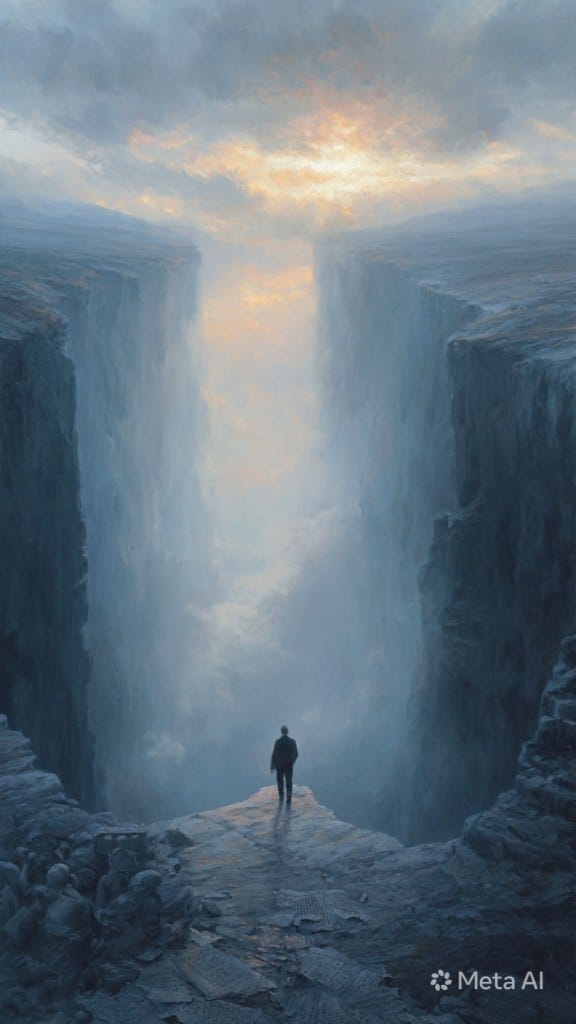
This leap is often misunderstood. It is not a jump into nothingness, nor is it mystical guesswork or irrationality. It is not blind faith.
Rather, it is a leap of faith into that which we hold to be the revelation of God.
It is the realisation that knowing God is not an intellectual achievement or a matter of holding correct definitions. It is not about possessing truth; it is about participating in it. Faith is subjective, passionate commitment. It is saying: “I cannot fully define You, but I trust the One who has revealed Himself to me in Christ.”
This faith grows and matures. As we live into it, we continue to encounter Christ not just in scripture, but in the ongoing reality of our lives. It is a journey of deepening relationship, not a static set of beliefs. It is living within what the Greeks called aletheia — truth as unconcealment, the ongoing uncovering of reality through divine self-disclosure and self-giving.
We move from trying to master God with our concepts, to humbly receiving God as He is.
Conclusion: The Invitation to Authentic Being
We have travelled a long way: from the comfortable illusion of the crowd, through the danger of reducing God to an idol, through the necessary pain of collapse, to the humble reception of divine revelation, and finally to the leap of faith that participates in authentic reality.
The central insight of this work is this: maturity — both human and spiritual — requires the death of illusion.
We are invited to let go of the need for certainty, the drive to define, and the comfort of the crowd. We are invited to step out of the small rooms we have built for God, and stand before the vast, mysterious, self-disclosing reality of Be[-ing].
To encounter the true God is to surrender our need to control Him. It is to trade the safety of the defined god for the wonder of the living God — accessible, tangible, intelligible, yet always infinitely more than we can grasp.
This is authentic being: living not in the shadows of our own making, but in the light of the One who is, who was, and who is to come.
“For now we see in a mirror dimly, but then face to face. Now I know in part; then I shall know fully, even as I have been fully known.”
— 1 Corinthians 13:12
메타데이터
- post_id
- 488c5cffd904
- slug
- the-death-of-idols-reconnecting-with-divine-reality-488c5cffd904
- url
- https://medium.com/@malcolm.j.hore/the-death-of-idols-reconnecting-with-divine-reality-488c5cffd904
- canonical_url
- https://medium.com/@malcolm.j.hore/the-death-of-idols-reconnecting-with-divine-reality-488c5cffd904
- author_url
- https://medium.com/@malcolm.j.hore
- status
- ok
- fetched_at
- 2026-06-27 23:56:40