Nkisi
Chapter 1 Where the threads cross
Nkisi
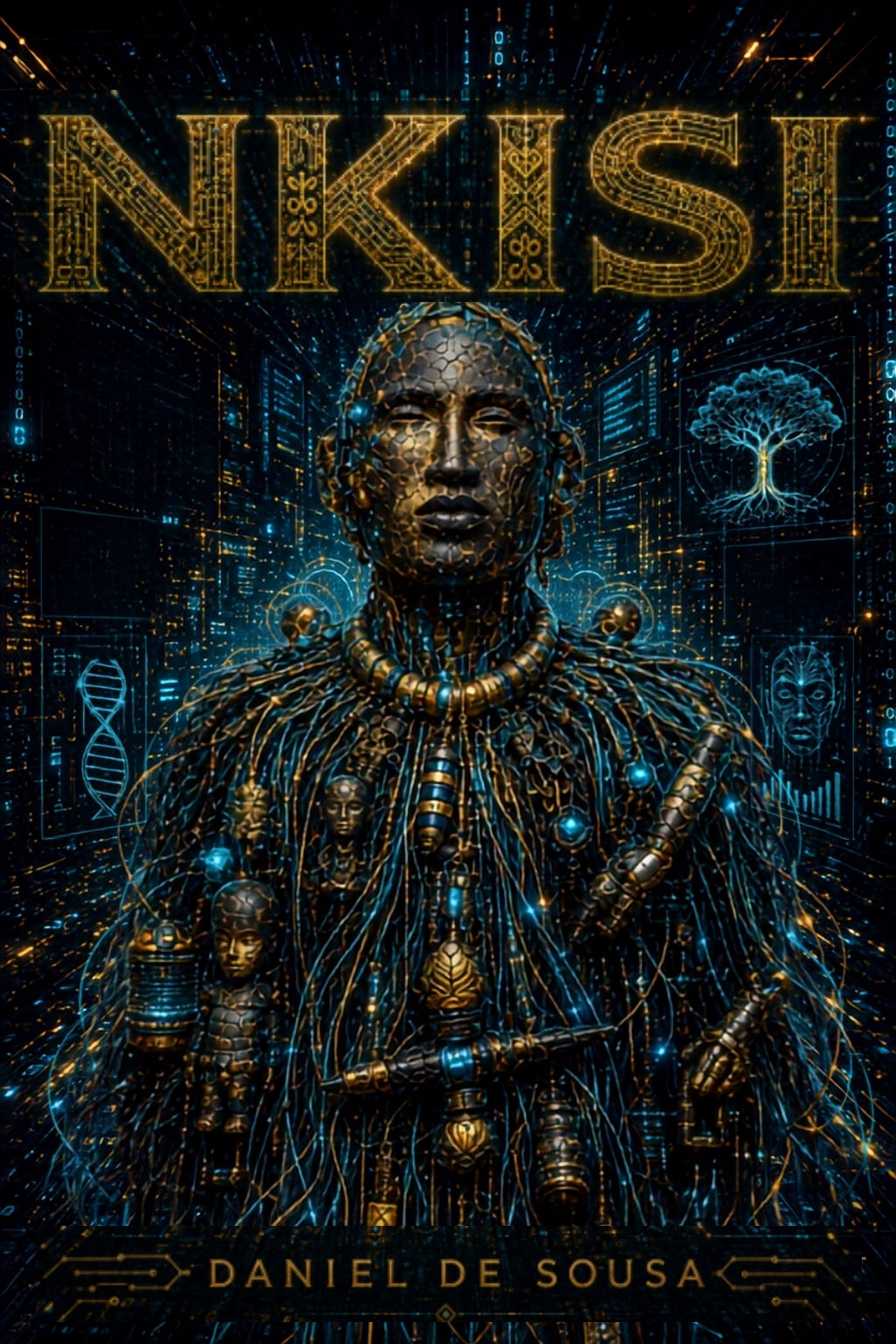
Chapter 1 Where the threads cross
The apartment was small, discreet, and safe. Amanda had said that on the nite they arrived, while locking the door with two turns of the key and one of the bolt, as if security were a recipe measured in precise movements. Cain didn’t respond. He was counting. From the bedroom to the kitchen, it was twenty-three steps. At his aunt’s house in Mynas, there were forty-seven. Cain didn’t need the floor plan that Amanda kept in the desk drawer, eighty-two square meters, she had told him at breakfast, as if numbers on paper could explain the difference between a place where silence breathed and one where it suffocated. He measured the world by the distance the body needed to travel to be alone. And in São Paulo, in that thirteenth-floor apartment of a brick building in Vila Mariana, loneliness came in smaller doses. Compressed. Like pills. The city compressed everything. The sky, the air, the silence. That’s why he woke up at 6:14, one minute before the alarm clock Amanda had set, one minute before the world demanded that he open his eyes and pretend he belonged there. The bedroom ceiling was white, with a crack in the shape of a river that ran from the baseboard of the ceiling to the center, where the chandelier should have been. There was no chandelier. Just a dark spot where the building’s plumbing marked the concrete, and Cain looked at it every morning thinking that, if one day the city decided to collapse, it would start from there: not from the outside, but from the inside, thru the veins of concrete and iron that supported the thirteen floors above him. The foam mattress made a dry sound when he got up. He put on the same jeans from yesterday, still clean from the knee down, dirty with graphite from the knee up, where he had leaned against the wall at São Joaquim station, and grabbed the gray t-shirt Amanda had left folded on the chair. “London Calling.” Faded letters. Fabric so thin on the shoulders that the light from the window passed thru almost transparently. The shirt belonged to his father. Cain didn’t remember his father’s smell, but sometimes, when the air in the apartment stood still, he pretended he was still there, trapped among the worn fibers.
In the kitchen, Amanda was making coffee. The smell was strong, astringent, the kind of coffee that doesn’t apologize for being bitter. She was wearing a light blue lab coat over her blouse, ready for her shift at the Hospital das Clínicas. — Today there’s a science class — she said, without turning her head. — You need an A4 sheet of paper for Professor Rocha’s assignment. I bought it. It’s on top of the fridge, next to the snack. Cain looked. There was a package of polvilho cookies, a small apple with a brown spot on the side, and a sheet of white paper, so white it seemed freshly created, without any notebook lines to hold his handwriting. “Thank you,” he said. The word came out softly, almost swallowed by the noise of the blender where Amanda was making the banana smoothie. Amanda turned off the blender, but she didn’t turn around immediately. She let the silence of the small kitchen envelop her, and amidst the steam of the coffee and the smell of ripe bananas, she felt the weight of the boy’s gaze on her back. She didn’t see him as strangers did, a skinny, awkward teenager hunched inside an oversized t-shirt. Amanda saw the black-skinned baby she had held in her arms thirteen years ago, the skin still damp with amniotic fluid, the hoarse cry that filled the delivery room. She saw Luiza, exhausted, smiling. She turned off the device. The silence that followed was the kind of silence Amanda knew how to read: the silence of Cain asking something without opening his mouth. Now, in that cramped kitchen in São Paulo, after so many years in the silence of the house in Mynas, she saw what time had done. His shoulders were no longer those of a child — they were broad, firm, arched in a posture that reminded her of Makala, the father. There was an honesty in Cain’s chin, in the way he held the sheet of paper carefully, as if paper were something precious. The dark skin, the high forehead, the dark eyes that didn’t shy away when she met them. Eyes of someone who observes more than speaks, but when they did speak, they carried the curiosity of someone who wants to know the why of things, not just the how. He had the aura of someone who had already suffered and did not let suffering rob him of his decency — a rare quality in adults, almost impossible in thirteen-year-old boys. — You’re taller — she said suddenly, her voice coming out rougher than she intended. — I almost don’t need to bend down anymore to look into your eyes. Cain didn’t answer. He just tilted his head, an expression she knew well, the same one he made when he was little and took apart the radio to see what was inside, the same one he made when, at seven years old, he asked why the sky was blue and didn’t like the answer. His curiosity was not noisy. It was silent, obstinate, dangerous. Like Luiza’s. Amanda felt her heart tighten. São Paulo. The big city. The danger that did not come from forests or rivers, but from people. A lot of people. She looked at his hands, long fingers, bitten nails, the skin at the tips dry from handling books and, she suspected, from touching things he shouldn’t. Things she couldn’t name, but felt when the air in the apartment grew thick, when the lights flickered for no reason, when Cain stared into nothingness with the intensity of someone seeing something that wasn’t there. — You don’t need to make friends, Makala — she repeated, more to herself than to him. — But you need allies. Cain took the sheet of paper. He folded it in half. Folded it again. He put it in his pants pocket, where it made a perfect square against his thigh. She saw his shoulder tense slightly upon hearing the name. “Makala.” The father’s name. The name he carried like an inheritance he still didn’t know how to spend. Amanda almost touched his face, as she used to when he was small and the world still fit between her arms. But he wasn’t small. And São Paulo was not a place that could fit between arms. — Go — she said softly. — The subway doesn’t wait. And I need you to come back in one piece. — I’m not looking for friends — he said. — I know. That’s what scares me. Cain nodded. He put the bruised apple in the pocket of his backpack — next to the polvilho biscuit — and headed toward the door. Before turning the doorknob, he stopped. He looked back. For a moment, in his eyes, Amanda saw the baby again. And she also saw the man he would become. The two, at the same time, superimposed on that thirteen-year-old face that the big city had not yet been allowed to break. “I’ll come back whole,” he said, with a confidence that was much more to calm his godmother’s heart. And he left. Amanda was left alone in the kitchen, with the coffee cooling in the mug and the distant sound of the subway, underground, like the heart of a city that never slept.
The blue line subway arrived at 7:02 — four minutes late. For the others, it was just another Monday. For Cain, it was a disruption in the rhythm. He felt it in his body before understanding it with his mind: a slight tension in the nape, as if someone had pulled an invisible string that only he had tied to his skin. That’s how the web worked. It wasn’t something he looked at, like in a drawing in a book. It was something he felt — physically, almost painfully — when the world around him went out of sync. The web was not a gift. It was not a blessing. It was more like a wound that had never properly healed, thru which the world seeped. When thousands of people believed, at the same time, that they were in control of their destinies, the air became dense. Cain felt the buzzing in his temples, a pressure in his ears, as if he were descending in a plane that never landed. And when something was out of schedule — a delayed bus, a red light, a subway that took four extra minutes — the web vibrated. Not violently. It was a pulse, a wrong beat, like a heart skipping a systole. He entered car 3207. The air conditioning was broken, but that didn’t matter. What mattered was the smell of iron, the metallic odor of one hundred and twelve people standing, according to the count his mind made automatically, without him asking. The web counted. The web always told. Not because Cain wanted to, but because it was her way of existing: she connected dots, traced lines between bodies, between destinies, between the young man with the green backpack at the door and the woman in high heels who would get off at the next station. He didn’t see bright threads or mystical lights. He saw, or rather, felt. connections. The boy with the green backpack was about to lose his job. The woman in high heels was lying to someone she loved. Cain didn’t know the details. He knew the weight. The web carried the weight of choices as if they were stones in a net, and he, for some reason that had never been explained to him, had been carrying that net on his shoulders for as long as he could remember being human. He held the metal bar with his left hand. And then, the web spoke louder. The electric current ran beneath the yellow paint of the bar, he felt it in the palm of his hand, not as a shock, but as a voice. A voice without words, or at least nothing he had ever been able to understand clearly. The city was made of those currents. Underground wires that people couldn’t see, but that kept everything running. Or everything trapped. Cain could never quite tell if the web was a map or a prison of steel wires. Sometimes, when he gripped the bar tighter, he felt the electricity surge up his arm, a cold wave that made the hairs stand on end. It wasn’t comfortable. It was familiar. Like the touch of a mother you don’t remember having, but that your blood recognizes. In that carriage, at 7:02 in the morning, with one hundred and twelve people believing they controlled their own lives, Cain closed his eyes for a second. The web pulsed. Someone in the carriage was about to cry. Someone was about to lie. Someone was about to die, not today, maybe not this year, but the line had already been drawn, the thread had already been pulled, and Cain felt the tremor of that future fall at the base of his spine. He opened his eyes. He let go of the bar a little. I couldn’t hold on for too long, or the web would start pulling back, and when it did, things would happen. Lights flickered. Radios were crackling. The city was made of chains. The Professor José Leite Lopes State School was seven minutes from the station, up a concrete slope where the asphalt melted on hot days and formed black puddles that lasted for weeks. Cain climbed the slope. The sun of São Paulo was not the sun of Minas Gerais. There, the heat was open, honest. Here, it came reflected in ten thousand glass windows, in windshields, in zinc roofs. A diffuse, treacherous heat that burned without warning of where it came from. The schoolyard was a rectangle of cement with four masonry bleachers painted blue and white, and a basketball court where the paint from the can was worn down to the concrete. Cain didn’t go to the court. He went to the back corridor, where there was a window overlooking an ancient eucalyptus tree and where the cell signal didn’t reach. It was the only place in the building where the web seemed thinner, easier to breathe. It was there that he saw her for the first time.
She was sitting on the floor, leaning against the blue tiled wall, with her legs crossed and an open notebook on her lap. It was a black-covered sketchbook, the kind you buy in architecture supply stores. She was drawing with a 6B pencil, the stroke dark and smooth, moving her hand quickly without looking at the paper. Cain stopped three meters away. Not because he wanted to, but because the web at that point had a knot. A concentration of lines that weren’t there before. She had short hair. Not short like a girl who impulsively took a pair of scissors to her hair. Short with a machine, number two on the sides, a bit longer on top, but messy, as if she had woken up and decided that the comb was an outdated invention. He was wearing a loose band t-shirt. The Smiths, “Meat Is Murder,” over a pair of worn-out jeans, and black All-Star sneakers with the white sole peeling off at the left heel. Small ears, two thin silver hoops in the right ear. The profile was sharp, the chin slightly forward, the posture of someone who doesn’t ask for permission to occupy the space they do. Cain said nothing. He just stood there, looking at the knot in the web. She looked up. — Are you going to stand there all day? — she asked. The voice was deep for the age, with a hint of hoarseness that seemed permanent. — Because if you are, I’ll have to draw you as someone I don’t know. And I also don’t like drawing people who stand still. They look like lampposts. “I’m not a lampposts,” said Cain. — Then sit down. Or get lost. The hallway is public, but the floor here is mine until the signal sounds. Cain hesitated. The web pulsed. He sat down. Not next to her — he left a meter of distance, the exact space of a tile between them. She went back to drawing. The sound of the graphite on the paper was dry, rhythmic. — You are the new one — she said, without asking. — The guy from Minas Gerais. The one who doesn’t speak. — I speak when I need to. — Everyone speaks when they need to. The trick is knowing when you don’t need to. — She turned the page of the notebook. Cain saw: it was a drawing of the school, but not as normal eyes would see it. She had drawn the outlines of the buildings, but between them, there were lines. Threads. Connections. The web. Cain’s blood ran cold. It wasn’t a metaphor. He felt the temperature of his skin drop, the hairs on his arm stand on end. He looked at the drawing, then at her. She didn’t seem to realize that she had drawn something impossible. Or maybe she did realize, and simply didn’t care. — What is this? — he asked, pointing at the paper, trying not to seem fake in his surprise. — What is what? — She looked at the drawing, then at him, confused. — It’s the school. Just the way I see it. — And how do you see it? She opened her mouth to respond, but didn’t get to speak. — Hey, look. The freak has a visitor. The voice came from the end of the hallway. Cain didn’t need to turn his head to know there were five. The web always showed the number before showing the face. Five of us approaching, like birds of prey. The one leading was a fourteen-year-old boy, maybe fifteen, with a modified school uniform: the white shirt was inside out, the sleeves rolled up to reveal an arm tattooed with a homemade drawing of a cross. Shaved head, eyebrow split by a thin scar. The other four were variations of the same model: baggy jeans, expensive running shoes, smiles that didn’t reach their eyes. “What’s up, freak,” said the leader, stopping two meters away. “Crossing your legs today?” How sweet. She almost looks like a real girl. The girl with short hair didn’t move. She just closed the sketchbook with a dry snap. “ — Go away, Diego — she said. — I don’t have patience for a male’s menstrual cycle today.” The four behind laughed, but the laughter was cut short by a look from Diego. — You shouldn’t talk like that, Lucca — he said, pronouncing the name slowly and as if it were something dirty. — It makes it seem like you have a dick. And everyone knows you don’t have one. Or do you? Is that the question, right? You come in a dress on school day, in pants the next. Speaks roughly. Walk rough. Cut your hair to look like a little gay guy. Then I get in doubt. We are left in doubt. What are you, after all? — I am whatever I want to be on the day I wake up — said the girl, her voice flat, without inflection. — Today I am a person drawing in a hallway. Tomorrow I can be someone else. The problem is that you were born without imagination. And my name is Lucca. Diego took a step forward. Cain stood up. The movement was so quick, so silent, that Diego instinctively recoiled, tripping over his own sneakers. — Who are you, kid? — Diego regained his balance, but his voice had lost a tone. — I haven’t seen you before. Get out of here. This is between us and the bitch. — It’s not between anyone — said Cain. The phrase came out without him thinking. His silence, that armor that had become a blade. Five words. Five syllables. Enough to fill the corridor. Diego laughed, but the sound was strangled. — Are you crazy, man? — Diego looked at the others, his boyfriend thinks he’s Batman.
He took another step. And then he did what men like him always do when silence intimidates them: he tried to break it with violence. The punch came awkwardly, from below, an elbow aimed at Cain’s stomach. Cain didn’t move. He didn’t need to. He saw the thread before the fist moved — saw the point where Diego’s choice would become irrevocable. And in the span of a second, something happened that wasn’t supposed to happen. The hallway light — a white LED tube held by metal clips — burst. The glass shattered into pieces on the ceramic floor, and at the same moment, a dry crack echoed thru the air. It wasn’t a lightning bolt. It was a crackle of static electricity, so strong that everyone’s hair stood on end for a second, as if someone had rubbed a balloon on the fabric of their shirt. Diego stopped. The fist halfway. The wide eyes. — What the hell… — whispered one of the boys behind. The smell of ozone filled the hallway. Cain hadn’t moved. His hands were open at his sides, fingers slightly curled. He felt something buzzing in his fingers, a sensation that was neither pain nor pleasure, but pure power — and at the same moment, fear. He didn’t know what he had done. Or maybe he knew, and didn’t want to know. — What are you doing here? — The voice came from the corner of the hallway, deep, tired, the voice of someone who has seen too much before nine in the morning. A middle-aged man, short-sleeved navy blue dress shirt, beige chinos, gray hair cut short. The student supervisor. He held a clipboard against his chest as if it were a shield, and his eyes moved quickly from one group to another: the five boys, Cain standing still, Lucca sitting on the ground, the shards of glass glinting on the cement. “The light bulb burned out,” said Diego, too quickly. “We were just passing by.” — Passing — Inspector Rui repeated, without inflection. — Five of you, passing. One on the floor, one standing, and a light bulb that decided to blow up at exactly the same moment. Fascinating coincidence. He looked at Cain. Inspector Rui’s eyes were small, hazel, and seemed to see thru lies as if they were made of glass. “Get up, girl,” he said to Lucca. “And you, boy.” All of you. Board of Directors. Now. “I didn’t do anything,” protested Diego. — Doing nothing is exactly what you will explain to the principal. Walking. The principal’s corridor smelled of floor wax and pine disinfectant. The walls were painted aquamarine up to a height of one meter eighty, and white above, as if the school had decided that the lower part of life was more important. Cain walked at the end of the group, keeping his distance. The hairs on his arm were still standing on end. He didn’t look at his hands. He was afraid of what he might see there. Lucca walked beside him, but did not look at him. She held the sketchbook against her chest with one hand, the other stuffed in her pants pocket. Diego and the others were ahead, grumbling, exchanging glances that promised more to come. The principal was a sixty-year-old woman, with white hair pulled back into a bun so tight it seemed to pull the skin on her temples. “Sit down,” she said, pointing to the blue plastic chairs lined up in front of the desk. “All of you.” They sat down. Diego and the four in a row. Lucca at the end, alone. Cain in the farthest chair, leaving one empty between him and Lucca. Inspector Rui stood by the door, arms crossed, the clipboard still against his chest. “Is anyone going to tell me what happened in the B block corridor?” asked the principal. The voice was not harsh. It was worse. It was the voice of someone who had already heard all the possible versions and was simply waiting for the worst. Silence. Diego looked at the ground. The other four looked at Diego. — The bulb burned out — said Diego, finally. — We were passing by and it exploded. — It exploded — the principal repeated. — By itself. — Alone. — And why, if the lamp exploded on its own, did Inspector Rui find you five around two students who are not part of your friend group? — We are not friends — said Lucca, suddenly. The voice came out clear, cutting thru the air like graphite cuts thru paper. — We never were. They don’t have friends. They have hostages. What happened is that Diego and his goons decided that today was the day to bother those who don’t look like them. The rookie — she pointed to Cain with her chin, without looking at him — showed up in the middle. The light bulb exploded. End of the story. The principal took off her glasses. She rubbed her nose with her thumb and index finger, a gesture that seemed rehearsed from decades of scoldings.
— Lucca — she said. — You know this school has a zero-tolerance policy against discrimination. — I know — said Lucca. — I also know that a zero-tolerance policy is like a speed limit sign: everyone sees it, no one respects it. But I didn’t come here to ask for protection, principal. I came here because the inspector ordered me to. And if you’re going to scold me, let it be for something I actually did. The principal put her glasses back on. She looked at Lucca for a long moment. There was no anger in her eyes. There was something more dangerous: evaluation. — You are a smart student, Lucca — she said. — Very smart. Your essay grade is the highest in the class. Intelligence, unfortunately, does not always mean wisdom. Wisdom is knowing when to use intelligence to build bridges, and when simply… to know when to be silent. — I stay silent when I have nothing to say — replied Lucca. — Today I had something. The principal sighed. Looked at Diego. — And you? Do you have anything to say, Diego, beside light bulbs that explode on their own? Diego shrugged his shoulders. — It’s just that she’s crazy, director. She keeps provoking. We were just passing by. — Passing — the principal repeated, as if the word tasted like ash. — All of you, passing. — She looked at Cain. — And you? You didn’t tell me your name. Cain felt everyone’s eyes on him. The principal, the inspector, Diego, Lucca. The web in that room was dense, confusing, a tangle of intentions he couldn’t read clearly. He didn’t like being seen. He didn’t like being asked. — Cain — he said. His voice came out quieter than he intended. — Cain Makala. — Makala — the principal repeated, as if tasting the name in her mouth. — It’s not a common name around here. — It’s not. — Do you have anything to add about the incident? Cain looked at his hands. They were normal. Thin fingers, bitten nails, brown skin. He no longer felt the buzzing. Or he felt it, but it was so faint that he could ignore it. — No — he said. — I have nothing. — Nothing? — The principal tilted her head. — You were in the hallway. The light bulb exploded. You didn’t see anything, didn’t hear anything, don’t know anything? Cain raised his eyes. Looked at the principal. Then, for a second, at Lucca. She didn’t look back. But he saw: her fingers tightened their grip on the sketchbook. “I don’t know,” he said. “I wasn’t paying attention.” The principal studied him for a moment that seemed to stretch beyond seconds. Then, she wrote something on the sheet in front of her. — Diego, you five, one-day suspension. Next time, it will be a week. Lucca, verbal warning. Next time, suspension. — She looked at Cain. — You, Makala. Pay attention. This school is not a place for those who don’t pay attention. Danger likes those who aren’t paying attention. She made a gesture with her hand. The meeting was over. Inspector Rui opened the door. Diego and the others left grumbling, exchanging looks of disguised triumph — a day of suspension was a paid holiday in their world. Lucca stood up. She walked to the door, stopped, and looked at Cain. — You didn’t have to — she said. The voice was lower now, the hoarseness almost a whisper. — Stand up. Speak. I can manage on my own. “I know,” said Cain. — So why? Cain didn’t answer. Not because he didn’t know. Because I didn’t know how to say it without revealing too much. Without showing that, when Diego raised his fist, he hadn’t thot about protecting Lucca. He had thot of pulling something, some wire, some chain, and the lamp had responded. Or had he responded to the lamp. He still didn’t know the difference. Lucca waited three seconds. Then, she shrugged. — Whatever it is — she said — , thank you. Really. But next time, let me take the blame alone. I’m better at this than you. She left. The sketchbook thumped against his thigh with each step. Cain was left alone in the room. Inspector Rui was still at the door, watching him with those hazel eyes that seemed to see too much. “You have one eye lighter than the other, you know?” said the inspector, suddenly. “The left one.” It looks more… gray. It’s not the hallway light. It’s you. Cain felt his blood run cold. “I don’t know what you’re talking about,” he said.
— No? I know. He opened the door again. “Go to class,” he said. “And pay attention.” As the principal said: danger likes those who aren’t paying attention. Cain left. The hallway was empty, the smell of floor wax still strong. He walked slowly, feeling his heart beat out of rhythm. He walked down the corridor of Block B. The glass shards were still on the floor, glimmering under the dim light of the emergency lamps that had turned on automatically. In the midst of the shards, something caught Cain’s attention. A feather. Dark, large, with a silver tip. She wasn’t there before. He was sure. He had looked at the floor when the inspector arrived, and there was nothing but glass. Cain bent down. He picked up the feather. It was warm as if charged with energy. When he touched it, he felt — not heard, felt — a vibration in his fingers. As if the feather were alive. Or as if it were waiting for him. He put the pen in his pants pocket, along with the sheet of paper folded in four. He walked to the science class, sat in the last desk, in the back row, and didn’t hear anything the teacher said during the next fifty minutes. On the sheet of paper, which was supposed to contain the work on ecosystems, he drew without thinking. Lines. Threads. Paths. And in the center, a face he didn’t immediately recognize: short hair, earrings, a smile that wasn’t a smile, but a half-open door. When the bell rang, Cain folded the sheet. He put it in his pocket, along with the feather. He didn’t know yet, but the web was moving. The knot that was Lucca was drawing closer. And on the horizon, beyond the gray sky of São Paulo, something was getting ready to pull the next thread. At the school exit, under the blue canvas awning that protected the gate from the rain, Lucca was leaning against the iron gate, drawing. She didn’t look up when Cain passed. But she said, to the air, to the paper, to anyone who was listening: — Tomorrow, same time, same corridor. Bring answers, Makala. Or bring nothing at all. But don’t bring lies. I am better at detecting lies than the principal. Cain stopped. He didn’t turn around. — Why? — he asked. — Because — said Lucca, and now she looked up, her almost black brown eyes fixed on him — , because when the lamp exploded, I saw your shadow. And shadows don’t lie. Hers had two extra arms. She started drawing again. Cain walked out thru the gate. The sun of São Paulo beat down hard on the asphalt, but he felt cold. In his pocket, the feather pulsed. Hot. Live. Waiting. And somewhere, in a place that was not on the maps, in a place that could only be reached by paths that few could see, two eyes opened. One eye was brown. The other shone with a red light that was not of this world. The door had closed. But another, invisible one, had just cracked open. And Cain Makala, who had learned early that silence was his armor, felt for the first time that he might need someone to break that silence, before the silence broke him from within.
메타데이터
- post_id
- 48976f4cbea9
- slug
- nkisi-48976f4cbea9
- url
- https://medium.com/@soulsas/nkisi-48976f4cbea9
- canonical_url
- https://medium.com/@soulsas/nkisi-48976f4cbea9
- author_url
- https://medium.com/@soulsas
- status
- ok
- fetched_at
- 2026-07-10 14:51:46