Mahindra XUV 7XO vs US SUVs: Why the Same Kind of Car Is So Much Cheaper in India
When Mahindra launched the XUV 7XO in India, one thing immediately stood out — the price.
Mahindra XUV 7XO vs US SUVs: Why the Same Kind of Car Is So Much Cheaper in India
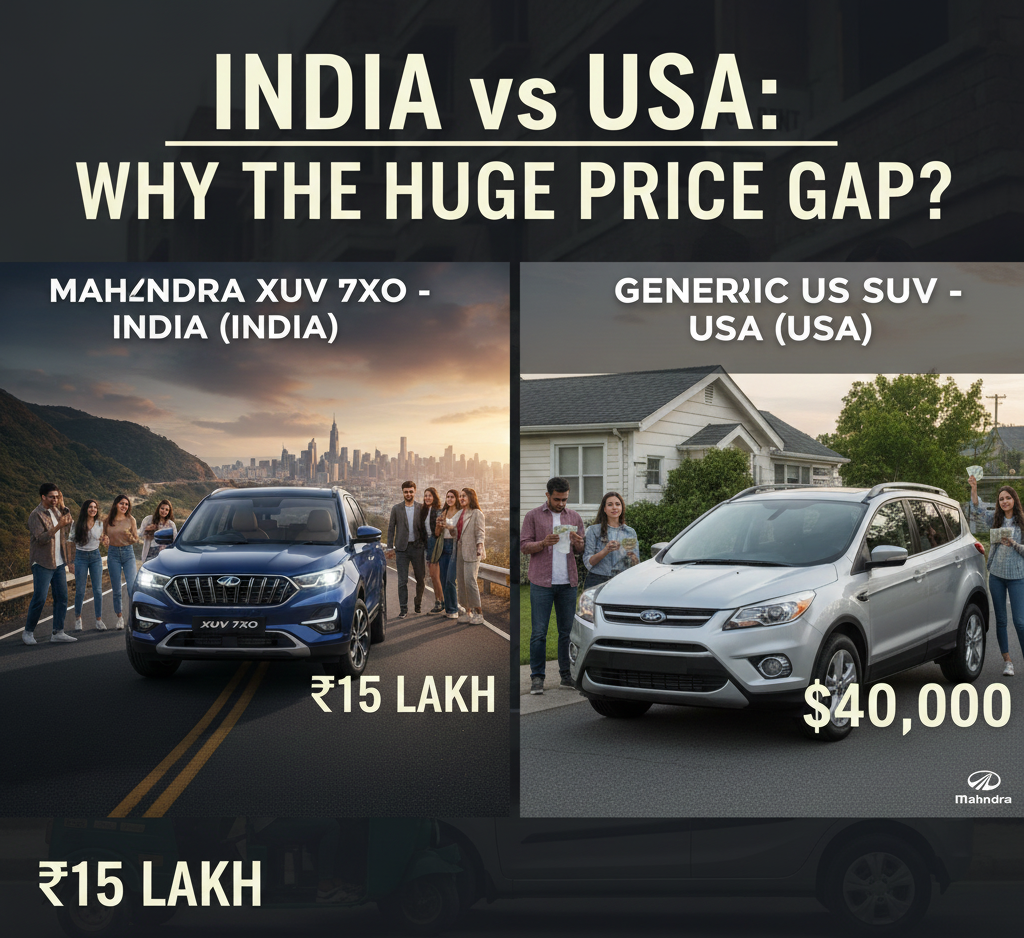
When Mahindra launched the XUV 7XO in India, one thing immediately stood out — the price.
For Indian buyers, it feels like a feature-packed SUV at a relatively affordable cost. But if you look at similar SUVs in the United States, the price difference feels shocking.
So the question is obvious:
👉 Why does a car like the XUV 7XO cost so much less in India compared to similar SUVs in the US? 👉 Are Americans overpaying, or are Indians getting a better deal?
Let’s break it down logically.
What Kind of SUV Is the XUV 7XO?
The XUV 7XO fits into the mid-size SUV category:
- Family-oriented
- Modern design
- Strong road presence
- Tech + safety focused
- Suitable for daily use and long drives
In the US, this same segment includes cars like:
- Toyota RAV4
- Honda CR-V
- Hyundai Tucson
- Ford Escape
These are not luxury SUVs — they’re everyday family cars.
Price Comparison: India vs United States
This is where things get interesting.
🇮🇳 India (Mahindra XUV 7XO)
- Positioned as a value-for-money SUV
- Affordable for upper-middle-class buyers
- EMI-friendly for salaried professionals
🇺🇸 United States (Equivalent SUVs)
- Considered standard family vehicles
- Prices often start where Indian SUVs end
- Financing is common, but absolute prices are much higher
Even after converting currency, US buyers typically pay 2–3× more for a similar type of SUV.
So why?
Reason 1: Manufacturing Location Matters a LOT
Mahindra designs and manufactures its SUVs primarily in India.
That means:
- No import duties
- Lower logistics costs
- Local supply chain
- Cheaper labor and operations
Most US SUVs are either:
- Manufactured in higher-cost economies
- Or priced to maintain high margins
Local manufacturing alone creates a huge price advantage for Indian cars.
Reason 2: Taxes Work Very Differently
In India:
- Taxes are high, but structured around engine size & category
- Manufacturers aggressively price cars to stay within tax-friendly limits
In the US:
- No GST like India
- But higher costs are baked into:
- Compliance
- Insurance
- Dealer margins
- Warranty obligations
- Legal liability risks
The final price in the US reflects total ownership risk, not just production cost.
Reason 3: Income Levels Change “Affordability”
This is a big psychological factor.
- In India, a ₹15–20 lakh SUV is a major financial decision
- In the US, a $30–40k SUV is considered normal
Manufacturers price cars according to what the average buyer can pay, not just what the car is worth.
Mahindra knows:
If pricing goes too high, Indian buyers simply won’t buy.
US automakers know:
Buyers are used to higher prices and longer loans.
Reason 4: Feature Strategy Is Different
Indian SUVs like the XUV 7XO focus on:
- Maximum visible features
- Tech and screens
- Comfort and space
- “Value perception”
US SUVs often focus on:
- Long-term durability
- Stricter safety standards
- Expensive compliance systems
- Higher insurance-grade components
Both are good — but they optimize for different markets.
Reason 5: Cost of Ownership Beyond the Price Tag
Even after buying the car:
India:
- Cheaper servicing
- Lower labor costs
- Affordable spare parts
US:
- Expensive servicing
- Higher insurance premium
- Costly repairs
- Higher fuel and maintenance expectations
So US buyers don’t just pay more upfront — they pay more every year.
Are Indian Buyers Getting a “Better Deal”?
Not exactly.
Indian buyers get:
- Better price-to-feature ratio
- Lower entry cost
- Higher emotional value
US buyers get:
- Better long-term durability expectations
- Higher regulatory safety buffers
- Strong resale ecosystems
Different markets, different priorities.
The Bigger Picture
The XUV 7XO represents something important:
👉 Indian car manufacturers now understand how to deliver global-level products at India-friendly prices.
And that’s why cars like this feel “cheap” when compared internationally — not because they’re inferior, but because they’re designed intelligently for the Indian economy.
Final Thoughts
When you compare the XUV 7XO with US SUVs, you’re not just comparing cars — you’re comparing:
- Economies
- Tax systems
- Buyer psychology
- Market strategies
And in that comparison, Indian buyers are finally getting serious value.
Call to Action (Medium-Style)
If you enjoy reading about cars from a money + logic perspective, 👉 Follow for more breakdowns on cars, cost, and smart ownership decisions in India.
메타데이터
- post_id
- 489fd950f978
- slug
- mahindra-xuv-7xo-vs-us-suvs-why-the-same-kind-of-car-is-so-much-cheaper-in-india-489fd950f978
- url
- https://medium.com/@vardan980514/mahindra-xuv-7xo-vs-us-suvs-why-the-same-kind-of-car-is-so-much-cheaper-in-india-489fd950f978
- canonical_url
- https://medium.com/@vardan980514/mahindra-xuv-7xo-vs-us-suvs-why-the-same-kind-of-car-is-so-much-cheaper-in-india-489fd950f978
- author_url
- https://medium.com/@vardan980514
- status
- ok
- fetched_at
- 2026-07-13 14:28:48
