The Bug in Our Cosmic Code: Why Physics Collapses When It Tries to Zoom In
A visualization of the defining crisis in modern physics. On the right, Einstein’s smooth, curved space fabric (General Relativity) governs…
The Bug in Our Cosmic Code: Why Physics Collapses When It Tries to Zoom In
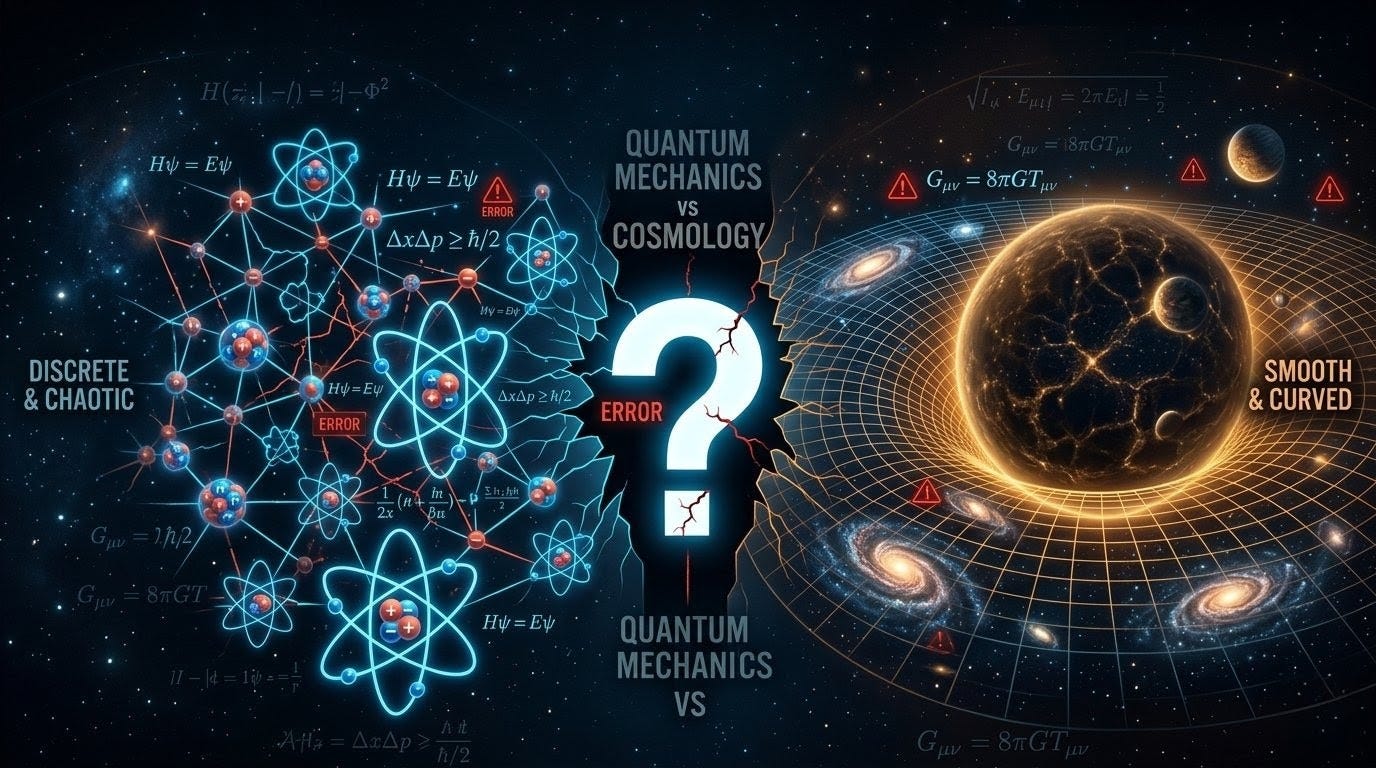
A visualization of the defining crisis in modern physics. On the right, Einstein’s smooth, curved space fabric (General Relativity) governs the massive cosmos. On the left, a chaotic, discrete, particle-based lattice (Quantum Mechanics) governs the subatomic. At the center is the unbridgeable gap: the singularity that generates error alerts and makes both standard models collapse. We cannot unite them.
We are taught in school that physics is an all-powerful toolkit capable of decoding the cosmos. We have equations for the orbit of Jupiter, and we have formulas for the behavior of an electron. Both toolkits work flawlessly in their own backyards.
But there is a dirty little secret hidden right beneath the glossy pages of standard physics textbooks: The moment you try to combine these two toolkits, the math doesn’t just stop working—it completely and violently collapses.
For decades, the holy grail of modern science has been a "Theory of Everything" to bridge the gap between scale-dependent quantum mechanics (the science of the incredibly small) and macro cosmology (the science of the incredibly massive). Yet, the bridge always breaks.
Why? Because our entire foundation is built on a blind assumption: that physical space is a smooth, continuous expanse that can be divided infinitely.
When you look closer at the mathematics of boundaries and thresholds, it turns out that our reality might not be a smooth, infinitely divisible fabric at all. It behaves like a highly structured, discrete system.
1. The Tale of Two Worlds (And the Unbridged Chasm)
To understand why physics breaks, let’s look at the two rulesets currently running our universe:
- The Macro World (General Relativity): This is Einstein’s masterpiece. It views space as a smooth, continuous, stretchable fabric. Massive objects like stars and planets warp this fabric, creating what we feel as gravity. It’s smooth, predictable, and elegant.
- The Micro World (Quantum Mechanics): This is the chaotic world of subatomic particles. Here, things don’t slide smoothly; they jump in fixed packets of energy called quanta. It is jittery, probabilistic, and ruled by uncertainty.
The Real-World Analogy: Imagine trying to play a high-stakes video game, but Player A is playing by the strict rules of a turn-based board game like Chess, while Player B is playing by the rules of an open-world simulation like Grand Theft Auto.
Separately, both games function beautifully within their own boundaries. But the moment you try to merge them—forcing a rigid chess piece to interact with a fluid, digital open-world car—the game engine crashes. That is exactly what happens when physicists try to apply gravity to the quantum realm. The cosmic game engine glitches out.
2. The Nightmare of r → 0 (The Ultimate Math Bug)
Why exactly does the engine crash? It all boils down to a terrifying mathematical loophole called an Infinite Divergence or a Singularity.
In classical mechanics and relativity, equations rely on the assumption that you can divide space infinitely. You can go from a meter, to a millimeter, to a nanometer, all the way down to absolute zero radius (r → 0).
But look at what happens in a basic inverse-square law formula (like Newton’s gravity or electrostatic equations), where distance (r) sits comfortably in the denominator:
Force=(G•m_1•m_2)/r²
As you zoom closer and closer to a point-like particle, that distance (r) shrinks toward 0. What happens to any fraction when the denominator approaches zero? The answer blows up into infinity.
In the real world, "infinity" doesn’t exist. If a scale or a speedometer hits infinity, it doesn’t mean you’re going infinitely fast—it means your tool is broken. When physics tools output infinite values at subatomic levels, the math is screaming at us that our assumption of infinitely divisible space is fundamentally flawed. Nature does not tolerate zeroes in the denominator.
3. The Digital Mirage: Is Space Pixelated?
If space isn’t continuous, what is the alternative? The alternative is a discrete informational grid governed by a fundamental resolution limit.

From continuous illusion to discrete grid. The universe might be like a high-resolution display. From a distance (our daily perception), everything looks smooth and continuous. But the closer physics looks (at the resolution threshold), the more reality begins to look like a discrete informational grid. The math breaks because standard models insist on a smooth curve, even when confronting the 'pixels’.
The Real-World Analogy: When you look at a high-resolution smartphone screen from a distance, the image looks incredibly smooth, continuous, and fluid. A curved line looks like a perfect, unbroken curve.
But if you take a powerful magnifying glass and press it against the glass, the illusion vanishes. The smooth curve turns into a jagged staircase of rigid, individual pixels.
Standard physics treats the universe like an impossible screen with an infinite resolution—no matter how deep you zoom, it expects to see a smooth line. But our computational models and subatomic deadlocks are hinting at a different reality.
If our fundamental equations generate breaking points at the smallest scales, it suggests that physical space has a minimum resolution threshold. Instead of an empty, continuous void, space acts as a geometric filter upon an underlying discrete system.
4. The Hidden Inconsistencies in Structural Boundaries
When we assume space is continuous, we also struggle to explain the exact structural boundaries of physical matter.
For instance, standard quantum mechanics models atomic electrons within stochastic, blurry probability clouds rather than fixed orbits. Why? Because a continuous model cannot easily pinpoint a rigid edge without encountering mathematical friction or quantum uncertainty.
Yet, when we look at the physical cores of atoms, protons, or even massive cosmic structures like planetary cores and galactic bulges, nature seems to target highly specific, stable geometric thresholds.
If space were completely continuous and infinitely fluid, these boundaries should bleed out or collapse infinitely into singularities. The fact that stable perimeters exist—from the microscopic radius of a proton to the macroscopic core of a galaxy—indicates that there are universal structural scaling laws balancing the micro and macro worlds, keeping them from collapsing into absolute nothingness or blowing up into infinity.
5. The Illusion We Hold Onto
We live our lives experiencing a continuous reality. We pour water smoothly into a glass; we slide our hand smoothly across a table. It feels continuous, so we blindly assumed for centuries that the math behind the fabric of space must be continuous too.
But we are reaching a point where modern physics has to face its own internal contradictions. We are holding onto a beautiful illusion because it’s comfortable and matches our daily human perception. Yet, when we crunch the numbers at the absolute core limits on a flat sheet of paper, the continuous model completely shatters.
The next time you read about science struggling to explain the core of a black hole, or failing to unify gravity with quantum particles, remember: the problem isn’t that we lack better telescopes or bigger particle colliders. The problem is that we are trying to divide something that might inherently be indivisible.
Perhaps it’s time to stop looking at the universe as an empty, infinite ocean, and start looking at it for what the mathematical contradictions are trying to tell us: we are looking at a highly structured system, and our current textbooks are simply running on a broken code.
메타데이터
- post_id
- 48a89a7c1636
- slug
- the-bug-in-our-cosmic-code-why-physics-collapses-when-it-tries-to-zoom-in-48a89a7c1636
- url
- https://medium.com/@anadihilo/the-bug-in-our-cosmic-code-why-physics-collapses-when-it-tries-to-zoom-in-48a89a7c1636
- canonical_url
- https://medium.com/@anadihilo/the-bug-in-our-cosmic-code-why-physics-collapses-when-it-tries-to-zoom-in-48a89a7c1636
- author_url
- https://medium.com/@anadihilo
- status
- ok
- fetched_at
- 2026-06-09 15:37:30