Zero-Emission Coal Fuel Cell: A Clean-Energy Breakthrough
It sounds too good to be true, but the technology is real — and the new green is black
Green Energy
Zero-Emission Coal Fuel Cell: A Clean-Energy Breakthrough
It sounds too good to be true, but the technology is real — and the new green is black
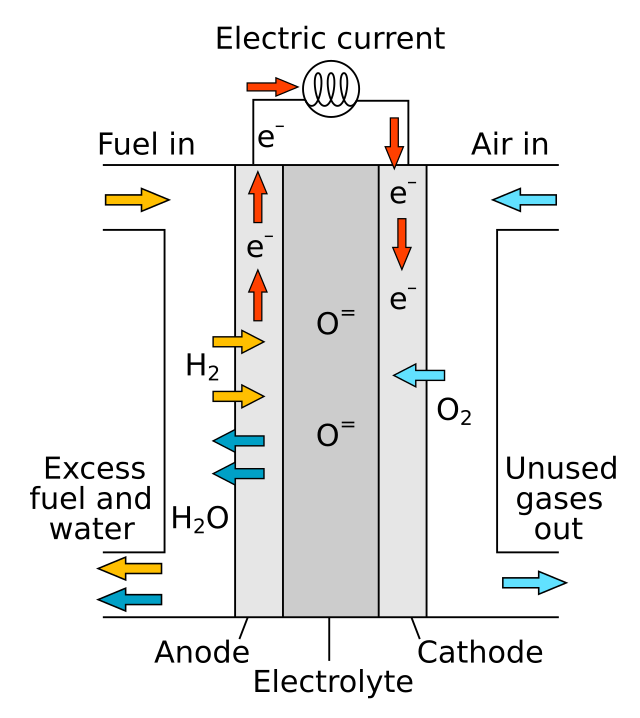
Solid oxide fuel cell. Image: Wikipedia
I was brought up in a town overlaying a labyrinth of coal mines, where the rivers ran black and the miners died early from emphysema. As children we played on coal spoil tips, sliding down them on pieces of cardboard. I have vivid memories of one Saturday morning when I was a teenager playing rugby in a place called Porth in the Rhondda Valley. We scrummaged near the corner and as a Number 5 — second row — I was up to my ankles in black water. Disgusting.
Not far away was Aberfan where a children’s school was buried under a slumped coal tip in 1966, killing 116 children and 28 adults’
You may have gathered by now that I loathe coal.
So the development of a direct carbon fuel cell by a research team in China piqued my interest. It is a significant technical milestone in the search for cleaner fossil fuel utilisation.
The technology is nothing like the solid zinc-carbon batteries most of us used to have in our flashlights before Nicad and lithium came to prominence. And it surprised me that zinc-carbon batteries are still a growth business, at over 4% per annum. Cheap to produce and in great demand in developing countries,their manufacture is increasing.
Anyway, this new technology, known as the zero carbon emission direct coal fuel cell or ZC-DCFC, aims to convert the chemical energy of coal into electricity through electrochemical reactions rather than conventional combustion.
By avoiding the burning of coal, the system effectively bypasses the traditional release of carbon dioxide and other pollutants associated with thermal power plants.
Technical foundations of the direct carbon fuel cell
The ZC-DCFC operates on principles similar to those of a standard battery or a hydrogen fuel cell but utilises pulverised coal as its primary energy source.
In a traditional coal-fired power station, coal is burnt to produce heat, which then boils water to create steam. This steam drives a turbine connected to a generator. This multi-step process is inherently limited by the Carnot cycle, resulting in energy conversion efficiencies that typically range between 33 per cent and 45 per cent.
The combustion process involves the direct reaction of carbon with oxygen in the air, producing large volumes of carbon dioxide, nitrogen oxides, and sulphur oxides. In other words, as dirty as dirty can be.
In contrast, the ZC-DCFC uses the direct electrochemical oxidation of coal particles at an anode. The process takes place within an electrochemical cell where coal is introduced into an anode chamber. Instead of burning, the carbon atoms in the coal release electrons as they react with oxygen ions that have migrated through a solid oxide electrolyte from the cathode.
These electrons flow through an external circuit, creating an electric current. Because the reaction is electrochemical and occurs at lower temperatures than combustion, typically between 500 and 700 degrees Celsius, the formation of nitrogen oxides is virtually eliminated.
The internal operating temperature of 500 to 700 degrees Celsius is achieved and sustained through a combination of external heating during startup and internal heat generation during operation.
Once the fuel cell reaches its operating temperature and the electrochemical reactions begin, the system generates its own heat, making the process largely self-sustaining.
Performance metrics and efficiency gains
The research team, led by academics from the Chinese Academy of Sciences and Shenzhen University, has reported that the ZC-DCFC can achieve significantly higher efficiency than traditional methods.
While current integrated gasification combined cycle systems reach about 45 per cent efficiency, the ZC-DCFC has the potential to reach or exceed 60 per cent. Some theoretical models for direct carbon fuel cells suggest that efficiency could reach as high as 80 per cent under optimal conditions.
A critical contributor to this efficiency is the elimination of the gasification step.
In many advanced coal technologies, coal must first be converted into a syngas (primarily hydrogen and carbon monoxide) before it can be used in a fuel cell. The ZC-DCFC removes this requirement, allowing solid coal to be used directly. This reduces the complexity of the power plant and minimises energy losses during fuel preparation.
Data from recent laboratory prototypes indicates that these cells can maintain high power densities. Unlike hydrogen fuel cells, which require expensive catalysts like platinum and complex storage solutions, the ZC-DCFC uses abundant coal and relatively lower-cost ceramic materials for the electrolyte and electrodes.
The 3D anode design developed by the team increases the surface area available for the reaction, further boosting the power output.
Environmental impact and carbon management
The primary environmental advantage of the ZC-DCFC is its ability to produce electricity with near-zero direct emissions. Because the fuel and air are kept separate by the electrolyte, the exhaust from the anode chamber consists of nearly pure carbon dioxide.
This is a significant improvement over traditional flue gas, which is a dilute mixture of nitrogen, carbon dioxide, and other gases.
The high purity of the carbon dioxide produced makes carbon capture and storage or carbon capture and utilisation much more cost-effective. The Shenzhen team has integrated an in-situ carbon dioxide conversion system that can transform the captured gas into valuable chemicals such as methanol or polymers directly at the site of generation.
This approach effectively turns a traditional pollutant into a feedstock for the chemical industry.
The technology addresses the issue of coal impurities. Traditional coal contains sulphur and ash, which can damage fuel cell components. The ZC-DCFC uses advanced electrodes that are resistant to these impurities, allowing the system to operate on various grades of coal, including those from deep underground reserves that are otherwise difficult to process cleanly.
Strategic importance in the energy transition
China remains the world largest consumer of coal, and its energy security is heavily dependent on this domestic resource. As of early 2026, the country continues to manage a significant number of coal-fired power plants, with approximately 1100 gigawatts of capacity.
Despite the rapid expansion of renewable energy sources like solar and wind, coal still provides a vital base load for the national grid.
So the imports continue, with Australia being the biggest supplier. A few years ago I came face to face with the reality as I sailed up the Australian coast past a fleet of ships waiting off Mackay to load coal for China. Mackay is typical of several ports on Australia’s east coast which ship coal to feed Chinese power stations.

Author screenshot of electronic chart with Chinese coalships in green waiting outside Hay Point Coal Loader in Queensland, August 2022
The coal is also used in China’s huge steel industry which in 2024 produced 1,005 million tons of crude steel. Yes, you read that correctly. Over 1 billion tons in one year.
The introduction of ZC-DCFC technology aligns with China’s 2060 carbon neutrality goal. It provides a pathway to utilise existing coal infrastructure and resources without the associated carbon footprint. Technologies like the ZC-DCFC are essential to ensure that this new capacity does not result in a long-term lock-in of high carbon emissions.
By converting coal into a “clean” fuel source, the country can maintain its energy stability while meeting international climate commitments.
But ZC-DCFC will still consume coal.
Challenges and future development
Despite the successful unveiling of the prototype, several hurdles remain before the ZC-DCFC can be deployed at a commercial scale. The durability of the materials is a primary concern.
Operating at temperatures of 600 degrees Celsius creates thermal stress on the ceramic membranes and seals. Ensuring that these components can last for tens of thousands of hours is necessary for a viable commercial power plant.
Scale-up is another significant challenge.
Laboratory cells typically produce power in the range of milliwatts or watts. Transitioning to megawatt-scale stacks requires precise engineering to ensure uniform fuel distribution and heat management across thousands of individual cells. The research team is currently focusing on modular designs that can be clustered to reach higher power outputs.
Economically, the cost of the ceramic materials and the precision manufacturing required for the fuel cells must decrease to compete with traditional coal plants or renewable energy. However, the potential for lower fuel costs and the elimination of expensive carbon scrubbing equipment may offset the higher initial capital expenditure.
Conclusion
The world’s first zero-emission coal fuel cell represents a shift in the perception of coal from a “dirty” fuel to a high-efficiency electrochemical energy source. By leveraging the high energy density of carbon and the efficiency of fuel cell technology, the ZC-DCFC provides a technical solution to one of the most pressing problems in the global energy sector.
As research continues into material science and modular scaling, this technology could play a central role in the sustainable transition of coal-dependent economies.
Meanwhile, the coal ships continue to queue outside Australian ports.
But my valleys in Wales are mostly green now. Mostly. We still have 350 dangerous coal tips.
https://tvbrics.com/en/news/china-unveils-near-zero-emission-coal-power-breakthrough/
https://energyandcleanair.org/china-energy-and-emissions-trends-march-2026-snapshot/
메타데이터
- post_id
- 48b3656fad9b
- slug
- zero-emission-coal-fuel-cell-a-clean-energy-breakthrough-48b3656fad9b
- url
- https://medium.com/the-dock-on-the-bay/zero-emission-coal-fuel-cell-a-clean-energy-breakthrough-48b3656fad9b
- canonical_url
- https://medium.com/the-dock-on-the-bay/zero-emission-coal-fuel-cell-a-clean-energy-breakthrough-48b3656fad9b
- author_url
- https://medium.com/@james-marinero
- status
- ok
- fetched_at
- 2026-06-14 11:28:49