Security Teams Don’t Have a Finding Problem. They Have an Engineering Attention Problem
AppSec spent a decade competing on detection coverage. The real bottleneck moved to deciding which findings deserve scarce engineering time…
Security Teams Don’t Have a Finding Problem. They Have an Engineering Attention Problem
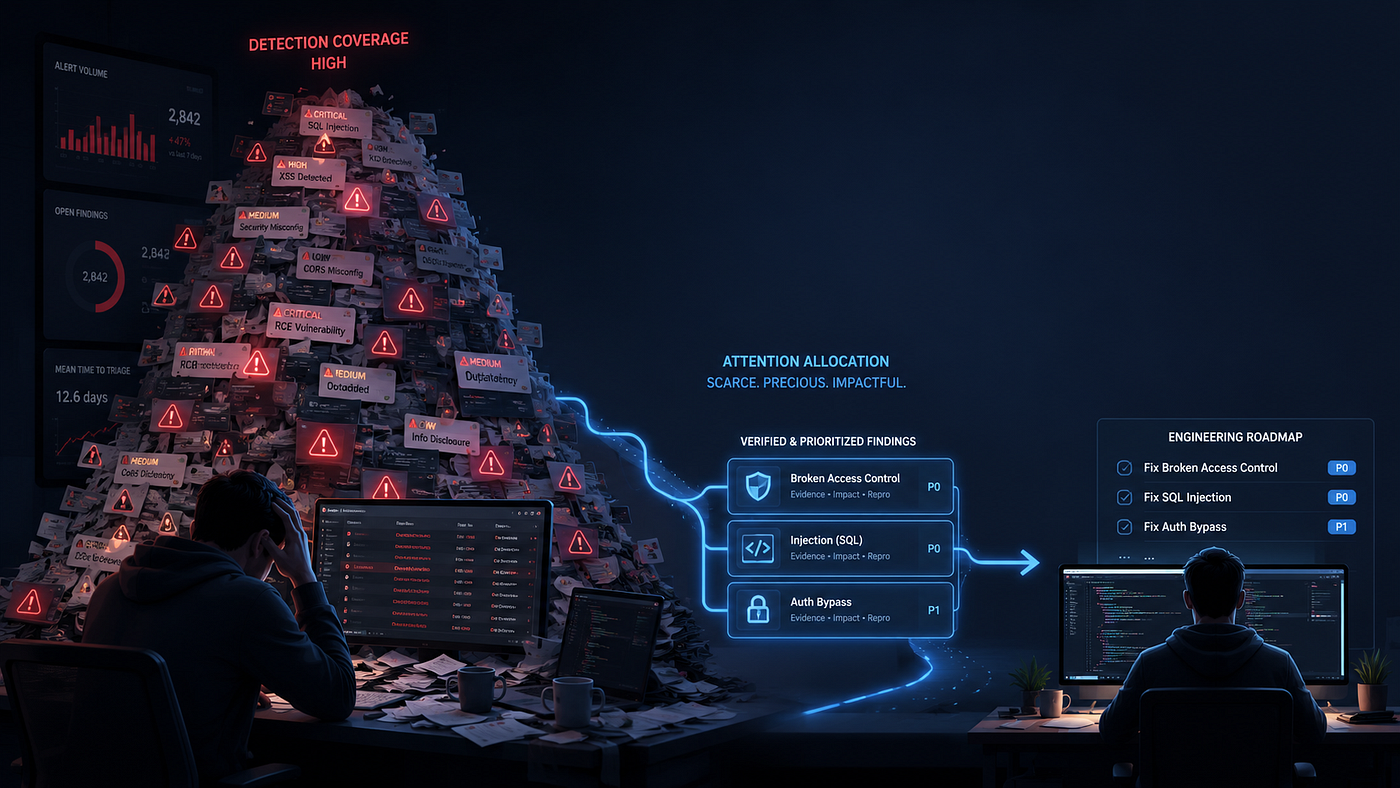
AppSec spent a decade competing on detection coverage. The real bottleneck moved to deciding which findings deserve scarce engineering time — and the data shows why.
Sonu Goswami: Positioning for funded B2B SaaS in security, compliance & regulated markets | Clarifying the economic wedge that accelerates complex deals
The coverage race is over
Not long ago, application security competed on one axis: coverage. More rules, more languages, more findings, higher detection rates. Every vendor pitch followed the same shape — we catch more than the last tool did.
That race is effectively over. Coverage stopped being the hardest problem — finding vulnerabilities is no longer where most mature AppSec teams get stuck.
What the data actually shows
Here’s what the data actually shows. In Cycode’s CISO survey, 85% said alert fatigue and vulnerability noise had strained the relationship between security and development teams. Separately, nearly nine in ten respondents said that same fatigue was the reason developers weren’t remediating critical vulnerabilities fast enough to matter for business risk. Palo Alto Networks reports legacy vulnerability backlogs regularly exceeding 100,000 findings per organization, with around 90% going unaddressed in any given month — largely because something like 94% of published vulnerabilities never see exploitation in the wild in the first place.
An attention allocation problem, not a detection gap
Read those numbers together and a different picture forms. The problem isn’t that organizations don’t know about their vulnerabilities. It’s that they know about too many of them, and have no reliable way to tell which ones are worth interrupting an engineer’s day for.
That’s not a detection gap. It’s an attention allocation problem.
Every security team already has more findings than engineering has capacity to investigate. That math doesn’t change with a better scanner — a better scanner just produces a longer list faster. They don’t simply lack hours. They lack attention. What actually changes the equation is something that tells engineering, with enough confidence, that this specific finding is worth dropping current work for, and this one isn’t.
The credibility cost hiding underneath
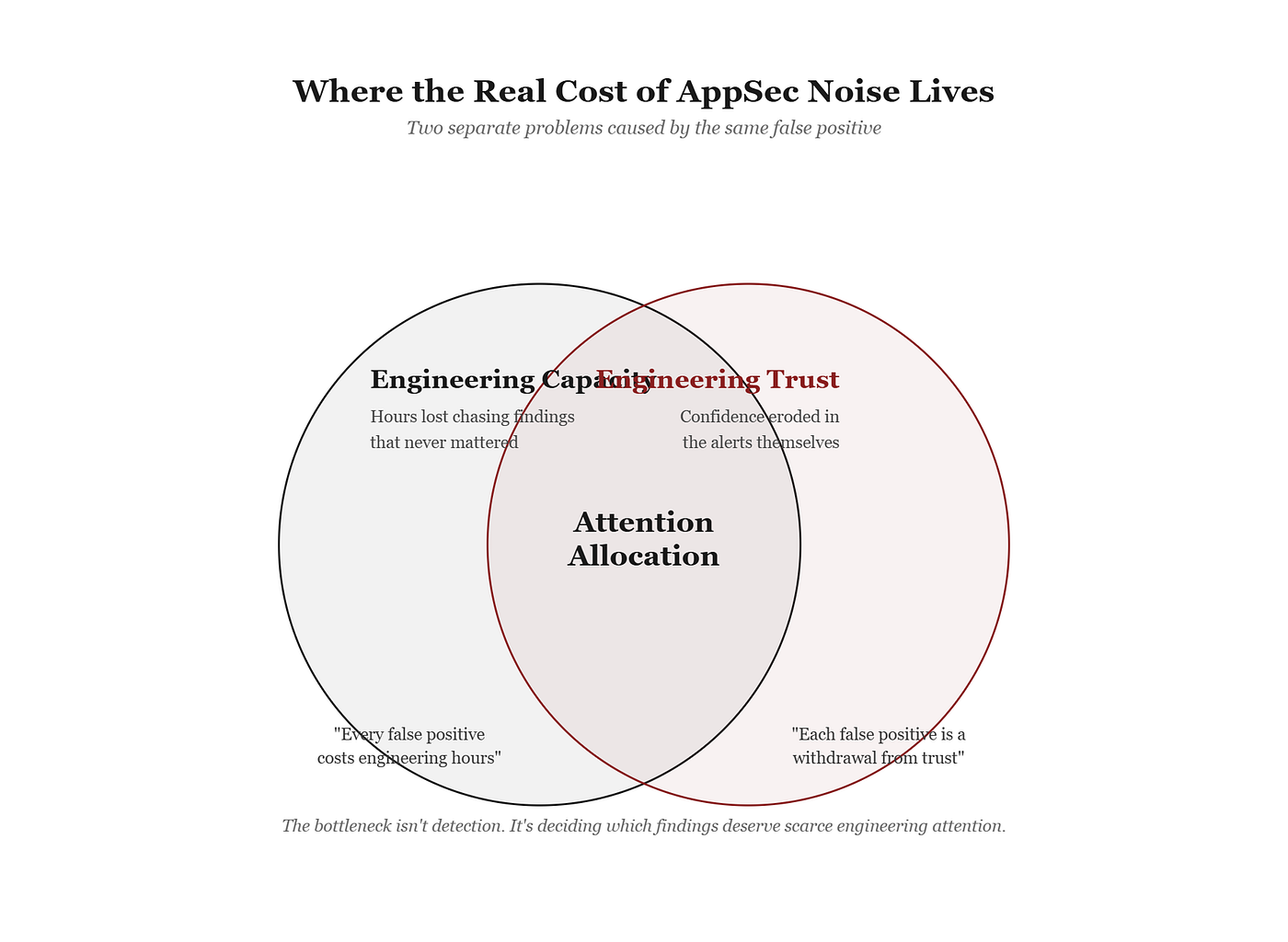
There’s a quieter cost hiding in those Cycode numbers too, separate from the raw hours lost. When findings turn out to be noise — over and over — engineering stops trusting the queue. Each false positive isn’t just wasted time. It’s a withdrawal from engineering trust. Security teams that send too many low-value alerts eventually find that even their high-value alerts get deprioritized by default, because nobody on the receiving end can tell the difference anymore without independently verifying it first. Equifax, 2017, is the case everyone still brings up. The patch alert for the vulnerability that got exploited was sitting right there in the queue. Nobody could tell it apart from the thousands of other tickets that didn’t matter.
So the cost of the current model isn’t just engineering hours. **It’s the credibility of the alert itself.**
What this reframes for vendors
This reframes what a winning product in this category actually needs to do. Most products still try to improve prioritization. The harder problem is producing evidence before engineering ever has to make a decision. They’re answering a harder question before the finding ever reaches an engineer: can we show, with evidence, that this is real?
That shift changes what the buyer is actually purchasing. It was never really “more accurate scanning.” It’s confidence — specifically, confidence cheap enough to use on every finding that might justify pulling an engineer off their roadmap. A security team that can say “we verified this is exploitable, here’s the proof” is asking for something fundamentally different than a team that says “our scanner flagged this as critical.” One is a request backed by evidence. The other is a request backed by hope that the severity label is correct this time.
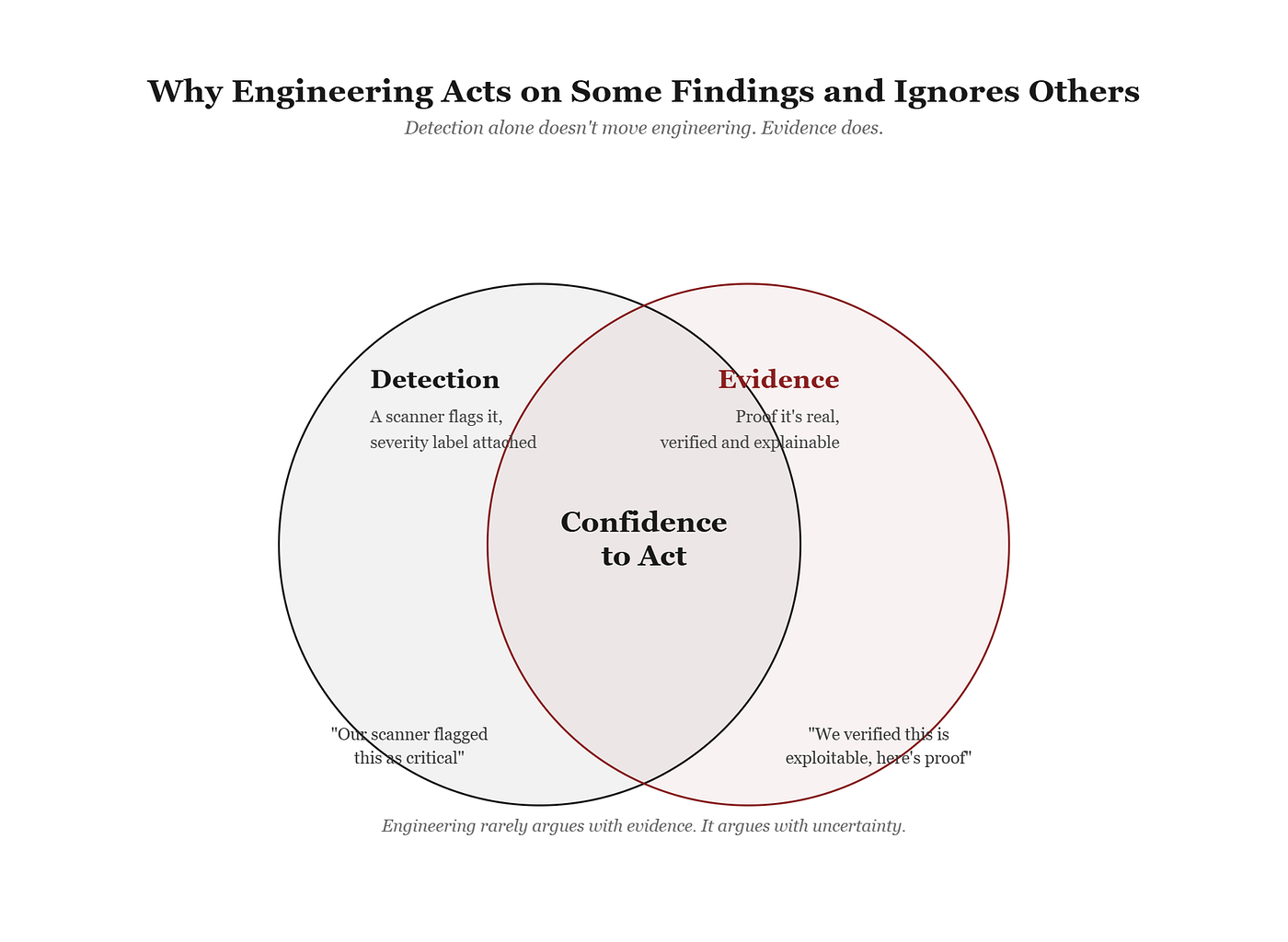
Engineering rarely argues with evidence. It argues with uncertainty.
Where the next competitive line gets drawn
The market hasn’t fully named this shift yet, which is part of why most AppSec pitches still default to coverage language — more rules, more languages, broader detection. But the actual constraint moved a while ago, from finding vulnerabilities to justifying which ones deserve scarce engineering time. The vendors who understand that distinction are building something closer to a decision layer than a detection layer, even when their homepage copy still describes them as a scanner.
The next competitive line in AppSec won’t be drawn by who discovers the most vulnerabilities. It’ll be drawn by who reduces the cost of deciding which ones deserve engineering attention.
메타데이터
- post_id
- 48bfcf55310a
- slug
- security-teams-dont-have-a-finding-problem-they-have-an-engineering-attention-problem-48bfcf55310a
- url
- https://blog.startupstash.com/security-teams-dont-have-a-finding-problem-they-have-an-engineering-attention-problem-48bfcf55310a
- canonical_url
- https://blog.startupstash.com/security-teams-dont-have-a-finding-problem-they-have-an-engineering-attention-problem-48bfcf55310a
- author_url
- https://medium.com/@sonuarticles74
- status
- ok
- fetched_at
- 2026-07-09 08:27:28