Scientists Found a Viable Way to Lower “Forever Chemicals” in the Blood
PFAS can stay in the body for years, but research suggests that blood/plasma donation may help reduce their levels.
Scientists Found a Viable Way to Lower “Forever Chemicals” in the Blood
PFAS can stay in the body for years, but research suggests that blood/plasma donation may help reduce their levels.
Photo by Naja Bertolt Jensen on Unsplash
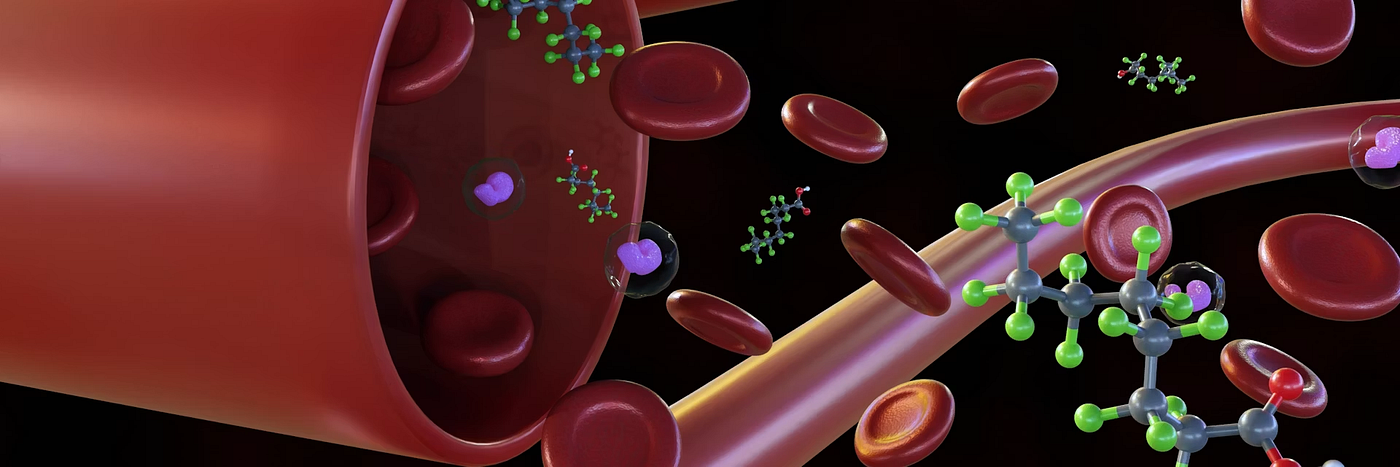
Per and polyfluoroalkyl substances, more commonly called PFAS, are a large group of synthetic chemicals used in everything from nonstick pans and waterproof clothing to food packaging and firefighting foam.
What makes these chemicals unique is that they have an extremely strong carbon-fluorine bond, one of the toughest chemical bonds in nature, which means they do not break down easily. That durability makes PFAS highly useful in industry, but it also means they stay intact, unbroken, for a very long time, earning them the nickname “forever chemicals.”
The Problem With These Chemicals
Over time, PFAS can enter the human body through contaminated drinking water, food, air, or consumer products. Once inside, the compounds circulate through the bloodstream and can accumulate in tissues and organs because the body struggles to eliminate them efficiently.
Researchers have detected PFAS in the blood of the vast majority of people tested worldwide, including in breast milk, liver tissue, and even umbilical cord blood.
In fact, one large-scale study found that fewer than 0.4 percent of the American population had undetectable levels of PFAS in their bodies, meaning that just about everyone has been contaminated.
While the specific mechanisms of harm remain unclear, the general public typically wishes to avoid the accumulation of synthetic substances within their systems.
Consequently, researchers are actively examining the potential effects of prolonged exposure on biological processes, including immunity, metabolism, hormone regulation, and cancer risk.
What the Research Shows
I found that three studies have indicated that regular blood donation may reduce serum PFAS levels; I will discuss two here, as the third provides little new information.
While these findings are significant in a research context, the FDA has not incorporated this practice into its official guidelines. Therefore, donating blood specifically to decrease personal chemical levels is not universally advised, but the evidence is there, and it is fascinating.
The first randomized clinical trial, published in JAMA in 2022, tested whether repeated plasma or whole-blood donation could lower PFAS levels in Australian firefighters with elevated exposure.
Firefighters were randomly assigned to donate plasma every 6 weeks, donate whole blood every 12 weeks, or undergo observation only for 12 months.
Both plasma and blood donation significantly reduced PFOS levels compared with observation, with plasma donation producing a larger drop (about −2.9 ng/mL for plasma vs −1.1 ng/mL for blood at 12 months).
For PFHxS, only plasma donation caused a significant reduction (about −1.1 ng/mL), while blood donation and observation showed no meaningful change.
Overall, repeated plasma (and to a lesser extent, blood) donation was more effective than no intervention at lowering PFAS levels. Still, the study notes that the clinical impact of these reductions remains uncertain and calls for further research.
The second study investigated whether routine blood removal at frequencies similar to those of standard blood donation could accelerate the elimination of several persistent PFAS compounds in a Canadian family with exceptionally high exposure linked to stain-repellent-treated carpets.
The family consisted of six members, including two parents and four children, all of whom had PFHxS concentrations significantly above the 95th percentile for Canadians.
Over a four to five-year period, family members underwent repeated whole blood removal procedures at volumes generally comparable to standard blood donation practices, roughly 500 mL every 56 days.
Researchers then compared the apparent half-lives of PFHxS, PFOS, and PFOA in family members with the intrinsic half-lives previously calculated in a group of highly exposed but untreated fluorochemical plant retirees.
Across the study period, PFAS concentrations declined dramatically. Average PFHxS levels fell from 125 ng/mL to 23.3 ng/mL, PFOS decreased from 43.4 ng/mL to 6.7 ng/mL, and PFOA declined from 5.7 ng/mL to 1.4 ng/mL.
For nearly all family members, the apparent half-lives of PFHxS, PFOS, and PFOA were substantially shorter than those observed in the untreated reference population. In several cases, elimination rates exceeded even the fastest PFAS eliminators among the fluorochemical workers.
The one exception was the mother, who underwent the lowest total volume of blood removal and showed slower declines in PFAS concentrations, supporting a dose-response relationship in which greater blood removal was associated with faster chemical clearance.
Something to keep in mind about this study is that it involved only a single family and lacked a formal, untreated control period within the participants. Because of these factors, the study cannot definitively prove causality.
Safety Considerations
One great thing about this intervention is that it is nearly risk-free. Donating blood, when done with a trained phlebotomist, is incredibly safe.
A standardized amount of blood is taken, with guidelines establishing a minimum time between donations, as well as a “mini physical” performed before donation that checks blood pressure, temperature, hemoglobin, and pulse to ensure you are healthy enough to donate.
Key Takeaways
PFAS exposure has become nearly unavoidable in modern life. Measurable levels are detected in the overwhelming majority of people tested. Because these chemicals persist in the bloodstream for years, researchers have been searching for practical ways to accelerate their removal from the body.
Interestingly, multiple studies now suggest that regular plasma or blood donation may modestly reduce circulating PFAS concentrations, particularly for PFOS and PFHxS.
While the long-term health significance of lowering PFAS levels remains unclear, the findings provide an unusual example of how a routine medical procedure may influence the body burden of environmental contaminants.
At the same time, these studies are still early, and blood donation should not yet be viewed as an officially recommended “detoxification” strategy.
The larger public health issue remains reducing PFAS exposure at its source rather than attempting to remove the chemicals after they have already accumulated in the human body.
메타데이터
- post_id
- 48c5a311507a
- slug
- scientists-found-a-viable-way-to-lower-forever-chemicals-in-the-blood-48c5a311507a
- url
- https://medium.com/microbial-instincts/scientists-found-a-viable-way-to-lower-forever-chemicals-in-the-blood-48c5a311507a
- canonical_url
- https://medium.com/microbial-instincts/scientists-found-a-viable-way-to-lower-forever-chemicals-in-the-blood-48c5a311507a
- author_url
- https://medium.com/@mcmarone7
- status
- ok
- fetched_at
- 2026-06-14 11:28:49