Retreat Reflections: The Relational Infrastructure of Systems Change
How retreats can be low-cost but non-extractive, joyful without being frivolous, and relational yet focused.
Retreat Reflections: The Relational Infrastructure of Systems Change
How retreats can be low-cost but non-extractive, joyful without being frivolous, and relational yet focused.
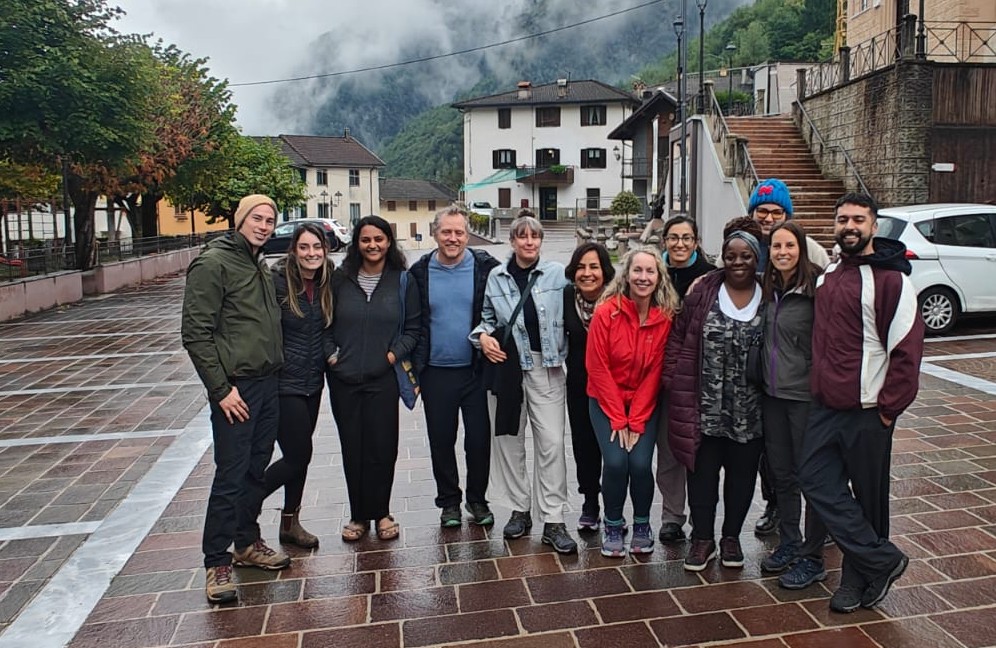
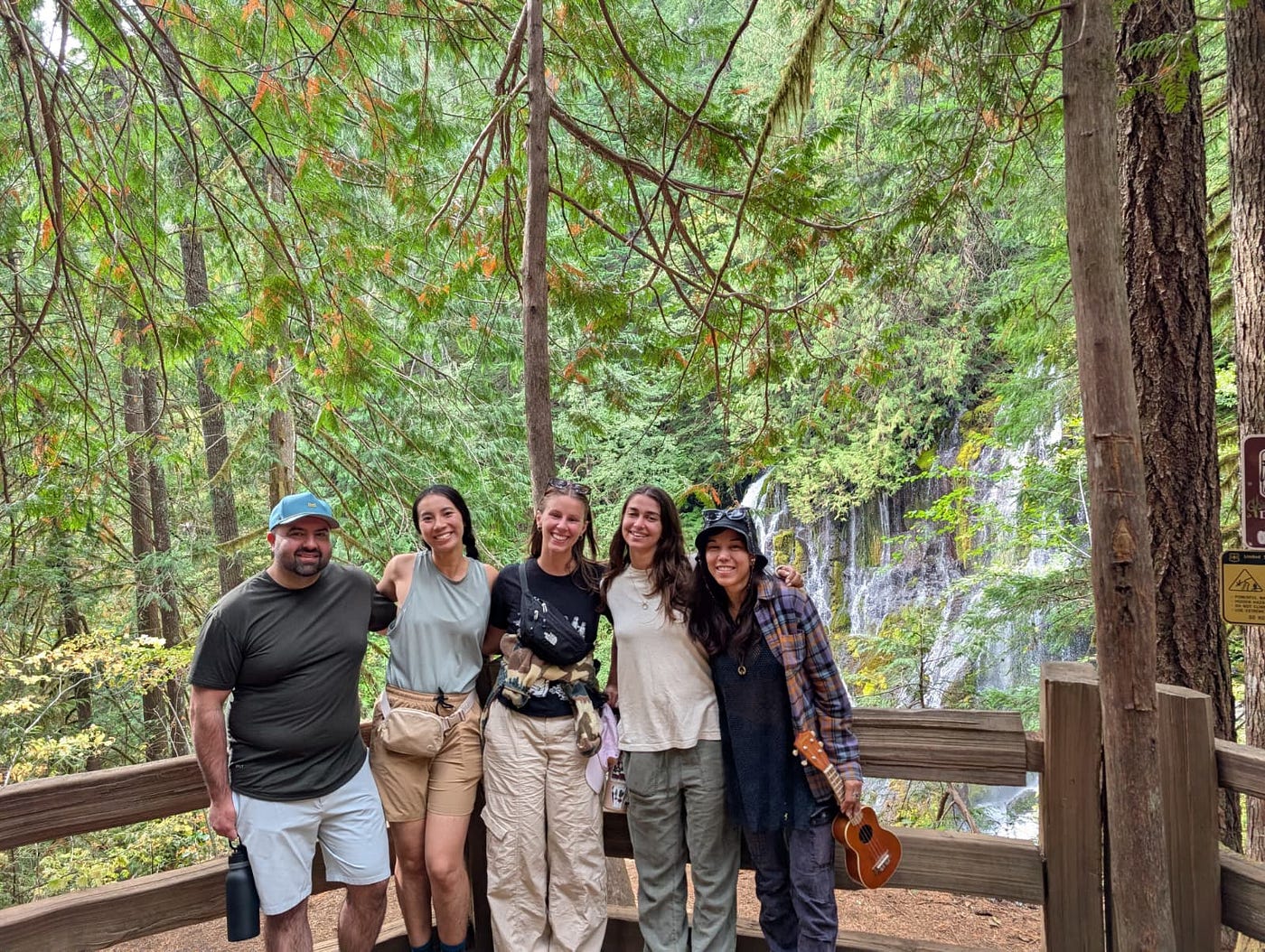
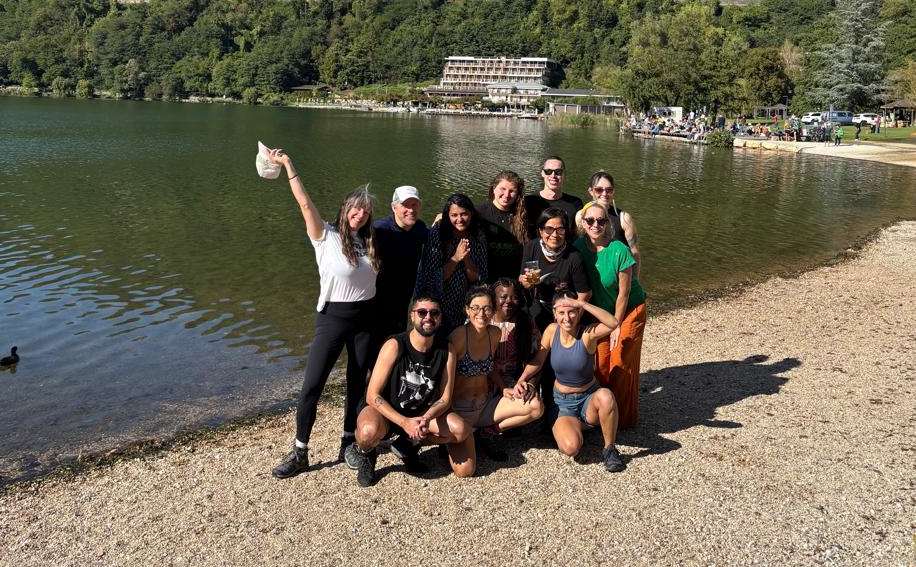
PGI’s 2025 retreat groups in northern Italy and Oregon, US.
At the Post Growth Institute (PGI), much of our work happens across countries, time zones, cultures, and areas of practice. We are connected by shared values and a commitment to transforming the ways money, power, and resources circulate in our communities and economies — and to model what that circulation might look like, internally. But, like many distributed organizations, we also know that online collaboration has limits. Trust can be built through screens, but it often deepens when people can experience one another beyond the frame of a Zoom call.
That’s why in-person retreats are so important to us. At first glance, a retreat can be difficult to fund, as it appears less tangible than a public program, research output, campaign, or training. Retreats are often seen as an indulgence or internal expense rather than a driver of external impact. Our experience has shown, however, that a carefully, intentionally, and equitably designed retreat can be one of the highest-leverage investments an organization makes.
Our recent retreats, which took place across five days in September 2025, created immediate outcomes, strengthened medium-term collaboration, and opened longer-term possibilities that would simply not have emerged in the same way online. Gathering across two cohorts in Europe and North America, we instantly saw outcomes such as increased commitment, accelerated work, and deepened trust between team members — including those on the board. The retreats also enabled wider participation from colleagues in the Global South and allowed us to model the forms of relational, resource-conscious, post-growth practice that our work exists to advance.
Wellbeing outcomes are operational
For some members of our team, the retreat was the first time they had met colleagues in person. For others, it was the first opportunity to spend extended, unstructured time together.
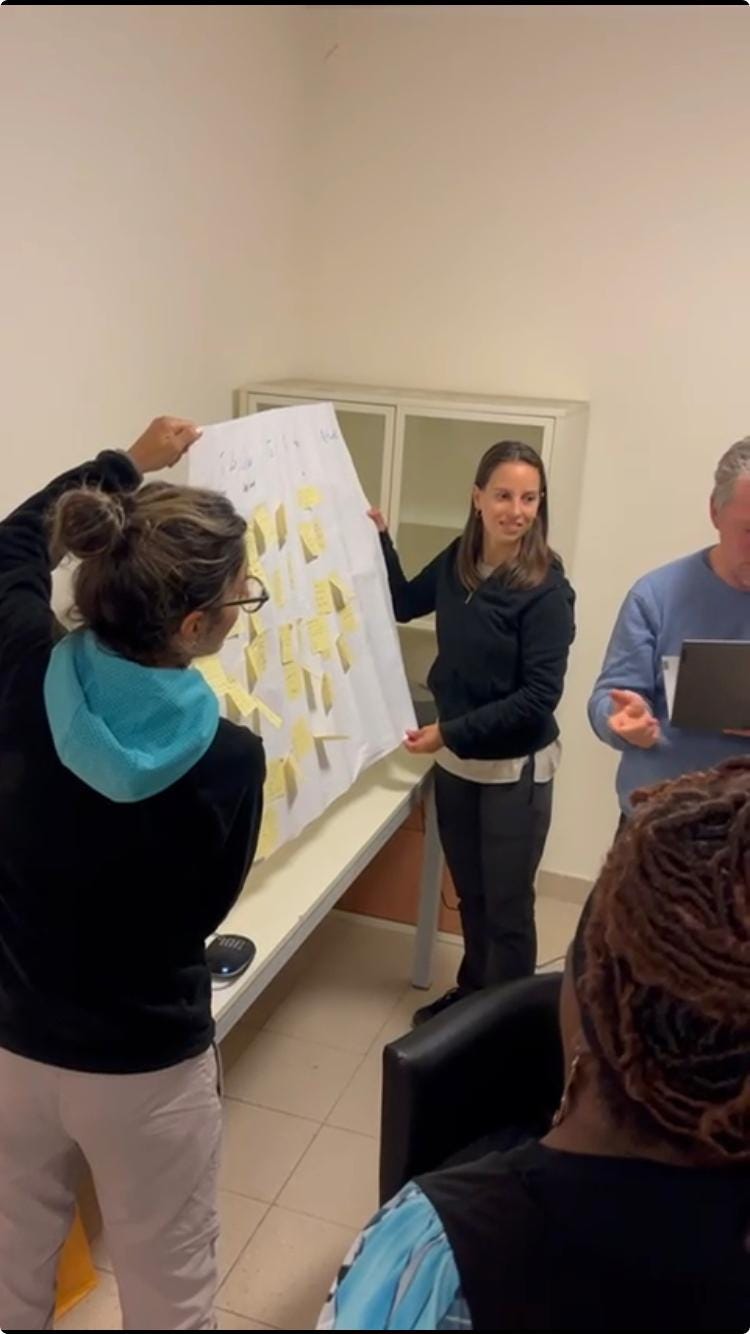
The retreat’s outcomes were made possible by a series of tangible design choices that centered wellbeing. We created a slow entry point, recognizing that some participants were arriving from much farther away than others and needed time to land before being asked to contribute. Late starts, spacious mornings, shared meals, extended check-ins, and flexible (opt-out) participation helped people listen to their own bodies and identify needs, while still remaining connected to the group. Instead of filling every hour with formal sessions, we allowed time for rest, conversation, cooking, walking, and spontaneous collaboration.
Through the time spent together, we noticed a marked increase in organizational buy-in. This was — and remains — reflected in individuals’ attachment to the PGI, their sense of commitment, and their felt relationship to one another. Crucially, this has translated directly into enhanced productivity. One participant who had not previously been deeply embedded in the wider team became much more connected through the retreat and has since stepped into a paid role. Others who were at transition points in their work with PGI became more engaged again, contributing to research, content, coordination, or organizational development with renewed energy. Colleagues who had previously worked together online found that decisions became easier, outreach became smoother, and collaboration moved noticeably faster.
In the months since, we have felt the difference in everyday work. Tasks that might previously have required careful interpretation or repeated clarification can now move through a stronger base of trust. People are more able to express needs clearly and receive each other with generosity. In this way, a key wellbeing outcome is also fundamentally operational.
Immediate, medium-term, and long-term impact
In the short term, we:
- Generated 20 concepts for content to be published here in Post Growth Perspectives.
- Made a collective breakthrough with the navigation for our new website — an important step that allowed us to move forward with this key strategic project.
- Created a Fellowship content and engagement plan for the remainder of that cohort.
- Designed workshops to share learnings from our Unearthodox reports.
- Updated the process for unbudgeted expense proposals.
- Explored multilingual Offers and Needs Market training.
- Identified ways to strengthen connection across Post Growth Alliance groups working in different time zones.
- Collected internal agreements regarding how we internally communicate for further discussion with the rest of the team around organisational values.
In the medium term. Our people are growing to understand the organization more deeply and feel part of a shared project. This has resulted in:
- Stronger relationships and renewed commitment.
- Increased productivity, which is evidenced by faster collaboration.
- More people stepping into roles, and decisions being made with less friction.
- In some cases, stalled projects have gained renewed momentum.
- Ideas have become easier to test because the relational ground is stronger.
In the longer term, the impact is strategic:
- We are developing capacity to hold complexity, distribute resources equitably, and respond to opportunities.
- Relationships formed in retreat ripple outward into partnerships, events, research, communications, governance, and movement-building.
- The retreat has become part of our shared memory, and is now used as a reference point for how we make decisions and practice the world we are working to co-create.
Trust makes work faster
Working relationships are made smoother by building trust — and trust is built when we spend quality time together: making food, negotiating needs, traveling, taking rest; noticing who steps in, who needs space, who holds care, and so much more.
This all matters because trust reduces friction and this, in turn, has a huge practical impact on productivity and operations. An old adage we like to work by at the PGI is that “slow is smooth and smooth is fast.” (It took us nine months to write this reflections piece, for example, because we knew that the true value of our time together would emerge over time. It’s important that we trust the process, as well as each other.)
In many workplaces, so much time can be lost to miscommunication, hesitation, defensiveness, or unclear expectations. Distributed organizations are particularly vulnerable to this — online communications are notoriously prone to misunderstandings. At the PGI, we believe in circulation — and that includes the surfacing of tensions as they arise, so that they don’t slowly accumulate to cause issues over time.
Retreats are an embodiment of this approach, allowing people to show up more fully. Our team members are unique humans with sleep patterns, food needs, humor, sensitivities, skills, ways of relating, and limitations. A well-held, carefully structured retreat creates the conditions for people to receive one another as they are.
This is especially important for the PGI because our work depends on giving and receiving. Again, coming back to our ambitions to circulate power and resources differently, this requires embodied practice. The essential work hides beneath questions such as who needs travel support, who can contribute more, how we hold structure without control, and how we stay flexible without becoming chaotic.
Practical design elements for equity
At the PGI, financial resources have long been limited. But a retreat can be transformative without being expensive. In fact, the constraints of our budget became part of the practice.
Across two retreats in the Global North, we worked with a remarkably limited budget of just $12,000 in total, while supporting international participation of 20 team members’ accommodation, food, transport, and reimbursement needs. This was only possible because we treated the budget as a shared design challenge and not a top-down allocation exercise.
Firstly, we ran a low-cost travel workshop to help participants find affordable routes and reduce costs. We researched average travel costs, gathered information through surveys and conversations, and used needs-based processes to allocate reimbursements. In practice, this involved being completely transparent about the total budget available and then asking people to communicate their needs in a relational way — through one-to-one calls where appropriate. This enabled us to hear people’s actual circumstances and distribute limited funds accordingly, without anyone feeling like the budget was being allocated unfairly.
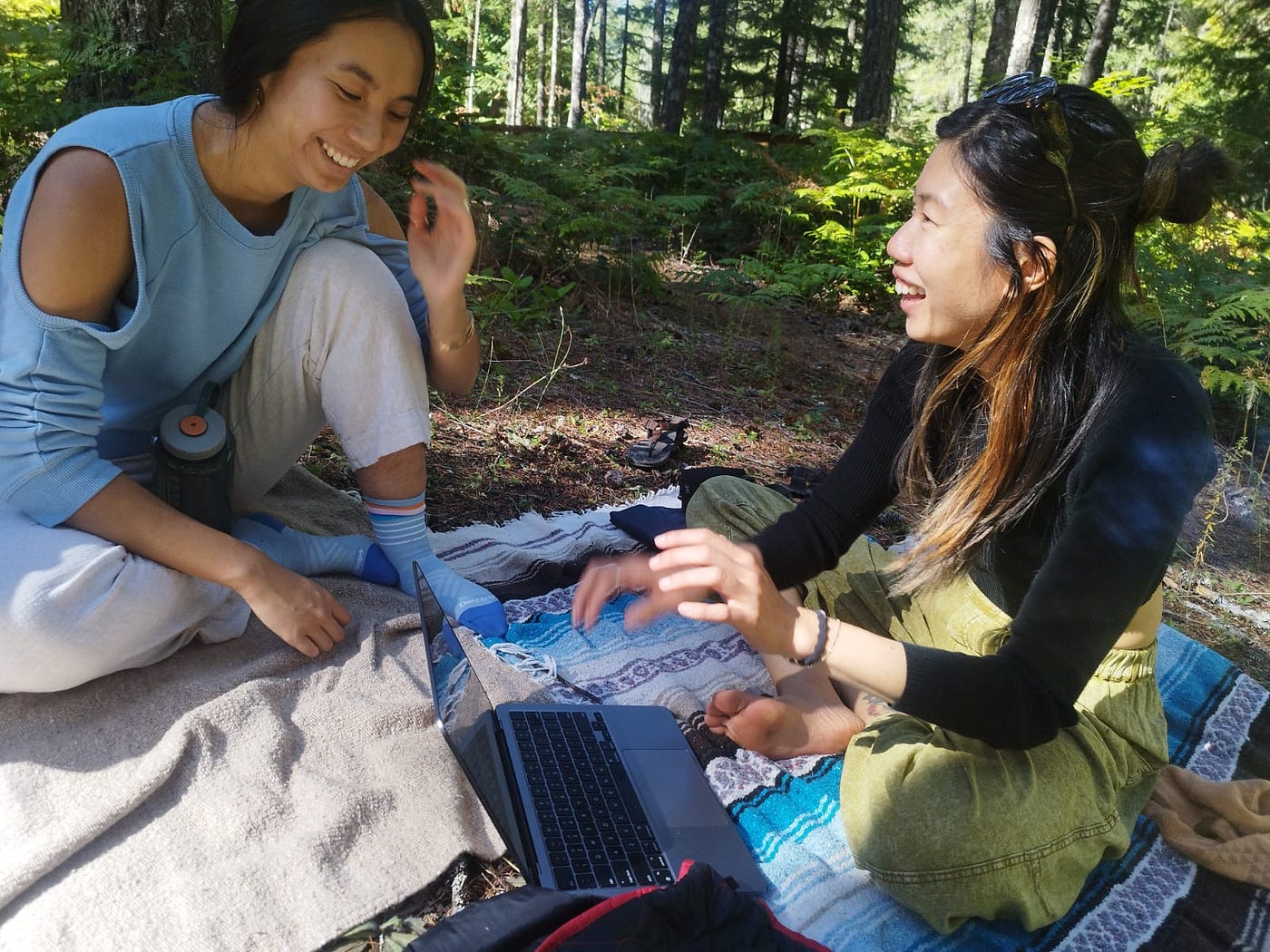
We also kept costs low by drawing on relationships, booking shared, not-for-profit accommodation, and opting to self-cater. Friends and family were called upon to provide local support such as transport and accommodation either side of the retreat for those arriving early or staying late — which in turn allowed more flexibility to fund affordable travel tickets. Food was bought and prepared collectively, which saved money while also offering the opportunity to bond over shared cooking and mealtimes.
Many organizational retreats reproduce the same patterns they claim to challenge: high costs, passive participation, and hidden inequalities around who can afford to attend. We wanted to avoid this, and took care to intentionally organize our time together to be relational, participatory, and resource-aware — in other words, a true post-growth retreat.
Over time, we’ve learned the radical power of transparency to embody solidarity and commitment. Participants understood from the beginning that we were working within constraints, and that openness made it possible for people with different levels of need and capacity to attend. Some could absorb most of their own costs, while others needed more support. Almost all reimbursements covered only partial travel costs, but everyone who wanted to was able to attend — showing us how much people valued participation. In being included in the process, our team members were empowered to make informed choices and act generously.
For funders, this is where the value-for-money case becomes especially strong. A modest investment activated a whole system of participation, wherein people contributed so much — from time, care, local knowledge, and emotional labor, to cooking, transport, facilitation, and logistical creativity. The initial financial support became a catalyst for value and impact that continues to compound over time.
From retreat to movement-building
One of the most tangible outcomes was the way the retreat enabled wider participation in external movement spaces.
By coordinating travel and gathering people together, we were able to support a group of team members including several from the Global South, to attend a Partners for a New Economy event in France that took place a few days after our retreat ended. Without the retreat, that level of representation would likely not have happened. The gathering allowed us to bundle travel support, strategize in person, and build the relationships needed for further collaboration. We were therefore able to arrive with enough relational grounding to contribute meaningfully and carry work forward afterwards. At the same time, this allowed us to optimize the impact of long-haul travel, given the carbon costs involved.
It also supported subsequent organizing, including giving one team member the initiative and inspiration to coordinate an event several months later in London. This is the kind of ripple effect that can be hard to capture in a standard project budget but is nonetheless central to movement work. We have seen how a retreat can become a launchpad for convening, coalition-building, leadership development, and public-facing impact — and are keen to further iterate the exciting possibilities it presents.
The retreat also strengthened relationships between the team and board members, helping connect those involved in strategic oversight with the day-to-day realities of the organization. Board members had the chance to experience our culture, strengths, and ways of working; while their presence showed staff that they are all one team committed to our shared goals and responsibilities.
Learnings to carry forward
Thanks to detailed feedback from participants, we came away with clear learnings for future retreats. A key one is the need for a more collaborative approach to shaping the schedule. Next time, we would like to begin by mapping the work that needs to happen alongside people’s preferences and daily rhythms, then forming working groups around where participants have the most energy and contribution to offer. This would help balance structure with emergence, while making the retreat feel more collectively owned from the start.
We also learned that earlier planning is essential, especially for visas, travel, accommodation, technology, and delegation. Two locations made participation more possible this time, but our longer-term aim is to gather everyone in one place where possible, with enough lead time to support equitable access.
Participants’ willingness to share this feedback is part of the impact. It reflects a culture of trust where people felt safe enough to name what worked and what they would need next time, knowing that their reflections will be well received and constructively applied.
Practicing the future in the way we gather
For a strongly values-led organization like the PGI, retreats reveal whether our values can truly be lived out in the ‘real world,’ beyond our distributed online work. Our experiences provide strong evidence that they can — while also offering rich learnings about points of tension and opportunities to continue iterating and improving.
We have tested our riskiest assumptions and proved that retreats can be low-cost but non-extractive, joyful without being frivolous, and relational yet focused. We’ve generated measurable outcomes while honoring the less visible forms of capacity that make those outcomes possible.
For funders seeking durable, field-level impact, this is an invitation to reimagine retreats as infrastructure. The most powerful investment is not always another output — sometimes, it’s the gathering that makes the next decade of outputs possible.
Inspired by this article? Here’s what you can do next:
- Find out more about the Post Growth Institute on our website.
- Sign up to our monthly Full Circle newsletter.
- Browse our Bookshop for inspiring titles on topics such as post growth, degrowth, healing from trauma, Indigenous mutual aid, and reimagined futures.
메타데이터
- post_id
- 48ccacda9bcb
- slug
- retreat-reflections-the-relational-infrastructure-of-systems-change-48ccacda9bcb
- url
- https://medium.com/postgrowth/retreat-reflections-the-relational-infrastructure-of-systems-change-48ccacda9bcb
- canonical_url
- https://medium.com/postgrowth/retreat-reflections-the-relational-infrastructure-of-systems-change-48ccacda9bcb
- author_url
- https://medium.com/@postgrowth
- status
- ok
- fetched_at
- 2026-06-26 03:39:16