Your Frontend Is Becoming a “Shared Folder Garbage Dump”
When everything becomes “shared,” ownership disappears and architecture slowly collapses.
Your Frontend Is Becoming a “Shared Folder Garbage Dump”
When everything becomes “shared,” ownership disappears and architecture slowly collapses.
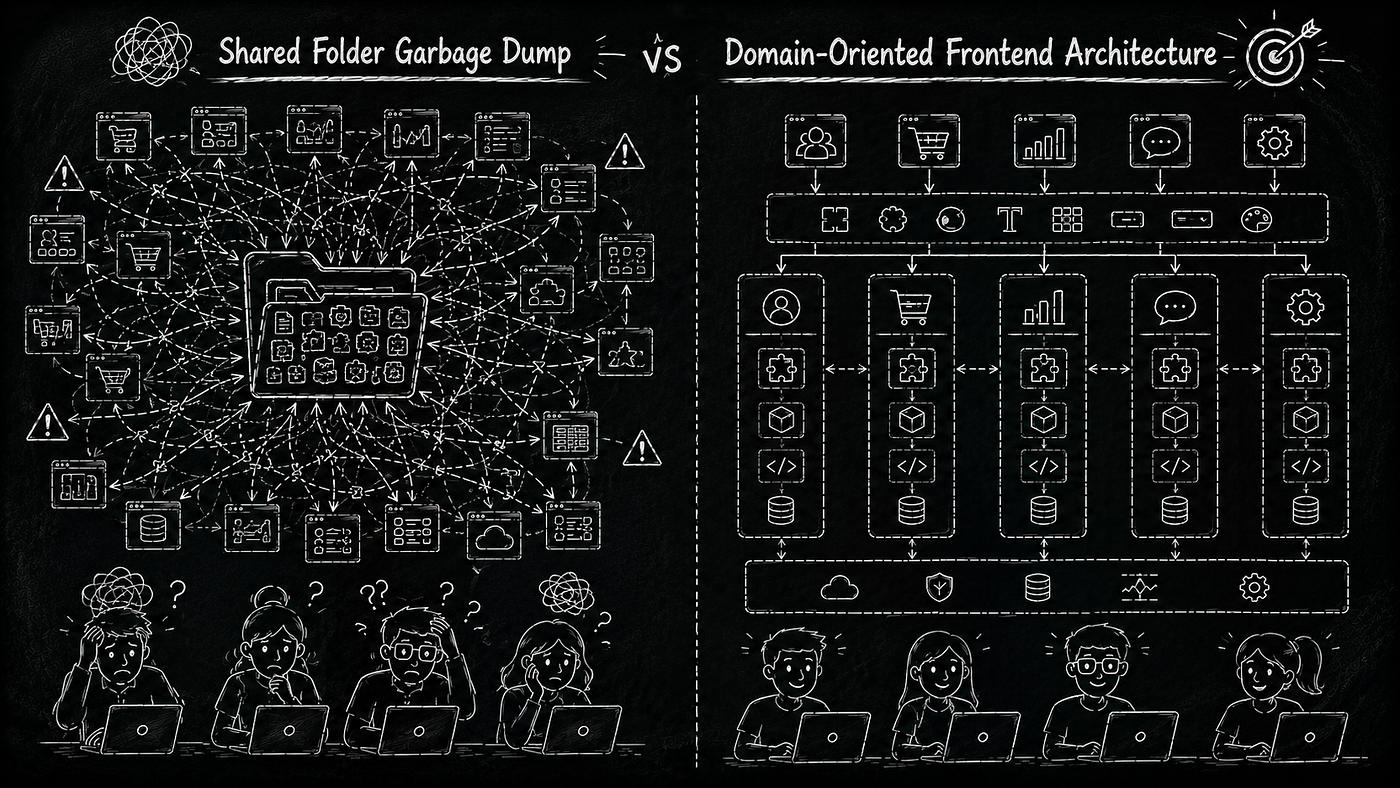
Almost every growing frontend project eventually creates this folder:
/sharedAt first, it seems harmless.
The intention is usually good:
- avoid duplication
- centralize reusable logic
- speed up development
But over time, the shared folder becomes one of the biggest architectural problems in the entire codebase.
Suddenly it contains:
- components
- services
- helpers
- pipes
- models
- constants
- utilities
- business logic
- API transformations
- random experiments
And nobody truly owns any of it.
This is how frontend architecture slowly turns into chaos.
Why Developers Create Massive Shared Folders
Because it feels efficient.
Instead of deciding:
- where logic belongs
- which domain owns it
- whether it should stay local
developers move everything into:
/sharedIt becomes the “safe place” for uncertain architecture decisions.
But uncertainty in architecture always becomes technical debt later.
The Real Problem Is Not the Folder
The real problem is:
Loss of Domain Ownership
When logic is pushed into shared:
- boundaries disappear
- dependencies spread everywhere
- unrelated modules become tightly connected
Now changing one utility may affect:
- payments
- reporting
- analytics
- admin dashboards
Nobody knows the actual impact anymore.
How Architecture Slowly Starts Breaking
Stage 1 — Small Shared Utilities
Initially:
/shared/utils/date.tsSeems reasonable.
Stage 2 — Shared Business Logic
Then teams add:
/shared/services/user-permission.service.tsNow business rules are leaking outside domains.
Stage 3 — Shared Components Everywhere
Soon:
/shared/components/smart-grid/Now every screen depends on one highly coupled component.
Stage 4 — Nobody Understands Dependencies
Eventually:
- debugging becomes difficult
- changes become risky
- onboarding slows down
- feature ownership disappears
The shared folder becomes a mini-monolith inside the frontend.
Bad Architecture Example
❌ Shared-Centric Structure
/src
 ├── shared
 │    ├── services
 │    ├── components
 │    ├── models
 │    ├── utils
 │    ├── state
 │    └── business-logic
Problems:
- unclear ownership
- hidden coupling
- massive dependency graph
- difficult refactoring
- accidental cross-domain usage
Better Architecture
✅ Domain-Oriented Structure
/src
 ├── finance
 ├── reports
 ├── users
 ├── audit
 └── shared
      ├── ui
      ├── design-system
      └── pure-utils
Now:
- business logic stays inside domains
- ownership becomes clear
- teams work independently
- dependencies stay controlled
Shared only contains:
- dumb UI primitives
- stateless utilities
- reusable infrastructure
— not domain intelligence.
The Hidden Scaling Problem
Large shared folders create invisible coupling.
This means:
A small change in one place can silently affect the entire application.
These systems become:
- fragile
- unpredictable
- difficult to evolve
The codebase may look organized physically, but architecturally it becomes deeply tangled.
Real-World Engineering Lesson
Senior engineers do not ask:
“Can this be shared?”
They ask:
“Who should own this logic?”
That question changes architecture quality completely.
A Better Rule For Teams
Before moving anything into shared, ask:
1. Is this truly generic?
OR Is it specific to one business domain?
2. Will multiple domains realistically use this?
OR Are we abstracting too early?
3. Does sharing reduce duplication?
OR Does it increase coupling?
Practical Example
❌ Bad
/shared/services/payment-validation.service.tsWhy bad? Payment validation belongs to the payment domain.
✅ Better
/payments/services/payment-validation.service.tsNow ownership is clear.
Senior-Level Insight
The strongest frontend architectures are:
- domain-oriented
- ownership-driven
- boundary-focused
— not “everything reusable.”
Scalable systems optimize for:
- independence
- clarity
- maintainability
not centralized convenience.
Final Takeaway
A shared folder should contain:
- primitives
- infrastructure
- stateless helpers
— not business intelligence.
Because once business logic becomes globally shared, frontend architecture slowly loses:
- ownership
- boundaries
- predictability
- scalability
And when ownership disappears, engineering velocity disappears next.
Connect with Me
If you enjoyed this post and would like to stay updated with more content like this, feel free to connect with me on social media:
- Twitter : Follow me on Twitter for quick tips and updates.
- LinkedIn : Connect with me on LinkedIn
- YouTube : Subscribe to my YouTube Channel for video tutorials and live coding sessions.
- Dev.to : Follow me on Dev.to where I share more technical articles and insights.
- WhatsApp : Join my WhatsApp group to get instant notifications and chat about the latest in tech
Email: Email me on dipaksahirav@gmail.com for any questions, collaborations, or just to say hi!
I appreciate your support and look forward to connecting with you!
메타데이터
- post_id
- 48de4915e315
- slug
- your-frontend-is-becoming-a-shared-folder-garbage-dump-48de4915e315
- url
- https://medium.com/angular-engineering/your-frontend-is-becoming-a-shared-folder-garbage-dump-48de4915e315
- canonical_url
- https://medium.com/angular-engineering/your-frontend-is-becoming-a-shared-folder-garbage-dump-48de4915e315
- author_url
- https://medium.com/@dipaksahirav
- status
- ok
- fetched_at
- 2026-06-09 15:37:30