Why Your Forex Broker’s Price Is Always a Few Milliseconds Behind Reality
And who quietly makes money from the gap.
Why Your Forex Broker’s Price Is Always a Few Milliseconds Behind Reality
And who quietly makes money from the gap.
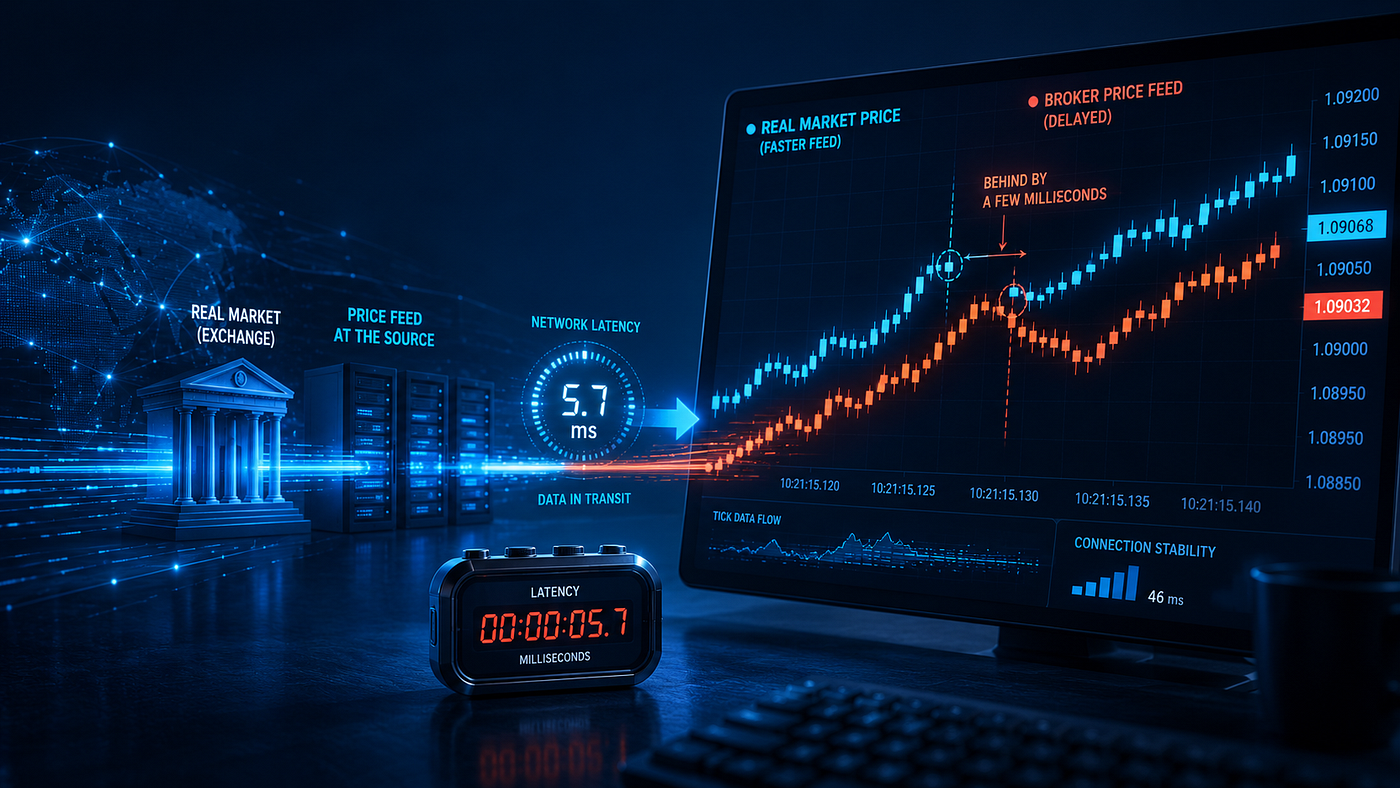
Open any forex trading platform and look at the price of EURUSD or gold. It looks authoritative. A precise number, updating several times a second, presented as the price.
It isn’t. It’s a price — one particular broker’s best, slightly delayed guess at what the market is doing right now. And the gap between that guess and reality is not a rounding error or a glitch. It is a structural, permanent feature of how the foreign exchange market is built. Once you understand it, a lot of otherwise confusing things about retail trading start to make sense.
This article explains where that gap comes from, why it can’t be closed, and who has spent the last decade building businesses inside it.
There is no “the price” in forex
Start with the thing almost no beginner is told clearly: foreign exchange has no central exchange.
When you buy a share of Apple, your order goes to a regulated exchange where there is, at any instant, one official best price that everyone sees. Forex has nothing like that. It’s an over-the-counter market — a sprawling network of banks, liquidity providers, and brokers, all quoting prices to each other. There is no single official number. There is a cloud of slightly different numbers, and the one on your screen is whichever number your particular broker decided to show you.
That already tells you the price on your screen is a choice, not a fact. But the more interesting part is how late that choice arrives.
How a price actually reaches your screen
Picture the journey of a single price update — say, the moment gold ticks up by fifty cents.
That move appears first on the fastest, most institutional venues: futures exchanges and top-tier electronic platforms where the largest players trade. Call this the leading edge of the market.
From there, the new price has to travel:
- A liquidity provider or prime broker picks it up.
- A price aggregator blends quotes from several sources into one composite feed — often applying its own filtering, smoothing, or a small markup along the way.
- Your retail broker takes that aggregated feed, applies its own filtering and markup, and republishes a number.
- That number travels across the broker’s servers and the internet to your trading terminal.
Every single one of those steps takes time. Not much — milliseconds — but time. And every step is an opportunity for the number to drift a little further from the leading edge.
A fast, well-built broker might complete this whole chain in a few milliseconds to a few tens of milliseconds. A slower broker — one leaning on a cheap third-party feed with heavy filtering — can lag the leading edge by hundreds of milliseconds. During volatile moments, like a major economic news release, that lag can stretch into whole seconds.
So the price on your screen isn’t wrong, exactly. It’s just old. It’s a photograph of where the market was a moment ago, not where it is now.
The gap is unavoidable — and that’s the point
Here’s the part that surprises people: this lag can’t be engineered away.
It’s not a bug that a better broker will eventually fix. It’s a direct consequence of the market’s shape. Forex is a chain of intermediaries passing prices down a line. Information physically takes time to travel down a line. As long as the market is built as a chain — and there is no central authority that could rebuild it — some links in the chain will always be behind other links.
Different brokers sit at different distances down the chain. Two brokers quoting gold at the exact same instant will show you slightly different numbers, because one of them is a little further behind than the other.
And wherever there is a predictable, measurable gap between a fast price and a slow price, somebody will build a business inside it.
Who profits from the gap
The business is called latency arbitrage, and the idea is almost embarrassingly simple.
Suppose you can watch the leading edge of the market — a fast institutional feed — and you can also trade with a broker whose price lags that feed by, say, two hundred milliseconds. When the fast feed shows gold jumping up, you know, with near-certainty, that the slow broker’s price is about to jump up too. It just hasn’t yet.
For those two hundred milliseconds, the slow broker is offering to sell you gold at the old, pre-jump price. So you buy. A fraction of a second later, the broker’s price catches up, and you’re holding gold you bought below the current market. You close the position and keep the difference.
You didn’t predict anything. You didn’t analyze a chart or take a view on the economy. You simply saw the future a few hundred milliseconds early — because you were watching a faster clock — and acted before the slow clock caught up.
That’s it. That’s the whole strategy. Everything else in latency arbitrage — and there is a lot of everything else — is engineering in service of that one idea.
Why it’s harder than it sounds
If it were as easy as the last paragraph, everyone would do it. Three things make it genuinely hard.
First, speed. Your entire loop — see the fast price, decide, send the order, get it filled at the broker — has to finish before the broker’s price catches up. If the broker lags by two hundred milliseconds and your loop takes three hundred, you arrive late and the edge is gone. Serious operators put their trading servers in the same physical data centres as the brokers and the feeds — places like the Equinix facilities in London and New Jersey — just to shave off the milliseconds that physical distance costs.
Second, the feed. You need a genuinely fast reference price to compare against. A free price from a charting website is itself delayed; comparing one delayed price to another delayed price tells you nothing. Real latency arbitrage runs on institutional-grade data, which costs real money.
Third, and most importantly: the broker fights back.
Why your broker doesn’t want this
When a latency arbitrageur wins, someone loses the same amount. That someone is whoever filled the stale price — and in a large share of retail forex, that’s the broker itself.
This is worth sitting with, because it reframes a lot of broker behaviour that traders find mysterious or unfair. A broker filling stale quotes for an arbitrageur is, in market-maker terms, being adversely selected — it is consistently trading with someone who knows something it doesn’t (namely, where the price is about to go). Every market maker in history has responded to that situation the same way: identify the informed trader, and stop losing money to them.
So brokers built detection. An account running latency arbitrage leaves a statistical fingerprint that’s hard to hide: very high win rates on trades held for just seconds, profits that cluster suspiciously right after the fast market moves, timing too precise to be human. None of these alone proves anything — a good scalper might show one or two — but together they’re distinctive.
And once a broker decides an account is doing this, it has a toolkit:
- Last-look — the broker takes a brief extra moment before accepting your order, and during that moment quietly checks whether the price moved against it. If it did, the order is rejected.
- Speed bumps — a deliberate execution delay applied to flagged accounts, lengthening your loop until the edge disappears.
- Asymmetric slippage — flagged accounts get filled a little worse than they asked, eroding the margin.
- Plain prohibition — most brokers’ terms of service explicitly ban “latency arbitrage” or “abusive trading practices,” and breaching those terms can mean a closed account or a refused withdrawal.
From the broker’s side, none of this is villainy. It’s the ordinary risk management of a business that loses money to informed counterparties. But it does mean latency arbitrage is not a passive money machine. It’s one side of a continuous, adversarial, technological tug-of-war.
An arms race that never ends
Put the two sides together and you get something economists would recognise instantly: an arms race.
Arbitrageurs spend money to get faster. Brokers spend money to get faster too — closing their own lag behind the leading edge — and to get better at detection. Arbitrageurs respond with techniques to make their trading look more ordinary. Brokers refine the detection again. Round and round.
The striking thing about this race is that spending money doesn’t end it — it just moves it. Ten years ago, latency arbitrage worked against top-tier brokers. Those brokers invested, closed their lag, and stopped being viable targets. Did the strategy die? No. It slid downmarket, to the mid-tier and dealing-desk brokers still running slow, heavily filtered feeds. The opportunity didn’t vanish. It relocated.
It will keep relocating, because the underlying cause — a market shaped like a chain of intermediaries — isn’t going anywhere. In stock markets, economists have at least proposed structural fixes, because stock markets have central exchanges whose rules could be redesigned. Forex has no centre. There’s no design authority, no rulebook for the whole network. The gap is woven into the fabric.
What this means if you’re an ordinary trader
You’re probably not about to colocate a server in a London data centre. So why does any of this matter to a normal retail trader?
A few reasons.
The price you see is a delayed, marked-up, broker-specific number. Treat it as such. It’s not a universal truth; it’s one vendor’s slightly stale quote with a margin baked in.
Broker “execution quality” is a real, measurable thing — not marketing fluff. How far a broker lags the real market, how it handles orders during fast conditions, whether it requotes or slips you — these differ enormously between brokers, and they directly affect every trade you make, arbitrage or not.
A lot of “guaranteed profit” marketing is built on this gap — and most of it oversells. Latency arbitrage is real. It is also infrastructure-heavy, adversarial, and aggressively countered by brokers. Anyone selling it as a hands-off, guaranteed-return product is, at best, leaving out the entire second half of the story.
The spread you pay is partly insurance. When brokers lose money to informed traders, they recover it the way every market maker does — by widening the spread charged to everyone else. Some of the cost of the arbitrage game is quietly paid by ordinary traders who never play it.
The takeaway
The price on your screen is not the market. It’s a snapshot, taken a few milliseconds ago, by one particular broker, with a margin added. The gap between that snapshot and the live market is small, permanent, and structural — and an entire technical discipline exists to operate inside it.
You don’t need to trade latency arbitrage to benefit from understanding it. You just need to stop thinking of your broker’s price as the price. It’s a delayed quote from one vendor in a market that has no centre. Once you see it that way, the broker’s behaviour, the spread you pay, and the more outlandish corners of trading marketing all become a great deal easier to read.
This article is a plain-language companion to a longer technical treatment. For the mechanics of latency arbitrage — strategy types, infrastructure, detection, and broker countermeasures — see the complete guide to HFT arbitrage and the dedicated explainer on latency arbitrage. A formal academic treatment of the same subject is available as a working paper: “Latency Arbitrage in Retail Foreign Exchange: Mechanisms, Detection, and the Broker Response.”
Disclosure: the author operates HFT Arbitrage Platform, a vendor of arbitrage trading software. This article is educational and does not recommend any trading strategy or product. Latency arbitrage is restricted or prohibited by many brokers’ terms of service; nothing here is encouragement to breach those terms
메타데이터
- post_id
- 4913dc7c74eb
- slug
- why-your-forex-brokers-price-is-always-a-few-milliseconds-behind-reality-4913dc7c74eb
- url
- https://medium.com/@serg.lutsak/why-your-forex-brokers-price-is-always-a-few-milliseconds-behind-reality-4913dc7c74eb
- canonical_url
- https://medium.com/@serg.lutsak/why-your-forex-brokers-price-is-always-a-few-milliseconds-behind-reality-4913dc7c74eb
- author_url
- https://medium.com/@serg.lutsak
- status
- ok
- fetched_at
- 2026-06-11 10:13:20



