From Art Deco to Decorative Arts
A 1920s Moment, a Century Later at the Old Colony History Museum by Katie MacDonald
From Art Deco to Decorative Arts
A 1920s Moment, a Century Later at the Old Colony History Museum*
by Katie MacDonald*
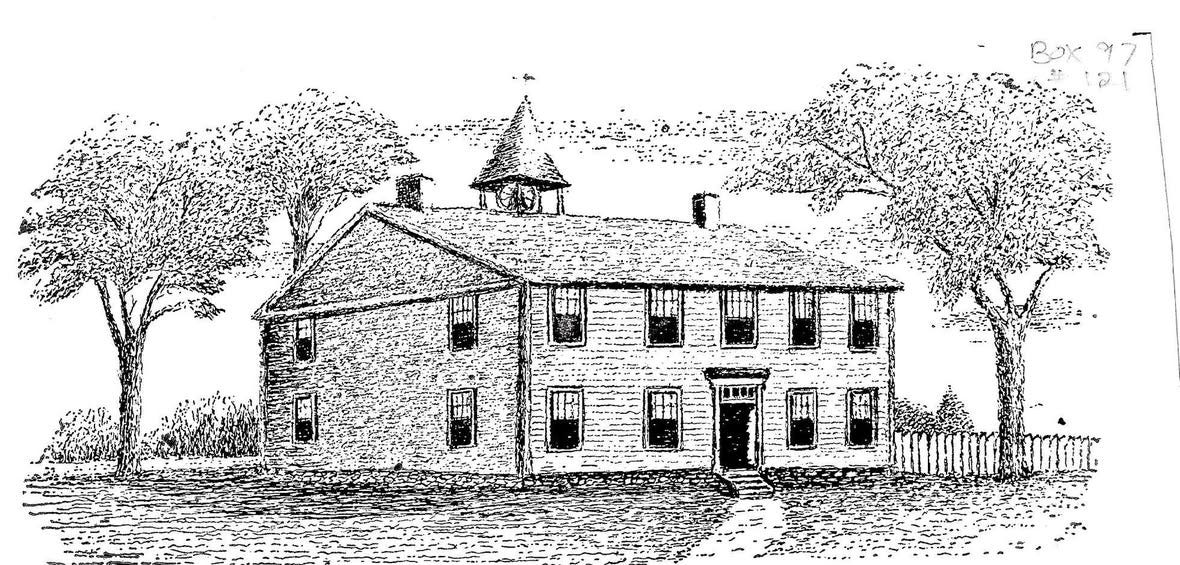
As the Old Colony History Museum celebrates 100 years in our historic Church Green building in Taunton this year, we’re looking back to 1926 as both an institutional milestone and a moment of cultural change. We’ve written a blog,¹ we’re installing a display on the fashion of the era, and we opened a new exhibit of Decorative Arts at our 173rd Annual Meeting.
In the museum’s first-floor gallery, this latest installation from the OCHM’s permanent collection brings together an unexpected grouping: a young woman’s 18th-century sampler stitched with remarkable skill, a 19th-century ceramic lion sticking his tongue out, a painted colonial drum, as well as exceptional examples of early American furniture, and three shelves, and a case, filled with silver objects that once marked both daily use and social distinction.
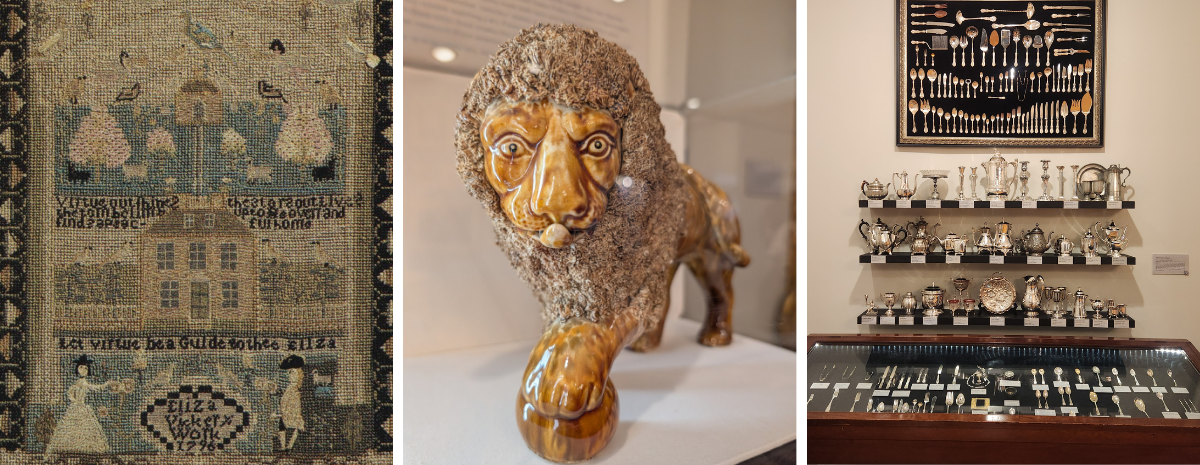
Details of items on display in the OCHM’s Decorative Arts exhibit
At first glance, these disparate items do not appear to belong in the same exhibit. They span different centuries, materials, and purposes. So, it is reasonable to ask: what do these objects have to do with one another — and what do they have to do with our celebration of the 1920s?
The answers are not found in any single object, but in a moment when the world began to reconsider not only art, but the very experience of design in everyday life. It is, in many ways, about how a 1920s moment still shapes how museums think today.
The Roaring Twenties
In the first quarter of the 20th century, society was in rapid transformation. The Wright Brothers had taken flight; the world had gone to war; and women had gained the right to vote in the United States.² Across the country, people were quietly subverting Prohibition, and testing the limits of law and propriety. In response to these changes, artists and designers began asking a shared question: What should beauty look like in a modern world?
What better place for artists to answer that question than in Paris? The undisputed heart of the artistic world in the ‘20s, the city, with its renowned art schools, prestigious museums, and history of international expositions, provided a space where new ideas could be introduced, tested, and refined. It was there that concepts of modernity began to take shape. These ideas, a century later, still resonate in unexpected ways, none better than in a certain ceramic lion now featured in a Decorative Arts exhibit at the Old Colony History Museum.

Color lithograph poster for the International Exhibition of Modern Decorative and Industrial Arts. 1925.
The Paris Exhibition of 1925
The Exposition Internationale des Arts Décoratifs et Industriels Modernes (International Exhibition of Modern Decorative and Industrial Arts), originally planned for 1915, was postponed by the outbreak of the First World War. In the postwar years, as Europe rebuilt and redefined itself, the idea gained new urgency and meaning.
The French government sought to stage an exhibition that would celebrate the supremacy of French design. It found a willing partner in the Société des Artistes Décorateurs (Society of Decorative Artists), an organization whose leaders saw an opportunity to elevate the decorative arts of furniture, jewelry, textiles, and others to the status of the fine arts of sculpting and painting.
The result was the 1925 Paris Exhibition, which opened on April 28, 1925. Great fanfare and celebratory “guns thundered across the Place de la Concorde and the Tuileries Gardens,” reported The New York Times.³

View of the Paris Exhibition on the “Esplanade des Invalides”

View of the Exposition looking across the Alexandre III Bridge and towards the Grand Palais.
The key requirement for exhibitors was that their work be “thoroughly modern.” Nothing could draw inspiration from the past. The New York Times asserted upon its opening: “That the fair will be magnificent there can be no doubt today. France has made up her mind to show the world what she is able to produce in the fields of modern art, and to prove that she has lost nothing of her ancient mastery in good taste.”⁴
Twelve monumental entranceways welcomed visitors to the Paris Exhibition, which covered 72 acres in the heart of the city. The Porte d’Orsay entrance, designed by architect Louis-Hippolyte Boileau, made it clear that visitors were about to see something they had never seen before.

Porte d’Orsay at the International Exhibition of Modern Decorative and Industrial Arts in 1925.
Visitors to the exhibition were welcomed by a radically modern structural design. Part architecture, part sign, it rose as a towering frame which read: Exposition des Arts Décoratifs et Industriels Modernes — 1925. Its bold, vertical, and stylized typography, rejected historical precedent in favor of a new visual language. On the reverse, a mural with deep brown tones flecked with gold and highlighting both geometric and abstracted natural forms, made the message to visitors unmistakable: This was something new.
Once inside the gates, visitors entered a carefully constructed world of modern design spread along the Seine River. Pavilions and other installations were arranged by international artists, architects, and even major department stores. Each offered its own interpretation of modern life. Interior displays designed by leading decorators showed how furniture, textiles, lighting, and sculpture could work together to showcase this new modern world.

Two interior designs for the 1925 International Exhibition of Modern Decorative and Industrial Arts. On the Left: “Office-library of the private apartments of a French Embassy” designed by Pierre Chareau Right: “Pavillon de l’Esprit Nouveau” designed by Le Corbusier
Complementing the artists, department stores transformed retail display into spectacle. These were not simply exhibitions of goods, but fully staged scenes that suggested how modern consumers might live in lavishly furnished rooms. Fashionably displayed interiors that blurred the line between exhibition and advertisement.

In this postcard created by Albin Salaün, for the Pavillon of the department store “Aux Galeries Lafayette,” the gold sunburst is a perfect example of the new style on display at the Exposition Internationale des Arts Décoratifs, Paris in 1925.
Within this immersive environment, a distinct visual language emerged. It was defined by geometric forms featuring sleek lines and verticality, both creatively accenting metal, leather, marble, and other luxury materials. Artists embraced bold color, strong contrast, and innovative typography.
This approach was shaped and embodied by many of the leading figures in the field of des Arts Décoratifs. Among them were furniture and interior designers Jacques-Émile Ruhlmann, Eileen Gray, and André Groult; architect Le Corbusier; and decorative artists including Edgar Brandt (ironwork), René Lalique (glass), Sonia Delaunay (fashion), Poul Henningsen (lighting), Gio Ponti (ceramics), and Albert Cheuret (chandeliers).
What emerged over the exhibition’s six months was a belief that a new decorative style could be formed without reliance on tradition. This would be a style in which modern themes, methods, and materials generated their own aesthetic language, reflecting a distinctly twentieth-century worldview.
Notably absent from the Paris Exhibition was any contribution from the United States. As a reporter for The New York Times observed: “Now, while the pavilions of the great nations stand open side by side, in a magnificent ‘roadway of nations’ along the Seine, there is again an expression of universal regret here that America is not among them.”⁵
This was no oversight. The year before the exhibition was to open, U.S. Secretary of State Charles Evans Hughes informed the French government that the United States would not participate. In response, American manufacturers were barred from exhibiting individually. Correctly identifying the moment and the potential disaster of not participating, Charles Russell Richards, Director of the American Association of Museums, convinced Herbert Hoover, Secretary of Commerce, to commission a study of the exposition. Artists, journalists, and department store buyers were sent as official delegates, producing detailed reports on what they saw. Richards later selected 400 objects from the Exhibition to tour eight American museums, thus ensuring its influence reached American audiences.⁶
Charles Russell Richards was right in understanding the importance of the moment. The impact of the exhibition was both immediate and lasting. Over its six-month run, more than 15,000 artists, architects, and designers presented their work to more than 16 million visitors from around the globe. This launched careers, shaped movements, and defined a new visual language. The Paris Exhibition is now recognized as the defining moment of the style we know as Art Deco.

Night view of the spectacular 50-foot glass fountain designed by René Lalique for the 1925 Paris Exposition Internationale des Arts Décoratifs et Industriels Modernes.
So What Does Any of This Have To Do With Our Ceramic Lion?!
As Curator of Collections Bronson Michaud envisions in the OCHM’s newest exhibit, decorative arts sit in that interesting space where usefulness and beauty intersect, where everyday objects become something more thanks to their design, craftsmanship, and creative expression.
Of course, decorative arts were not new in 1925, but the act of more fully elevating them was. After the Paris Exhibition, they surged into the cultural spotlight, gaining unprecedented visibility and influence. It is within that context that we can reexamine our diverse collection here in Taunton and discover pieces from various centuries that reflect a broader celebration of the decorative arts.

Items on display in the OCHM’s Decorative Arts exhibit
This redefinition of decorative arts has had lasting consequences. It influenced how objects were produced, how they were evaluated, and, crucially for museums, how they were preserved and categorized. The framework that emerged in the wake of this moment continues to shape the language of collection and interpretation today, even when the objects themselves belong to earlier centuries and different cultural contexts.
Beyond grand exhibition halls and international fairs, the 1925 Paris Exhibition gave a name to a movement. It catapulted Art Deco to prominence and, perhaps most importantly to our story, helped redefine how the world sees design.
A century later, that 1920s rethinking of design still shapes not only the objects we value, but how we understand them, and how museums share the objects of the past with the visitors of today.
We invite you to visit the Old Colony History Museum and see them for yourself.
Notes
- Earlier this year, OCHM Board President William F. Hanna shared a history of how the directors of the Old Colony Historical Society came to purchase the Bristol Academy a century ago. Read it here: https://ochm.medium.com/building-the-museum-1852-2026-74d29b268626
- In Taunton, the path to women’s suffrage is detailed in our March 2026 blog: https://ochm.medium.com/taunton-and-the-path-to-womens-suffrage-fde960c1ec33
- “DOUMERGUE OPENS WORLD’S ART SHOW,” Special Cable to The New York Times, New York, New York, April 29, 1925. https://www.nytimes.com/1925/04/29/archives/doumergue-opens-worlds-art-show-twentyone-nations-combine-with.html
- Ibid.
- Ibid.
- Marilyn F. Friedman, “The United States and the 1925 Paris Exposition: Opportunity Lost and Found,” Studies in the Decorative Arts 13, no. 1 (Fall–Winter 2005–2006): 94–119, https://www.jstor.org/stable/40663213
메타데이터
- post_id
- 4920ddab04da
- slug
- from-art-deco-to-decorative-arts-4920ddab04da
- url
- https://medium.com/@ochm/from-art-deco-to-decorative-arts-4920ddab04da
- canonical_url
- https://medium.com/@ochm/from-art-deco-to-decorative-arts-4920ddab04da
- author_url
- https://medium.com/@ochm
- status
- ok
- fetched_at
- 2026-06-09 18:16:15