Group Gains: How Teams Build (and Break) Performance
When chemistry wins games, and culture decides if you ever play them well.
Group Gains: How Teams Build (and Break) Performance
When chemistry wins games, and culture decides if you ever play them well.
Part 4 of 6 in the Fitfty Series: “Psychology of Sports and Exercise”
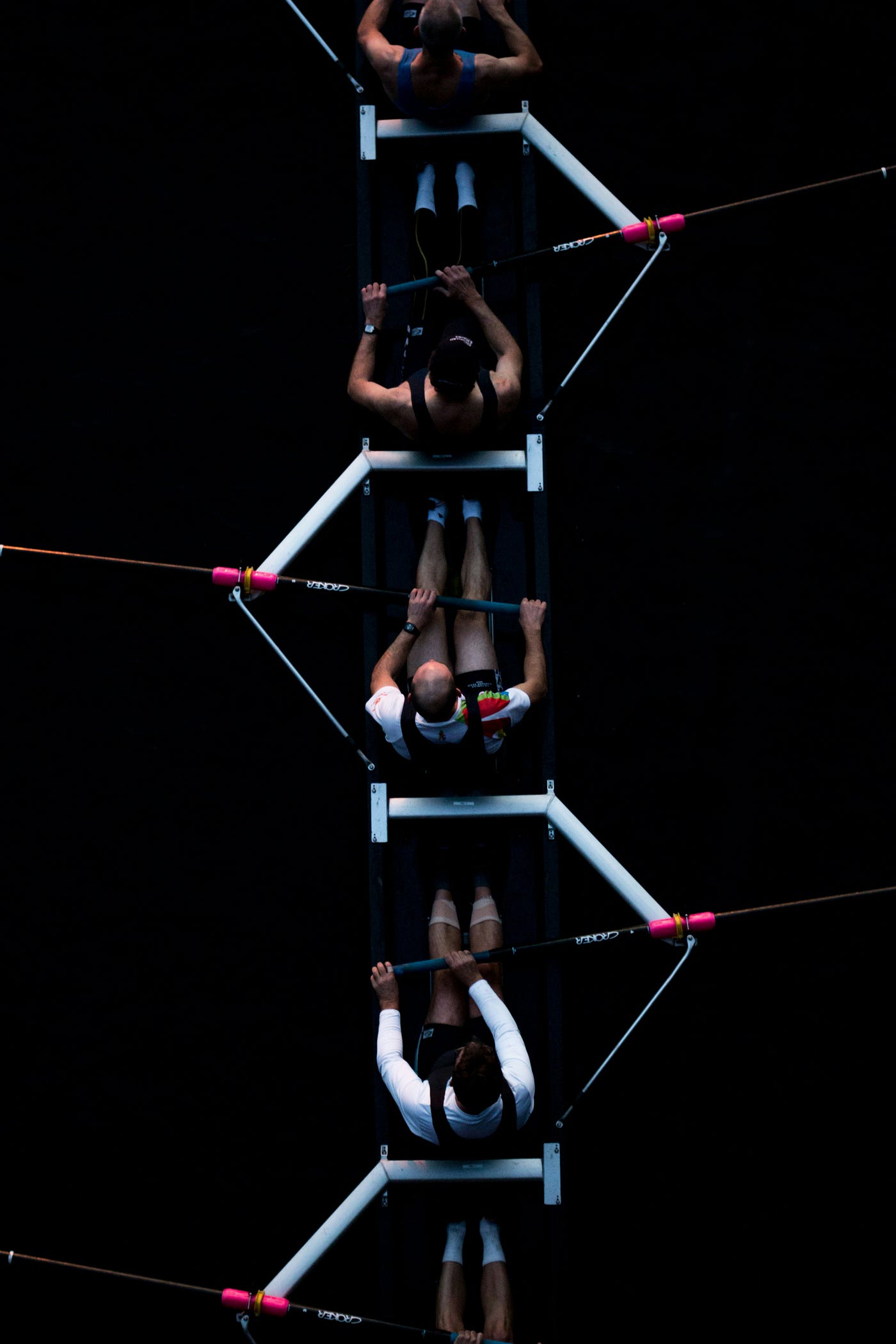
True synchrony is silent. Power emerges not from individual strength, but from the rhythm only trust can build.
🧭 Introduction: The Myth of the Lone Genius
In sport, the image of the lone athlete pushing past limits is seductive — but misleading. No one reaches the top alone. Behind every podium moment, there’s a network: coaches, teammates, competitors, even rivals. And while individual psychology is crucial, team psychology is the real multiplier. It can elevate the average, or sabotage the exceptional.
This article explores the psychology of teams — what makes a group perform beyond its talent, or implode in spite of it. Think shared flow states, toxic hierarchies, collective identity, and recovery after implosion. This is the psychology of us — the final layer of mental performance.
🏗️ 1. More Than the Sum: What Makes Teams Click?
Sports teams aren’t just collections of fit bodies. They’re dynamic systems of emotion, trust, competition, hierarchy, rhythm, and ritual. The most successful teams operate in what psychologists call shared mental models — a kind of psychological alignment where individuals anticipate each other without speaking.
Example: GB Men’s Rowing, 2000 Sydney Olympics
Their mantra? “Will it make the boat go faster?” Every decision — from nutrition to arguments — was run through that filter. The crew wasn’t just physically synchronised; they were psychologically aligned. They won gold.
Key concept: Shared success requires shared language, shared values, and a shared sense of “why.”
🏛️ 2. The Invisible Hand: Group Dynamics and Hierarchy
Every team forms an invisible structure — status, influence, deference. This isn’t necessarily negative. When healthy, hierarchy helps roles stay clear and pressure flow downward. But when ego outweighs role clarity, it turns corrosive.
Case: France’s 2010 World Cup Collapse
Despite world-class players, infighting, public mutiny, and a fractured locker room led to an early exit and national scandal. Why? Not ability — but a failure of psychological safety, trust, and leadership clarity.
Modern team psychology draws on Tuckman’s stages of group development: forming, storming, norming, performing. Skip the storming phase, and the team often crumbles under pressure.
🧠 3. Social Neuroscience: The Brain in a Team
Science backs it: our brains change when we’re in sync with others. Functional MRI studies show that when athletes feel part of a cohesive team, their mirror neuron activity increases. They become more attuned to each other’s movement and emotion.
In rugby or basketball, this creates a kind of shared flow. Teammates anticipate passes, adapt formations, and read cues without a word. And yes, this can be trained.
Study: In 2021, the University of Exeter found that teams with high “psychological synchrony” outperformed more individually skilled teams in complex drills. It wasn’t raw ability — it was predictive cohesion.
🤝 4. Trust Is a Muscle, Too
In elite team environments, trust defines the ceiling of performance.
Kate Richardson-Walsh, captain of GB’s gold-medal-winning women’s hockey team, introduced a brutally honest system. Teammates wrote down moments they felt let down — and read them aloud. The discomfort built emotional clarity. The clarity built trust.
And trust reduces decision latency. When trust is high, there’s no second-guessing. In high-stakes sport, that split-second matters.
⚠️ 5. Group Pressure: The Double-Edged Sword
Groups elevate. Groups can also destroy.
The same mechanics that fuel cohesion — mirroring, emotion, loyalty — can descend into groupthink. When harmony matters more than honesty, problems fester.
Case: USA Gymnastics Scandal
Years of abuse were hidden not for lack of awareness, but because group silence and power dynamics crushed dissent. Loyalty became complicity. Culture isn’t always benevolent.
Prevention strategies:
- Allow structured dissent
- Create safe whistleblowing channels
- Reward disagreement that improves clarity
🫂 6. Building Belonging: Identity and Inclusion in Teams
Great teams give people a reason to show up that isn’t just the scoreboard.
According to Michael Platow’s work on social identity theory, athletes who deeply identify with their team:
- Experience less burnout
- Are more supportive teammates
- Recover faster from failure
Example: England’s Lionesses built a purpose around legacy — what they’d leave behind for future generations. It shaped their rituals, interviews, and post-match reflections. They weren’t just playing together — they were playing for something.
🔧 7. Repair After Rupture: Can a Broken Team Heal?
Yes — but only through deliberate repair.
Case: The Chicago Bulls, 1995–98
After Jordan’s first retirement, coach Phil Jackson didn’t just rebuild tactics. He rebuilt team identity using:
- Circle meetings
- Zen rituals
- Personality typing
- Storytelling drawn from Native American culture
The result? Three more championships. The team was rebuilt with emotional bandwidth, not just physical strength.
Key insight: When teams experience trauma — failure, betrayal, burnout — they need space to process it together. Otherwise, it leaks.
🎖️ 8. From Military to Sport: Lessons in Collective Stress
Sport has borrowed from military psychology — not in aggression, but in cohesion under fatigue.
In SAS training and Royal Marine briefings, soldiers are taught:
- Role fluidity under stress saves lives
- Mission clarity trumps emotion
- Honest debriefs are sacred
Application in sport:
Several professional rugby teams run pre-season stress inoculation events with ex-forces trainers. They simulate confusion, fatigue, and conflict — not to punish, but to observe psychological roles under duress.
It’s not about toughness. It’s about adaptive trust.
🧑🏫 9. Coaching the Collective Mind
The best coaches are architects of emotional climate.
Southgate, Klopp, and Eddie Jones all do it differently, but they share common tools:
- Rituals (like England’s gratitude circles)
- Shared language (“courage is our style”)
- Attention to meaning, not just metrics
In elite sport today, coaching is not just physical. It’s narrative and emotional engineering.
💡 10. Lessons Beyond the Locker Room
You don’t need to wear a crest to build a team environment. If you train with anyone else — friends, partners, a class — this applies.
Ask yourself:
- Do we reflect, or just rush?
- Do I feel safe to fail here?
- Is there a story bigger than our reps?
Try this:
- Set group intentions, not just goals
- Make space for venting post-session
- Acknowledge each other outside of performance
Because performance isn’t just fuelled by energy. It’s fuelled by connection.
🎯 Final Thoughts: Team Is a Feeling
You can’t fake chemistry. But you can nurture the soil where it grows.
Real teams don’t need speeches to know when to pass. They don’t need praise to trust each other’s intent. And when they win — it feels like something more than achievement. It feels like belonging.
In a lonely world, that might be the rarest victory of all.
Proof of Authorship:
This article was signed by the author using Keybase.
View the signed proof here
📌 Coming Next in the Series: The Mind-Body Lock-In
Part 5 explores how mental state and physical performance intertwine — not just moment-to-moment, but across seasons, careers, and comebacks. From psychosomatic injuries to peak performance rituals, we’ll dive into how mind and body truly move as one.
🗂️ Article Menu — Series: Psychology of Sports and Exercise
➡️ *The Inner Game Never Ends*
➡️ *From Locker Room to Boardroom*
➡️ *Mental Muscles: What Makes an Athlete Tick*
➡️ Group Gains: How Teams Build (and Break) Performance
➡️ *Final Reflections: Where Psychology Is Headed Next*
📚 References
- Kerr, J. (2013). Legacy: 15 Lessons in Leadership. Constable.
- Tuckman, B. W. (1965). Developmental sequence in small groups. Psychological Bulletin, 63(6), 384–399.
- University of Exeter. (2021). Group synchrony and performance under dynamic pressure.
- Richardson-Walsh, K. (2016). Interview in The Guardian on GB women’s hockey team culture.
- Janis, I. L. (1982). Groupthink: Psychological Studies of Policy Decisions and Fiascoes. Houghton Mifflin.
- Platow, M. J. (2012). The Psychology of Social Identity and Group Membership. Open University Press.
- Chicago Bulls documentary. (2020). The Last Dance. ESPN Films / Netflix.
- Jackson, P. (2006). Sacred Hoops: Spiritual Lessons of a Hardwood Warrior. Hyperion.
- Royal Marines Leadership & Ethics Centre. (2018). Training under pressure and decision-making protocols.
- Gallagher, R. (2020). Jurgen Klopp: Red Machine. Reach Sport Publishing.
- FA Learning. (2021). Southgate’s Culture-Building in the England Squad. FA Technical Reports.
- UK Sport. (2023). Mental Health and High-Performance Environments Report.
메타데이터
- post_id
- 492da2da619c
- slug
- group-gains-how-teams-build-and-break-performance-492da2da619c
- url
- https://medium.com/@fitfty/group-gains-how-teams-build-and-break-performance-492da2da619c
- canonical_url
- https://medium.com/@fitfty/group-gains-how-teams-build-and-break-performance-492da2da619c
- author_url
- https://medium.com/@fitfty
- status
- ok
- fetched_at
- 2026-07-19 01:25:31