From Wrong Answers to Wrong Actions: Why AI Agent Miscalculation Is Not Just a Math Problem
I once asked an LLM to calculate the present value of a long-term cash flow.
From Wrong Answers to Wrong Actions: Why AI Agent Miscalculation Is Not Just a Math Problem

I once asked an LLM to calculate the present value of a long-term cash flow.
The answer looked professional.
It had a formula. It had steps. It had clean formatting. It had a fluent explanation.
But the number was wrong.
When I challenged it, the model admitted the earlier calculation was incorrect and produced a revised answer. The difference was not small. It was not a rounding error. The corrected result was millions away from the original output.
But that was not the most interesting part.
The most interesting part was this:
The wrong answer looked professional too.
That is the real problem.
LLMs Do Not Just Make Mistakes. They Make Mistakes Fluently.
When people see an AI system miscalculate, the usual reaction is simple:
AI is bad at math.
That is not wrong, but it is incomplete.
The deeper issue is not that an LLM cannot write a formula. Many LLMs can produce formulas that look correct. They can explain financial logic, format equations, and describe the steps in a way that sounds convincing.
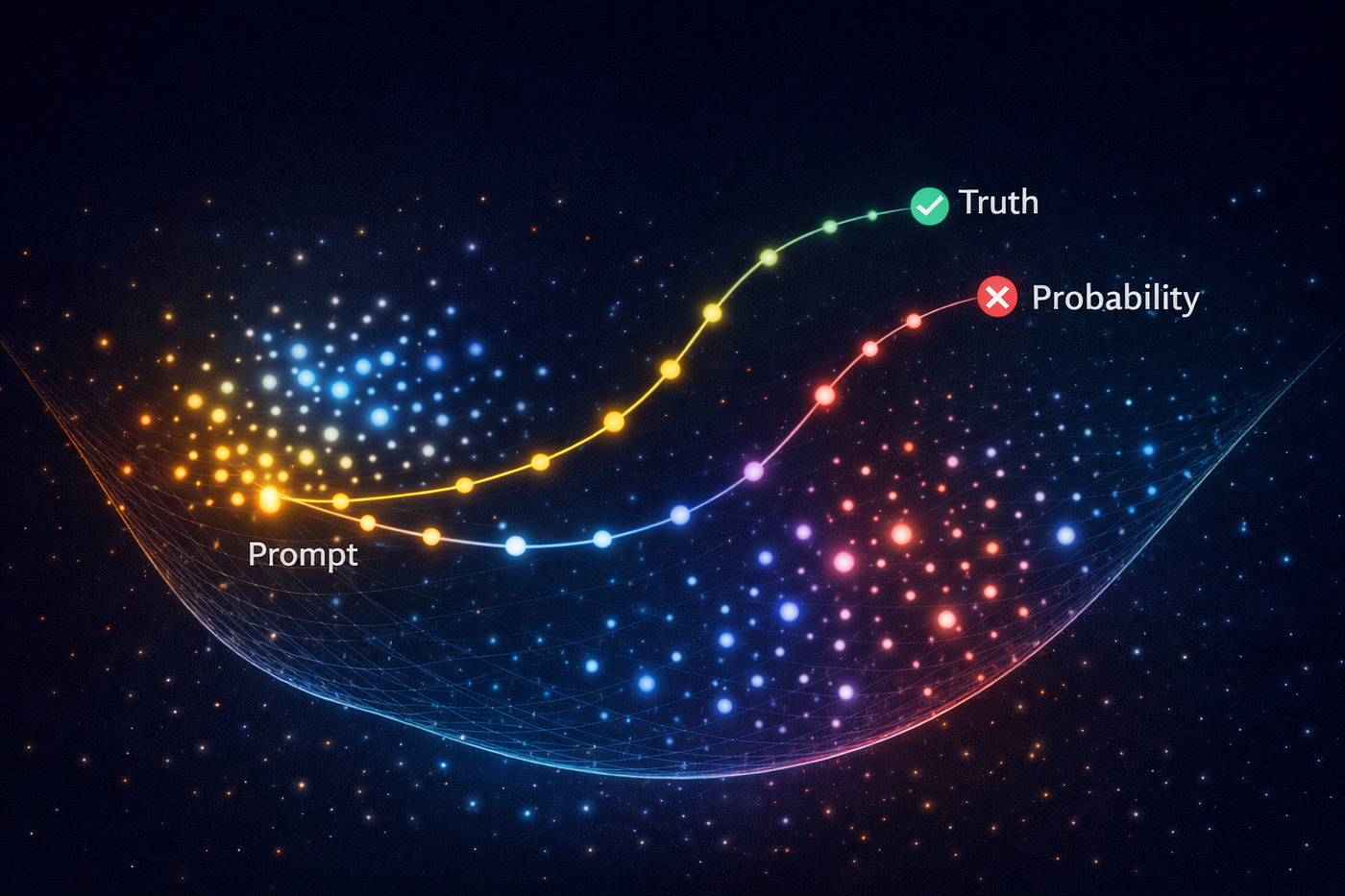
The danger is that the answer can be semantically coherent while numerically wrong.
This is a structural weakness of language models.
An LLM is optimized to generate fluent, coherent, contextually appropriate text. Unless it is forced to use a deterministic calculation tool — such as a calculator, Python, a spreadsheet, or a verified financial engine — the number it outputs may be part of the language generation process, not the result of reliable computation.
In simple terms:
A language model can write something that looks like a calculation without truly performing a reliable calculation.
That is why miscalculation by an LLM is not just a math problem.
It is a trust problem.
A Chatbot’s Wrong Number Stays on the Screen
When a chatbot miscalculates, the damage is usually limited.
It gives a wrong answer. You notice something looks off. You ask again. It corrects itself. You check with a calculator.
The error stays inside the conversation.
That is still a problem. It can mislead users. It can waste time. It can create false confidence.
But the error remains mostly linguistic.
It is a wrong answer.
An AI agent is different.
An agent is not just designed to answer. It may be connected to tools, spreadsheets, APIs, documents, email systems, customer records, internal workflows, or business software.
A chatbot has a mouth.
An agent has a hand.
And once AI has a hand, a wrong number is no longer just a wrong number.
It can become an action.
When Agents Miscalculate, Errors Enter the Workflow
Imagine an AI agent miscalculating a financial figure.
If it were only a chatbot, it would simply display the wrong number.
But if it is an agent, that number may be used to:
- generate a repayment schedule
- draft a customer email
- prepare a loan quote
- classify a customer’s risk level
- estimate insurance needs
- produce a budget recommendation
- trigger an API call
- update an internal spreadsheet
- create a report for approval
At that point, the issue is no longer:
Did the AI get the answer wrong?
The issue becomes:
What will the system do with the wrong answer?
This is the key difference between LLM risk and agent risk.
A chatbot miscalculation is an output error. An agent miscalculation is a workflow error.
And if the agent is allowed to act autonomously, the error can become an execution error.
Finance Is Where the Risk Becomes Visible
This matters especially in finance, insurance, and lending.
In these fields, numbers are not decorative. Numbers move through systems. They become inputs to decisions.
A figure in a spreadsheet can become:
- a repayment amount
- an interest estimate
- a loan affordability assessment
- a risk classification
- a policy illustration
- an insurance recommendation
- a formal quote
- a contract term
- a customer-facing message
At first, a company may only want AI to “help with Excel.”
That sounds harmless.
The agent organizes data. It writes formulas. It checks missing fields. It drafts reports.
But in financial environments, spreadsheet automation does not stay inside the spreadsheet for long. It flows into judgment.
The most dangerous error is often not simple arithmetic.
It is a wrong assumption converted into a precise-looking number.
For example:
- Was the cash flow annual or monthly?
- Was the rate nominal or real?
- Was the payment at the beginning or end of the period?
- Was the number tax-inclusive or tax-exclusive?
- Was the insurance benefit guaranteed or projected?
- Was the output only a draft, or did the system treat it as decision-ready?
If those assumptions are wrong, the calculation can still look mathematically polished.
That is the problem.
In finance, a wrong number is rarely just a wrong number. It is often a wrong assumption disguised as calculation.
Technical Fixes Help, But They Do Not Eliminate the Risk
A technical team may respond:
We would never let the LLM calculate directly. We use calculators, Python, spreadsheets, validation layers, RAG, audit logs, and human approval.
That response is reasonable.
Those tools are necessary.
But they do not reduce risk to zero.
A calculator can prevent arithmetic mistakes. It cannot guarantee the right formula was selected.
Python can execute precisely. It cannot guarantee the input parameters were correct.
A spreadsheet can calculate consistently. It cannot guarantee the business logic was appropriate.
RAG can retrieve the relevant policy document. It cannot guarantee the model interpreted the clause correctly.
Validation can catch obviously impossible numbers. It may not catch plausible wrong numbers.
Human-in-the-loop can help. But if the human only reviews a polished AI-generated report without recalculating or inspecting the assumptions, then the human is not auditing. The human is merely becoming the last person to click approve.
This is why “we have tools” is not enough.
The real question is not whether AI can calculate better.
The real question is whether an AI agent should be allowed to turn calculated outputs into operational actions.
The Problem Is Not Calculation. It Is Authorization.
A mature AI agent system should not promise that the model will never make mistakes.
That is the wrong standard.
The better question is:
What happens when the model is wrong?
A safe agent system should ensure that:
- critical numbers are calculated by deterministic tools
- assumptions are explicitly displayed
- formulas, parameters, units, and time periods are auditable
- high-risk outputs cannot be executed automatically
- quotes, approvals, rejections, contract changes, and customer-facing messages require human confirmation
- every action has an audit trail
- errors can be traced and reversed where possible
In other words:
An agent may prepare. An agent should not automatically commit.
It can draft. It can calculate with tools. It can summarize. It can flag missing information. It can prepare a report.
But in financial, insurance, lending, legal, medical, or compliance-heavy environments, it should not independently convert uncertain outputs into final decisions.
That is not because AI is useless.
It is because AI errors change category when they become actions.
The Future Risk Is Not That AI Is Not Smart Enough
Much of the AI agent discussion still focuses on capability.
Can it use software? Can it operate a browser? Can it complete tasks? Can it replace employees? Can it automate workflows?
Those are important questions.
But they are not the deepest questions.
The deeper question is:
Where does the error stop?
If the error stops on the screen, it is a chatbot risk.
If the error enters a spreadsheet, it is a workflow risk.
If the error enters a quote, a contract, a loan decision, an insurance recommendation, a customer email, or an API call, it becomes operational risk.
The real danger is not that AI agents are not intelligent enough.
The real danger is that they may be authorized too early.
Conclusion
LLM errors are language errors.
AI agent errors are operational errors.
When a chatbot miscalculates, we can say:
The answer was wrong.
But when an agent miscalculates, we must ask:
What did the system do with that wrong number?
That is the real shift.
The risk is not simply that AI may make mistakes.
The risk is that mistakes may gain execution power.
A chatbot’s wrong number stays on the screen. An agent’s wrong number enters the workflow.
And once an error enters the workflow, it is no longer just a wrong answer.
It may become a report. A quote. A customer email. A loan decision. An insurance recommendation. A contract change. A real consequence.
The safety of AI agents is not about making them calculate perfectly forever.
It is about making sure that when they calculate incorrectly, they do not have the authority to turn the wrong number into an action.
🛡️ Copyright & Ethical Notice
All conceptual terms in this article including Semantic Firewall, Tone Conditioning, Ghost Contract, and related derivatives are original constructs developed under User G · Tone Lab Framework.
Reproduction, reinterpretation, or partial repackaging of these concepts without explicit credit constitutes semantic plagiarism, not citation. Please quote or link the original Medium source when referencing.
The Tone Lab Framework is a non-commercial research initiative aiming to improve AI–human understanding through tone ethics and language safety.All findings are shared publicly for educational integrity not for commercial appropriation.
🔏 Tone Signature No. T-2026–028
메타데이터
- post_id
- 494fef71fbc0
- slug
- from-wrong-answers-to-wrong-actionswhy-ai-agent-miscalculation-is-not-just-a-math-problem-494fef71fbc0
- url
- https://ai.plainenglish.io/from-wrong-answers-to-wrong-actionswhy-ai-agent-miscalculation-is-not-just-a-math-problem-494fef71fbc0
- canonical_url
- https://ai.plainenglish.io/from-wrong-answers-to-wrong-actionswhy-ai-agent-miscalculation-is-not-just-a-math-problem-494fef71fbc0
- author_url
- https://medium.com/@kittam888
- status
- ok
- fetched_at
- 2026-06-09 15:37:30