The Asynchronous Mempool. Building a Dual-Engine AI Security Pipeline from Scratch.
Web3 security is fundamentally a latency problem. By the time a malicious transaction is finalized on the Ethereum mainnet, the capital is…
The Asynchronous Mempool. Building a Dual-Engine AI Security Pipeline from Scratch.
Web3 security is fundamentally a latency problem. By the time a malicious transaction is finalized on the Ethereum mainnet, the capital is gone. The industry standard relies heavily on reactive post-mortem analysis. Real security requires analyzing the mempool. It requires flagging anomalous logic in milliseconds before validators commit the block.
You cannot achieve this latency with standard Python scripts. You certainly cannot achieve it using synchronous API calls.
I am building 0xNeural. It is a custom machine learning architecture designed to detect Web3 exploits natively. Phase 1 requires a robust ingestion and math layer. The system needs to understand two completely different streams of data simultaneously: the behavioral patterns of a wallet, and the semantic logic of the smart contract it interacts with.
Building the mathematical architecture is a great exercise. Engineering the infrastructure to keep it alive in the real world is where the actual work begins.
Engine 1: The Behavioral Footprint
To handle the behavioral data, I refused to rely on the magical abstractions of PyTorch and TensorFlow. I built a neural network and Autograd engine entirely from scratch using pure calculus.
Modeled after Andrej Karpathy’s educational tool Micrograd, this engine implements automatic differentiation by applying the Chain Rule to calculate local derivatives. I built a scalar-valued computational graph engine. Every time a math operation executes, the custom Value class secretly records the operation and the children that produced it. When the backward pass is called, the engine builds a Directed Acyclic Graph using topological sort.
Managing raw float values without C++ memory protections or optimized tensor operations is a recipe for wild gradients and NaN crashes. I engineered a real-time translation layer that intercepts live hexadecimal data from the blockchain. It extracts the behavioral footprint and applies strict mathematical Min-Max scaling on the fly before the data ever touches the inference engine. Because I bypassed standard deep learning frameworks, the inference engine is incredibly lightweight.
Engine 2: The Semantic Parser
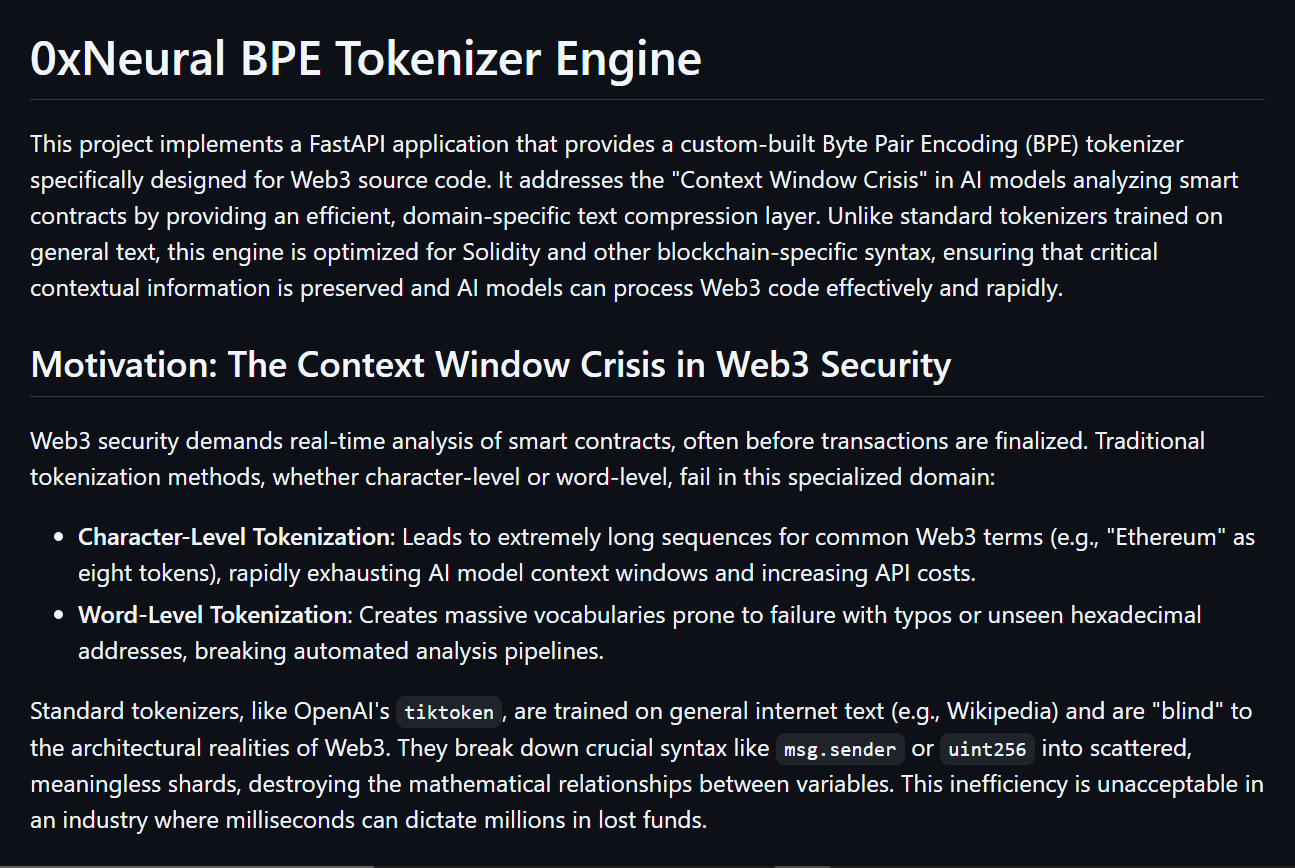
Neural networks only process numbers, not text. Standard tokenizers face the “Goldilocks” problem. Word-level tokenization creates a massive vocabulary and breaks easily on Out-of-Vocabulary words, while character-level tokenization forces models to process words like “Ethereum” as 8 separate tokens, rapidly exhausting the context window.
The solution is sub-word tokenization, specifically Byte-Pair Encoding. Historically, BPE was first published by Philip Gage in his 1994 article “A New Algorithm for Data Compression” before being adapted for modern neural networks.
Standard tokenizers are trained on general internet text like Wikipedia and Reddit, making them completely blind to the architectural realities of Web3. Relying on them to parse a smart contract is an engineering flaw. I built the algorithm logically using fundamental data compression principles. The engine scans sequences of integers to count the frequency of adjacent pairs, and iteratively replaces the targeted frequent pair with a new, single integer ID.
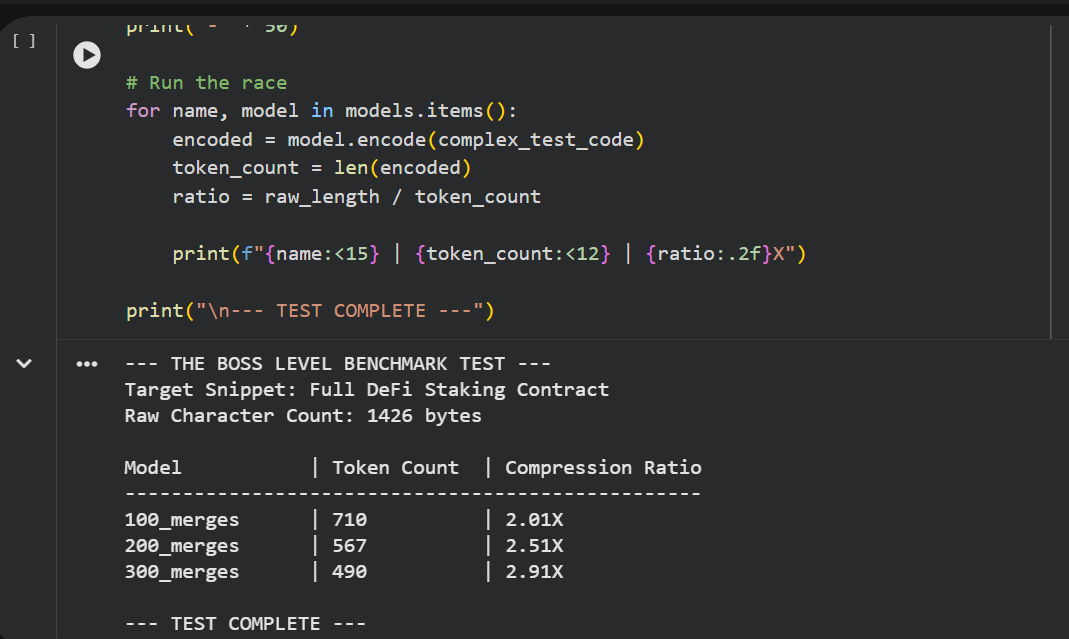
I trained this custom tokenizer on millions of characters of deployed smart contracts. The deployment is perfectly reversible without data loss. In benchmarking, my custom 300-merge model compressed a highly complex DeFi staking contract by nearly 3X. By compressing the tokens, I effectively tripled the context window and speed of any downstream AI reading the contract.
The Collision: When Math Meets the Mempool
The math was sound. The execution layer was broken.
When I initially wired these two engines together, the pipeline choked. I am engineering this entire architecture on an 8GB RAM CPU-only laptop. Pulling tens of thousands of wallet transactions locally threatens to crash the Python environment due to Out-Of-Memory errors. But the true bottleneck was network latency.
I was running a standard synchronous for loop over 50 pending transactions using the requests library. For every smart contract detected, the script stopped completely. It waited for the Etherscan API to return the source code. It then waited for my tokenizer to compress the text. Finally, it launched four simultaneous historical data requests to the Alchemy RPC.
If a single block contained five smart contract interactions, the entire dashboard froze. The behavioral data pipeline was actively blocked while the semantic data pipeline finished parsing text.
Furthermore, I hit the brutal reality of the “Data Engineering Tax”. Handling rate limits and cleaning raw blockchain data often takes longer than actually building the machine learning model. By running four historical queries per transaction across 50 transactions, I was carpet-bombing the Alchemy free tier with 200 concurrent RPC requests. This instantly triggered a 429 Too Many Requests ban.
To survive, the script forced itself into an exponential backoff loop. It literally put itself to sleep for seconds at a time to avoid a permanent IP ban. The dashboard slowed to a crawl. What should have taken milliseconds was taking thirty seconds. In an environment where attackers drain liquidity pools in a single block, this architecture was entirely unacceptable.
The Decoupling: MLOps in the Cloud
I realized that keeping the text compression engine tied to the frontend rendering loop was an architectural fatal flaw. I had to decouple the infrastructure and weaponize Python’s concurrency.
I stripped the BPE Tokenizer out of the main loop. I containerized the pure-Python logic into a FastAPI microservice and deployed it to Render. This isolated the heavy text compression logic to the cloud. The Streamlit app reverted to its true purpose. It acts as a single pane of glass for data visualization, entirely separated from the ingestion engine.
Next, I completely ripped out the synchronous requests library. I rebuilt the entire data pipeline using aiohttp and asyncio. I built an orchestrated, dual-pipeline execution model. When a transaction enters the system, the architecture fires the semantic ingestion task (routing the code to the cloud) and the behavioral history tasks (querying Alchemy) at the exact same time. The neural network no longer waits for the text compressor.
The Pressure Valves
Total parallel execution creates a new problem. It maximizes network throttling. If you fire 200 asynchronous requests at Alchemy simultaneously, they will ban your API key instantly.
To prevent the asynchronous engine from getting blacklisted, I installed strict pressure valves. I implemented asyncio.Semaphore logic to act as a tollbooth for the network traffic. I wrapped the exact RPC calls in a custom throttle function.
The pipeline now queues the requests intelligently. It hovers exactly at the 15-request-per-second ceiling of the Alchemy free tier. It allows exactly 15 requests through at a time, and the moment one resolves, the next instantly takes its place. It never triggers the exponential backoff sleep penalty.
The system now pulls the data, scales the arrays, queries the cloud tokenizer, and hands the pre-computed results to the unified Streamlit command center for instant rendering.
The Result
The architectural shift yielded a massive speed multiplier. A process that previously bottlenecked the CPU for 30 seconds now executes in 3 seconds. The system actively reads behavioral vectors and semantic smart contract logic fast enough to catch anomalies while the block is still sitting in the mempool.
This is not a theoretical academic exercise. It is a live, resilient MLOps system. You cannot secure decentralized systems using sequential bottlenecks or tools built for chat applications. You must control the C-level logic, respect the rigid network constraints of the blockchain, and build the math yourself.
Phase 1 of 0xNeural is complete. The ingestion and math foundations are locked. The next objective is the cognitive layer. I am opening a fresh repository to build the “Attention is All You Need” Transformer matrix from scratch.
Test the live Mempool Sentinel architecture: 0xNeural Explore the main 0xNeural Orchestrator Repo: https://github.com/Ogezi-Emmanuel/0xNeural Review the standalone BPE Tokenizer Microservice: https://github.com/Ogezi-Emmanuel/0xneural-Tokenizer
메타데이터
- post_id
- 495e12c855ca
- slug
- the-asynchronous-mempool-building-a-dual-engine-ai-security-pipeline-from-scratch-495e12c855ca
- url
- https://medium.com/@Emmysunday/the-asynchronous-mempool-building-a-dual-engine-ai-security-pipeline-from-scratch-495e12c855ca
- canonical_url
- https://medium.com/@Emmysunday/the-asynchronous-mempool-building-a-dual-engine-ai-security-pipeline-from-scratch-495e12c855ca
- author_url
- https://medium.com/@Emmysunday
- status
- ok
- fetched_at
- 2026-06-09 14:34:10