111th World Congress of Esperanto—The International Language 1.-8.8.2026
How a Language Congress in Graz Can Spark a Movement of Personal Power
# EO # Esperanto
111th World Congress of Esperanto—The International Language 1.-8.8.2026
How a Language Congress in Graz Can Spark a Movement of Personal Power
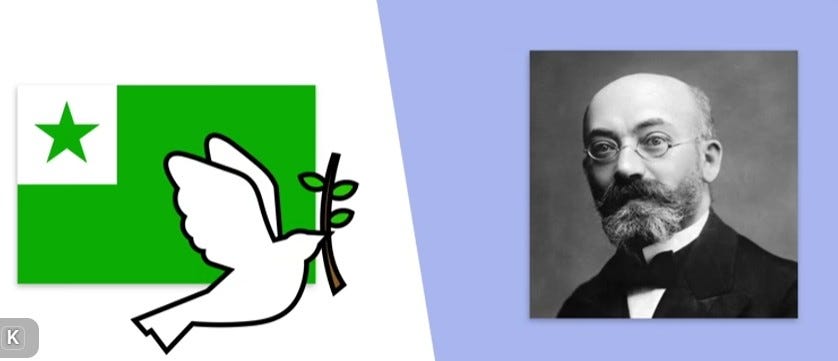
Portrait of L. L. Zamenhof beside the green‑star Esperanto flag, symbolizing the creation of a world language meant to foster peace and international understanding.
Tomorrow, August 1, 2026, the 111th World Esperanto Congress—Universala Kongreso—opens its gates in Graz, Austria.
Around 1,500 people from dozens of countries will fill a UNESCO World Heritage city for a week, all speaking one language that belongs to no country and therefore the whole world.
Graz has hosted this congress before — in 1913, 1926, 1949, 1970, 1987, and 2024 — and its local Esperanto club, one of the most active in Europe, even put together a full city guide in Esperanto for the occasion.
The week ahead holds the movement fair, the book service, the 48th Esperantologia Konferenco (a full day of academic talks on archives, language rights, and where Esperanto stands after 140 years), concerts, city walks, and an ecumenical service with pastors from three continents.
But numbers and programs aren’t why I’m writing this. I’m writing this because of what this small, stubborn language has already proven, twice over, in its own history—and because 43 years ago, I was part of proving it too.
One Man Started Everything
In 1887, one eye doctor in Warsaw sat down and built a language from scratch.
Ludwik Lejzer Zamenhof grew up watching Poles, Russians, Germans, and Jews fight and misunderstand each other over nothing but words in the way. Not blood. Not religion. Just language, standing between people who could have been friends.
He decided the world needed a tool it didn’t have yet—and built it.
One man, working mostly by himself, made something that still has millions of speakers in over 120 countries, 139 years later.
One Man Stopped Esperanto
to Be the Language of Diplomacy Worldwide
Thirty-three years after Zamenhof had released Esperanto publicly, one person stopped it to become big.
Representatives of many countries came together and called themselves the League of Nations, hoping to prevent further wars. One practical question immediately appeared: which language should the world use for diplomacy so that nations could speak to each other on equal ground? Ten countries wanted Esperanto—a neutral, easy, non‑dominant language. But a single French delegate blocked the idea. One man stopped Esperanto from becoming the worldwide language of diplomacy. One man’s opposition changed the linguistic direction of the whole planet.
ONE — ONE — ONE
The number of this congress.
What could that ONE stand for?
For me, it stands for the power of ONE—the reminder that one individual can shift history.
I first carried that message into a World Esperanto Congress 43 years ago, when I brought behind the iron curtain to Hungary and presented The Hunger Project there. Its core idea: individual commitment matters.
Dozens of Esperantists signed to represent that message in their home country, because they understood that ONE person can shift the fate of the world, as has happened with Esperanto and its enemies, who could not kill it.
Today, this message is more important than ever.
The 111th Congress arrives with three ones in its name—a perfect symbol for the truth we keep forgetting:
movements begin with individuals
History turns because one person decides.
Empowerment starts with ONE.
One person built something that reshaped how millions talk to each other. One person blocked something that could have reshaped how the whole world talks to each other. Both are true. Both prove the same thing: commitment and will live in individuals, not in crowds.
What the Hunger Project Is About
In 1981, I got exposed to that idea through the Hunger Project, and it changed my life. It was built on one core belief:
Each individual is the key to change.
Most of us are taught the opposite—that we’re small, that real change needs governments, armies, or decades of policy.
Zamenhof and Hanotaux, the French that stopped it, had already proven the opposite, from both directions, before I ever heard the theory.
Reframing: The Alchemy of Change
We grew up absorbing limiting beliefs everywhere—quietly, constantly.
The voting metaphor: You drop your vote into an urn. An urn is a container for the dead. Who named it that? Why? Doesn’t that say something about what we think our voice is worth?
The medical metaphor: Homeopath Antonie Peppler once said the hidden message behind every vaccination is, "You and your own body can’t handle this alone—help must come from outside.”
Food for thought, same as the urn.
In 1981, the Hunger Project taught me that
problems continue because of wrong believes, like:
There isn’t enough (money, knowledge, people) &
I’m not able.
Change the frame, and the outcome changes with it.
Failure becomes the fuel for the next try.
The Question Only You Can Answer
What is it that you can — or want to — change?
Awareness—the inner switch
Awareness is the moment you stop running on inherited scripts and start seeing what’s happening—inside you, around you, and because of you. It’s not analysis. It’s not overthinking. It’s the shift from automatic to intentional.
Awareness is where “someone should” turns into “I can.”
Why outer slogans never worked
Politicians tried to activate people with slogans:
- Kennedy, USA: Don’t ask what your country can do for you…
- Obama, USA: Yes, we can.
- Merkel, Germany: Ja, wir schaffen das. (“We can do it!“)
- Podemos, Spain: political party name literally means "We can.”
They were all appeals from the outside. And appeals rarely create real action. They reach the ear, but not your heart.
The truly effective impulse comes from inside—from your own awareness. From the moment you see clearly, feel clearly, and decide clearly. Then you act. Then you implement. Not because someone nudged you from the outside — but because you moved from the inside. That can be the only true motion! No other.
Awareness is ignition from inside.
Awareness is the moment you stop running on inherited scripts and start seeing what’s happening—inside you, around you, because of you.
It’s the shift from automatic to intentional.
Awareness is where “someone should” turns into “I can.”
The Power of One: A Short List
History keeps handing us the same proof, in different centuries.
One act, one shift.
Nikolaus von Zinzendorf started one of the first organized global mission movements. Johannes Gutenberg built one printing press and broke the Church’s monopoly on the written word for good. Jeanne d’Arc, a teenage peasant girl, walked into a war room nobody wanted her in and turned the Hundred Years’ War.
Fear didn’t stop them.
Gandhi used radical non-violence to break British colonial power. Martin Luther challenged the religious authority of his time and lit the Reformation. Rosa Parks stayed in her seat, and that became the spark of the U.S. civil rights movement. The White Rose—Sophie Scholl distributed leaflets against Hitler, knowing exactly what it would cost, and it cost them everything. Dietrich Bonhoeffer, a German pastor, refused to look away from what his own country was doing, and it cost him his life.
Today.
Felix Finkbeiner founded Plant-for-the-Planet at age nine and stood in front of the UN General Assembly at thirteen, telling governments that children were already planting trees while adults were still debating. Boyan Slat saw plastic while diving in Greece at eighteen and turned a school presentation into The Ocean Cleanup, now running real systems in real oceans and rivers.
Two projects I admire and support.
[embed]This is a little sample invitation of how the language sounds
1983—the 68th World Congress in Budapest, Hungary
Today this 111th congress is the perfect moment to reconnect with where I left off in 1983, after winning more than forty contact people behind the Iron Curtain—something that felt impossible at the time.
The Iron Curtain was the political and physical wall that split Europe after World War II into a free West and a communist East. Closed borders, surveillance, almost no contact between people on opposite sides.
I had traveled to the congress in Hungary carrying Hunger Project material—MALSATO‑PROJEKTO—translated into Esperanto after only a few weeks of learning the language.
The Munich Esperanto group had sponsored the printing. And there, in Budapest, I found dozens of people from many different countries I could never have reached any other way, who signed on to the idea without hesitation: that one person, deciding to act, is enough to start something real.
The International Hunger Project office in San Francisco gave me a title after that: “Pioneer of pioneers.” Jay Greenspan put it this way: “The Hunger Project is a project of pioneers, and you are a pioneer of pioneers.”
I’d say the same about Esperantists.
Esperantist are pioneers — people who adopt a language one man invented on purpose,
freely, without anyone telling them to.
Why I’m Writing This Now
-for the 111th Congress 1.8.2026
43 years and a few projects later, the 111th World Esperanto Congress opens in Graz tomorrow.
I want to use this moment to say: Most of us were taught that we’re not the key. That change happens somewhere else, decided by someone else, on a scale we can’t touch.
Zamenhof, Hanotaux, and every Esperantist who signed a Hunger Project pledge card in a language nobody made them learn—all prove the opposite.
Each one person, deciding, is
enough to change what happens next on this earth.
It’s time to wake up to what the history of this small, stubborn language has already shown us, more than once.
You do count. You make a difference.
A New Greeting for Right Now
Every language carries a small truth inside its greetings.
“I greet the God in you. " Grüß Gott (Bavarians, South Germany)
“I am because you are," Ubuntu (African)
“En Lakesh”—" I am another you” (Mayan)
“I’m OK, you’re OK” (transactional analysis)
Here’s mine:
“I am it, you are it — now!”
Equal. No fight. Coexisting, contributing to each other. And a reminder that the only moment we ever actually get to act in is this one.
In Esperanto:
Mi estas ĝi— vi estas ĝi— nun.
The root of change. The moment of power. No other moment. You and me. Now.
Why Now?
A Number and a Fairy Tale Hinting at an Open Secret
One of my favorites: Dornröschen, Sleeping Beauty
—the story of a young princess cursed into a hundred-year sleep until the right moment, kairos, arrives, and one person succeeds where everyone else failed.
A story about timing, waking up, and the power of the one who dares to break through what seemed impossible.
I believe the time to break the chains of that old programming—the myth that we’re powerless—is now.
Mi estas ĝi— vi estas ĝi— nun.
— -
This article, and others, will also be available in Esperanto. Ĝis bonvido!
Editing How One Person Can Change Everything — Medium
[embed]WTH, do I gain anything from learning Esperanto? You already speak English. So why bother?medium.com
Editing One Frenchman’s Veto Kept the World from Speaking Esperanto — Medium
메타데이터
- post_id
- 495efd951cbf
- slug
- 111th-world-congress-of-esperanto-the-international-language-1-8-8-2026-495efd951cbf
- url
- https://medium.com/esperanto/111th-world-congress-of-esperanto-the-international-language-1-8-8-2026-495efd951cbf
- canonical_url
- https://medium.com/esperanto/111th-world-congress-of-esperanto-the-international-language-1-8-8-2026-495efd951cbf
- author_url
- https://medium.com/@louisa-light
- status
- ok
- fetched_at
- 2026-08-27 04:23:05





