Security Drift Begins Long Before the First Misconfiguration
Cloud teams automated infrastructure delivery years ago. The architecture layer — where security intent becomes deployed reality — is still…
Security Drift Begins Long Before the First Misconfiguration
Cloud teams automated infrastructure delivery years ago. The architecture layer — where security intent becomes deployed reality — is still mostly manual. That’s the problem nobody talks about.
Sonu Goswami: Positioning for funded B2B SaaS in security, compliance & regulated markets | Clarifying the economic wedge that accelerates complex deals
The problem that barely has a name yet
Cloud security built an entire industry around validating infrastructure after it was built. The harder problem — preventing architecture from fragmenting before infrastructure exists — barely has a name yet.
That’s a different problem. It requires a different kind of product. And it starts with understanding why drift — the word the industry uses for almost everything — is actually a[ symptom of something that happened much earlier.](https://sonusaaswriter.com/)
Where the market is actually moving
Most security products still assume architecture already exists. Their job is to monitor it, validate it, scan it, protect it. They operate on what’s already been designed and built.
The meaningful shift happening now is one layer earlier — to the point where architecture itself becomes the control. Not a document describing controls. Not a policy enforcing controls after deployment. The architecture, made executable, enforcing consistency before a single line of infrastructure is written.
That’s a different category of product entirely. And it’s the one gap that every downstream security tool currently assumes someone else has already filled.
The layer that never got automated
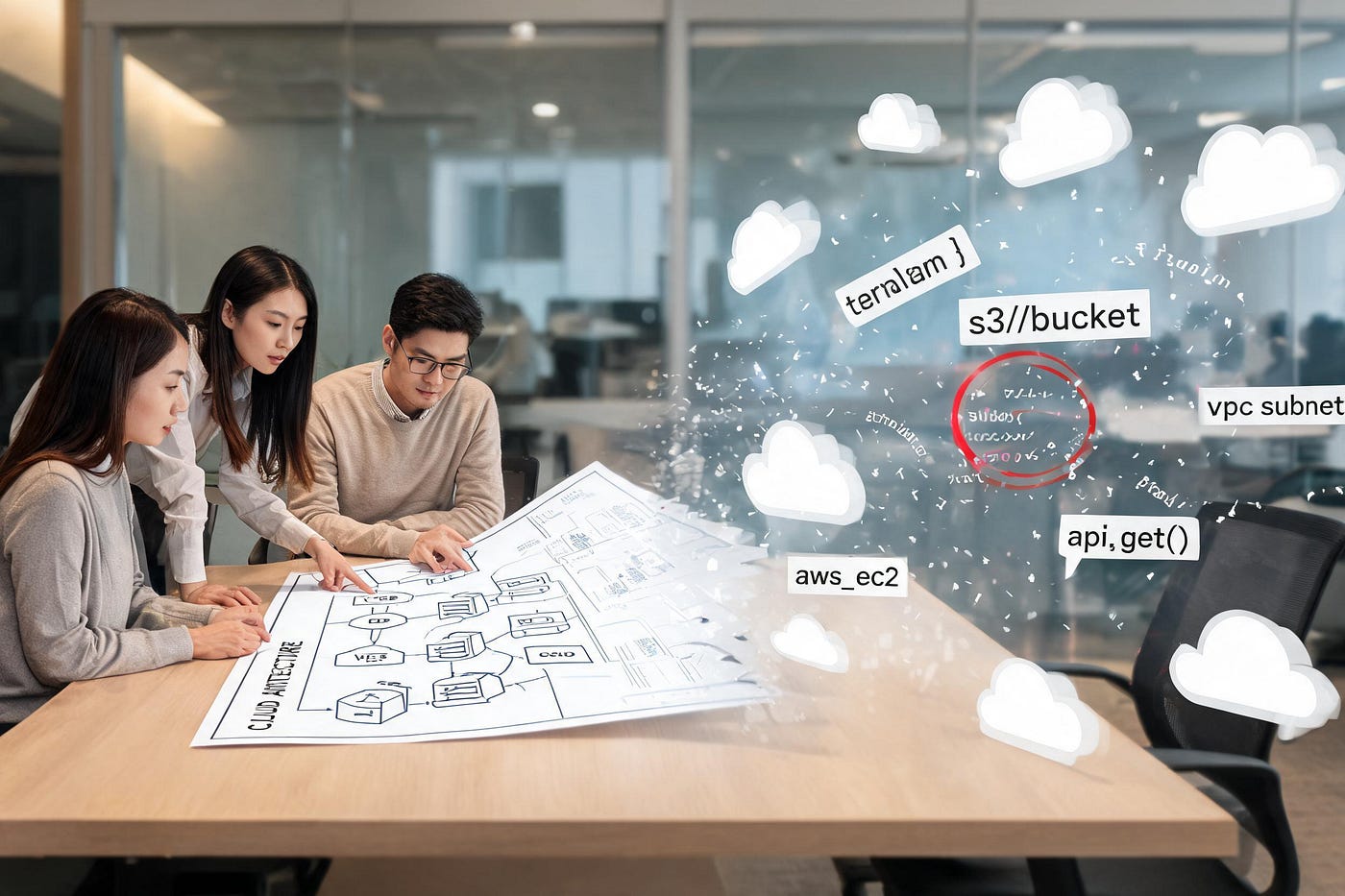
Spend time with any platform engineering team running a serious cloud environment and you’ll see the same pattern. They have Terraform. They have CI/CD pipelines. They have IaC scanners catching misconfigurations before deployment. Infrastructure delivery is largely automated.
What isn’t automated is the layer upstream of all of that. The moment where a security principle becomes an architecture decision becomes an infrastructure pattern becomes a deployed system. That translation still depends on people — security architects explaining standards, engineers interpreting guidelines, teams making local judgment calls that seem reasonable in isolation.
The 2025 Accenture State of Cybersecurity Resilience Report found that 83% of organizations hadn’t established a secure cloud foundation with integrated monitoring, detection, and response capabilities. That number doesn’t reflect a shortage of security tools. It reflects what happens when the architecture layer stays manual while everything downstream gets automated.
What’s actually going wrong
The industry calls it security drift. That framing points at the wrong problem.
Drift implies something was correct and moved. The more accurate description is that the translation between architecture intent and deployed reality was always imprecise — and at cloud scale, every imprecision compounds.
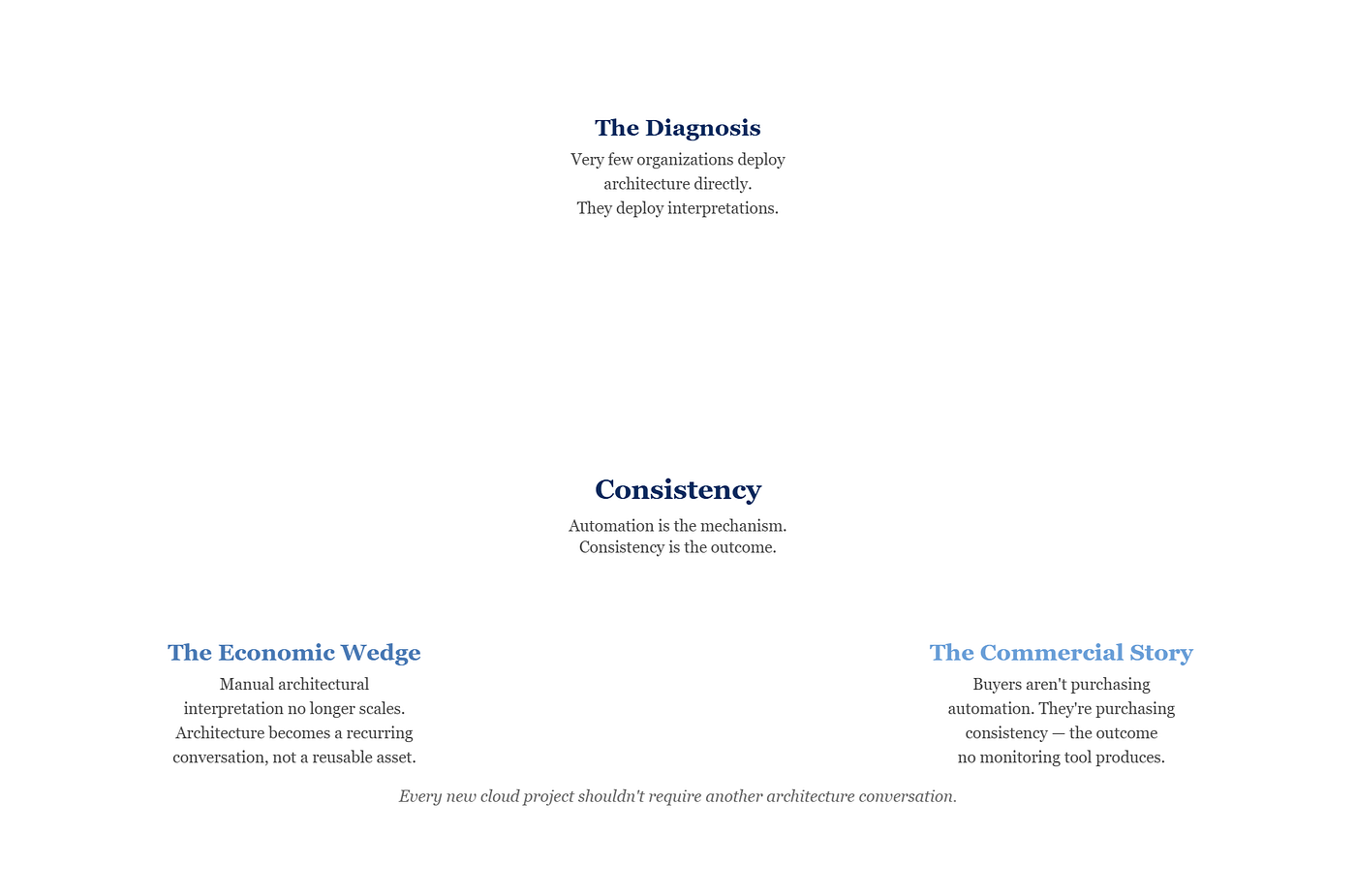
Very few organizations deploy architecture directly. They deploy interpretations of architecture.
Security architects define intent. ↓ Platform engineers interpret it. ↓ Application teams modify it. ↓ Infrastructure gets deployed. ↓ Weeks later another team changes something. ↓ Months later another project copies part of it.
The original design slowly disappears. No single change is catastrophic. The accumulation is.
Each step in that chain is a translation. Each translation is an interpretation. By the time CSPM or a posture management tool catches the problem, what it’s detecting isn’t drift from policy. It’s drift from the original design. Those are different failure modes — and only one of them gets fixed by better monitoring.
The cloud environment isn’t drifting from compliance checkboxes. It’s drifting from what someone intended when they sat down and designed the system. That distinction matters because posture management can tell you what’s wrong. It can’t tell you how far reality has moved from the original intent — because the original intent was never encoded in anything the tool can read.
What happens to the people responsible for holding that intent? Security architects become reviewers instead of designers. Platform teams become policy interpreters instead of builders. The work shifts from creating to correcting, from designing to explaining, and it never stops because the underlying system keeps reinterpreting itself faster than any team can manually realign it.
What’s actually being reduced when this problem gets solved isn’t security drift. It isn’t misconfigurations. It’s architectural reinterpretation — the repeated human act of translating design intent into execution decisions, with slightly different results every time. Automation isn’t the outcome that matters. **Consistency is.**
Every engineer shouldn’t have to reinterpret the original design. The system should carry it forward.
The buyer everyone gets wrong
When people think about who buys security architecture tooling, they assume security architects. The people who own the standards, write the threat models, run the design reviews.
That’s not where the economic pain actually lands.
Platform engineering carries the weight. They’re the team responsible for making hundreds of cloud decisions consistently — across environments, regions, teams, product lines, and time. They don’t own security policy. They don’t own compliance evidence. But every deployment they ship either honors the original architectural intent or quietly departs from it.
The incentives never line up cleanly. Platform engineering is measured on delivery speed. Security is measured on policy adherence. Compliance is measured on audit evidence. Three different scorecards, pointing in three slightly different directions, with no shared system holding them together.
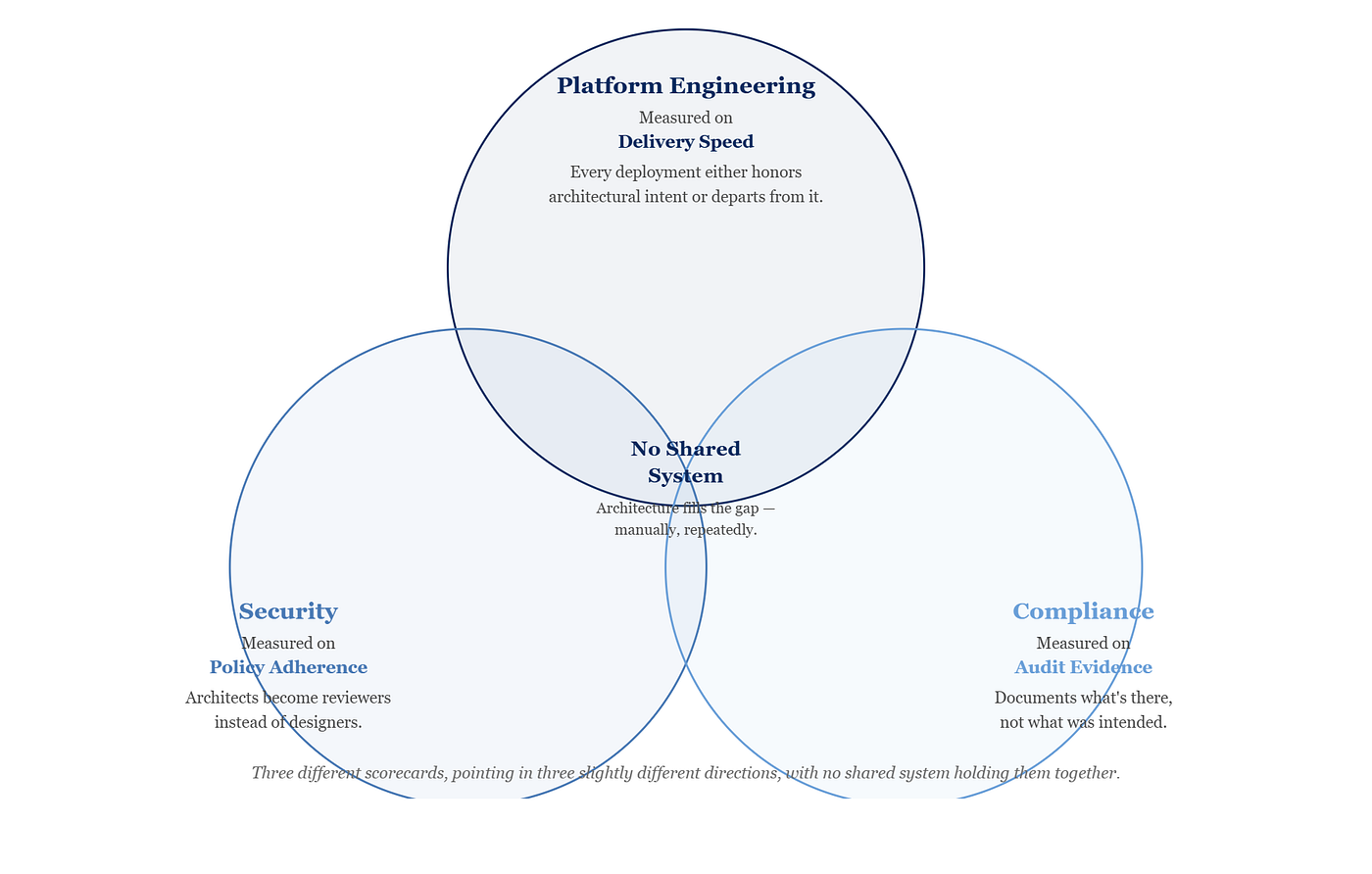
What fills the gap is human coordination. Architecture reviews. Design approvals. Security sign-offs. Pattern explanations repeated project after project by architects who are already stretched thin.
Every architecture review that has to happen again is evidence that architecture didn’t scale. The knowledge lives in people, not in systems. And when knowledge lives in people, every new project starts from scratch.
Every new cloud project shouldn’t require another architecture conversation. But that’s exactly what happens when architectural intent lives in documents and people instead of systems that carry it forward automatically.
The cost isn’t employing more architects. The cost is that architecture becomes a recurring conversation instead of a reusable asset. Every project that needs a security architect to explain the same patterns again is a project that’s consuming design capacity instead of deploying it.
This is why the buyer isn’t purchasing automation. Manual architectural interpretation no longer scales — and that’s the constraint they’re actually trying to solve. Consistency is the outcome. Automation is just the mechanism.
Architectural entropy is the real competition
This is not a CSPM (Cloud Security Posture Management) problem. Not a CNAPP (Cloud Native Application Protection Platform) problem. Not an IaC (Infrastructure as Code) scanning problem.
Those tools operate downstream of architecture. They find what the translation produced. Some of it is wrong. They flag it. Engineers fix it. The same pattern reappears in the next deployment, because nothing upstream changed.
But there’s a deeper reason this keeps happening — one that rarely gets named directly.
Architecture has quietly become the system of record for enterprise security. Policies change. Infrastructure changes. Engineers change. Cloud services change. The architecture document is the one artifact that’s supposed to hold stable intent across all of that motion. When it isn’t executable — when it can only be read, not enforced — every one of those changes becomes an opportunity for reality to diverge from intent.
If architecture isn’t executable, every deployment becomes a new interpretation. That’s not a monitoring problem. That’s a foundation problem.
The real competition is architectural entropy — the natural tendency of any cloud platform to move further from its original design the longer it lives and the more teams touch it. Not because engineers are careless. Because architecture was never executable. It was always a document someone had to interpret.
The longer a cloud environment runs, the wider that gap grows. Security teams layer more controls on top of fragmented foundations. Compliance teams document what’s there rather than what was intended. Platform engineers work around inconsistencies because fixing the root cause would require stopping everything else.
What automation actually missed
Cloud infrastructure automation solved a real problem. Provisioning is faster, more consistent, more auditable. That’s genuine progress.
What it didn’t solve is the question one layer up: is what we’re provisioning what we actually intended to build?
Infrastructure automation assumes the pattern is correct. It executes the pattern consistently. If the pattern was wrong — if it was a reinterpretation of the original architecture rather than an expression of it — automation just makes the mistake consistent and fast.
Infrastructure became programmable years ago. Architecture is still largely conversational. That gap is where security debt accumulates — not one misconfiguration at a time, but structurally, across every system built on top of a design that nobody encoded into anything executable.
That’s the commercial story the category hasn’t fully told yet. Organizations aren’t buying architecture tooling because they want more automation. They’re buying it because manual architectural interpretation stopped scaling — and consistency is the only outcome that closes that gap. Neither a CSPM alert nor a posture management dashboard can produce it on its own, because by the time they’re reading the environment, the inconsistency has already been built in.
Security drift begins long before the first misconfiguration. It begins the moment an engineer has to decide what the architecture actually meant — and makes a call that’s slightly different from the one made on the last project.
The organizations that close this gap won’t do it by monitoring more carefully after deployment. They’ll do it by making architecture executable before deployment — turning design intent into something a system carries forward continuously, without depending on someone to restate it every time engineering builds something new.
Before you go
Thousands of developers share what they’re building, learning, and discovering across our publications every month. One account connects you to our entire network of publications and communities.
메타데이터
- post_id
- 4969334a42a1
- slug
- security-drift-begins-long-before-the-first-misconfiguration-4969334a42a1
- url
- https://blog.venturemagazine.net/security-drift-begins-long-before-the-first-misconfiguration-4969334a42a1
- canonical_url
- https://blog.venturemagazine.net/security-drift-begins-long-before-the-first-misconfiguration-4969334a42a1
- author_url
- https://medium.com/@sonuarticles74
- status
- ok
- fetched_at
- 2026-07-13 13:12:13