The Strange Future of First Class: Why Most Airlines Are Killing It While Others Are Making It More…
For decades, First Class has been the crown jewel of commercial aviation. It symbolized the height of luxury: caviar, champagne, private…
The Strange Future of First Class: Why Most Airlines Are Killing It While Others Are Making It More Luxurious Than Ever.
For decades, First Class has been the crown jewel of commercial aviation. It symbolized the height of luxury: caviar, champagne, private suites, and service that felt closer to a five‑star hotel than a flight. But today, something unusual is happening. Across much of the world, airlines are quietly removing First Class from their fleets, replacing it with more Business Class seats. At the same time, a handful of carriers are investing millions to create the most extravagant First Class cabins ever built. It’s a paradox that reveals a major shift in how airlines think about luxury, profit, and the future of long‑haul travel.
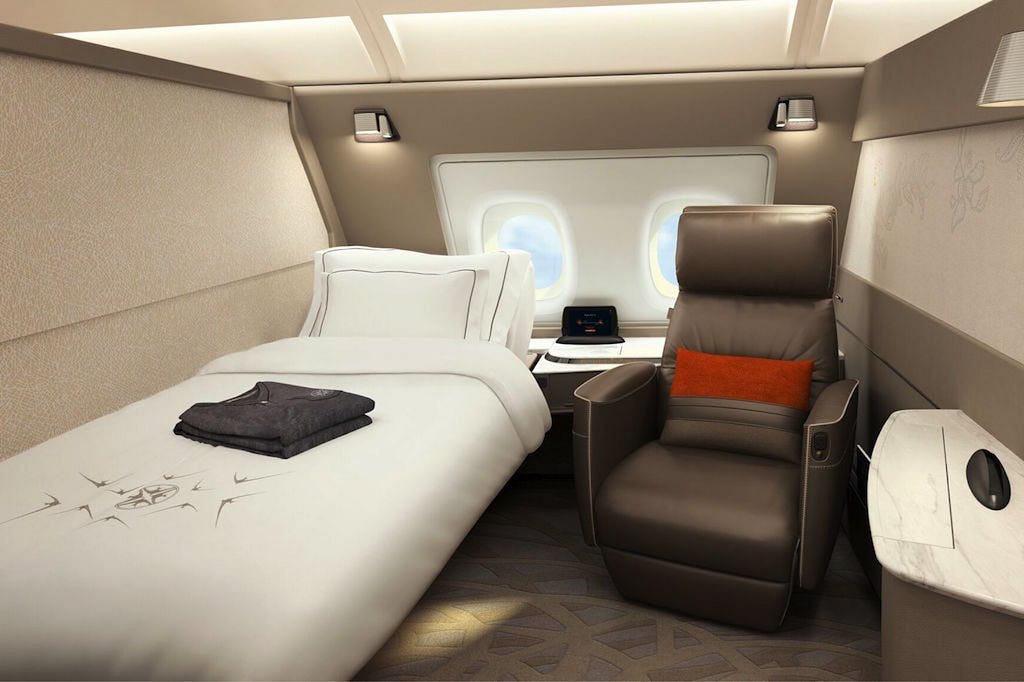
The biggest reason for this change is that Business Class has simply become too good. What used to be exclusive to First Class lie flat beds, privacy, restaurant‑style meals, and massive entertainment screens is now standard in Business. Products like Qatar Airways’ Qsuite, ANA’s “The Room,” and British Airways’ Club Suite offer levels of comfort that would have been unimaginable in Business Class twenty years ago. For most travelers, and more importantly for most corporate travel budgets, Business Class already delivers nearly everything they need. The gap between Business and First has narrowed so much that many passengers no longer see the point of paying extra for First.

There’s also the issue of space. A single First Class suite can take up the room of two or even three Business Class seats. From a financial perspective, that’s hard to justify. Business Class seats sell more consistently, and airlines can earn more revenue by filling that space with additional Business seats rather than a small number of ultra‑luxury suites. This is why airlines like United, Delta, and American have removed First Class entirely, and why others like British Airways, Cathay Pacific, and Qantas have reduced it to only a few aircraft. The economics simply don’t work for most carriers.

Corporate travel policies have also changed dramatically. Years ago, companies routinely paid for First Class on long‑haul flights. Today, almost none do. After the pandemic, travel budgets tightened even further, and Business Class became the new ceiling for most corporate travelers. With fewer business passengers allowed to book First Class, demand dropped, and airlines responded by phasing it out.
But here’s the twist: while most airlines are eliminating First Class, a select group is doing the opposite. Carriers like Emirates, Singapore Airlines, Air France, Lufthansa, and Etihad are expanding their First Class offerings and making them more luxurious than ever. These airlines serve markets with a growing number of ultra‑wealthy travelers especially in the Middle East, India, China, and Southeast Asia. For these passengers, exclusivity matters, and they’re willing to pay for it. For these airlines, First Class isn’t just a product; it’s a brand statement. Even if only a few people fly it, the effect enhances the airline’s entire image.
This is why we’re seeing products like Emirates’ “Game Changer” suite with floor to ceiling doors, Singapore Airlines’ A380 Suites with separate beds and armchairs, Lufthansa’s new First Class Suits allegris, and Etihad’s return of The Residence. These aren’t just seats they are private experiences inside a commercial aircraft. They’re designed for celebrities, billionaires, government officials, and travelers who want complete privacy and are willing to pay a premium for it.

Meanwhile, many airlines that don’t want to offer First Class are creating a middle ground: “Business Plus.” These are Business Class products so advanced that they blur the line between Business and First. Qatar’s Qsuite, ANA’s “The Room,” and Virgin Atlantic’s Upper Class are perfect examples. They offer privacy, comfort, and luxury that satisfy most premium travelers without the cost or space requirements of a true First Class cabin.
All of this leads to a surprising conclusion: First Class isn’t dying. It’s reducing. For most airlines, it no longer makes financial sense, and Business Class has become the new gold standard. But for a small group of global carriers, First Class is evolving into something even more exclusive, more private, and more luxurious than ever before. It’s becoming a product designed not for the many, but for the very few.
The future of First Class won’t be defined by how many airlines offer it, but by how far the remaining few push the boundaries of luxury. For most travelers, Business Class will continue to improve and become the default premium experience. But for the ultra‑rich, First Class will transform into a private sanctuary at 35,000 feet a level of comfort that only a handful of airlines can deliver.
메타데이터
- post_id
- 4974b7302e4e
- slug
- the-strange-future-of-first-class-why-most-airlines-are-killing-it-while-others-are-making-it-more-4974b7302e4e
- url
- https://medium.com/@sidgaviationobserver/the-strange-future-of-first-class-why-most-airlines-are-killing-it-while-others-are-making-it-more-4974b7302e4e
- canonical_url
- https://medium.com/@sidgaviationobserver/the-strange-future-of-first-class-why-most-airlines-are-killing-it-while-others-are-making-it-more-4974b7302e4e
- author_url
- https://medium.com/@sidgaviationobserver
- status
- ok
- fetched_at
- 2026-07-25 07:06:12