Cultural Studies
It’s harder thank you’d think
Cultural Studies
It’s harder thank you’d think
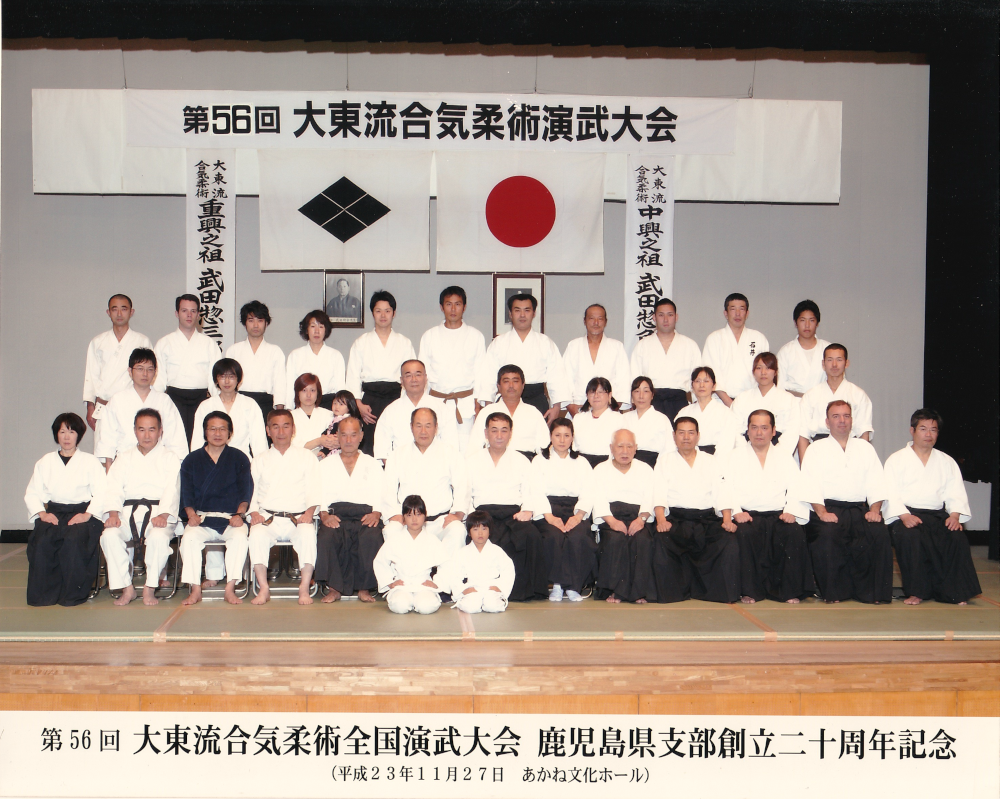
Okinoerabu, 2011. One of the rare recent pictures where all three Kondo brothers are present, and outnumbering the foreigners in the picture.
Budo and koryu training are highly cultural in nature; they are a subcultural representation anchored in the broader Japanese culture. As such, it’s only natural to expect a deep understanding of the cultural canvas on which a tradition paints its practice from the instructors of any dojo of that tradition.
But how much of the culture do you need to learn? How familiar do you need to be with Japanese culture? Is learning Japanese a requirement? Should you also study history? And overall, how invested do you need to be in a tradition such as Daito-ryu?
In this article, I’ll be discussing those subjects, using some anecdotes from my time training in Japan. I’ll also be showcasing some examples of what a lack of cultural investment can result in.
A dumb gaijin
To put everyone at ease, here’s a quick story to show how desperately ignorant I was on my first trip to Japan.
I was to stay at a friend’s residence when I arrived in Japan, and without too much trouble, I went from the airport to the train station where he lived. However, it would be several hours before he would be back from work, and since I had not eaten yet I decided to go to a restaurant nearby.

Not Edamame
Not knowing what to order, I pointed at a picture of green beans and did my best to politely order them. When they arrived, I picked one and bit through the skin; the waitress, seeing me doing so (and my facial reaction after a first bite), had to teach me how to properly eat what I have now learned is edamame.
I’ll insert a pause here to give a chance to everyone to contain their laughter.
The point is, it’s that it’s *easier than you think to be culturally dumb or ignorant. *And having other people to guide you can really help.
Language skills

After reading the first chapters, I’m now scared to imagine what the advanced guide might look like.
Soon after arriving, I found myself in a number of Japanese dojo to train — one of which was the Katsushika dojo of mainline Daito-ryu, where I would soon find a second home.
I’ve always been a slow learner when it comes down to languages. So for the first few years of training, I would rarely be able to do much more than watch carefully, try to replicate and apologize to my irate senpai when I was just being lost in what we were doing.
As I gradually increased my level of Japanese, however, the cloud of unknowing gradually started to lift. I began to have more meaningful discussions with my senpai. He started to tell me more about the practice, in further detail. Those interactions essentially became the missing piece to a feedback loop which informed my practice as I incremented over it.
And as my level increased further, this also started to become true of the discussions I had with Kondo sensei. I know for a fact he wasn’t happy with my progress though; heck, he even took the time to berate me about it in a speech at my own wedding. But the better I got in Japanese, the more specific our conversations became. I was able to ask more pointed questions and to understand answers composed with more subtleties.
Much of the language in Budo is just plain Japanese; some words and expressions, however, are specific to the subculture, and knowing the difference is essential to understanding what is likely of importance to your tradition.
Connecting with others

Okinoerabu, 2011. Right to left: M. Ishii (my senpai), and M. Kuriyama (practitioner of the Katsushika dojo who also practiced under Tokimune sensei). This was the first time I had the chance to meet M. Kuriyama.
The biggest gain from increased language skills was by far the ability to connect with my elders. Beyond simply understanding what they were trying to convey, I was able to feel it. But it goes far beyond the spoken words.
There’s an expression in Japanese for describing someone who is disconnected from what’s going on around them: KY, which is short for kuuki yomenai. The literal translation would be not being able to read the air.
Here’s a very basic example: you make a statement about how you think something is a really good idea, and your Japanese friend just stays silent. Chances are, that means they disagree, but the normal next step would be to propose an alternative view closer to theirs. In short, you need to be able to dig into your relational history and your understanding of your friend to understand what is going on in their mind, address it, and get the conversation back on track.
Might I point out, this is just plain, regular Japanese.
I was having a conversation over email recently on a related subject with an acquaintance who raised the point that most people do not understand intimacy in a feudal Japanese context. I would suggest that most foreigners do not understand it in a modern Japanese context either, which makes the gap of understanding even greater.
Traditional practices use deep human connections as a backbone for teaching and transmission. Without human connection, you will not be able to reach intimacy, and your practice will be greatly deprived. Certain experiences become harder to share and grasp, and the level of genuine understanding you have of the tradition harder to judge.
Culture of habits
Going back to the connection with others, not knowing the customs can also lead to sometimes unpleasant, sometimes funny situations.
Some years ago, we had a practitioner from abroad come for training on a weekend, and when Kondo-sensei is there he generally gets katsudon or oyakodon for everyone at the lunch break (so we may jump back to training as quickly as possible). In Japan, many of the local places will deliver the food on actual plates which you then clean and leave at the doorstep for collection later on.
As such, when everyone was done eating, I had to clean up the plates before returning them. The guest’s plate was still filled with scattered rice, while everyone else’s was pretty much as clean as could be.
Of course, one cannot expect everyone else’s skills with chopsticks to be on par with daily users. But still, people will notice your efforts — or lack thereof — to integrate with the general culture.
All that to say, it generally pays to be a pleasant guest.
There are certain parts of Budo practice that presuppose a certain basic cultural behavior and understanding. For instance, senpai/kohai isn't a Budo concept, it’s a broader Japanese concept. Not all seniors are your senpai. While it will have a distinct expression in koryu and Budo, it is still connected to the more generally accepted concept. And knowing the difference matters.
History

Not all history is ancient. Aikibudo Newspaper published by the Daitokan (Source: personal archives)
Most serious practitioners would agree that pursuing historical research is essential to develop a clear and true understanding of your practice. However, doing so can be extremely challenging without proper linguistic and cultural understanding — and, more specifically, a mechanism to gradually refine both.
I intend to write a longer article on the subject in the future. For now, I just wish to point out how difficult it is to interpret historical records. Beyond archaisms and kuzushiji, you also need to interpret the content in a way aligned with the historical and cultural context.
Lucky for us, there are a number of books and publications covering koryu history, but while informative, many also often tend to be rather subjective interpretations. This is entirely understandable, given how open to interpretation the documents available to us today are, and how little research coverage many specific topics get.
But there’s a deeper reason for that I believe. Koryu, by nature, is essentially a tuning exercise. If you study the history of a koryu, it’s generally to deepen your own understanding and inform your own practice.
While there exist translations and material in English, there’s really nothing like doing the interpretation work yourself.
Asian Fusion
The world of martial practice is filled with instructors who have never even set foot in the country of origin of their practice — in the case of Budo practices, in Japan.
And yet, they borrow all the terms, languages, and cultural traditions. They speak of rei as if it could be directly translated to respect, pretend to have read documents that are not even translated into modern Japanese, and ultimately try to reproduce the practice by looking from afar.
[embed]Something “akin” to Daito-ryu?
This brings us to Daito-ryu. Which the above certainly is not; at best it is a poor imitation spiced up with visually “cool” movements having nothing to do with martial pragmatism, let alone Daito-ryu culture. I’m not sure what the sword practice is supposed to be inspired by, either. It’s certainly not looking like anything I’ve seen or studied.
And I think anyone who knows anything about Japanese culture will find themselves scratching their head at how the tasuki is being used here.
Appropriating another culture simply for style or show is wrong. It leads practitioners to believe they are learning something valuable and culturally accurate. You make a fool of yourself, and likely fools of others walking in your tread.
Big in Japan
This is not just a problem abroad, but also in Japan. For instance, there are some lineages claiming their roots to Saigo Tanomo and Saigo Shiro, instead of Takeda Sokaku.
[embed]Saigo-ha Daito-ryu seminar, 1991
I’m pretty sure this would come as a surprise to any researcher studying those two historical characters. And I suspect this is why both the article on Wikipedia and this website now seem to state that Saigo Tanomo was a “spiritual influence” and that their practice is in no way connected to what most would consider Daito-ryu proper.
つまり、西郷派大東流のルーツとなった山下芳衛系の大東流は、武田惣角系やその他の大東流とは全くの別物であり、たまたま名前が同じであっただけ、という結論である。時代によって、武田惣角系を初めとする大東流諸派との共通点を探ってきた西郷派大東流ではあるが、現状、他派とは異なった体系・思想を有する武術団体としての立場を明確にしている。 — Wikipedia
But how many people at this seminar believed they were learning Daito-ryu from a genuine lineage, I wonder?
The information I could find from other sources is rather limited, but so far, there really seems to be no link to Daito-ryu at all. I’d of course welcome any information which would demonstrate otherwise.
Japanese and foreigners alike can become guilty of cultural appropriation. Daito-ryu is a narrow subculture with its own traditions, history, and idiosyncrasies, one that takes years of exposure to become familiar with.
Aikidos and Aikidon’t
I tend to say that I have never practiced Aikido. But it’s not exactly true.
[embed]Chida Tsutomu sensei, one of the instructors I had the chance to train under once
On my first trip to Japan, in 2007, I trained for 2 weeks at the old Yoshinkai dojo in Shin-Nakano, while at the same time participating in Daito-ryu training at the Katsushika dojo.
Fast forward to 2009, I came back for more training. Meanwhile, I had kept up practicing Daito-ryu in Canada in the meantime but had not pursued Aikido any further.
And yet, one of the first things I was told was to stop doing the kata like Yoshinkan techniques. Not because it was bad, but because it is not Daito-ryu.
I was essentially told to leave my preconceptions at the door.
A large number of Daito-ryu practitioners arrive at Daito-ryu through Aikido practice. I suspect some see Daito-ryu practice as an extension of Aikido. But I find this understanding a bit backward: Aikido came in large part from Daito-ryu, not the opposite. As such, it must include key differences and philosophies.
As such, you need to put aside your other practices when practicing Daito-ryu. You need to study Daito-ryu for what it is, not through the prism of another practice.
You should also make a clear distinction between the practice. You should definitely segregate each practice, and avoid mixing them into one. Doing so without the approval of your Daito-ryu instructor would certainly be frowned upon, and would most likely not be allowed.
Conclusion
You can become part of the culture, but should not appropriate it unduly. Besides being disrespectful, you won't be able to confirm whether you are doing anything right, and may even lead others in the wrong direction.
When practicing Daito-ryu, we essentially borrow a cultural practice to better ourselves in some way. This is as true for Japanese individuals as it is for foreigners; everyone needs to be introduced to the specificities of a tradition’s subculture.
All the language, culture, and human connections are a conduit to reach some form of intangible truth. Something beyond idiosyncracies and words.
If you are to practice proper Daito-ryu — or any other koryu, for that matter — you will need to put aside your other practices for the time you are on the mats practicing Daito-ryu. You will need to learn at least some Japanese. You will also greatly benefit from conducting your own historical research, develop an above-average understanding of the Japanese culture, and developing your own personal connections with other people part of the tradition.
Spend the time learning the language. Spend the time learning Japanese culture. Spend the time learning Daito-ryu history. Make up your own educated opinion instead of relying on others.
You might not become great at any of it, but I can guarantee you: the effort is worth the investment.
메타데이터
- post_id
- 4979d259e7c
- slug
- cultural-studies-4979d259e7c
- url
- https://daito-ryu.blog/cultural-studies-4979d259e7c
- canonical_url
- https://daito-ryu.blog/cultural-studies-4979d259e7c
- author_url
- https://medium.com/@marc.trudelbelisle
- status
- ok
- fetched_at
- 2026-06-23 06:34:20