Tilopa’s Sage Advice
By Michael Erlewine
Tilopa’s Sage Advice
By Michael Erlewine
In my sixty-some years of doing my best (trying to learn) to practice dharma, there are a few pithy (short and easy to remember) suggestions that have stuck in my mind and actually turned out to be of great use to me. None more so than the classic “Six Words of Advice” of the great Mahasiddha Tilopa. Here are the main four of those six; see below for all six.
(1) Don’t Prolong the Past
(2) Don’t Invite the Future
(3) Don’t Alter the Present
(4) Relax, As It Is.
These are just words, but they are considered words that have been echoed down the dharma lineages through the centuries. The Mahasiddha Tilopa was not just another lineage holder, but aside from the celestial Vajradhara from whom Tilopa received his inspiration, Tilopa is the head of the particular Mahamudra lineage I belong to, the Karma Kagyu Lineage.
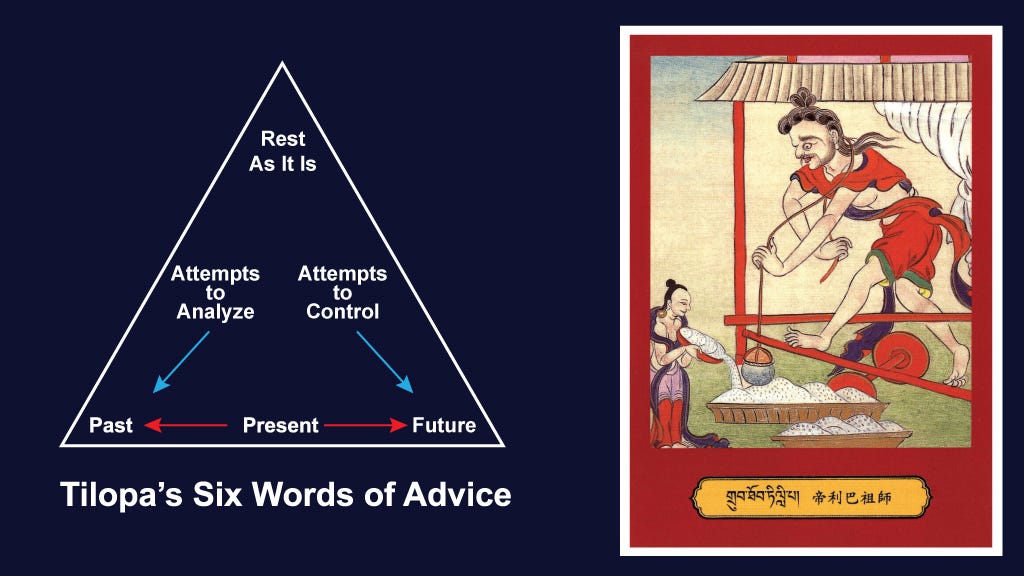
To make these words of advice clear, I even include a little diagram or map I drew up to make it (hopefully) easier to absorb. I find that these words of advice help me to be more aware as to where my mind is currently focused. As they say, who knows where the mind goes. Sooner or later, we must Know.
And too much of the time I am anywhere but where I would like to be. That is why these six words of advice have been so valuable for me. Being reminded (becoming aware) of what I am actually doing with my mind (and my time), even roughly, points out to me that I am usually, as they say, “Every which way but loose.” And how is that?
That is because I am easily distracted and prone to jump on any passing train of thought and take a little ride, a ride that seldom goes anywhere I really want to go. It just wastes time and is at best entertaining, scary, worrying, and so on. And it is a good thing that I like movies, because most of the time I seem to be watching one of my own projections and not enjoying (or at least reacting) to it at that. This tendency to ignore the true nature of things is what Tilopa is pointing out. Ignorance amounts to what we ignore and have habitually ignored.
Tilopa suggests that we allow the mind to rest naturally, like we would if we sit down in a big soft chair after a day of hard work. Relax. It is not like there is a ‘right’ place, object, or subject to allow the mind to rest on, but there does seem to be a right way of resting, one that allows mindfulness and clarity to arise.
In other words, this or that object or subject of focus (whatever we are thinking) is not “bad” (or “good”) in itself, and negative attachment (revulsion) is no different from positive attachment (love and like). The ignorance of attachment is itself attachment. Buddhist fundamentalism would be no different from any other kind of fundamentalism, dividing the world into good and bad, subject and object, and so on.
That is not what the dharma intends.
Tilopa points out that it is best not to dwell (be attached) to the past, present, or future, although, as we well know, they are all equally attachable. Don’t spend all of your time there. By that same token, what Buddhists call the “Three Times” (past, present, future) are all more than workable, from a dharma standpoint. We can start where we are at this moment. There is no need to run to or from the three times. Tilopa says to just relax and leave thoughts of the three times go, just as they are. Don’t bother to pretty them up or even think about them. Let it be.
Tilopa suggests that we “let go” of the three times, not either glorify, deny, or shun them. Thoughts of the past, present, or future are all just that, thoughts. We are advised to become aware that we have become attached to and fixated on these thoughts and just let go of the attachment and rest in the ensuing release and flow.
In the more advanced meditation practices, practitioners are taught not to just look at the content of a thought (what the train of thought is about), but instead to look at the nature of that thought, and the most remarkable thing is that all thoughts share the same nature. Once we have seen and realized the actual nature of one thought, we have done the same for all thoughts, past, present, or future. But this ability to realize this takes time and practice. We have to train in this.
Tilopa suggests to not prolong the past, invite the future, or think about or alter the present. His message, as mentioned, is about not becoming attached or carried away by thoughts, like getting on our train of thought and taking a ride without being mindful that we are doing just that — being distracted. Tilopa’s is an easy method for waking up and becoming aware of what we are doing each moment. Take a look; be aware.
When Tilopa says let go and ‘rest as it is’, that rest is beyond attachment of any kind to the past, present, or future. We let go once we realize that we have become attached, but we first have to realize it.
For example, if we find ourselves prolonging the past, trying to figure it out, etc., Tilopa does not mean for us to somehow get out of the past and into the present or future instead. All three times are misdirection. In fact, there is no particular place to go, as Chuck Berry pointed out. Tilopa means for us to let go of our ‘attachment’ to the past, present, and future and just rest as it is — however we are always in the present moment. And because we are not used to just being present, this can be very hard to do. We can’t stand to let go!
Past, present, or future makes no difference. The three times are identical in nature and are not sources of refuge for us.
Attachment itself is not somehow evil or bad by nature. Attachment to anything only distracts and obscures our authentic nature from being seen, which is why Tilopa suggests we let go of attachment to the three times and just rest in the true nature of the mind itself, which is something we can learn to do. And he is showing us how.
For me, these six words of advice serve as constant reminders for me to be aware, realize, and once I locate my attachments and reactions, relax my hold on them, and learn to just let them go so that the mind can clear.
I find that this is a process that I can gradually learn to do all throughout my day, not just in formal sitting-meditation practice. The amount of time I allocate to sitting-on-the-cushion practice is nowhere near the time I can spend in this practice that Tilopa suggests. There are few dharma practices that I have come across that are as easy and simple as this one. Anyone can do it and you can start right now, in this present moment.
I realized early on that going to church on Sunday for an hour or so would never be enough to get a rascal like me into any kind of heaven or enlightenment. It would take real practice time for me to realize much of anything. Tilopa’s six words of advice are an easy opportunity to accumulate real practice time, like: all day long. It is, as they say, a no-brainer!
I include here Tilopa’s suggestions for those who may have missed them until now.
TILOPA’S SIX WORDS OF ADVICE
Let go of the past, rather than prolong it.
Let go of the future, rather than invite it.
Let go of the present and don’t alter the present
Let go of analyzing, rather than figuring anything out.
Let go of controlling, rather than trying to make things happen.
Relax right now, just as it is.
In summary, the method Tilopa presents is to not alter the present moment and to relax, just as it is.
[Diagram by me.]
EMAIL Michael@Erlewine.net Note: If you would like to have access to other free books, articles, and videos on these topics, here are the links:
Free books: SpiritGrooves.net.
Free Videos: YouTube.com/channel/UC3cL8v4fkupc9lRtugPkkWQ
MAIN BLOG: https://www.facebook.com/MichaelErlewine
https://www.instagram.com/erlewinemichael/
https://michaelerlewine.substack.com/
https://medium.com/@MichaelErlewine/
As Bodhicitta is so precious,
May those without it now create it,
May those who have it not destroy it,
And may it ever grow and flourish.
메타데이터
- post_id
- 4983bd69d4b7
- slug
- tilopas-sage-advice-4983bd69d4b7
- url
- https://medium.com/@MichaelErlewine/tilopas-sage-advice-4983bd69d4b7
- canonical_url
- https://medium.com/@MichaelErlewine/tilopas-sage-advice-4983bd69d4b7
- author_url
- https://medium.com/@MichaelErlewine
- status
- ok
- fetched_at
- 2026-07-19 02:17:21