Kuro no Kiseki II: Crimson Sin art book interview
A translation of of the Kuro no Kiseki II Official Visual Collection art book interview with Falcom president Toshihiro Kondo.
Trails through Daybreak II art book interview
The following is a translation of an interview with Kondo Toshihiro, president of Nihon Falcom, as published in Kuro no Kiseki II Official Visual Collection, released in Japan on 16 February 2023, pp 152–159. It also contains spoilers for Trails through Daybreak II and all earlier games in the series. A special thanks to Koyushii’s invaluable corrections and additions.
Please continue reading at your own discretion.
Trails through Daybreak II’s theme of ‘original sin’ and exploring new ways of story-telling through time leaps
Transferring time leap memories into the sequel
It’s been over four months since Trails through Daybreak II was released. What kind of feedback did you get from players? In predecessor Trails through Daybreak we did our best to offer new elements and with Daybreak II we aimed to evolve that direction by further improving those elements. The main features of the game are the seamless battles and return of mini-games, like fishing, which had been part of previous Trails games couldn’t be implemented in Daybreak. We received a lot of positive feedback on their return. On the other hand, players were vocal about the story. The game contains some rather shocking scenes and were received mixed feedback to this. Fan favourites regularly ended up in horrible scenarios and the response was quite divisive. That said, I have the feeling that overall we achieved more than what we originally aimed for.
What impressed me most was the rewinding and time leap mechanics of the Genesis. Nothing in the setting of the series so far was directly related to time leaps. Introducing time leaps like this allowed us to explore new developments. I also believe that this will be a point of reference for how to continue into the sequels. By the way, we had already decided to include time leaps when we announced that the character (刻) from time (時刻) would be a keyword in Daybreak.
The prologue of Trails from Zero opens with a scene where the Special Support Section is defeated, which was undone by KeA as the Sept-Terrion of Zero. Does that event differ from the time leaps in Daybreak II? [end of p152] That perplexed me as well and I discussed this with the staff during development. In KeA’s case she changed the past, a phenomenon that occurred during the recreation of the Sept-Terrion of Mirage. She didn’t rewind time, so it’s different from what’s happening with the Genesis time leaps.
Time leaps were an important component in structuring the game’s story and as a result, there were quite a few bad endings resulting in a character’s death. What difficulties did you run into creating these parts? At the start of the series we planned to not show the deaths of major characters, with the exception of a few. For this game, however, we deemed it necessary. Some talented and competent characters also met their fate, so the scenario writers took great pains to show these events to the game’s audience in a convincing manner.

Time leaps are a by-product of the Oct-Genesis. Van and his companions experienced the rewinding of time due to ‘forced resets’ using the Genesis, that enabled them to repeatedly retry after they observed an undesirable outcome’.
As for the consequences of time leaps, the game hints at several possible outcomes for Calvard and there are characters who retain those memories. Will their memories of time leaps be gradually forgotten as events converge? I think those who experienced time leaps first-hand will retain those memories. Zin and Kirika remember their Shard bodies were used during the coup d’état. As a result, they may still feel like they owe President Gramheart. (laughs)
Memory retention varies from person to person, doesn’t it? For example, the Z-1 racer Arslan hadn’t been touched by the Genesis and seems to remember only that something happened. The closer a character is to the time leap’s core the moment it happens, the more memory they’ll retain of this peculiar event.
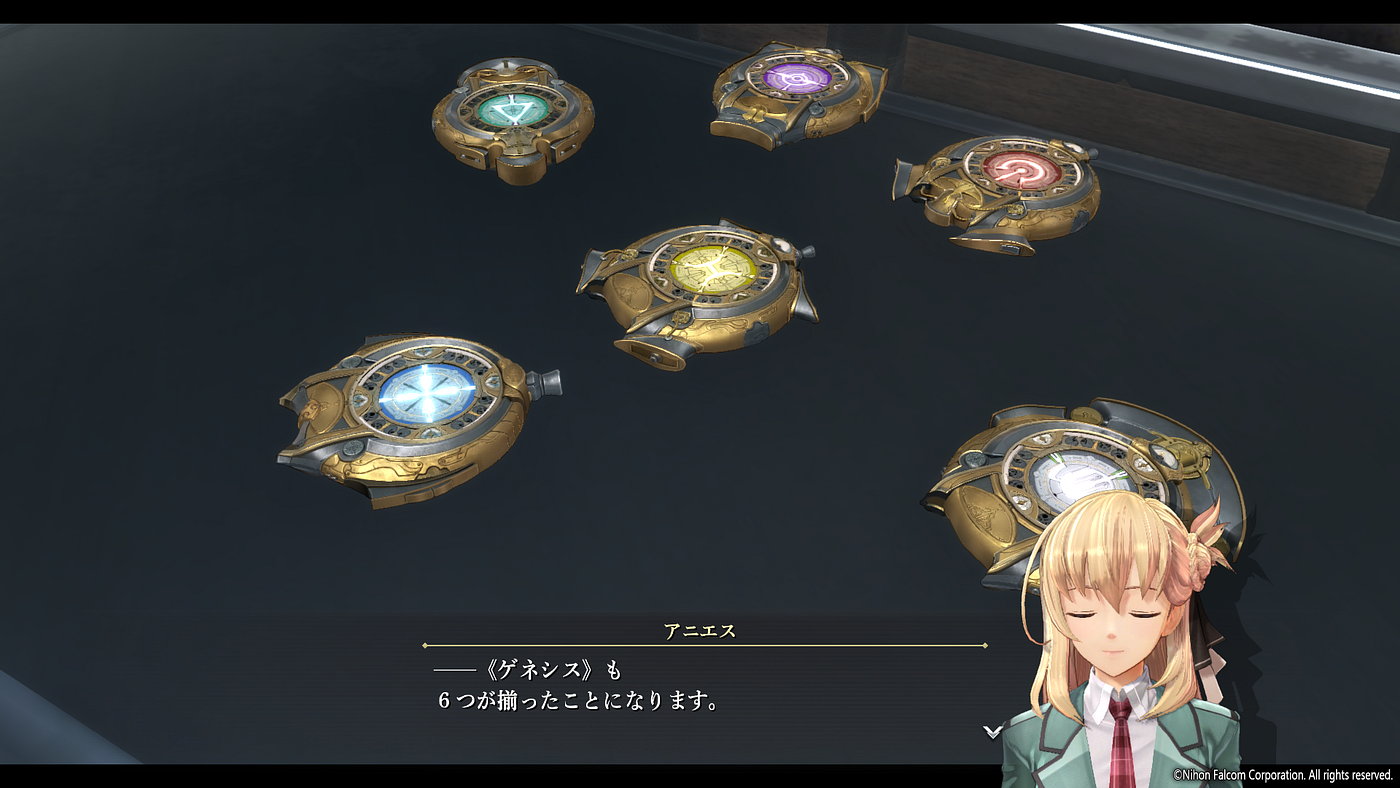
In Daybreak II all eight Genesis are collected. As octo [meaning eight in Latin] in Oct-Genesis suggests, is there also a special function that can only be activated when all of them are gathered? That’s the part where we’re delving into the truth behind the Calvard arc. The next game will reveal these details. Please look forward to it. Everything about the Genesis itself also hasn’t been completely uncovered yet. The devices must’ve had what we could call their original purpose. Even the time leaps in Daybreak II may have been a secondary feature. I think the memories Van and his friends experienced in the game will play a role in getting to the truth behind the Genesis.
New elements and improvements in Daybreak II, starting with Märchen Garten
The Märchen Garten is a major new addition in the game. What reasons led to the creation of this freely accessible dungeon? The game’s story consists of multiple chapters with changing settings and occasional shifts in time periods. That choice limited our options to offer a more traditional RPG experience where many party members fight together. So one of the reasons was to have a place where we could circumvent this limitation. Another reason came from the story’s direction, which resulted in cities and dungeons as battlefields. Staff members expressed their wish to also have characters fight in more natural environments, to have that sense of spaciousness. I actually remember a similar request from the staff during Ys IX. (laughs)
In the early concept artwork, the Märchen Garten was portrayed as a much more simplistic dungeon. At what point did the place become more entangled with the main story? The moment we decided on the Märchen Garten, we also decided to include it in the story. We had Trails into Reverie’s True Reverie Corridor in mind when we created it, but we wanted to integrate the Märchen Garten into the main story. So we used Marduk Company because they’re a deeply mysterious organisation, of which we’ve learnt in Daybreak that we’ve got no clue how much technology they actually possess. So we used it as a means of access to those familiar environments.
Märchen Garten also enables player to strengthen crafts. What was the idea behind this feature? Märchen Garten is neither a main nor a sub dungeon, so it introduced a flavour we hadn’t tried before. We wanted to motivate players to take on the challenges of a place like that without risking the feeling of a bonus too much. Players might feel forced if you make such a place mandatory. That’s how the plan to bolster crafts came into play. Although it’s possible to finish the story without bolstering crafts, doing so could smoothen battles and make playing the game more enjoyable. Personally, I worried it would be redundant because the game also offers other ways to improve your characters’ strength. Still, exploring of Märchen Garten, collecting training stones (錬成石) through Shard Token analysis and bolstering crafts turned out to be good combination.
In Märchen Garten you can freely assemble your party. Which characters were popular? Many players use their favourite characters in Märchen Garten. Among them Shizuna is the most popular one. She can tag along for a long time since she becomes available in Act 2 and performance-wise she’s an outstanding addition. Another reason she’s used so often is simply because she’s a popular character, based on surveys. Many staff members also included Shizuna in their party. Swin and Nadia are also popular. Both have been easy to use since their introduction in Reverie, but now they came equipped with more crafts and powered up S Crafts.
The combat mechanics system saw a number of improvements, like the EX Chain. How was the response to these additions? We managed to implement everything we could think of in Daybreak’s battle system, bringing combat to full fruition in one go. When we looked back after a while, however, we came up with ideas that could further improve certain aspects. Two of those were the Quick Arts during field battles and EX Chain during turn-based combat. These additions streamlined the flow of battles. By incorporating these additions in Daybreak II, we could make battles more enjoyable and polish the system even further. [end of p153]
Oct-Genesis, Zeque Space Military Base, Saint of the End: preparing for the sequel as mysteries thicken
Another system unique to the Calvard arc is LGC Alignment, which shifts around based on your choices. The system had a major impact on the story in Daybreak, such as changes in the organisations you fight alongside, but it didn’t have much an effect in this game… LGC Alignment was horribly incompatible with Daybreak II’s story centred around time leaps. (sweats) Leaping back in time may renders your choices meaningless, though perhaps not all of them… That’s why this game ties it to the Black Tamahagane (黒玉鋼) in the last dungeon. We’d like to revive the system in the next game as something tied closely to the story.
In the game there’s trailing, hacking, card games, basketball and — back for the first time since Reverie — fishing. Please share why you added so many mini-games. The underlying mechanics for fishing were in place for last game, but due to various reasons we couldn’t implement it. That’s why we felt we had to add it to Daybreak II. Ideas for the other mini games also originated from our work on Daybreak. We even added a basketball court in Edith City’s Saiden District. Trailing a target was born from our search for a mini-game befitting a Spriggan.
There were also events, like the big wheel or bouldering, that looked like they should’ve been part of a mini-game or an activity but actually weren’t. That’s right. Perhaps we can use them in the next game. (laughs)
Lingering mysteries of Arkride Solutions Office members and points of interest for the sequel
I got the feeling that this game deepened Agnès’ and Elaine’s feelings for Van. Will the next game provide a clear conclusion? What will happen is something we can discuss after next game. What I can say is that I don’t expect a situation where it’s up to the player’s choice, like in the Cold Steel arc. In Cold Steel we used that system to show student life and the bonding with friends. For the Calvard arc we want to introduce another system for personal relationships.
For players it felt like the ultimate dilemma, choosing between Agnès and Elaine during the Aramis School Festival. (laughs) I suppose the relationship with the female leads is one of the game’s appeals. We would like to approach this in a different way than we’ve done in the series so far.

The decision between Van’s companion during the Aramis School Festival in the Final Act: Agnès or Elaine? How will the relationship between Van and these two develop in the next game?
Another Arkride Solution Office member is Aaron, whose biological father Leroy makes an appearance and mentions curious details, like ‘that blood’. Does he also have a profound bond with the Taikun that slumbers inside Aaron? That’s rather difficult to talk about right now. What I will say is that it’s a clear hint that Aaron, Leroy and the Taikun are all red-haired. I’ll leave the details to your imagination. Of course, we don’t introduce new characters for no good reason in the series. That includes Leroy.
Among the artwork published in this art book is an illustration of what looks like Aaron becoming the Tyrant. Is this foreshadowing? The weapons in the illustration certainly look like Aaron’s. Perhaps this will be used in the future. Consider it as a possible idea for Aaron for now.
The brotherly tribe that share their ancestry with the Kurga, as discussed in Feri’s Connect event, turned out to be the nomadic people of Nord Highlands, introduced in the Cold Steel arc. Could you explain why the original tribe branched? The nomads originally arrived in the Nord Highlands about a 1000 years ago and it’s said they came from the east. Based on the similarities in skin tone between Gaius from the Cold Steel arc and Feri, it looks like they originally descended from the same ethnic group. Looking back at everything the people of the Nord accomplished, it’s clear they assist the people who ended up shaping Erebonia’s history. Back in the day they supported Dreichels and in the present age Gaius helps Rean. Their actions must be in line with their peoples’ aim. If so, there must be a reason why the Kurga tribe remained in the east. Keywords like ‘the wind’ for people of the Nord and ‘breath of fire’ for the Kurga should fuel your imagination.
Feri danced as the shrine maiden of the Kurga. Her position as shrine maiden is presented as being somehow important, right? Passing down the position of shrine maiden must hold some meaning for the Kurga clan. Her brother Kasim also mentioned something along those lines, so please look forward to Feri’s future.
From reports we’ve learnt that Risette never went to school. There will be more about her in relation to Marduk Company in the future, like why she has no experience with school life and why she’s in her current body.
In the chapter Fragments Quatre’s intersex characteristics and angelic powers are revealed. We really zoomed in on Quatre this time. It looks like Quatre managed to put behind some of the burdens from the previous game.

Secrets regarding Quatre’s birth and past with the D∴G Cult were revealed. The angelic power that remains in Quatre’s body will also appear in the future.
I’m actually more interested in Professor Hamilton’s next move than Quatre’s. As a gentle, bespectacled character, she’s undoubtedly an easy target for many theories as to who the Trails mastermind is. (laughs) As one of the three disciples, there’s likely something going on with Professor Hamilton. Although she looks like a soft-natured elderly woman, her relationship with Professor Epstein hasn’t been clearly depicted yet. I suspect this will be the crux going forward.
By the way, are there plans for the 14-year-old Risette or internet idol Quatrea to reappear? I honestly don’t know. (laughs) Perhaps there’s a role for them in some way, but that depends on how things pan out.
The game reveals that Judith can transform into Grimcats through the use of a portable powder case. It was made 50 years ago and given to Dominique, the Grimcats of that time. Was it Professor Epstein who gave it to her? I won’t affirm anything at this point in time, but ‘50 years ago’ is definitely a keyword here. Doesn’t the design of the powder case have a contemporary finishing touch, though? (laughs) There are still many unanswered questions surrounding Grimcats, like why was Dominique chosen for this role, why do they behave like social thieves and why is the role inherited like it’s a family business? [end of p154]
The future reveals of Shizuna and the jaeger corps Ikaruga
I was surprised to find Shizuna as our ally until the end. Will there be another chance to cooperate in the future? That depends on the situation and may change depending on how the story of the sequel unfolds. That’s perfectly in line with Shizuna’s personality: it’s not out of character for her to lend us her strength as an ally and also to step up as an enemy, just like in Daybreak and in this game. That’s also the nature of Ikaruga as a group. They’ve been working under the Republican government’s contract until the completion of Zeku Space Base. We don’t know what they’ll do after that contract is finished.
Daybreak II revealed several new facts related to Ikaruga, but the organisation remains shrouded in mystery. It’s been revealed that Yun Ka-fai was its former chief. It’s also an important group to keep an eye on in the context of the entire Trails series. Although they claim to be a jaeger corps, you don’t get the impression that they’re in for the mira like other jaeger corps. What I can say without a doubt, however, is that Ikaruga is one of the organisations deeply involved in the story going forward.
Who exactly is Obaba (オババ) often mentioned in dialogues and seems to fill in for Yun Ka-fai as chief of the Ikaruga? Obaba is not the current chief of the Ikaruga. What we know about Obaba right now is that she’s well-versed in folklore. Also, based on how her surroundings treat her, she might be related by blood to previous chiefs.
Is the fact that Shizuna is called ‘princess’ also related to her bloodline? I can’t affirm that, but there’s a meaning behind the way characters address each other, so it might be a good idea to sort out such information.
The game also hints that the Black God One Blade school and Eight Leaves One Blade school have the same ultimate goal but different approaches as to how to achieve it. I wonder what specific differences there are. The game explains that Black God One Blade is the sword ‘of darkness’ and Eight Leaves One Blade is the ‘sword of light’. The fundamental difference is that Black God One Blade can’t be learnt by ordinary people, because it requires a level of reason or logic (理) that would drive a normal person mad. That’s why the school of swordsmanship is passed down only to someone who has transcended something, like Shizuna. Yun Ka-fai devised the Eight Leaves One Blade so that even a human can learn the Black God One Blade school. Eight Leaves One Blade knows several forms and a practitioner must master one form and comprehend all others to attain aforementioned reason or logic.
According to Shizuna, it appears to be difficult for someone outside the Black God or Eight Leaves schools to reach the eastern part of Zemuria. Is this simply a matter of power or does getting there require something special that practitioners these two schools do possess? This will also be addressed in the next game, so I’ll refrain from commenting. It’s true, though, that only a few people like former Ikaruga chief Yun Ka-fai managed to set foot in Eastern Zemuria. Please note that among this limited group of people is Professor Hamilton, a researcher.
Rufus’ whereabouts while Swin and Nadia’s relationship deepened
I felt that Swin and Nadia became much closer after their battle with the Garden Master. Is it safe to assume they’ve grown out of their brother-sister relationship? During the Aramis School Festival in the Final Act, Swin surprised Nadia by demonstrating an assertive attitude we hadn’t seen before, so I think they’ve taken a step forward. Swin used to be burdened by the idea that he had to take Ace’s place as Nadia’s older brother, fuelled by the guilt of killing Ace. Being able to talk to a grown up Ace, even though it was a simulation, must’ve been liberating for him. Think of Swin and Nadia’s relationship as finally having reached a starting point.
Although the simulacrum was a representation of Ace, it knew about their exploits during Reverie. When was it simulated? Ace himself died at the age of 15. The simulacrum was a simulation of a future in which Ace hadn’t died. That’s why the simulacrum had the original Ace’s memories while also knowing about Swin and Nadia’s decisive battle with Emperor.

A fateful encounter with Ace liberates Swin from the guilty consciousness he’d been harbouring. In the events that followed, he showed a level of assertiveness that surprised Nadia.
Just as the consciousness of Auguste alias the Garden Master was absorbed into a D∴G cult artifact, I thought Ace’s consciousness was also absorbed into this artifact. The Garden Master, who had kept his consciousness concealed inside that artifact for a long time, discovered the simulacrum of Ace after the Garden’s destruction and used it for his own ambitions
Is it possible that Rufus, Swin and Nadia’s leader, didn’t show up in Calvard because he’s working on something else? That’s wholly due to the unusually strict surveillance of, for example, the CID. If you really think about it, Rufus is an extremely dangerous man. (laughs) First he throws an empire into disarray and then his simulacrum is set on destroying the world. In the eyes of the public he died and therefore a small part of him is forgiven. From the perspective of Calvard’s government, however, the revelation that Rufus is in fact still alive would be nothing short of an alarming situation, especially now they’re preparing the major announcement of their Zeku Space Base. That’s why surveillance is unusually strict and why it’d be impossible for him to enter Calvard. Of course, Rufus himself understands that he’s in no position to make a sudden appearance. Also, another reason is that Rufus had assets stashed here and there, but these were all confiscated and now he simply lacks the funds needed for his exploits. (laughs)
What recurring characters will make their debut in Calvard?
Pater-Mater served as parents for Renne and was revived as AI. What are the chances of it reappearing in a body like the Gordias-class? That’s technically possible. If you were to install Pater-Mater’s AI in an Assault Frame, it might resemble its earlier appearance. Whether this will actually happen, I don’t know.
I felt that Zin played a lot of unfavourable roles in this game, like his Shard body being used. Wouldn’t this be a good opportunity for him to accept his promotion to S-rank bracer? Zin was promoted to pre-S-rank bracer before the start of Daybreak as recognition for his achievements, but for some reason he dropped the ball when the game’s spotlight focused on him… Then again, if someone else had been in his shoes they also wouldn’t have been able to avoid their Shard body getting used, so in that sense he really couldn’t help it. The Calvard arc isn’t over yet and there’s still room for him to shine, so please keep your eyes peeled on Zin. [end of p155]

Pater-Mater destroyed itself and ceased functioning during its rescue of Renne in Trails to Azure. Five years later, Pater-Mater returns to Renne’s side as the AI of a Hollow Core.
Shards were used in various ways, like the Shard body of Zin and Kirika. Grendel is also a Shard body. Please explain again what makes a Shard special. Shard is written as 霊子装片 in kanji. The first character (霊) means ‘spirit’, so basically you can think of it as a piece of spiritual energy. Then there’s the orbment, which has an internal mechanism that causes all kinds of phenomena and is used without users understanding the fundamentals. The usage of Shards is cutting-edge orbal technology where orbments create force fields of energy depending on the situation.
Speaking of Shard bodies, Grimcats is also like that. Grimcats has been around for 50 years now, so why has this cutting-edge technology been used since that time? That’s part of the setting. I can’t discuss it in detail because the story will still address the mysteries of the orbments first introduced in Trails in the Sky.
By the way, going back to Zin again for a bit, he was promoted to playable character in one of the updates. Fie was also added. How do you decide which characters to add? For the 13 October update we picked characters that would naturally fit in with the story. Fie has transferred and is now officially a member of Calvard’s Bracer Guild. Her return to Erebonia in Daybreak’s ending was temporary. She was already planning to return to the Calvard and to fight.
As for characters outside Calvard, Lila from Liberl Kingdom showed up for the first time in a long time. Can we interpret her appearance as foreshadowing related to Liberl? We don’t know right now. As a neighbouring nation, Liberl might be concerned what Calvard as a superpower will do next and it’s possible Lila may play a role in this.
I’m also interested what Liberl looks like now. It used to have this pastoral, idyllic atmosphere. The culture in Calvard and Erebonia has advanced, so I think those developments will have had an effect on Liberl as well. Zeiss, the Industrial City, might have changed beyond recognition. Even we didn’t expect Zemurian culture to develop to this point. At the time of Sky we just wanted to make steampunk, we never expected it turn out like this. (laughs)
Among the Erebonians we’ve discovered that both Towa and Crow are active in Calvard. What are the possibilities of other Round of Seven members travelling to the Republic? That’s certainly possible. There’s already been a scene in which they mention Gaius in relation to the Septian Church. That said, there’s a lot to cover of Calvard’s story and the plan is to prioritise existing characters and organisations.
The next game will reveal Calvard’s mysteries, like the Genesis and the Zeque Space Military Base
Grendel-Zolga’s true identity turned out to be Dingo, who also had been giving advice under the name of ‘C’ as if he knew the future. Can you tell why Dingo did this? As told in the game, he was drawn into the Genesis and transformed into Grendel-Zolga. I can’t reveal further details [of why Dingo was chosen] yet, as this will be addressed in the next game and will connect to the rest of the story. After finishing the 13 October update, you even get a hint regarding a connection between Dingo and Hamilton. What she means when she mentioned ‘that time’, and everything leading up to, is not just from Dingo’s side but also from Hamilton’s. That very part plays a role in the truth behind the Genesis.

Having seen everything, atop the Trion Tower Professor Hamilton mutters to herself that she can make it in time. What exactly did Dingo entrust her with?
Whenever Dingo speaks as if he knows the future, Professor Epstein comes to mind, who wrote in his notes that ‘the world will end in the year 120X’. Why he was able to create the things he made 50 years is another mystery. It’s said he created the Genesis, but did he completely understand its functions? I’ll go ahead and say he did ‘understand’. Furthermore, there’s information in the notes in Agnès’ possession, suggesting there was some kind of intention.
The revolutionary Auguste was the true identity of the Garden Master. Will the sequel explore the story behind Calvard’s revolution, the time in which he lived, and especially Sheena Dirke? That’s the plan. Even though Sheena wasn’t discussed in its main story, you could find several anecdotes about Sheena at the statues of Dirke Memorial Park in Daybreak. All of these were put in entirely intentional. That’s how Auguste appeared in Daybreak II. What he was actually doing is something we kept intentionally vague.
In previous Trails arcs the history of each nation played an important role. Will stories from the time of the revolution play an important role for Calvard as well? I don’t doubt that the republican revolution will play a major role on par with the unexpected revelations as we unravelled the history of Erebonia during the Cold Steel arc.
I’m curious about the past of Calvard, but there’s also a lot in the present story that I wonder about. For example, Ikaruga was safeguarding the Ishgal Mountain Range for, I assume, the Zeku Space Base. That’s right. This was touched on in the Reverie episode “Another Hot Springs Paradise”. Besides, it’s hard to believe that President Gramheart started working on a grandiose plan like a military space base only after his inauguration as president, so careful preparations should’ve started before that.
Is there a reason why the Zeku Space Base has to be built right there? That reason will be revealed in the sequel. If you were to imagine a ‘space military base’ right now, it might be interesting to refer to the story of Ishmelga Rean in Reverie. In the normal ending of Trails from Cold Steel IV, Rean sacrifices himself by breaking through the atmosphere with Valimar.
To what extent is Marduk Company involved in the construction of the Zeku Space Base? They’re deeply involved, but the initiator is still with the government of Calvard. In this case, the government and Marduk actually don’t have close ties. Marduk is an industrial organisation like the Reinford Group in Erebonia. However, its technology differs from the others and deploys cutting-edge engineering, leaving Marduk shrouded in big mysteries. When President Gramheart carried forward the space military base project, I guess he just evaluated their technology with an unprejudiced eye and ordered the project without delving into those aspects of the company. Marduk also has many collaborators, like Professor Cronkite, Kasim as head of security and Hermès the courier, so it’s definitely a company to keep an eye on in the future. [end of p156]

The game didn’t reveal President Gramheart’s goal. The official announcement of the Zeku Space Base has been scheduled. What will be said there?
In the game, Hermès is addressed as ‘major’. She’s in the military? Hermès is one of those characters who will be developed in the future. Please keep that in mind. By the way, during recording her voice actress was the most surprised that Hermès has a military background. (laughs)
I’m also interested in the relationship between Marduk and the city-state of Valis, which has an increasing influence on the economy of countries in the region. To Marduk, Valis is a top-tier organisation or perhaps you could call it a sponsor. They’re basically in the position to invest in countries or organisations and has close ties with Marduk because of this position. Of course, you can’t be in the dark when it comes to investing and as their knowledge grows so does their influence in Zemuria. Crossbell used to have a lot of economic power, but now immediately after it re-established its independence it’s Valis’ presence that comes out ahead.
Nemeth Island is also managed by a hotel group affiliated with Valis. Does its owner Harwood have a connection with Valis? There’s no connection between Harwood and Valis. He’s involved in the hotel management on Nemeth Island just as business. Harwood purchased the island and hotel in an attempt to wipe it clean from Paradise.
By the way, in concept art for Nemeth Island there’s a line mentioning a meteorite crater. What did you have in mind for the setting while you were planning the game? At one point we were planning to make Nemeth Island free to explore and one of the ideas was adding this spot to make things more interesting. You might associate meteorites with space and the Zeque Space Military Base, but since the crater didn’t make it into the final game, there’s no connection there.
The presence of the Septian Church grows with the appearance of the Saint of the End
This game reveals the D∴G cult’s plan to replace humans with a higher species. There’s also the Roaming Demon Lord that slumbers inside Van. Will we learn more about this higher species in the future? At this stage I can only say it’s a possibility. However, it’s a component that can’t be ignored when discussing Van’s background. Please note that, apart from the Roaming Demon Lord slumbering inside Van, other beings you can think of as a higher species occasionally appear in this arc.
By the way, did the storyline of the D∴G cult end in this game? The D∴G cult operates in a number of factions and among them, the faction on Nemeth Island was a group who stained their hands in particularly sinful deeds. Their deviation from the path of humanity resulted in some unexpected outcomes. However, aside from the faction on Nemeth Island, there may be still a possibility that other factions of the D∴G cult will do something in the future.
A lot of higher species appeared in Trails in the Sky The 3rd, with Kevin as its protagonist, and were also mentioned by Bergard in the previous game. Is there a profound connection between the Septian Church and these higher species? The Septian Church originally spread its teachings, including the origin of the current world, during the Dark Ages, a period following the Great Collapse 1200 years ago. It’s been told that these people declared books on higher species as banned reading material. To that end [the Septian Church and a higher species] may not be unrelated. It’s been quite a while since Sky The 3rd, which discussed higher species at length, and of course it’s meaningful that it’s been touched on again now. Try to imagine the possibilities.
Speaking of the Septian Church, it’s been revealed that Nina’s true identity is that of Saint of the End. Who exactly is she? She’ll be discussed from the next game onward, which will be soon. By the way, so far there have other people who’ve been known as saints, right? There’s Erebonia’s Lianne, the Lance Maiden, and Ursula, who was close to Crossbell’s divine wolf. Both were declared saint by the Septian Church. I hope you’ll give the meaning behind the name ‘Saint of the End’ some thought in light of this system of canonisation. Furthermore, Nina has left behind many meaningful messages, like “To witness my empty and selfless void” during the Final Act and “I also…wonder whether a day will come that I’ll love myself” during her Connect event. It’s interesting to investigate her from that perspective.

Nina, alongside Ashladd and his Papel Guard special unit Iscariot, attempt to destroy Grendel-Zolga as an heretic. What power of sight do these special silver eyes bless the Saint of the End with?
There’s no doubt that Ashladd, vice-commander of the Papal Guard’s special unit Iscariot, knows a lot about Nina, right? He’ll say little about Nina, regardless of what he knows. That bring us back to another question: what even is Iscariot?
Is the absence of the Papal Guard’s commander related to Nina being the Saint of the End? At this point we can’t say whether the commander’s existence is camouflage or bluff. However, it will probably hold some meaning, so I encourage you to give it some thought.
The Connect event with Celis and Leon also touches on Dominion and their attendants. It revealed that Abbas studied under Bergard and is a remarkable practitioner of the Kunlun style. As the Septian Church is an organisation closely related to the continent of Zemuria, they’ll become more important as the story progresses. Please look forward to the next game.
Will Ouroboros set their plans for Calvard also in motion now new Enforcers joined their ranks?
Other than Harwood’s independent actions, Daybreak II saw no major action from the society, Ouroboros. Are we to assume that their plan saw no progress in the game? Harwood’s actions were entirely to his own liking. As for Ouroboros, the Grandmaster and President Gramheart had already concluded a secret treaty with each other, so things didn’t really take off in this game. A couple of Enforcers moved to remonstrate Harwood, right? Next up, the Sixth Anguis whose creations cause trouble at many levels. (laughs) [end of p157]
Will the reaction weapon created by Novartis ever be used? I think it’s unlikely the society would use the reaction weapon. The society’s weapons, like the colossal battleship Glorious and archaisms, may be more geared toward performance or their own satisfaction. That’s why I can’t imagine them using weapons of mass destruction like the reaction weapon. And Novartis probably worked on it only out of interest.
There’s a section where Harwood was aware of the time leaps from an early stage. Did he hear about the functions of the Genesis from the Garden Master? The game doesn’t state this clearly, but in the setting there are no close ties like exchanging information between Harwood and the Garden Master. Harwood may have predicted the existence of time leaps from the information he had on hand. I think that’s why they could finish off the majority of Nemeth Island with poison gas or blow up the island with Quatre’s angelic powers. That said, for someone like Harwood who commits crimes for fun, he probably would’ve settled for the result even if the time leap hadn’t triggered. (laughs)
Unlike the children that were part of Garden and saved by Elaine in the Reverie episode “Forward, Sword in Hand”, as mentioned on page 66 of this art book, Ixs and Jolda are affiliated with Ouroboros and were working alongside Harwood. Have these characters changed considerably from the initial setting? We decided in an early stage that the twins came from Garden and were recruited as Enforcers by Harwood. The information in the art book is concept artwork from even before then. The idea that they’re the illegitimate children of Gerard was decided when we fleshed out the setting.
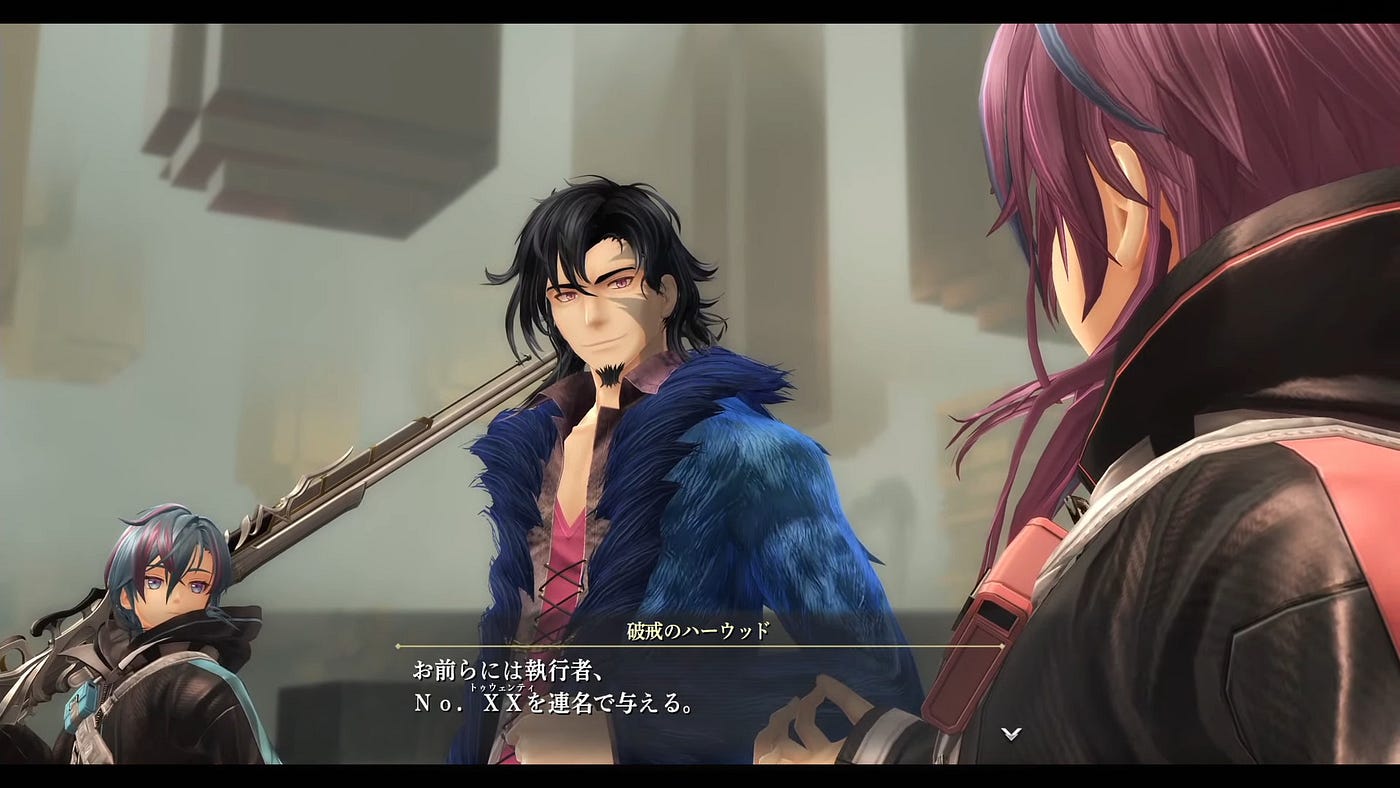
Behind the scenes Ixs and Jorda worked to join up with Harwood. The details are unknown, but it appears this was their final examination before becoming Enforcer. Together Ixs and Jorda become No. XX, the third Enforcer from the last.
When exactly will the secret treaty between the society and Gramheart end? We don’t know the specifics, but during the Finale Harwood says that the agreement is about to expire. Ouroboros has its own plan, probably related to the Sept-Terrion of Aidios. But they’re not the only organisation operating in relation to the Sept-Terrion, right? Of course, there’s the Septian Church and possibly Marduk Company as well.
Is there a reason Ouroboros works in the order of Liberl, Crossbell, Erebonia and now Calvard when it comes to the Sept-Terrion? Ouroboros operates under the Orpheus Final Plan, so I think they have some idea what will happen, where and in what order. However, the degree of their involvement in each country varies and depends on the situation. For example, in Trails in the Sky they were actively involved with the Liberl Kingdom, but in the Crossbell arc Mariabel and the Crois family took the centre stage. In the Trails of Cold Steel saga the empire got into action and Ouroboros intervened. Please look forward to what will happen in the next game.
Now you mention the Cold Steel saga, at that time there was talk of Harwood and Lucrezia operating in Calvard, right? Of course. It’s possible there was some intention behind that as well.
In previous game we’ve seen pairs of Holy Beasts and clans safeguarding the Sept-Terrion. Does Daybreak II hint at these element? I’m definitely not going to comment on that. (laughs) What I can say is these elements have always appeared in the Trails series so far, so I think it’s only natural for these to appear in Calvard as well. We try to not follow a similar pattern in the way the treasures appear. In Trails in the Sky there was only the Sept-Terrion of Space and in Trails of Cold Steel the two Sept-Terrion of Fire and Earth were fused together. The Calvard arc might throw a curve ball or a pattern we haven’t seen before.
Ixs and Jolda have been appointed Enforcer No. XX, which was described as the ‘third number from the last’. Do I understand correctly that the last Enforcer is No. XXII and that there are two more vacant slots? We honestly don’t know whether No. XXII will be the last one. Many players have been predicting that the Enforcers would line up with the numbered order of tarot cards and to some extent we have patterned things after it. However, the last tarot is number XXI, so let’s wait and see what will happen.
One question I’ve had from the start is whether the numbering of Enforcers is determined by the order in which they’re appointed. That’s correct. The first one was No. 0, Campanella, followed by No. I, McBurn. Numbers are given in the order they join. Recent additions are Shirley as No. XVIII, Cedric as No. XIX and now Ixs and Jorda as No. XX. It’s different for the Anguis, where another fitting person can fill in a vacant position, so they’re not numbered in order.
Loewe was No. II, so it’s surprising how relatively quickly he joined. Ouroboros was somewhat involved in the Hamel Tragedy, which caused Loewe to join Ouroboros, because I have a feeling the society was aiming to secure their combat capabilities at the time. Loewe received the Kernviter, a sword forged through Divergent Laws, and his death was regretted, so he must’ve been an important member of the society who was in the Grandmaster’s favour.
Following Loewe is Lucrezia as No. III, suggesting that Ouroboros managed to defeat the Order of the Moonlight Horse she and Harwood belonged to with only the combat capabilities they had gathered up to that point. Few in numbers, indeed, but still capable of shutting down the Order just fine, because both McBurn and Loewe are strong. (laughs) There are also many members who’ve joined Ouroboros at a young age and became Enforcer after growing up, like Joshua and Sharon. Giving the order in which Enforcers joined some thought might lead to interesting discoveries.
By the way, up until Reverie Blueblanc had the prize for perfect attendance in the series. Won’t he make an appearance in the Calvard as well? In the 4spg mission “Search for A Certain Someone’s Son” (さる御子息方の搜索) in Daybreak, Melchior didn’t sound like his usual self. When I checked with the staff, they said ‘Now you mention it, he does look like Blueblanc’. I guess it’s not one of Blueblanc’s disguises after all. Looking back again, the quest resolves rather leniently for Melchior’s standards. Besides, Blueblanc has his own aesthetics, so it could’ve been his work if it’d been a bit more playful. (laughs) [end of p158]
The end of the Calvard arc marks a major milestone in the series, reaching 75–80% completion and is heading toward its climax
The Trails of Cold Steel anime is currently airing and features original characters
The anime The Legend of Heroes: Trails of Cold Steel: Northern War started airing on 6 January. Why was the Northern War, set in North Ambria, picked as its subject? When discussing the anime, [animation company] Tatsunoko Productions asked how they could make an anime out of the Trails from Cold Steel saga, taking its length into account. We decided it would be best to focus on the area surrounding the games and to involve Erebonia as well, so we proposed two ideas for the anime: one was about the Northern War, the other about the city-state of Jurai, starring Crow.
Was Tatsunoko in charge of the settings for the characters? That’s right. Although we supervised the project, we didn’t impose strict limitations.
Are there plans for the games to touch on characters from the anime? Depending on how things pan out, there might be content that finds its way back in the main games. In addition, there’s a smartphone game based on the anime in development by Userjoy Japan that’s scheduled for release in 2023.
What parts of the anime would you recommend viewers to pay extra attention to? The story takes place between Trails of Cold Steel II and III, so I think players of the games will get to see a lot. The main cast consists of characters original to the anime, but there also will be familiar faces will, like Rean. The highlight will be how protagonist Lavian works behind the scenes to thwart the political manoeuvres of Erebonia, that is, of Osborne, the Blood and Iron Chancellor. The anime shows what kind of people live in North Ambria and what happened there. As the story progresses, the setting shifts from North Ambria to Erebonia and they’ll visit places that also appeared in the games. You might see unexpected people around town as a result of several proposals Tatsunoko made. Fans of the series may not just enjoy the main story, but also find it interesting to carefully examine each scene. In any case, as viewers we’re also looking forward to enjoy a Trails created by people not working for Nihon Falcom. Of course it’s broadcast on TV but also available as stream, so definitely watch if you’re interested.

If the Oct-Genesis aren’t retrieved by 1209, everything will end. The game’s Septian Calender has reached S.1209 and the time limit is rapidly approaching.
The Calvard arc should finish with the next game, its story unfolding at an unstoppable pace
The ending of Daybreak II contained the message ‘to be continued in Kuro no Kiseki’s final chapter’, suggesting the arc will finish in the next game. When are you planning to release the sequel? The Calvard arc will definitely come to an end and we’ve already decided what will happen, how we’ll present this and which mysteries will be resolved. Through trial and error we’re currently working on the question as to how the Calvard arc’s ending fits in the process of wrapping up the Trails series as a whole. As for the release date, this year [2023] we’re working on the release of Ys X so Daybreak II’s sequel will be released in 2024 or later.
The ending of this arc makes me wonder about the conclusion of Calvard’s story, of course, but also whether we’ll get to see the end of world as described in Professor Epstein’s writing. That’s part of my discussions with the staff, but that discussion has only just started. There’s a substantial amount to cover until the ending and once it starts, there’s no stopping for the story. Some aspects won’t be clear until we’re a little further along with the production, like how much we can cram in, so it’s also possible that the remains will end up in a separate work… (sweats) Honestly, though, I really don’t want to split it up. Even after development is finished, we continuously discuss and make careful decisions to ensure we’re on the right track.
If you had to pick one character we’ll have to be on the lookout for in the sequel, who would it be? Characters like President Gramheart will definitely take the spotlight. So far, we’ve depicted him as a politician and now we’ll go digging deeper into his character. Same goes for Shizuna. If you were to ask whether her storyline has been shown so far, then the answer is no. There’s still much to discuss, like the inner working of Ikaruga. Then, of course, there’s Van. There’s still a lot to resolve, especially for a protagonist, like the mystery surrounding Grendel and his relationship with Agnès and Elaine.
By the way, if you were to say now, how many new characters are you planning to introduce in the next game? Our priority is to first develop the characters that already made their debut in the story. First, we have to decide how to wrap up the story. We’ll think about new characters after that.
What’s your vision for the future of the Trails series, even if it’s just in broad strokes? Right now, we expect the Trails series to be finished for 75%-80% at the end of the Calvard arc. We’re planning to cover President Gramheart’s motives and the enigmas of the Genesis within the Calvard arc. Mysteries surrounding fundamentals of the series, like Aidios and the Sept-Terrion, will also get quite some explaination. Then we’ll move on to the next arc, but we haven’t decided where it’ll take place. The staff has a several ideas for the protagonist’s background or vocation, so we’re thinking about it thoroughly.
To wrap up, what would you like to say to fans of the Trails series? We believe that the ending of the Calvard arc will be a bigger milestone in the Trails series than fans can imagine. Of course, production on the sequel of Daybreak II has started and we’re sure it’ll grab your full attention from the get-go. We’re also preparing something that’ll be a weight of the shoulders for what everyone was worried about in Daybreak II. Up until now we’ve shown the conclusions of the Liberl, Crossbell and Erebonia arcs, but ending of the Calvard arc will be done with the ending of the entire Trails series in mind. We feel that pressure, but even more is that it’s a rewarding challenge. We would appreciate it if you‘d give us a bit more time until the Trails series is completely finished and it would make us very happy if you were to join us for the next arc as well. [end of p159]

Van will also be the main character in the next game. All mysteries, like why he houses a demon or why he’s able to transform into Grendel, will be revealed in the Calvard arc’s finale.
메타데이터
- post_id
- 4998e87e53b4
- slug
- kuro-no-kiseki-ii-crimson-sin-art-book-interview-4998e87e53b4
- url
- https://medium.com/@gu4n/kuro-no-kiseki-ii-crimson-sin-art-book-interview-4998e87e53b4
- canonical_url
- https://medium.com/@gu4n/kuro-no-kiseki-ii-crimson-sin-art-book-interview-4998e87e53b4
- author_url
- https://medium.com/@gu4n
- status
- ok
- fetched_at
- 2026-07-25 01:02:52