VLANs, Firewalls, and DMZs: Core Concepts for Network Security
When people first learn about cybersecurity, they often focus on attacks, malware, and hacking techniques. While understanding threats is…
VLANs, Firewalls, and DMZs: Core Concepts for Network Security
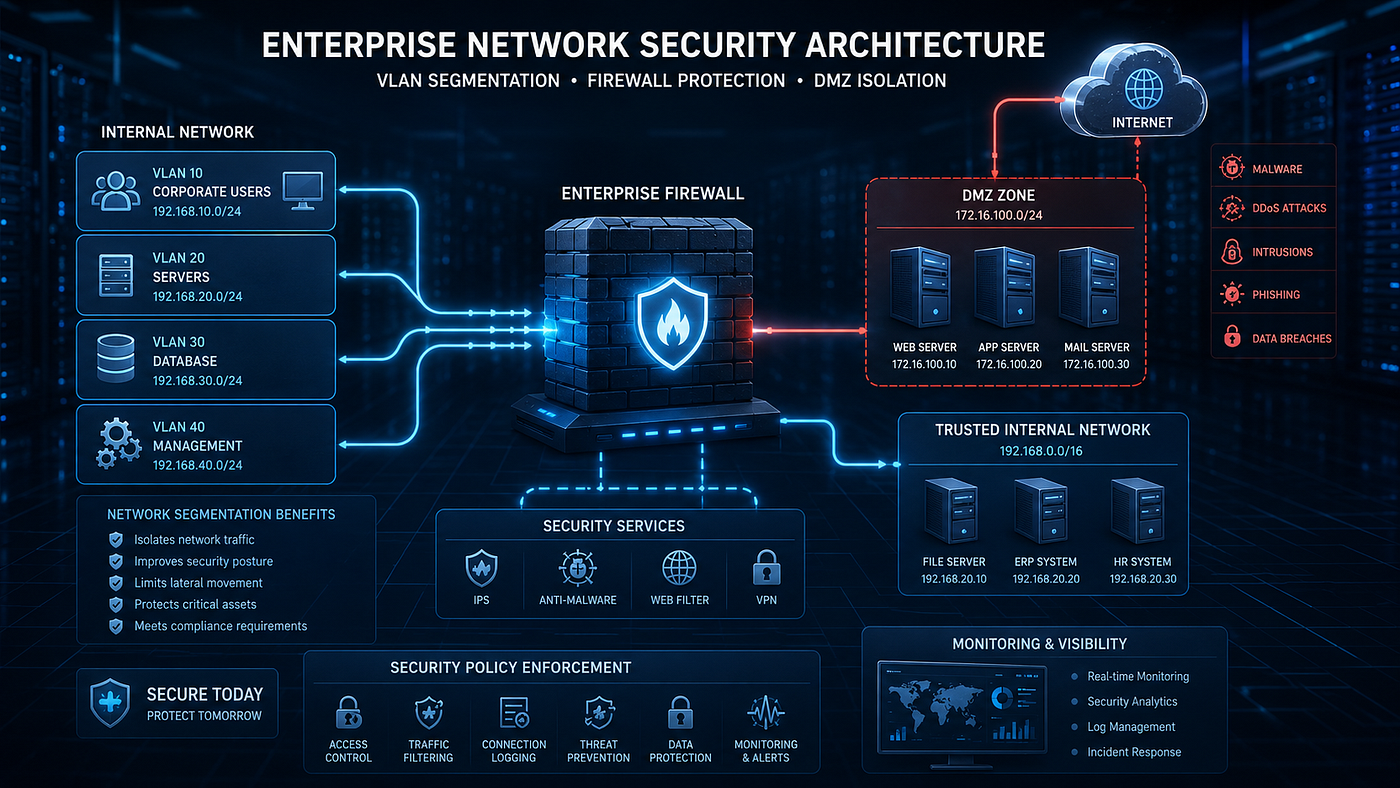
When people first learn about cybersecurity, they often focus on attacks, malware, and hacking techniques. While understanding threats is important, effective cybersecurity starts with something much more fundamental: network architecture.
A well-designed network doesn’t just connect devices — it controls access, limits risk, and helps prevent attackers from moving freely within an environment.
Three of the most important concepts in network security are VLANs, Firewalls, and DMZs. Together, they form the foundation of many modern security architectures.
If you’re studying cybersecurity, networking, or IT infrastructure, understanding these concepts will help you see how organizations protect their most valuable digital assets.
Why Network Security Architecture Matters
Imagine a company where every computer, server, printer, and database is connected to the same network without restrictions.
If an attacker compromises a single device, they could potentially access everything else.
This is why security professionals focus on creating boundaries inside networks. The goal is simple:
- Limit access
- Reduce attack surfaces
- Contain threats
- Protect critical resources
VLANs, firewalls, and DMZs are essential tools for achieving these objectives.
What Is a VLAN?
A Virtual Local Area Network (VLAN) is a logical way of separating devices into different network segments, even when they are connected to the same physical switch.
Think of a large office building.
Everyone works in the same building, but departments such as Human Resources, Finance, and IT occupy different rooms and require different levels of access.
A VLAN works similarly.
Instead of placing all devices in one large network, administrators divide them into smaller, isolated groups.
Why VLANs Improve Security
Without VLANs, every device can potentially communicate with every other device.
This creates unnecessary risk.
VLANs help by:
- Separating departments
- Limiting unnecessary communication
- Reducing broadcast traffic
- Containing malware outbreaks
- Supporting access control policies
For example:
- Employees may be placed in one VLAN
- Servers in another VLAN
- Guest Wi-Fi users in a separate VLAN
If a guest device becomes infected, the threat is less likely to reach internal systems.
Real-World Example of VLAN Security
Imagine a university network.
Students, professors, administrators, and servers all use the same physical infrastructure.
Using VLANs, administrators can create separate logical networks for each group.
Even though everyone shares the same switches and cables, access remains controlled and organized.
This approach improves both security and performance.
What Is a Firewall?
A firewall is a security device or software that monitors and controls network traffic based on predefined rules.
Think of a firewall as a security checkpoint at an airport.
Not everyone is allowed through.
Traffic is inspected before it enters or leaves the network.
The firewall determines:
- Who can connect
- Which services are accessible
- What traffic should be blocked
- What traffic should be allowed
Why Firewalls Are Critical
Every organization connected to the internet faces constant probing and attack attempts.
Firewalls provide a first line of defense by:
- Blocking unauthorized access
- Filtering malicious traffic
- Restricting risky services
- Monitoring network activity
- Enforcing security policies
Without firewalls, organizations would expose many internal resources directly to potential attackers.
Types of Firewalls
Modern environments use several firewall types:
Packet Filtering Firewalls
Inspect basic packet information such as IP addresses and ports.
Stateful Firewalls
Track active connections and make more intelligent decisions.
Next-Generation Firewalls (NGFW)
Provide advanced capabilities such as:
- Application awareness
- Intrusion prevention
- Threat intelligence integration
- Deep packet inspection
Today’s enterprise environments increasingly rely on next-generation firewalls for stronger protection.
What Is a DMZ?
One of the most misunderstood networking concepts among beginners is the DMZ (Demilitarized Zone).
Despite its military-sounding name, the concept is quite simple.
A DMZ is a separate network segment designed to host systems that must be accessible from the internet.
Examples include:
- Web servers
- Email servers
- DNS servers
- Public-facing applications
Why Organizations Use a DMZ
Imagine a company website.
Customers need access to it from anywhere in the world.
However, the organization’s internal database should remain protected.
Placing the web server directly inside the internal network would be risky.
Instead, the web server is placed inside a DMZ.
This creates a buffer zone between:
- The public internet
- The internal network
If attackers compromise the web server, they still face additional barriers before reaching critical systems.
DMZ Security Benefits
A DMZ helps organizations:
- Isolate public-facing systems
- Reduce exposure of internal resources
- Improve network segmentation
- Limit attacker movement
- Strengthen defense-in-depth strategies
In many organizations, the DMZ acts as a controlled middle ground between trusted and untrusted environments.
How VLANs, Firewalls, and DMZs Work Together
These technologies become even more powerful when combined.
Consider a typical enterprise network:
Internal VLANs
- Finance VLAN
- Human Resources VLAN
- IT VLAN
- Server VLAN
Firewall Controls
The firewall determines which VLANs can communicate with each other.
For example:
- Employees may access web servers
- Guests may access only the internet
- Finance systems may have restricted access
DMZ Layer
Public-facing services are placed inside the DMZ rather than the internal network.
Together, these controls create multiple security layers.
Even if one layer fails, others continue to provide protection.
Defense in Depth: The Bigger Security Picture
Cybersecurity professionals often talk about Defense in Depth.
This means relying on multiple security controls rather than a single solution.
VLANs, firewalls, and DMZs are perfect examples.
Instead of trusting one device or one policy, organizations build overlapping layers of protection.
This approach helps:
- Detect attacks earlier
- Slow attacker movement
- Reduce damage from breaches
- Improve overall resilience
No single security control is perfect.
Layered defenses provide stronger protection.
Common Mistakes Beginners Make
Many cybersecurity students assume security starts with advanced tools.
In reality, weak network architecture often creates bigger risks than missing software.
Common mistakes include:
- Placing all devices in one network
- Exposing servers directly to the internet
- Allowing excessive communication between systems
- Misconfiguring firewall rules
- Neglecting network segmentation
Understanding these fundamentals helps prevent serious security gaps.
Final Thoughts
VLANs, firewalls, and DMZs may not sound as exciting as ethical hacking or malware analysis, but they are among the most important concepts in cybersecurity.
These technologies help organizations create structure, enforce boundaries, and protect critical assets from both external and internal threats.
For aspiring cybersecurity professionals, mastering these concepts provides a strong foundation for understanding network defense, security architecture, and enterprise security operations.
The more you understand how networks are organized and protected, the better prepared you’ll be to defend them.
메타데이터
- post_id
- 499e372b5cef
- slug
- vlans-firewalls-and-dmzs-core-concepts-for-network-security-499e372b5cef
- url
- https://medium.com/@ferdiedogawaexp/vlans-firewalls-and-dmzs-core-concepts-for-network-security-499e372b5cef
- canonical_url
- https://medium.com/@ferdiedogawaexp/vlans-firewalls-and-dmzs-core-concepts-for-network-security-499e372b5cef
- author_url
- https://medium.com/@ferdiedogawaexp
- status
- ok
- fetched_at
- 2026-06-21 22:26:41