Why Molecular Dynamics Hit a Speed Wall (And What’s Coming Next)
A human heartbeat takes one second. In that same second, a protein folds and unfolds roughly a million times…
Why Molecular Dynamics Hit a Speed Wall (And What’s Coming Next)
A human heartbeat takes one second. In that same second, a protein folds and unfolds roughly a million times.
This is the timescale problem that haunts molecular dynamics. The phenomena scientists care most about — protein folding, drug unbinding, conformational changes, catalytic cycles — happen on microsecond to millisecond timescales. But simulating a single microsecond can take days of wall-clock time, even on powerful GPUs.
The math is brutal. To capture meaningful biological motion, you need femtoseconds-resolution timesteps. A microsecond of simulation requires 500 million timesteps. A millisecond requires 500 billion. Every single step demands calculating forces between thousands of atoms, updating positions, managing constraints, and handling long-range electrostatics.
For decades, this has been molecular dynamics’ defining limitation: we can watch molecules move, but only in agonizingly slow motion.
The Anton Anomaly
In 2008, D.E. Shaw Research unveiled Anton, a supercomputer purpose-built for one thing: molecular dynamics.
The results were staggering. Anton simulated a millisecond of protein dynamics — something that would take years on conventional hardware — in a few days. Papers published using Anton’s trajectories revealed protein folding pathways, drug binding mechanisms, and conformational transitions that had been completely inaccessible before.
Anton achieved this through radical specialization. Instead of using general-purpose processors, it implemented MD algorithms directly in custom silicon. Every calculation that typically happens sequentially — force computation, integration, constraint handling — was parallelized across specialized pipelines. The communication between nodes was optimized for the specific data patterns of particle simulations.
The result was hardware that ran MD roughly 100× faster than the best GPUs of its era.
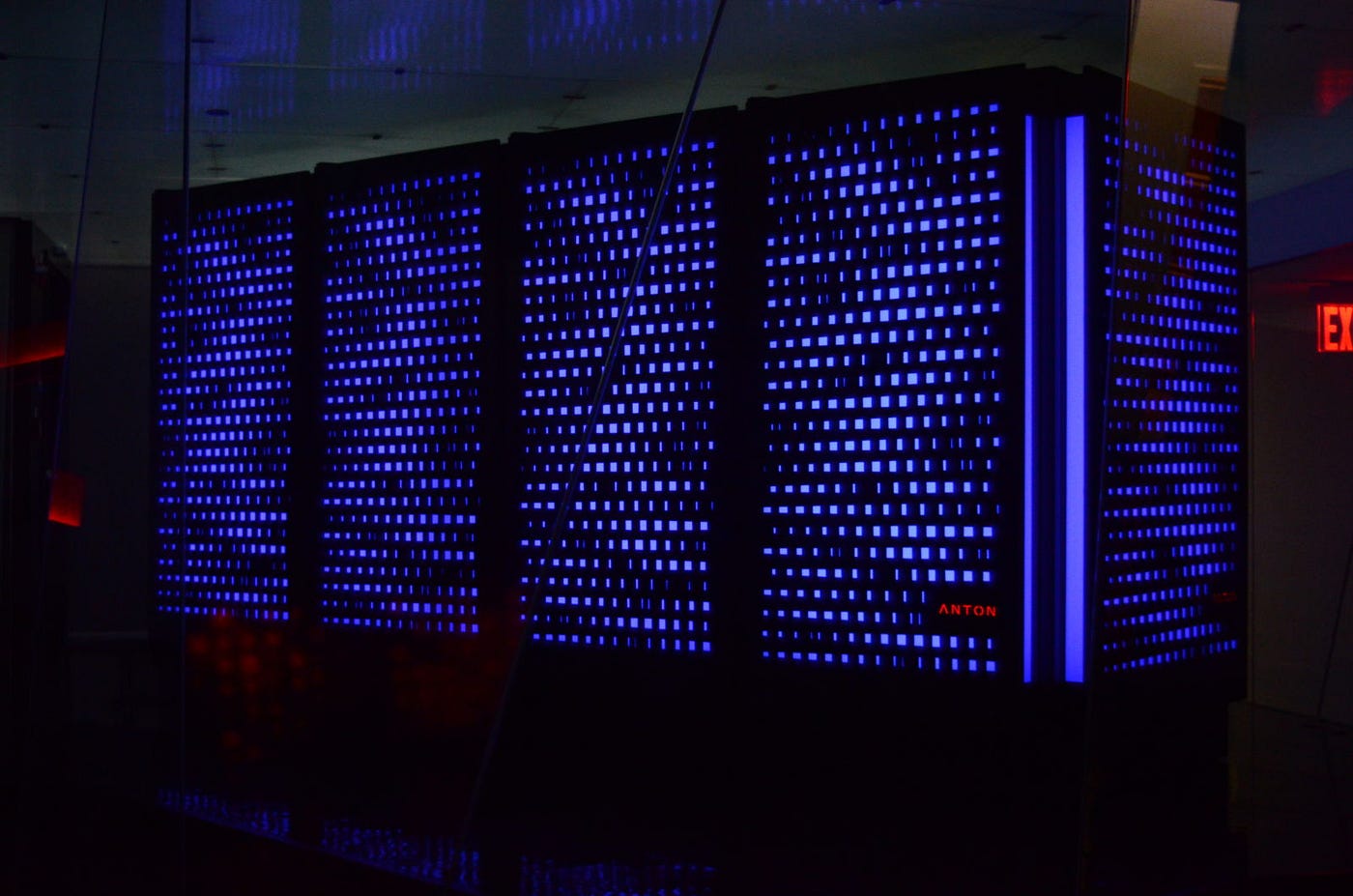
Image of Anton, a massively parallel supercomputer designed and built by D. E. Shaw Research
But there was a catch: only a handful of Anton machines exist. Access is limited to a small number of labs through a competitive application process. For the vast majority of researchers, Anton’s capabilities might as well be science fiction.
The field learned a hard lesson: the bottleneck wasn’t software. It was physics meeting silicon.
Why GPUs Fell Behind
NVIDIA GPUs have been the workhorse of molecular dynamics for over a decade. CUDA enabled massive parallelization, and software like GROMACS, AMBER, and OpenMM made GPUs accessible to thousands of labs.
But GPUs were never designed for MD. They were built for graphics rendering, then repurposed for deep learning, and adapted for simulation as an afterthought. This creates fundamental mismatches.
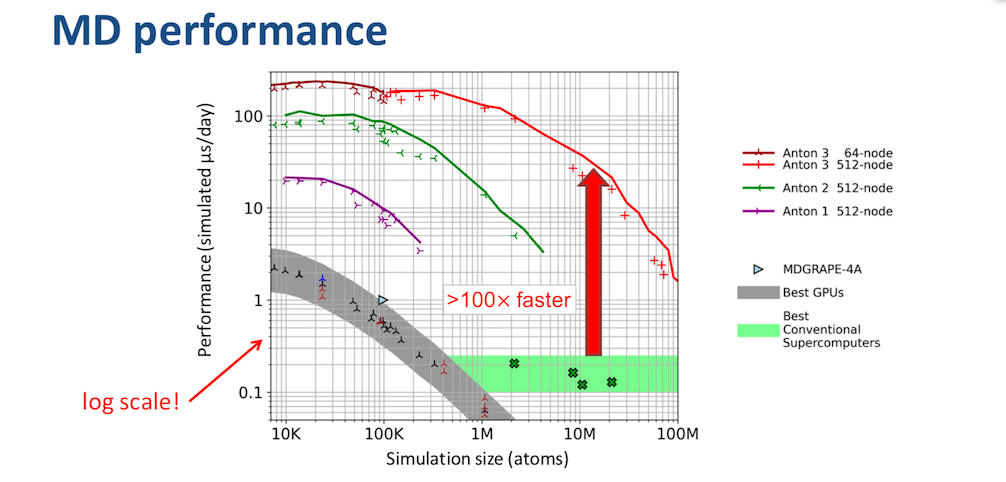
Anton vs Supercomputer vs GPU performance scaling comparison
Memory bandwidth becomes the limiting factor. MD simulations are memory-bound, not compute-bound. You spend more time shuffling atomic coordinates and force arrays between memory and compute units than you do actually calculating forces. GPUs optimize for dense matrix operations — not the sparse, irregular memory access patterns that dominate particle simulations.
Communication overhead kills scaling. Simulating large systems requires partitioning atoms across multiple GPUs, and every timestep requires exchanging boundary information. On general-purpose interconnects, this communication latency eats into any gains from parallelization. Past a certain system size, adding more GPUs barely helps.
Power efficiency suffers. MD simulations run continuously for days or weeks. GPUs burn through hundreds of watts, most of it wasted on transistors that sit idle because they’re designed for workloads MD doesn’t have. The cost per simulation becomes prohibitive.
The gap between Anton and GPUs hasn’t closed — it’s widened. Anton 3, announced in 2021, delivers performance that would require a small data center’s worth of A100 GPUs to match. And even then, the power bill and coordination overhead would make it impractical.
For researchers, this means a painful trade-off: either simulate small systems on GPUs, gaining accessibility but sacrificing scale, or compete for rare Anton time, gaining speed but losing control.
The Next Generation
The breakthrough comes from asking a different question: what if you designed chips specifically for performing intensive scientific computations, such as molecular dynamics, but made them accessible at scale?
At Vorticity, we’ve been working on exactly this problem. Our approach with Pyrite9 is to redefine efficiency and precision in high-performance workloads. Engineered to push boundaries, it sets a new bar in scientific computing.
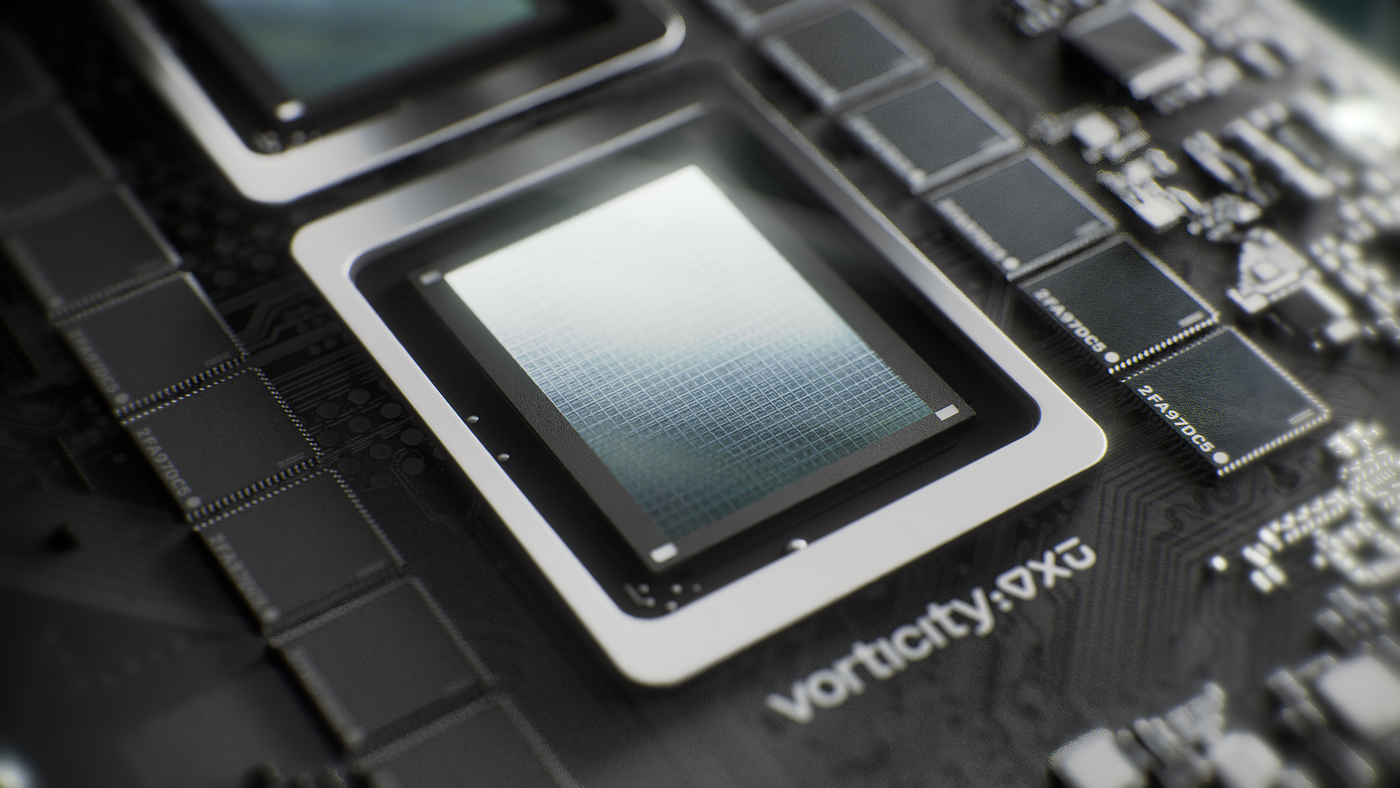
Early testing shows what’s possible when you stop forcing MD algorithms onto GPU architectures. Simulations run an order of magnitude faster than equivalent GPUs while consuming a fraction of the power. Experiments that would require a rack of A100s can run on a single Pyrite node — for less cost and energy.
But here’s what matters most: speed alone isn’t revolutionary. Anton was fast, but inaccessible. The goal is to make Anton-class performance available at cloud scale, so that speed becomes a feature anyone can access, not a prize you compete for.
When Hardware Meets Platform
When Pyrite9 comes online, the implications for MD will be great:
Interactive exploration becomes possible. Instead of submitting a job and waiting, you can iterate. Adjust parameters, rerun, compare — all within the same work session. The feedback loop tightens from days to hours.
Ensemble sampling becomes practical. Want to run 100 replicas to catch rare events? On GPUs, that’s weeks of compute. On next-gen scientific-computing silicon, it’s days. Now stack on unlimited parallelization and no server queues, and we’re talking about hours. Statistical convergence that was aspirational becomes routine.
System sizes grow. The same hardware efficiency that speeds up small systems enables much larger ones. Full-length antibodies, membrane proteins in realistic bilayers, entire viral capsids — systems that required Anton-class resources become accessible to everyone.
Beyond the Speed Barrier
The history of science is full of moments when new instruments unlocked new questions.
The telescope revealed that planets orbit the sun. The microscope revealed that life is made of cells. The particle accelerator revealed the structure of matter itself.
Molecular dynamics has been powerful but constrained — a microscope that could only watch in slow motion, only peer at small systems, only run in specialized facilities.
Custom MD silicon breaks these constraints. Not by incremental improvement, but by rethinking the problem from the transistor up.
What happens when simulation speed stops being the limiting factor? When the bottleneck shifts from “how long will this take?” to “what should we simulate next?”
Researchers start asking different questions. They simulate drug binding not once, but thousands of times, mapping full free energy landscapes. They watch entire signaling cascades play out in near-real-time. They run evolutionary screens in silico, testing mutations faster than they could synthesize them.
The computational microscope doesn’t just zoom in — it speeds up.
What’s Coming
Ten years from now, the idea of waiting days for a microsecond trajectory will seem quaint. Researchers will spin up simulations as casually as they run BLAST searches today. Drug designers will iterate through binding poses in real-time. Students will learn chemistry by watching reactions unfold at atomic resolution, scrubbing through trajectories like video files.
This future doesn’t require waiting for Moore’s Law to catch up. It requires building the right hardware for the right problem — and making it accessible.
Anton showed us what’s possible when silicon meets simulation. The next generation of MD accelerators will show us what’s possible when that speed reaches everyone.
The speed barrier is about to break. The molecules are about to move faster. And science is about to accelerate in ways we’re only beginning to imagine.
Interested in the hardware? Learn more about our vision ↗
메타데이터
- post_id
- 49d473f5b2e9
- slug
- why-molecular-dynamics-hit-a-speed-wall-and-whats-coming-next-49d473f5b2e9
- url
- https://medium.com/vorticity-xyz/why-molecular-dynamics-hit-a-speed-wall-and-whats-coming-next-49d473f5b2e9
- canonical_url
- https://medium.com/vorticity-xyz/why-molecular-dynamics-hit-a-speed-wall-and-whats-coming-next-49d473f5b2e9
- author_url
- https://medium.com/@eric_2
- status
- ok
- fetched_at
- 2026-06-09 15:37:30