How Microfluidic Chips Could Unlock the Next Generation of AI — The One Breakthrough You Haven’t…
AI isn’t just getting smarter — it’s getting hotter. The next big leap in artificial intelligence may depend not on algorithms or GPUs…
How Microfluidic Chips Could Unlock the Next Generation of AI — The One Breakthrough You Haven’t Heard About Yet
AI isn’t just getting smarter — it’s getting hotter. The next big leap in artificial intelligence may depend not on algorithms or GPUs, but on a radical cooling innovation happening deep inside the silicon.
When AI Started Overheating
A massive data center hums under the desert sun — rows of GPUs blinking like city lights. Inside, AI models devour electricity to train trillion-parameter networks, generating realistic videos and simulating human reasoning.
Every AI chip consumes enormous power, pushing thermal limits. Fans roar, coolants flow, and still, temperatures climb. Companies are hitting a physical wall — no longer constrained by ideas or algorithms, but by the raw limits of thermodynamics.
This is where one of the quietest revolutions in technology begins. A breakthrough that could rewrite the rules of AI infrastructure: Microfluidic cooling.
The One Breakthrough You Haven’t Heard About Yet
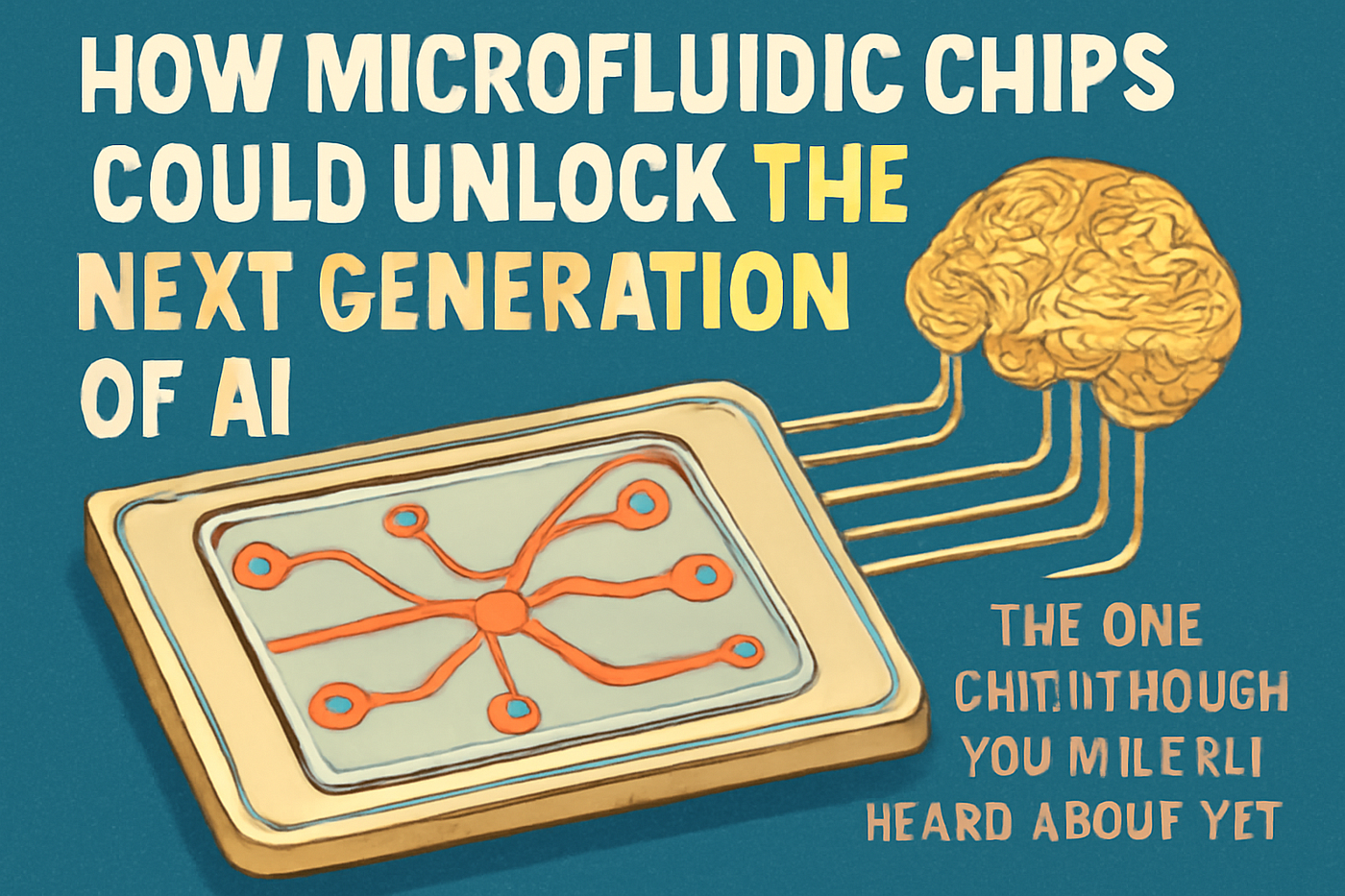
Earlier this month, Microsoft unveiled something extraordinary: AI chips embedded with microscopic liquid channels — veins etched directly into the silicon itself.
Instead of cooling chips from the outside (like traditional heat sinks or immersion tanks), these channels carry coolant inside the chip, right where the heat is born.
It’s like giving the processor its own circulatory system — a living, breathing network of coolant pathways.
The result? A 3× improvement in heat removal efficiency, and a potential leap in how densely we can pack computing power.
⚙ The Core of It — What Makes Microfluidic Cooling Special
Before we imagine the future, let’s break down how this works.
Core Principles (At a Glance)
- Micro-channels etched into silicon: Tiny grooves — thinner than a human hair — are built directly into the chip.
- Coolant circulates through these channels: Liquid absorbs heat much faster than air or metal conduction.
- 3× heat removal improvement: Tests show drastically reduced hot spots and smoother thermal distribution.
- Smaller, denser AI servers: Better cooling means chips can be packed closer together without risk.
- Eco-friendly data centers: Reduced need for giant air conditioners or immersion baths.
The Science Behind It — Simplified
Traditional cooling removes heat after it spreads across the chip surface. That’s like trying to cool a hot car engine with a fan — it works, but not efficiently.
Microfluidic cooling starts inside the chip. The coolant flows through microchannels that sit right beneath the transistors — the hottest regions. It whisks away heat instantly, keeping temperatures balanced and performance consistent.
💡 Think of it as giving your AI chip a bloodstream that carries away heat as efficiently as your body cools itself.
This doesn’t just make chips cooler; it extends their lifespan, prevents thermal throttling, and even opens the door for 3D-stacked AI chips — something engineers once thought impossible.
Why This Breakthrough Matters for AI
AI progress has always depended on three things — data, algorithms, and compute. Microfluidic cooling supercharges the third pillar.
1. Bigger, More Powerful Models
Training LLMs like GPT-5 requires massive energy. Microfluidic cooling keeps the chips stable even under insane workloads — removing the thermal limit from model scaling.
2. More Compute per Square Foot
Better cooling allows data centers to fit more GPUs into smaller areas. That means denser clusters, faster training, and less real estate cost.
3. Greener AI Infrastructure
Cooling can account for up to 40% of a data center’s energy use. Efficient liquid systems drastically reduce electricity consumption — good for both budgets and the planet.
4. New Chip Designs
Chipmakers can now rethink layouts — stacking layers vertically instead of spreading heat horizontally. This could lead to compact, super-efficient AI processors we’ve never seen before.
5. Leveling the Playing Field
Lower cooling costs mean startups and research labs can train large models too — not just trillion-dollar companies with Arctic data centers.
How It Could Transform the Industry
This isn’t a small tweak. It’s a foundational shift for every layer of AI infrastructure.
- Chipmakers (Nvidia, AMD, Intel) can design smaller, denser chips.
- Cloud providers (Microsoft, Google, AWS) can run larger AI clusters at lower cost.
- Sustainability advocates get a real-world way to reduce the carbon footprint of AI.
- Developers and researchers gain affordable, scalable compute.
Microfluidic cooling could become the unsung hero behind the next decade of AI breakthroughs — enabling not just smarter models, but a smarter planet.
Imagine the Future
Imagine laptops running massive AI models without heating up. Devices analyzing data instantly — cool, silent, efficient. Global data centers that no longer need to live near rivers or ice caps, but operate anywhere, powered by micro-scale cooling.
That’s the world microfluidic technology is quietly building.
Final Thought
The next great leap in AI would come from better molecules — liquid flowing through microscopic veins, carrying away the heat of intelligence itself.
Because sometimes, the true power of isn’t about thinking faster or in reaction but It lies in staying cool enough to keep thinking and going at all.
Thanks for Reading.
메타데이터
- post_id
- 49d656a2baf3
- slug
- how-microfluidic-chips-could-unlock-the-next-generation-of-ai-the-one-breakthrough-you-havent-49d656a2baf3
- url
- https://medium.com/@SwapDilettante/how-microfluidic-chips-could-unlock-the-next-generation-of-ai-the-one-breakthrough-you-havent-49d656a2baf3
- canonical_url
- https://medium.com/@SwapDilettante/how-microfluidic-chips-could-unlock-the-next-generation-of-ai-the-one-breakthrough-you-havent-49d656a2baf3
- author_url
- https://medium.com/@SwapDilettante
- status
- ok
- fetched_at
- 2026-06-09 15:37:30