Autism Diagnoses Are Skyrocketing. Here’s What the Numbers Really Tell Us
The numbers are real. So is the fight over who gets to explain them.
Autism Diagnoses Are Skyrocketing. Here’s What the Numbers Really Tell Us
The numbers are real. So is the fight over who gets to explain them.
© Sam Peeters, 2026
For a long time, autism was something people rarely talked about. Now it is one of the biggest topics in healthcare and education. Waiting lists at diagnostic centres run up to four years. Schools for special education are full. And on social media, the subject is everywhere.
But what do these rising numbers really tell us? About autism, about care, and about the way we have started to live as a society?
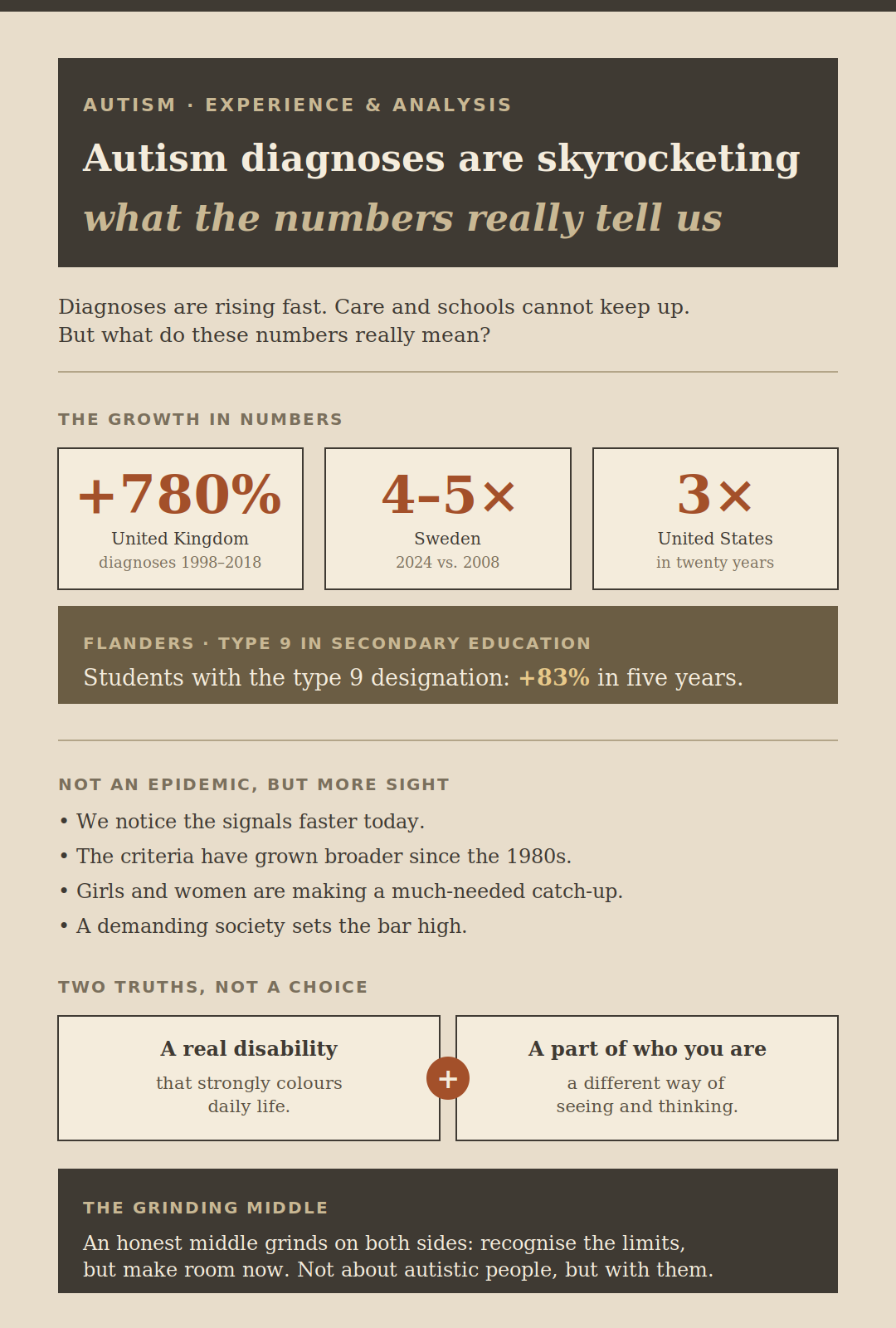
For me, every honest answer starts with admitting that I write from one particular corner. I write from clinical experience and from struggle, but that is not the only valid point of view. For some people, autism is mainly a serious disability that strongly colours daily life. For others, it is just as much a part of who they are: a different way of seeing and thinking. Both sides are true, and they do not cancel each other out. Anyone who immediately calls one of them “the reality” and the other “a trend” is closing the debate before it even begins. That is exactly what I want to avoid here.
The Growth in Numbers
In wealthy countries, diagnosis rates are shooting up. In the United Kingdom, researchers recorded a rise of 780 percent between 1998 and 2018. Sweden counted four to five times as many children with an autism diagnosis in 2024 as in 2008. In the United States, the number tripled in twenty years.
My own region, Flanders, in Belgium, is no exception. There is no central database here, but the figures from the student guidance centres point clearly in the same direction. In secondary education in the school year 2023–2024, around 3 to 4 percent of students had what is called a “type 9” orientation: the term for students with autism without an intellectual disability. In just five years, the number of students with this designation rose by 83 percent.
According to international experts, these figures do not prove an “autism epidemic.” They mainly show that we notice the signals faster today, and that the diagnostic criteria have become broader since the 1980s and 1990s. Still, we should not ignore the role of our environment. We live in a performance-driven society that overstimulates and asks a lot of us: planning, flexibility, social skill. The bar is often set too high, so people hit the hard limits of their disability sooner. Calling autism nothing more than a luxury problem of modern society ignores that daily reality. But the opposite is also true: reducing everything to an individual disorder ignores that our environment helps create those limits.
The Catch-Up for Women, and the Price of Masking
A big part of the current rise comes from a much-needed catch-up for girls and women. For decades, autism was mostly seen through a male lens. The attention went to obvious behaviour, like being loud or disruptive, and to stereotyped interests like trains or planets.
Girls more often process their difficulties inward. They camouflage and mask what is hard, in order to meet social expectations. This survival strategy costs an enormous amount of energy. Often it stays invisible until the person collapses, sometimes only as an adult. Plenty of women get their diagnosis late in life, after recognising a lot of their younger self in their own child.
It is good to pause at such stories, but I also want to be honest about the selection I make. These are stories of pain and isolation. They are real and they deserve respect. But there are also autistic adults who say their diagnosis brought relief: a language for what they always felt, a community, the end of years of thinking something was deeply wrong with them. Anyone who only hears the stories of suffering gets a distorted picture. And anyone who only hears the stories of liberation does too.
Even with a diagnosis, many women still run into stubborn clichés, often within the medical world itself. I have heard of doctors who doubted someone’s autism simply because she made eye contact and could talk easily. That is a painful example of how deeply outdated images are still rooted, and of why we need solid, evidence-based help that looks further than the myths.
Social Media: Between Recognition and Self-Diagnosis
The role of social media in this explosion goes two ways. Platforms like TikTok take autism out of the taboo zone. People find recognition and a community there. In the United Kingdom, 10 percent of young people now call themselves autistic, a number far above the clinical estimates.
There is a real risk here. Many traits of autism overlap with other things, like trauma, burnout or an attachment problem. So a professional view stays important, because a wrong self-assessment can send someone down the wrong path.
But this calls for some humility too. For a lot of people, and especially for women and for those who cannot afford a private assessment, self-recognition is not a passing fad. It is often the only way in, inside a system that I myself call a bottleneck of four years’ waiting. It is not fair to complain about those waiting lists and at the same time look down on people who recognise themselves because they have no other option. Whoever keeps the gate locked behind an expensive, years-long diagnosis should not be surprised that people look for their own key. So the question is not only how we protect people from a wrong self-diagnosis, but just as much how we make the real diagnosis more accessible.
A System Under Pressure
Meanwhile, the care and education system here is creaking at the seams. A formal diagnosis is often the absolute condition for getting extra support. That creates a huge bottleneck. The waiting times for specialised diagnosis run up to four years, and after that, families hit waiting lists for home support all over again.
Special education is groaning too. Over the past five years, the number of requests to move to special secondary education (type 9) rose by 42 percent. The smaller class groups and the structured environment are a relief for many students. But this constant flow toward special education is not a sustainable, structural solution. The answer is not to let mainstream education keep going as it does now, and to separate everyone who differs a little from the norm into a separate circuit.
Not About Us, but With Us
There is one more thing that stands out in many texts about the rising numbers, and in this text too. Who gets to speak? Usually it is experts, doctors, diagnostic centres and policy figures. Autistic people themselves often only appear through their story of suffering.
That is a blind spot. The autism community has been asking for something simple for years: do not only talk about us, talk with us. Not because experience replaces research, but because the two need each other. Numbers show patterns that an individual cannot see. Lived experience shows what a number can never capture. An honest debate needs both, on equal footing. Anyone who pushes the experience side aside as “trendy” or “just affirmative” loses information they cannot do without.
The Solution: The Grinding Middle
So where is the key? For me, it lies in what I call the grinding middle. On one side, that means a sober recognition of the individual, clinical limits of autism. On the other side, it means the duty to make structural room, as a society, for clearer, more literal and lower-stimulation environments.
But I have to be honest about a fair criticism of that idea. A “middle” can easily become a hidden way to put the price on one side only. If the “middle” means that autistic people have to recognise their disability now and wait patiently, while society will make room someday, in a vague future, then it is not balance. Then it is the familiar request to the minority to stay reasonable, while the majority gives up nothing.
So an honest middle grinds on both sides. It asks autistic people not to wish away the real limits of their disability. But it asks at least as much from society: not to make room someday, but now. We have to dare to redesign school and work from the ground up. In practice, that means clear information, real moments of rest, and respect for clear structure. Not only for those with a diagnosis, but for everyone. Only when both sides give something, and the burden does not fall on the weakest party alone, do we work toward truly sustainable, workable solutions. And only then do we give autistic people both the care and the place in society they have a right to.
메타데이터
- post_id
- 49e1ab3fa94c
- slug
- autism-diagnoses-are-skyrocketing-heres-what-the-numbers-really-tell-us-49e1ab3fa94c
- url
- https://medium.com/@tistje/autism-diagnoses-are-skyrocketing-heres-what-the-numbers-really-tell-us-49e1ab3fa94c
- canonical_url
- https://medium.com/@tistje/autism-diagnoses-are-skyrocketing-heres-what-the-numbers-really-tell-us-49e1ab3fa94c
- author_url
- https://medium.com/@tistje
- status
- ok
- fetched_at
- 2026-07-13 06:23:13