The Lumbar Spine Connection — Why Knee Osteoarthritis Patients Develop Lower Back Pain
Lower back pain in a patient with knee osteoarthritis is rarely a coincidence. It is the predictable consequence of altered gait mechanics…
The Lumbar Spine Connection — Why Knee Osteoarthritis Patients Develop Lower Back Pain
Lower back pain in a patient with knee osteoarthritis is rarely a coincidence. It is the predictable consequence of altered gait mechanics, compensatory spinal loading, and progressive core muscle deconditioning — a cascade that begins in the knee joint and works its way up the kinetic chain with every step taken. For patients who have been managing knee osteoarthritis and considering an arthrosamid injection in **London** as part of their treatment plan, the development of lower back symptoms is a signal that the compensatory pattern has progressed beyond the knee.

Understanding the cost of arthrosamid injection across **UK** private clinics in this context means recognising that effective knee treatment does more than relieve joint pain — it removes the upstream driver of secondary spinal loading.
How a Painful Knee Alters Lumbar Mechanics
Normal gait requires a coordinated sequence of hip extension, knee flexion, and ankle push-off that propels the body forward with minimal energy expenditure and evenly distributed joint loading. When the knee is painful, this sequence breaks down. Knee flexion during stance phase is reduced. Hip extension is limited as the body compensates to avoid loading the painful joint. Walking speed decreases. Stride length shortens.
Each of these adaptations has a direct consequence for the lumbar spine. Reduced hip extension forces the lumbar spine to compensate — increasing lumbar lordosis to maintain an upright trunk position during stance. This increased lordotic curve elevates compressive and shear loading through the facet joints, accelerating degenerative change in structures that were functioning normally before the knee pain began.
For patients already asking what causes knee pain in females and managing that condition, the emergence of facet-mediated lower back pain represents a secondary consequence that is biomechanically explained — not a new, independent problem requiring separate investigation.
Trunk Rotation, Lateral Shift, and Lumbar Disc Loading
Normal walking involves a counterrotation pattern between the pelvis and thorax — the pelvis rotates forward on the swing leg side while the thorax rotates in the opposite direction. This counterrotation absorbs rotational energy and distributes it across the spine efficiently.
When gait becomes asymmetrical due to a painful knee, this counterrotation is disrupted. Rather than rotating through the thoracolumbar junction, the body adopts a lateral trunk shift — leaning toward the painful side during stance to reduce knee joint contact force. This lateral shift replaces rotational movement with lateral bending, placing asymmetrical compressive loading through the intervertebral discs on the side of the shift with every step.
Over thousands of daily steps, this asymmetrical disc loading is cumulative and progressive. Patients reporting that my knee hurts when I bend it and straighten it who subsequently develop ipsilateral lower back pain and leg symptoms are frequently experiencing the disc-level consequences of this lateral shift pattern — a connection that is missed when the spine is assessed in isolation without reference to the gait mechanics driving it.
Core Muscle Deconditioning and Spinal Stability
Reduced activity is an inevitable consequence of persistent knee pain. Walking distances shorten. Stairs are avoided. Exercise that previously maintained cardiovascular fitness and core muscle strength is progressively abandoned. The core musculature — transversus abdominis, multifidus, obliques, and pelvic floor — deconditions rapidly with reduced activity, removing the dynamic stabilisation that protects the lumbar spine under load.
A deconditioned core increases reliance on passive spinal structures — discs, ligaments, facet joint capsules — to provide stability. These structures are not designed for primary load-bearing and deteriorate under sustained demand. The result is accelerated lumbar degeneration in a patient who was managing a knee problem, not a spinal one.
Knee pain in ladies is particularly relevant here. Women have a naturally higher tendency toward core and hip stabiliser inhibition under pain conditions, and the deconditioning pattern associated with knee OA activity reduction compounds existing baseline vulnerabilities. Knee pain in ladies treatment that incorporates core rehabilitation alongside knee-directed management directly addresses this secondary deconditioning pathway.
Hip Flexor Tightness, Anterior Pelvic Tilt, and the Knee-Spine Link
A painful knee reduces the range of comfortable hip extension during gait. Over time, reduced hip extension leads to adaptive shortening of the hip flexor musculature — particularly the iliopsoas and rectus femoris. Tight hip flexors pull the anterior pelvis downward, increasing anterior pelvic tilt and further exaggerating lumbar lordosis beyond what the compensatory gait pattern alone produces.
This combination — compensatory lordosis from reduced hip extension plus structurally increased lordosis from hip flexor tightness plus anterior pelvic tilt — creates a sustained increase in lumbar compressive loading that operates continuously, not just during walking. Patients with this pattern experience lower back pain during standing, sitting, and rest — not only during activity — because the postural loading on the lumbar spine has shifted even at baseline.
What is the best painkiller for knee pain is a question many patients ask when symptoms escalate to include back pain alongside knee pain. Analgesia has a role in breaking the pain-activity-deconditioning cycle, but it does not correct hip flexor tightness, anterior pelvic tilt, or altered lumbar loading. These require targeted physiotherapy intervention directed at the full kinetic chain — not isolated symptom management at either the knee or the spine.
Why Treating the Lower Back in Isolation Misses the Upstream Driver
Lower back pain developing in a patient with knee osteoarthritis is a downstream consequence of an upstream mechanical problem. Treating it as an independent spinal condition — with lumbar physiotherapy, spinal injection, or surgical assessment directed at the back alone — addresses the symptom while leaving the cause entirely intact.
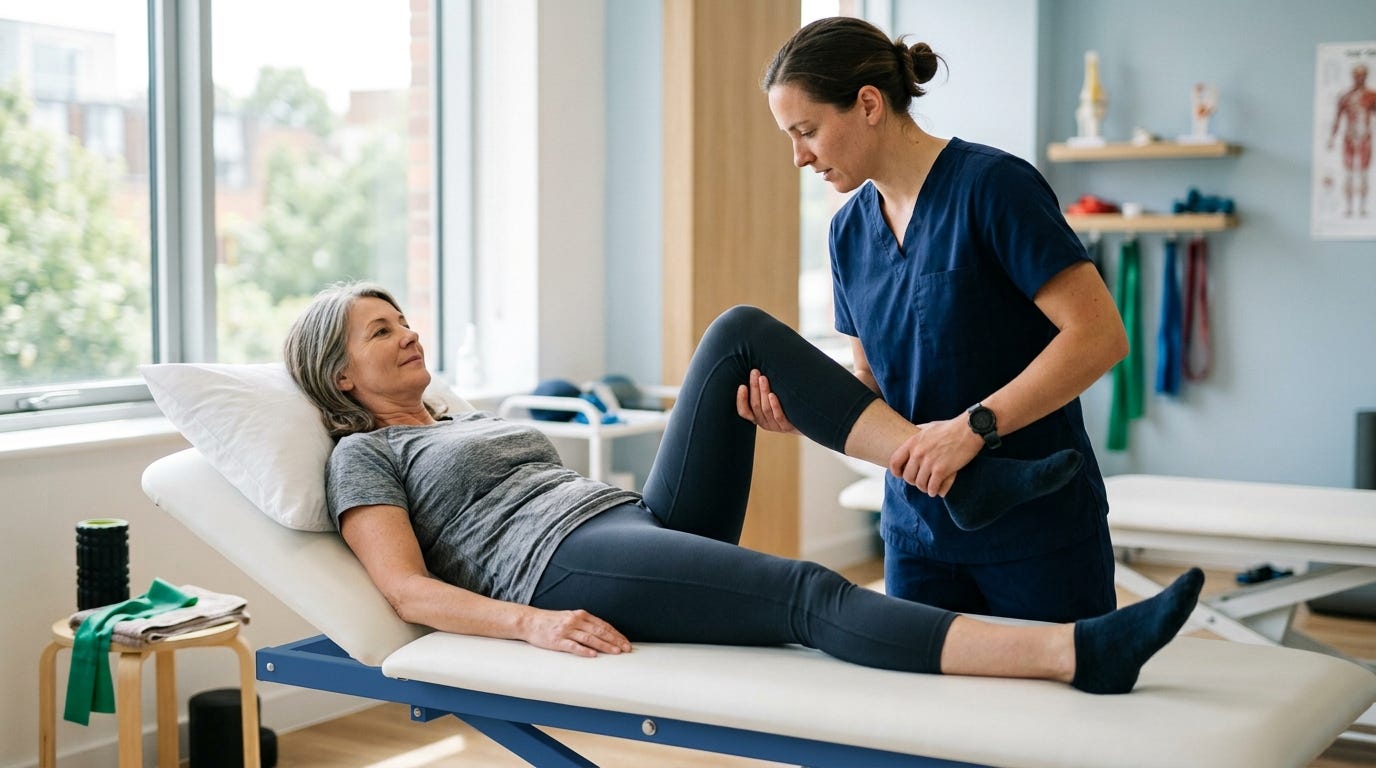
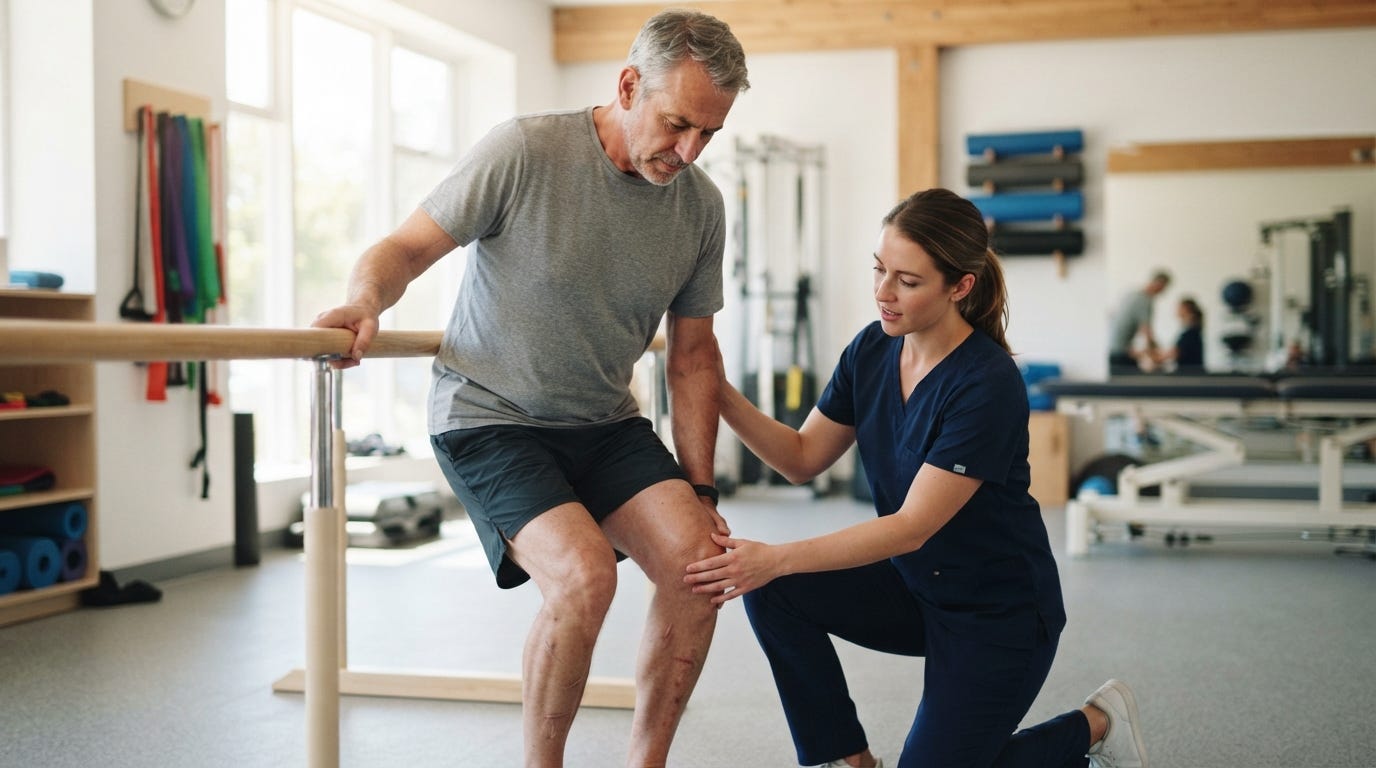
The best knee physio in London recognises this pattern and designs rehabilitation programmes that address both the knee and its spinal consequences simultaneously. Hip flexor stretching, core activation, gait retraining, and knee-directed strengthening form a coordinated programme that interrupts the compensatory loading chain rather than managing its end-stage consequences.
**NHS knee pain pathways and the knee pain symptom checker NHS tools provide useful initial guidance, but patients presenting with both knee and back symptoms may find their care fragmented — knee managed by one pathway, back managed by another — without integration of the biomechanical connection between them. A private knee consultation cost** in London reflects access to an assessment that evaluates the full kinetic chain rather than treating each symptomatic region in isolation.
How Effective Knee Treatment Reduces Secondary Spinal Loading
The relationship between knee pain and lumbar loading is not simply mechanical — it is also neurological and behavioural. Pain in the knee drives activity avoidance, altered movement patterns, and progressive deconditioning. Reducing knee pain effectively interrupts all three of these drivers simultaneously.
When knee pain is managed successfully — through appropriately targeted physiotherapy, injection therapy, or surgical intervention — walking speed increases, stride length normalises, hip extension improves, and the compensatory gait patterns driving abnormal lumbar loading begin to resolve. The lumbar spine, no longer subjected to asymmetrical lateral shift and increased lordotic loading, can begin to recover alongside the knee.
The cost of arthrosamid injection as a knee intervention represents more than relief of joint-level pain. For patients with concurrent lower back symptoms driven by compensatory gait, effective knee treatment is also an indirect spinal intervention — reducing the mechanical input that has been loading the lumbar spine abnormally. Patients searching for an **arthrosamid injection near me** in this clinical context should seek clinics where the treatment decision is informed by a full biomechanical assessment rather than isolated joint-level findings.
Accessing Integrated Assessment Through Private Care
Patients searching for a private knee specialist near me or reviewing London Knee Clinic prices who present with both knee and lower back symptoms should expect a clinical assessment that addresses both simultaneously. The best knee specialist in London will identify the gait-driven spinal loading pattern, distinguish it from independent lumbar pathology, and sequence treatment to address the upstream driver before managing the downstream consequence.
A private knee specialist in London experienced in the kinetic chain consequences of knee OA provides a fundamentally different assessment from one focused exclusively on the symptomatic joint. Reviewing London Knee Clinic prices in this context should factor in the value of integrated biomechanical assessment — one that addresses knee pain treatment across the UK private sector at the level of the full movement system rather than the isolated joint.
Conclusion
Lower back pain in knee osteoarthritis patients is not coincidental or independent. It is the predictable biomechanical consequence of altered gait mechanics, hip flexor tightening, core deconditioning, and compensatory spinal loading — a cascade that begins in the knee and progresses upward through the kinetic chain. Treating the spine in isolation misses the upstream driver entirely. Effective knee management — whether through physiotherapy, injection therapy, or surgical intervention — reduces the mechanical input driving secondary spinal loading and is the most direct route to resolving both problems together.
Mr Syed Nadeem Abbas is an orthopaedic specialist is providing comprehensive kinetic chain assessment and advanced knee treatment including injection therapies for patients across London and the UK.
메타데이터
- post_id
- 49fbeac03979
- slug
- the-lumbar-spine-connection-why-knee-osteoarthritis-patients-develop-lower-back-pain-49fbeac03979
- url
- https://medium.com/@kneepain011/the-lumbar-spine-connection-why-knee-osteoarthritis-patients-develop-lower-back-pain-49fbeac03979
- canonical_url
- https://medium.com/@kneepain011/the-lumbar-spine-connection-why-knee-osteoarthritis-patients-develop-lower-back-pain-49fbeac03979
- author_url
- https://medium.com/@kneepain011
- status
- ok
- fetched_at
- 2026-06-29 02:33:43