Current evidence suggests LDL alone may not fully reflect cardiovascular risk
What current studies indicate about ApoB, Lp(a), and cardiovascular risk
Current evidence suggests LDL alone may not fully reflect cardiovascular risk
What current studies indicate about ApoB, Lp(a), and cardiovascular risk
The traditional lipid markers — total cholesterol, LDL-C, HDL-C, and triglycerides — have been the standard for decades (sometimes referred to as the “classic lipid panel”). But what’s the deeper story behind these markers?
Modern biochemistry shows that it’s not just the amount of cholesterol that matters, but the number and type of particles carrying it. Important markers like ApoB and lipoprotein(a) [Lp(a)] were unintentionally overlooked for decades. Now, thanks to new research and testing, our understanding — and ability to assess cardiovascular risk — has finally begun to catch up.
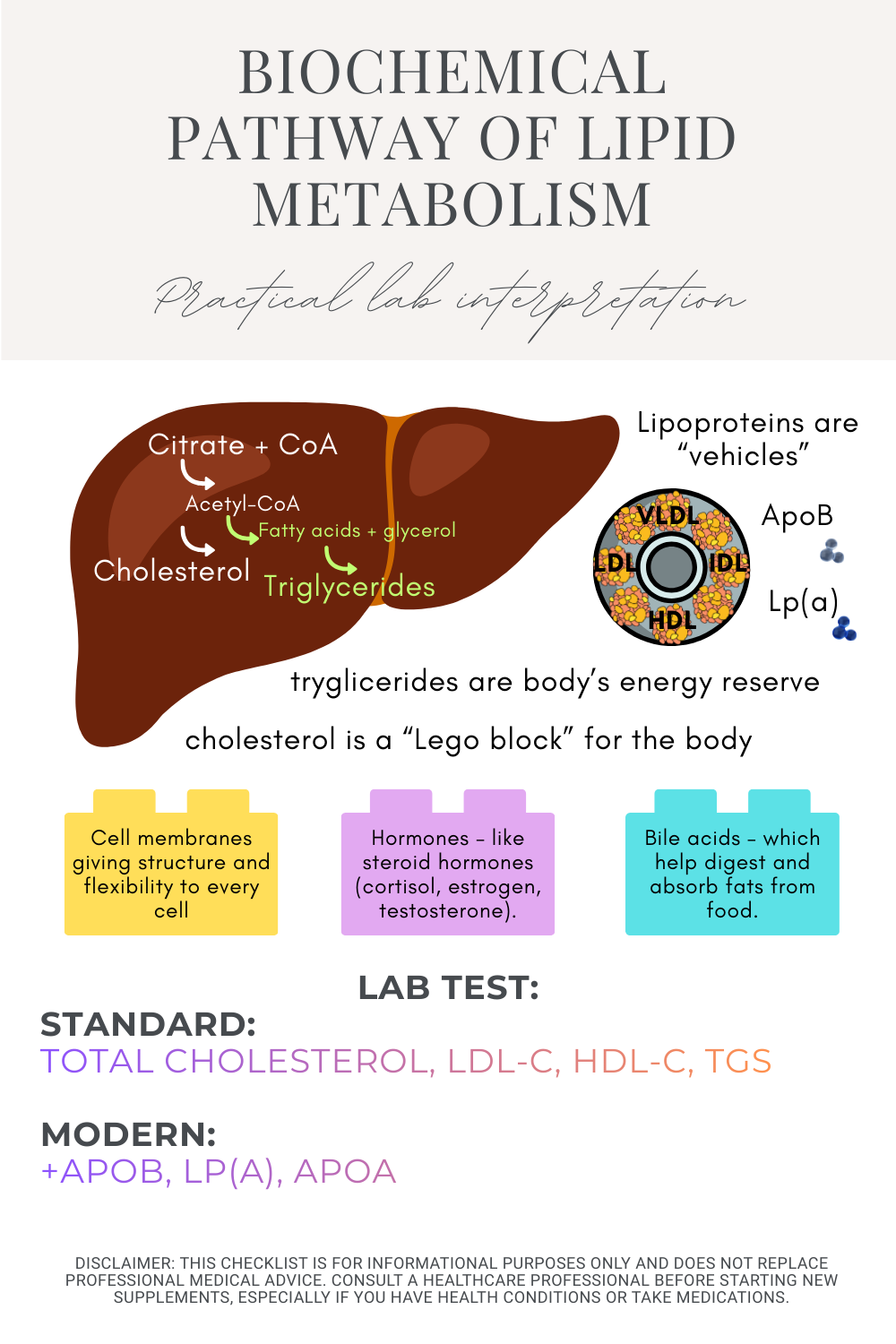
A lipid panel is essential for evaluating various pathological states, including dyslipidemia, metabolic syndrome, diabetes mellitus, and familial hypercholesterolemia. Measuring total cholesterol, LDL-C, HDL-C, and triglycerides helps identify metabolic disturbances contributing to disease progression. Beyond diagnosis, the lipid panel is key in preventive medicine, guiding cardiovascular risk assessment. Modern approaches also include ApoB, and Lp(a), providing a more complete picture of atherogenic potential and enabling earlier, tailored interventions.
Two markers, ApoB and Lipoprotein(a) [Lp(a)], give additional insight into your cardiovascular risk — sometimes revealing hidden danger even when your LDL appears “normal.”
First to terms and definitions.
Key Lipid Markers Explained
- LDL (Low-Density Lipoprotein): Elevated LDL is associated with an increased number of cholesterol-carrying particles, which may relate to cardiovascular health.
- HDL (High-Density Lipoprotein): High HDL helps remove excess cholesterol from arteries back to the liver, lowering cardiovascular risk. HDL is considered a “protective” lipoprotein, and its main protein is ApoA.
- Triglycerides (TGs): High triglycerides, especially when combined with low HDL or high LDL, contribute to atherogenic particles and raise heart risk. Triglycerides are the main energy storage molecules, transported in VLDL and chylomicrons.
- Total Cholesterol (TC): The sum of all cholesterol types in the blood, including LDL, HDL, and other lipoproteins.
- ApoA (Apolipoprotein A-I): Main protein on HDL; essential for HDL formation and function. Higher ApoA levels generally reflect better HDL-mediated cholesterol removal and cardiovascular protection.
- ApoB (Apolipoprotein B-100): A protein present on every atherogenic particle, including LDL, VLDL, and IDL. Measuring ApoB reflects the actual number of cholesterol-carrying particles, which can reveal risk even if LDL-C levels seem normal.
- Lp(a) (Lipoprotein(a)): A genetically determined LDL-like particle with apolipoprotein(a) attached. Levels are mostly inherited and remain stable throughout life. High Lp(a) is a strong independent cardiovascular risk factor because it adds pro-inflammatory and pro-thrombotic properties to LDL particles. Measurement is usually done once in adulthood; values are reported in mg/dL or nmol/L, but interpretation must consider assay variability.
Key Point: While LDL-C measures the cholesterol cargo, ApoB counts the vehicles (all atherogenic particles), and Lp(a) represents an extra-risk vehicle with unique harmful properties. Together, these markers give a more complete picture of cardiovascular risk than traditional cholesterol measures alone.
ApoB and Lp(a): Core Lipid Markers for Cardiovascular Risk
Apolipoprotein B‑100 (ApoB) and lipoprotein(a) [Lp(a)] have emerged as essential biomarkers for assessing cardiovascular risk beyond the traditional lipid panel. Both markers are closely tied to atherogenic lipoproteins — particles that carry cholesterol and triglycerides and contribute to the development of atherosclerosis. ApoB is found on all major atherogenic particles, including low‑density lipoprotein (LDL), very‑low‑density lipoprotein (VLDL), and intermediate‑density lipoprotein (IDL). Because each of these particles contains one ApoB molecule, measuring ApoB provides a direct count of the number of atherogenic particles in circulation, offering a more precise estimate of lipid‑related cardiovascular risk than LDL‑C alone¹.
Lipoprotein(a) [Lp(a)] is an LDL‑like particle with an additional apolipoprotein(a) [apo(a)] component. This structure not only delivers cholesterol into the arterial wall but also carries oxidized phospholipids and promotes pro‑inflammatory and pro‑thrombotic processes, which contribute to plaque formation and instability. Lp(a) levels are largely genetically determined and remain relatively stable throughout life, making a single measurement sufficient for risk stratification in most adults. High Lp(a) has been shown to be a causal risk factor for atherosclerotic cardiovascular disease (ASCVD) and related conditions such as aortic valve stenosis. Patients with elevated Lp(a) have a significantly higher risk of cardiovascular events even when traditional cholesterol markers such as LDL‑C are within normal ranges².
Recent consensus in clinical lipidology recognizes both ApoB and Lp(a) as core measures to assess cardiovascular risk, particularly in individuals with intermediate or high ASCVD risk, family history of premature cardiovascular disease, or unexplained cardiovascular events despite optimal LDL‑C levels. These markers help refine risk stratification and guide personalized preventive strategies³.
Recent findings
Oxidized LDL (oxLDL) is a key atherogenic particle. When LDL, VLDL, or IDL enter the arterial wall, they can become oxidized, stick to the vessel lining, trigger inflammation, and promote foam cell formation — driving atherosclerosis, heart attacks, and strokes. Elevated circulating oxLDL is increasingly recognized as a marker of higher cardiovascular risk in both general and high-risk populations. Receptors such as LOX-1, which bind oxLDL, are emerging as potential therapeutic targets and drug delivery avenues⁴.
What this means in simple terms: Think of LDL and similar particles as “vehicles” delivering cholesterol and triglycerides. Oxidized LDL is a marker studied in cardiovascular research for its potential role in arterial changes. Measuring oxLDL gives extra insight into underlying arterial damage beyond just LDL‑C levels alone. Note: This is a conceptual explanation and not a clinical recommendation.
Why LDL Alone Can Be Misleading
Not all LDL particles are created equal.
- Particle number matters more than cholesterol content. Two people may have the same LDL-C, but one may have many small, dense LDL particles — more atherogenic — while the other has fewer, larger, “buoyant” LDL.
- Small, dense LDL (sdLDL) particles have different biochemical properties that can influence cholesterol metabolism and vascular function.
- Measuring ApoB captures the total number of atherogenic particles, providing a more accurate estimate of risk than LDL-C alone.
Lp(a): The Genetic Risk Factor
Lp(a) is unique:
- Levels are largely determined by genetics.
- High Lp(a) may contribute to cardiovascular risk independently of LDL-C levels.
- Because lifestyle changes have minimal effect on Lp(a), early measurement is crucial.

Subscribe to stay updated and make sure you don’t miss our upcoming deep dive into these important markers.
Other articles to Longevity topics:
Disclaimer
The information in these posts is provided for educational purposes only and is not intended as medical advice. Any health-related decisions should be made in consultation with a qualified healthcare professional.
Timeline: Lipid Tests, Guidelines & Medications
1800s–1900s — Early discoveries ▪ 1856 — Cholesterol found in atherosclerotic lesions (Virchow). ▪ 1885 — First chemical test for cholesterol (Liebermann‑Burchard reaction) developed.
Early 1900s — Lipoproteins identified ▪ 1929 — HDL discovered. ▪ 1947 — LDL discovered. ▪ 1949 — Lipoprotein fractionation developed using ultracentrifugation.
1950s–1970s — LDL / HDL and atherosclerosis ▪ 1955 — LDL identified as a major risk factor for coronary heart disease. ▪ 1973 — LDL receptor discovered. ▪ 1976–1981 — First statin compounds (HMG‑CoA inhibitors) discovered.
1970s–1980s — Guidelines & early statins ▪ 1984 — Consensus conference on lowering cholesterol to prevent CHD; guidelines influenced global practice. ▪ 1987 — First statin (lovastatin / Mevacor) approved for clinical use. ▪ Late 1980s–1990s — Standard lipid panel (TC, LDL‑C, HDL‑C, TGs) becomes routine in clinical practice.
1990s — Landmark clinical trials ▪ 1994 — Scandinavian Simvastatin Survival Study (4S) demonstrates statins reduce mortality and heart attacks. ▪ 1995 — WOSCOPS shows statins benefit primary prevention.
2000s — Expanded understanding and therapy ▪ 1996–2008 — Statins (e.g., atorvastatin/Lipitor) become best‑selling and are widely used. ▪ 2008 — JUPITER trial shows benefit even with normal LDL when inflammation is present.
2010s–2020s — Beyond standard lipids ▪ Increased research into ApoB and Lp(a) as better risk markers than LDL‑C alone. ▪ Guidelines in Europe and elsewhere begin recommending ApoB measurement for refined risk, especially in high TG patients.
2020s — New therapies & refined risk stratification ▪ Emerging RNA‑based drugs targeting Lp(a) show dramatic Lp(a) reduction in trials, potentially available later in the 2020s. ▪ Lipid guidelines increasingly incorporate ApoB, Lp(a), and comprehensive risk inventories beyond classic LDL‑C.
References:
1- Mach, F., Koskinas, K. C., Roeters van Lennep, J. E. et al. 2025 Focused Update of the 2019 ESC/EAS Guidelines for the management of dyslipidaemias. Atherosclerosis 409, 120479 (2025). https://doi.org/10.1016/j.atherosclerosis.2025.120479
2- Hernando‑Redondo, J., Niño, O. C. & Fitó, M. Atherogenic low‑density lipoprotein and cardiovascular risk. Curr. Opin. Lipidol. 36, 8–13 (2025). https://doi.org/10.1097/MOL.0000000000000963
3- Allan D Sniderman, Michael J Pencina, George Thanassoulis, ApoB and Lp(a): core measures to assess cardiovascular risk, European Heart Journal, Volume 46, Issue 27, 14 July 2025, Pages 2702–2704, https://doi.org/10.1093/eurheartj/ehaf204
4- Mehta JL, Li D, Chen H, et al. Oxidized LDL and atherosclerosis: Pathophysiology and therapeutic perspectives. Circulation Research. 2024;134:1120–1135. https://doi.org/10.1161/CIRCRESAHA.124.323456
메타데이터
- post_id
- 4a0031fed3fa
- slug
- stop-obsessing-over-ldl-what-apob-lp-a-really-reveal-about-heart-risk-4a0031fed3fa
- url
- https://medium.com/@longevity50plus/stop-obsessing-over-ldl-what-apob-lp-a-really-reveal-about-heart-risk-4a0031fed3fa
- canonical_url
- https://medium.com/@longevity50plus/stop-obsessing-over-ldl-what-apob-lp-a-really-reveal-about-heart-risk-4a0031fed3fa
- author_url
- https://medium.com/@longevity50plus
- status
- ok
- fetched_at
- 2026-07-11 23:07:18