The Shirt Off One’s Back
Singaporean Youth Gang Culture as Embodied Resistance in Royston Tan’s “15” (2003)
The Shirt Off One’s Back
Singaporean Youth Gang Culture as Embodied Resistance in Royston Tan’s “15” (2003)
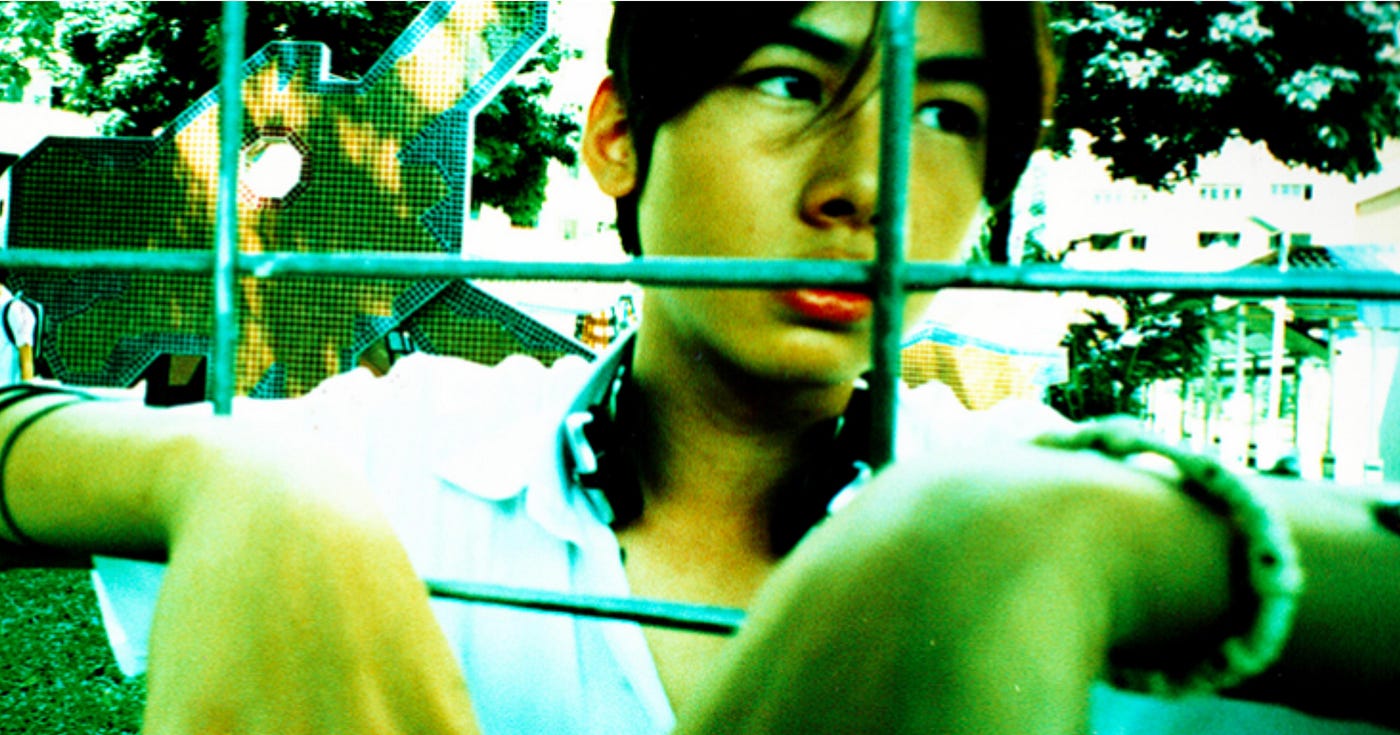
Incarcerated in more ways than one. (Mothership)
On the brightly polished and effortlessly clean plastic seats of the MRT (Mass Rapid Transit), our tarnished and sullied motley crew sits listlessly in silence, staring into nothing.
Or perhaps, inwards into themselves? Wondering yet again why they feel nothing — or rather, why they feel like nothing? They seem, almost, like hand-drawn figures cut out of an animated film: caricatures of the wayward teen clad in poorly-placed self-pierced facial piercings, half-finished Japanese sleeve tattoos, and loudly-dyed attempts at punk hairstyles. Uncannily wrapped up in the tightly tapered monochrome school uniforms they don, much like that of a straitjacket, keep them in a state of constant internal epistemic conflict and also serves as a warning to all morally upstanding, civic-minded Singaporeans that what — not who — you see is not normal. Sunny Singapore speeds by past the train’s windows, leaving them behind as the somber lyrics to Jack Neo’s Hokkien beng (Singlish for Chinese male delinquent) anthem Siàu-Iân Eng-Hiông (Young Heroes) reverberates solitarily through their collective trance. Melvin lets his head fall onto Vynn’s shoulder in quiet acceptance that much like his government, society, school, and even his family — his hiaⁿ-tī (Hokkien for brother) — cannot see him. For he is unseen. He is nothing. (Tan, 2003, 1:27:00–1:28:18)

Our tragic anti-heroes. (Youtube)
Singaporean filmmaker Royston Tan’s 2003 ethnographic fiction masterpiece 15: The Movie remains divisive and controversial within Singaporean discourse, yet nevertheless persisting into the contemporary as a critically acclaimed and unabashedly realistic depiction of Chinese teenage gang-life within the Singaporean context.
This film, then, acts as a brilliant companion piece for the ensuing analysis of the figure of the Malay Gangster as detailed in Barker, Harms, & Lindquist’s Figures of Southeast Asian Modernity (Barker et al., 2013). The Malay Gangster, as is embodied in the Omega gang member Ajat through the research of sociologist Kamaludeen Mohamed Nasir, is an individual that is forced to navigate life through precariously sprinting along the tightropes of socioeconomic boundaries, and adopting hegemonic logics and methodologies that are often in opposition to one’s own epistemology so as to secure subsistence. And through utilizing a number of other written sources, as well as the author’s own auto-ethnographic accounts alongside the aforementioned references:
The ensuing essay will serve to argue that the figure of the Malay Gangster — as well as Singaporean youth gang culture as a whole — exists as a manifold form of embodied and lived socio-economic resistance against the state’s ongoing efforts at affective governmentality and engineered social stratification.
The following three sections of this essay will serve to bolster this thesis, each foregrounding a different marker by which we can begin to better deconstruct and analyze the figure and its adjacent subaltern community in question historically, as well as its passage into modernity and thusly into the present moment in comparison with other notable figures of Singaporean, and by extension, Southeast Asian modernity.

“If we die, we die together.” (Mothership)
“A RUNAWAY WORLD”
We begin with Singapore’s fabled yet troubled founding father: the man that had actively defined and moulded the island-nation into what it is today as one of history’s greatest economic success stories, claiming the title of being one of the great Four Asian Tigers at the turn of the century (Ortmann, 2008). This came at a cost, however, one that was fully paid and has since come to fruition through the nation-state’s characteristic electoral authoritarian rule of law: culminating in the state’s inclination towards draconic public policy and rigid self-policing. Lee Kuan Yew was an iron-fisted leader that was able to steer Singapore towards achieving its eventual economic boom through socially engineering a schema that would enable the population to self-affirm and self-justify the mass commodification of the self and family for the betterment of the state. Singaporean society has since also come to develop a system of social rule that has been defined by that of an ultraconservative moral compass— in that should one fall outside of the bracket of what has been defined by the state (and thus, the people) as morally upright or socially accepted, one is to then thusly subject to social and/or legal punishment by right of a universally applicable and undeniable sort of logic.
This sort of hyperpragmatic moralism, as I have coined it, can very much be traced back to Lee’s own personal philosophy, and in no ways had developed in any sort of social vacuum, so to speak. In a 1994 interview with Indian-American journalist Fareed Zakaria, Lee — whom had stepped down as Prime Minister and fulfilled the role of Senior Minister at the time — unapologetically espouses his fondness for eugenics and race science, an innate ideological division between the “East” and the “West,” a fixation with restoring and preserving Confucian ethics and family values, and ultimately the unwavering dedication to the belief in an omnipresent and omniscient force of good and evil that drives all human agency (Zakaria, 1994).
It is, then, without surprise that we now find the Singaporean habitus defined by the institutionalization of patriarchal racialization at all levels and scales; the state’s watchful gaze pervading through both the physical and digital walls of every Singaporean household — and centrally — through the eyes of every Singaporean citizen. And it is through this formula that we arrive at a principal unit of measure in the collective consciousness: identity. The Singaporean state’s efforts to install the image of the island-nation as a global city has dominated mass media both domestically and abroad ever since the very genesis of its independence, and in this endeavour to define state identity there has been no shortage of resultant collateral. Frameworks such as the CMIO (Chinese-Malay-Indian-Others) race model has homogenized social groups, flattening diversity and heterogeneity (Kathiravelu, 2017), and urban development policy continues to contribute to an unending cycle of place(un)making (Chang & Huang, 2008). These markers remain only the tip of the iceberg in foregrounding the vast amount of cultural lag that had been produced by the country’s legacy of rapid development. And as we return to the figure in question, investigating the role of Singaporean secret societies within this history reveals how some groups that fall outside of state classification are not only necessarily aberrant to modernization, but are in fact entirely constitutive to it. Secret societies of today and yesteryear can trace their lineage back to the Chinese triads of British Singapore, of whom were a revenue stream and on-the-ground fixers of sorts for the colonial state. In post-independence, as the PAP (People’s Action Party) came to power, the Singaporean state inherited this symbiotic relationship, and furthermore, formalized it rather than dismantling it (Nasir, 2013). And thus, the modern pai kia was born.
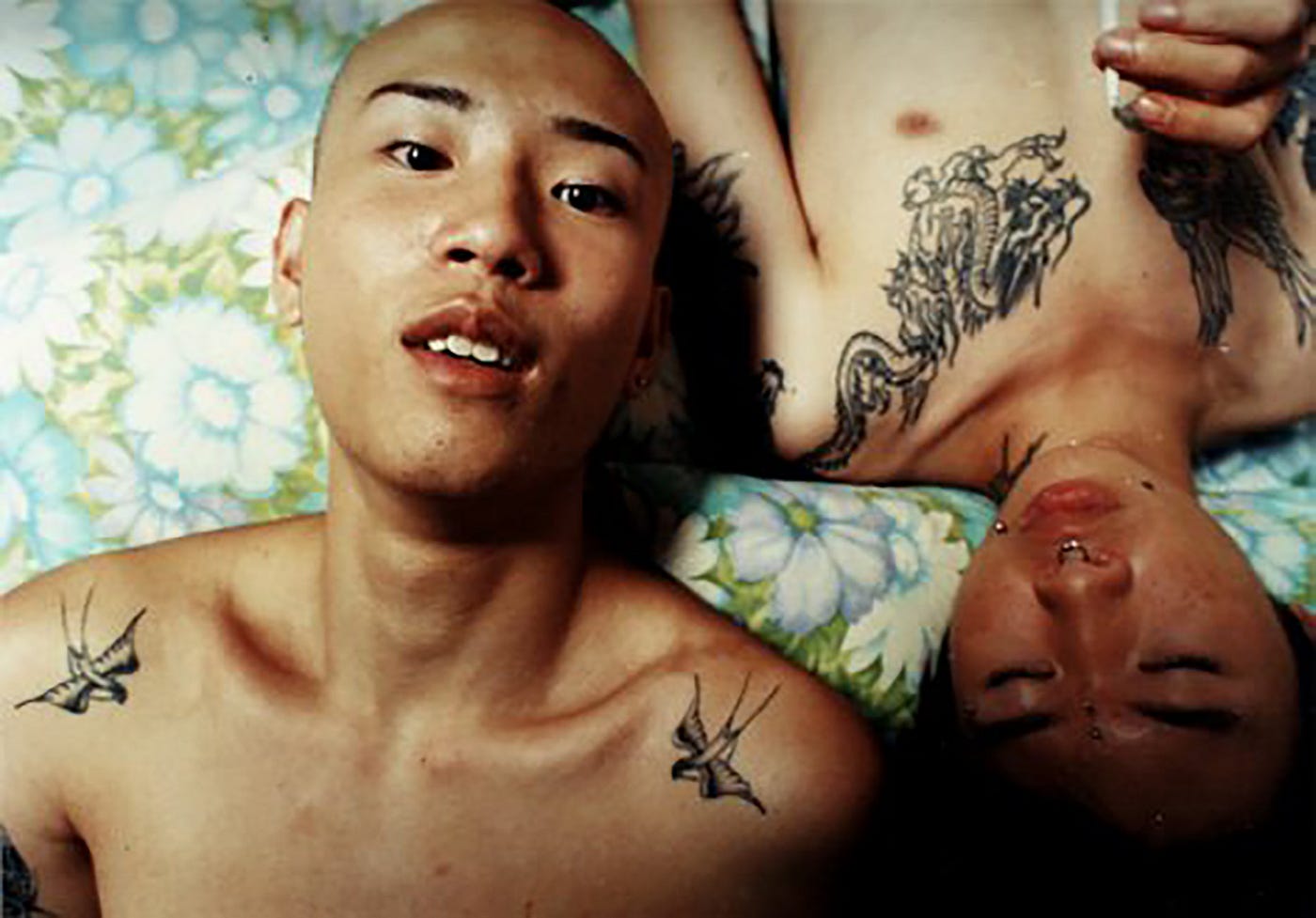
Melvin and Erick. (Directors Notes)
THE OMNIPRESENT PANOPTICON
To clarify, pai kia (Hokkien/Singaporean colloquial translating to bad kid) is generally used to refer to delinquency in general, expanding beyond secret society members to also include thugs, bullies, hooligans and the like. And oftentimes today, those enlisted in what we traditionally know as organized crime networks are few and far between, as such syndicates have since largely been wiped out by the state. Essentially, it is imperative to note that within the contemporary Singaporean context, the designation of secret society and gang are often used in conjunction with one another, but often do not necessarily equate to ties with transnational crime networks despite secret societies’ tracing their inception to the far-reaching Chinese triads of yesteryear.
And just as we take care to clearly define such terminology, it is also key to highlight the emergence of a new actor in this domain. From the ashes of the ah beng (Chinese gangster) and samseng (Malay gangster) of days past rose the infamous YP (young punk: Chinese male delinquent) and matrep (common Malay forename Ahmad, + rep as in “reputation”). These two figures, alongside their female counterparts — the XMM (xiǎo mèi mèi) and minah (of Aminah, a common Malay name for women) respectively — have come to shape much of the youth delinquent subculture in the present. The primary means by which the YP/Matrep differs from our figures of the Ah Beng/Samseng manifests in the lack of adopting a strict adherence to tradition and rituals à la code of honour or the rules of the streets. Perhaps as globalization had begun tightening its grip on Singapore, they had consequently evolved instead into more of a modernized anti-authority, anti-social fringe culture without much care for upholding tradition — whilst maintaining some stylistic carryover from their predecessors.
But what remains as one of the foremost driving factors behind these figures seeking out secret societies is that of lacking social acceptance and belonging. As it is depicted in the film, our cast of anti-heroes face down the merciless gaze of the state at every level of their being: be it through disciplinary action at school (Tan, 2003, 03:03–03:20), judgement from strangers in public (Tan, 2003, 26:10–27:05; 36:48–38:56; 53:06–54:07), and even rejection from parents in the home (Tan, 2003, 19:01–19:20; 1:06:28–1:07:52). But what persists through as most intriguing is this raw and passionate desire to truly be seen, recognized and perceived as themselves in simultaneous conflict with the state’s gaze enforcing the model identity. Armani’s paradoxical relationship with visibility illustrates this dichotomy perfectly: stating in his closing monologue how he was resigned to being valued as nothing in life, but thus had to absolutely have as visible of a suicide as possible as a form of settlement (Tan, 2003, 43:27–47:27). This pulls towards another key characteristic of the subculture: body modification. The need to fill the body with more tattoos and piercings is not simply just to pay homage to traditions past, but rather a despairing attempt to reclaim one’s identity and self (Sweetman, 1999). The irony behind their obsession with long-defunct systems of territorial dispute also reveals an attempt at reclaiming space, of which ~90% of land is state-owned; their notorious e-scooters and bikes posing a directly visible challenge to Singapore’s exorbitant car prices and administrative fees. And what is perhaps the most vulgar and inexcusable transgression remains — the state’s monopolization over bodies. The necropolitical exercise of power is echoed thoughout the film via the then-criminalized act of suicide (Tan, 2003, 18:06–18:18). Though this has since been repealed in 2020, the fatalistic worldview is still very much embodied (Tan, 2003, 1:26:06–1:26:17), as these surplus bodies have concretized themselves as literal failures of the state awaiting disposal or expiry.
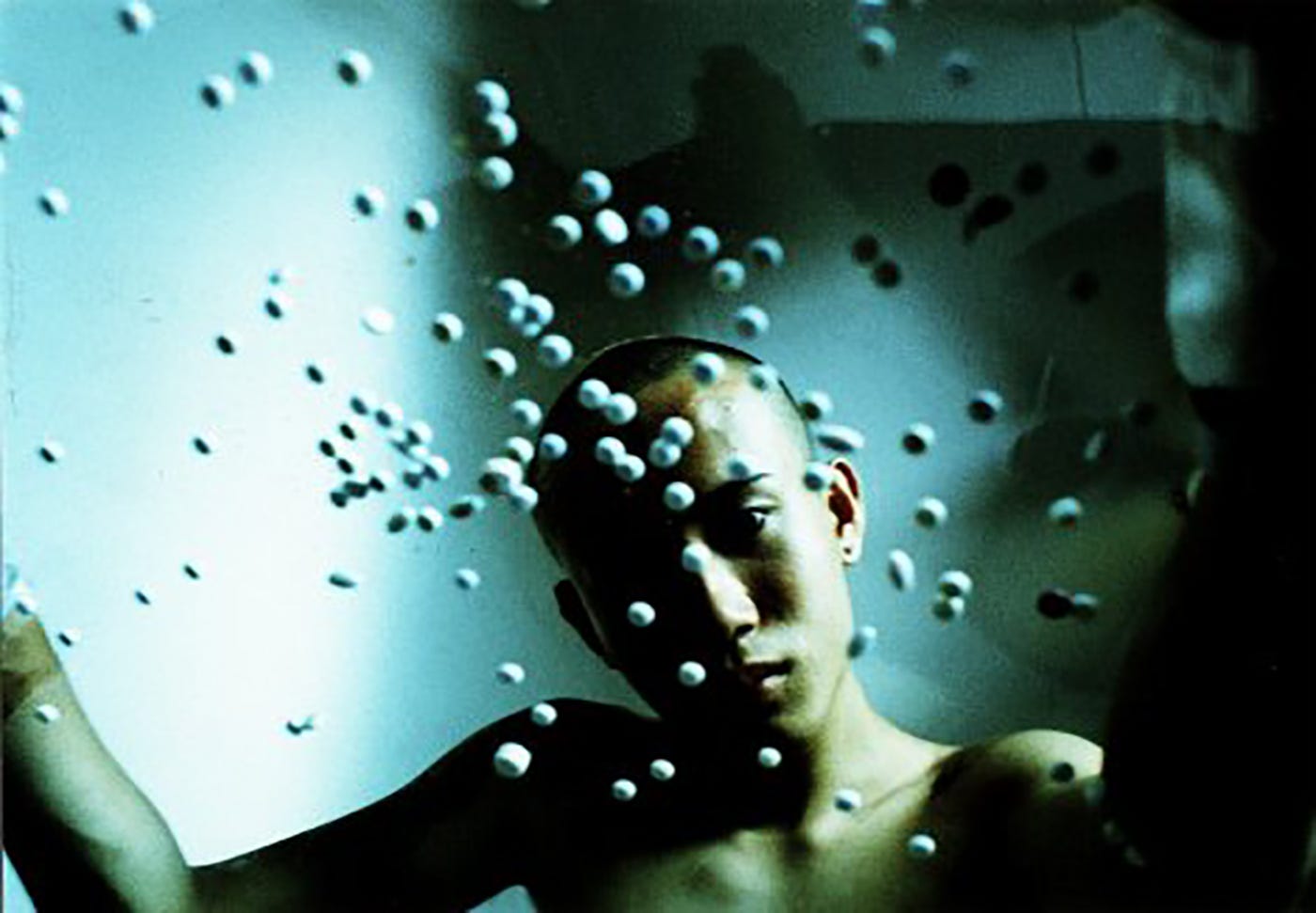
Erick engaging in some rather lucrative business practices. (Directors Notes)
“SHIRT” BUSINESS: THE INFORMAL LABOUR NETWORKS OF TODAY
And as I conversed with my friends who were former gang members in consolidating research for this paper, I was reminded of a word that is repeatedly used to describe gang matters and membership: shirt. To “play shirt” is to be involved in gangs, to challenge another with “you play what shirt” is to demand an admission of one’s gang allegiances, and hence: “shirt business” was the terminology used in place of criminal work. I found this iconography strangely fitting, as these youths experience state disposal through academic streaming (Tan, 2003, 14:24–15:49), being obstructed from ease of flow into the formal economy before they even enter it (Pratt et al., 2017), leaving the body as the only site where both labour and resistance survives. We observe through Shaun in the film how the body becomes an intimate site of contention through becoming a drug mule (Tan, 2003, 1:03:58–1:06:00), whereby the body is rendered into pure commodity — contrasted against the habit of smoking and other vices so as to reclaim the body and refuse state-defined productivity.
In the present, however, secret societies have since ironically followed in the state’s footsteps, and evolved with the times: rapidly digitizing and forgoing traditional induction rituals for swift recruitment in the name of maximizing profit margin. Singaporean gangs’ rackets now largely manifest through digital petty crimes, running scams, or — for the boldest initiates — loan-sharking. Secret societies loan out credit accounts from low-level gang members to use as shadow accounts to gamble on online gambling sites such as GemBet, as online gambling is outlawed in Singapore. This post-Fordist labour reorganization mirrors legal economies’ shift to flexible, networked, gig-style work (Fraser & Batchelor, 2024) — effectively recontextualizing these criminal labour networks as informal labour systems in resistance to the state’s efforts to engineer financial and economic legitimacy instead of simply pathological deviance.

Round and round they go, trying their hardest to ignore life rolling on past them. (Youtube)
CONCLUSION
As Ajat expresses at the end of his written section, his “status frustration” lies primarily in the organization of his gang, which almost reflects that of the state. He actively moves between worlds so as to accrue the sufficient sociocultural capital to advance himself in the gang hierarchy (Nasir, 2013). Alas, the tendrils of neoliberal capitalism had even found their way into gang ontologies, not only reshaping it towards a proclivity for precarious labour, but also mirroring the state’s sins of institutional racism. And as other figures of modernity like the Peri-Urban Tenant are equally co-produced through shared peripheral disposability, there exists figures like the Schoolteacher that serve as their ideological antithesis — the integer the state had successfully produced placed in direct opposition to the one it chose to fail. But no matter the role these figures play in the social order, they are all made to don the uniform assigned to them. These uniforms, however, were never made for them. Each and every one of them an intricately designed carapace, if you will — one for each of us to inhabit.
WORKS CITED
Barker, J., Harms, E., & Lindquist, J. (Eds.). (2013). Figures of Southeast Asian modernity. University of Hawaiʻi Press.
Chang, T. C., & Huang, S. (2008). Geographies of everywhere and nowhere: Place-(un)making in a world city. International Development Planning Review, 30(3), 227–247. https://doi.org/10.3828/idpr.30.3.3
Kathiravelu, L. (2017). Rethinking race: Beyond the CMIO categorisations. In L. K. Seng, P. T. Thum, & J. M. T. Chia (Eds.), Living with myths in Singapore (pp. 159–168). Ethos Books.
Nasir, K. M. (2013). The Malay gangster. In J. Barker, E. Harms, & J. Lindquist (Eds.), Figures of Southeast Asian modernity (pp. 198–200). University of Hawaiʻi Press.
Ortmann, S. (2008). Whither the developmental state? Explaining Singapore’s continued developmentalism. Third World Quarterly, 29(6), 1101–1115. https://doi.org/10.1080/01436590802201162
Pratt, G., Johnston, C., & Banta, V. (2017). Lifetimes of disposability and surplus entrepreneurs in Bagong Barrio, Manila. Antipode, 49(1), 169–192.
Sweetman, P. (1999). Marked bodies, oppositional identities? Tattooing, piercing and the ambiguity of resistance. In S. Roseneil & J. Seymour (Eds.), Practising identities: Power and resistance (pp. 163–191). Palgrave Macmillan. https://doi.org/10.1007/978-1-349-27653-0_4
Tan, R. (Director). (2003). 15 [Film]. Zhao Wei Films. https://archive.org/details/15_The_Movie
Zakaria, F. (1994). Culture is destiny: A conversation with Lee Kuan Yew. Foreign Affairs, 73(2), 109–126.
메타데이터
- post_id
- 4a0dd8b3f09b
- slug
- the-shirt-off-ones-back-4a0dd8b3f09b
- url
- https://medium.com/@nijoules/the-shirt-off-ones-back-4a0dd8b3f09b
- canonical_url
- https://medium.com/@nijoules/the-shirt-off-ones-back-4a0dd8b3f09b
- author_url
- https://medium.com/@nijoules
- status
- ok
- fetched_at
- 2026-06-24 04:09:36