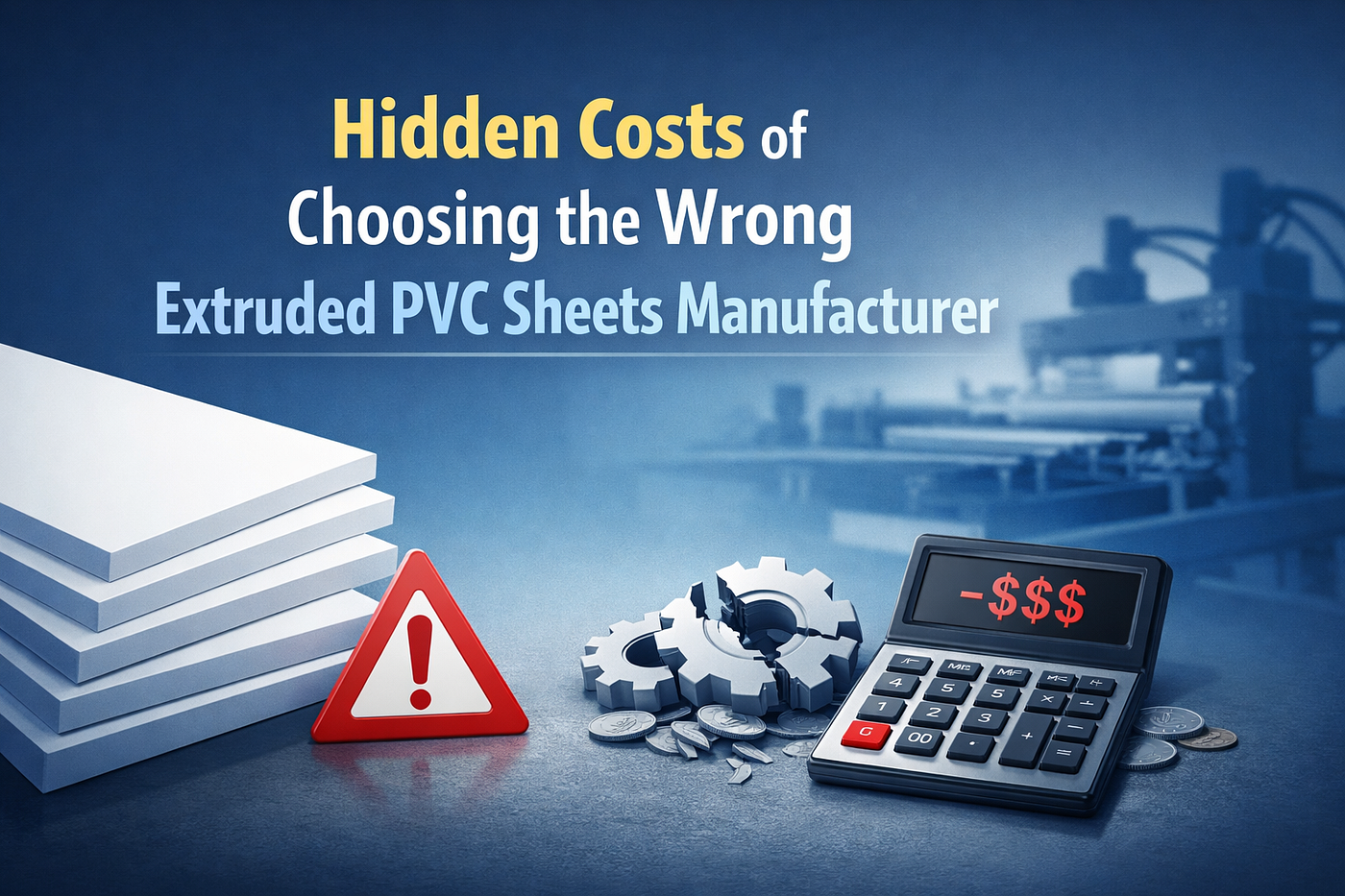
Hidden Costs of Choosing the Wrong Extruded PVC Sheets Manufacturer
In construction and infrastructure projects, material decisions look simple on paper. A PVC sheet is a PVC sheet — right?
Hidden Costs of Choosing the Wrong Extruded PVC Sheets Manufacturer
In construction and infrastructure projects, material decisions look simple on paper. A PVC sheet is a PVC sheet — right?
Not quite.
For project managers, procurement heads, and contractors, selecting the wrong **Extruded PVC Sheets Manufacturer** can silently drain budgets, delay timelines, and damage client trust. The invoice may look competitive. However, the real cost becomes apparent months later — in site rework, warranty claims, and structural failures.
In today’s margin-sensitive construction industry, hidden costs are more dangerous than visible ones.
This article explains where those costs come from — and how to avoid them.
Why Manufacturer Selection Matters More Than Price?
PVC sheets are widely used in:
- Wall cladding
- False ceilings
- Clean rooms
- Signage structures
- Industrial partitions
- Exterior paneling
Because they are lightweight and cost-effective, many buyers focus on unit price. But inconsistent supply quality creates risk across the project lifecycle.
A reliable manufacturer controls:
- Raw material composition
- Thickness consistency
- Density control
- UV stabilization
- Fire-retardant properties
- Load-bearing performance
If any of these variables fluctuate, downstream costs rise quickly.
1. PVC Sheet Quality Issues Lead to Early Failure
Inconsistent Thickness and Density
Low-cost manufacturers often cut corners in extrusion calibration. This results in:
- Uneven sheet thickness
- Weak structural areas
- Poor screw holding strength
In commercial interior partitions, this may lead to bending or surface cracks within 12 to 18 months.
Poor UV Resistance
Exterior applications demand UV stabilization. Without proper additives:
- Sheets discolor
- Surfaces become brittle
- Cracks appear
This leads to replacement cycles far earlier than expected.
According to industry studies from organizations like the American Society for Testing and Materials (ASTM), material inconsistency significantly reduces service life in polymer-based construction materials.
For infrastructure projects with 5–10 year warranties, this becomes a serious liability.
2. Construction Material Failure Creates Cascading Costs
When PVC sheets fail, the impact is not limited to replacement cost.
It triggers:
- Labor reinstallation costs
- Scaffold re-erection expenses
- Delays in project handover
- Client dissatisfaction
- Penalty clauses
In large infrastructure contracts, even a 2-week delay can result in penalty charges of 0.5–1% of project value.
A minor sourcing decision can suddenly become a contractual issue.
This is where many procurement teams underestimate risk.
3. Hidden Cost of Site Rework
Rework is one of the largest hidden drains in construction budgets.
Research from the Construction Industry Institute shows rework can account for 5–9% of total project cost in infrastructure projects.
PVC sheet-related rework may involve:
- Removing installed panels
- Surface refinishing
- Structural reinforcements
- Waterproofing corrections
Rework not only increases cost but also reduces labor productivity and morale.
For contractors working on tight deadlines, this disrupts the sequencing of multiple trades.
4. Supply Chain Instability and Project Delays
An unreliable Extruded PVC Sheets Manufacturer often struggles with:
- Raw material shortages
- Batch inconsistency
- Poor logistics coordination
- Delayed dispatch
For large construction sites, just-in-time material delivery is critical.
If sheets arrive late or in mixed specifications:
- Installation teams remain idle.
- Equipment rental days increase.
- Other dependent work stalls
Idle manpower on site can cost thousands per day.
5. Fire and Safety Compliance Risks
Fire safety standards are becoming stricter across commercial buildings.
If PVC sheets lack certified fire-retardant properties:
- They may fail inspection.
- Authorities may reject the installation.
- Recertification becomes mandatory
This is especially critical in:
- Hospitals
- Metro stations
- Airports
- Commercial complexes
Non-compliance is not just a cost risk. It’s a legal risk.
6. Brand and Reputation Damage
Contractors and project managers are judged by outcome, not supplier excuses.
If visible defects appear within a year:
- End clients lose trust.
- Future bids weaken
- Word spreads across developer networks.
In infrastructure, reputation capital is priceless.
Choosing the wrong manufacturer may save 3–5% in procurement cost, but can damage long-term business relationships.
7. Long-Term Lifecycle Cost Impact
Many buyers focus on upfront cost instead of lifecycle cost.
Low-grade PVC sheets may require:
- Replacement in 2–3 years
- Frequent maintenance
- Surface coating repairs
High-quality sheets often last 8–10 years with minimal maintenance.
When calculated across the lifecycle:
Lower price ≠ Lower cost
Smart procurement considers:
- Durability
- Warranty support
- Technical documentation
- Batch traceability
- Consistent quality testing
Early Warning Signs of a Risky Manufacturer
Project managers should look out for:
- No third-party test reports
- Inconsistent sample thickness
- No documented quality control process
- Vague answers on fire rating
- No long-term project references
A professional Extruded PVC Sheets Manufacturer provides:
- Technical data sheets
- Compliance certificates
- Batch-level inspection records
- Transparent production capability
Actionable Takeaways for Project Leaders
Before finalizing your supplier:
- Request certified test reports.
- Verify UV and fire rating compliance.
- Ask for large-project references.
- Inspect batch consistency physically.
- Evaluate logistics capability.
Small verification steps reduce major risk exposure.
Conclusion
In construction and infrastructure projects, material risk is business risk.
Choosing the wrong **Extruded PVC Sheets Manufacturer** does not just impact material cost. It affects timelines, compliance, client trust, and long-term profitability.
For project managers and procurement leaders, the smarter question is not:
“What is the lowest price per sheet?”
It is:
“What is the total lifecycle cost of this decision?”
Evaluating manufacturers carefully at the start prevents expensive corrections later.
If you’re planning a new infrastructure project, build a supplier evaluation checklist before issuing your next PO. Prevention always costs less than rework.
FAQs:
1. Why does PVC sheet quality vary between manufacturers?
Quality depends on raw material grade, extrusion control, additives, and quality testing standards.
2. How do PVC sheet quality issues affect infrastructure projects?
They can cause bending, cracks, discoloration, and eventual construction material failure.
3. Are cheaper PVC sheets always risky?
Not always. But unusually low pricing often signals reduced material density or weaker additives.
4. What certifications should a PVC sheet supplier provide?
Look for fire rating compliance, UV resistance reports, and standardized mechanical testing certifications.
메타데이터
- post_id
- 4a2d616097bc
- slug
- hidden-costs-wrong-extruded-pvc-sheets-manufacturer-4a2d616097bc
- url
- https://medium.com/@gajesh4545/hidden-costs-wrong-extruded-pvc-sheets-manufacturer-4a2d616097bc
- canonical_url
- https://medium.com/@gajesh4545/hidden-costs-wrong-extruded-pvc-sheets-manufacturer-4a2d616097bc
- author_url
- https://medium.com/@gajesh4545
- status
- ok
- fetched_at
- 2026-06-23 03:48:11