Theory of Every Spiritual Thing: Episode 36 —The Holographic Cosmos: How Every Part Holds the…
Philosophical dialogues between a father and his children about the principles of Japanese Shinto philosophy (Released on Medium: August…
Theory of Every Spiritual Thing: Episode 36 —The Holographic Cosmos: How Every Part Holds the Whole in Shinto Cosmology
Philosophical dialogues between a father and his children about the principles of Japanese Shinto philosophy (Released on Medium: August 12, 2025)
In this series, “Theory of Every Spiritual Thing,” I will introduce you to the fantastic world and cosmology of Japanese Shinto philosophy (based on the teachings of Sect Shinto, which is different from State Shinto) through dialogues between Dad, a Japanese Shinto philosopher, and his two children, Phil and Sophy.
Previously on Episode 35: In Episode 35, we explored the Principle of Uncertainty and how particles constantly flicker in and out of existence. According to Shinto cosmology, this flickering reflects the interplay between the creative force (Izanagi) and the dissolving force (Izanami), revealing that all things in the universe are part of a great cosmic cycle of birth and death.
→* Go back to Episode 35 here.*
Episode 36: The Holographic Cosmos — How Every Part Holds the Whole in Shinto Cosmology
Sophy: Hey Dad, you said the non-material universe became hidden behind the material one… but where did it actually go?
Dad: Great question. Everything in space and matter is a reflection of monadic vibrations. Each monad is still connected to all others in the non-material universe. In other words, everything in this world is still linked to the whole.
Phil: Wait, so you’re saying even the tiniest monad contains the information of the entire cosmos?
Dad: Exactly. Every point in space, every atom, every monad is like a mirror of the universe.
Sophy: Whoa… so each tiny part of reality carries the whole? That’s amazing — and kind of mysterious.
Dad: It’s mysterious, yes, but you’re not the first to think that way. There’s actually a word for it: “holon.”
Sophy: Holon?
Dad: Yes. A holon is something that is both a part and a whole at the same time. It comes from the Greek word holos (whole) and part. Holons are self-contained units, but they also function as parts of a greater whole.
Phil: So like, each cell in my body is part of me, but it also acts as a whole on its own?
Dad: Exactly. Your heart is part of your body, but it is also made up of cells and systems. Each holon reflects a similar dual nature.
Sophy: That kind of sounds like monads, too. Each one holds the whole in a tiny mirror.
Dad: That’s the Shinto view. Leibniz said monads reflect the universe, but Shinto philosophy goes further: monads interact and harmonize. They resonate.
Phil: Still a bit abstract…
Dad: Then let me show you something fascinating: have you ever heard of a hologram?
Sophy: Yes! That 3D image made from light?

First photograph of a single hologram taken from different viewpoints
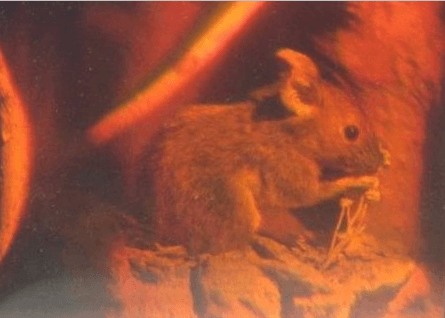
Second photograph of a single hologram taken from different viewpoints
Dad: Exactly. And here’s the magic part: if you cut a piece of a holographic film, that little piece still shows the entire image.
Sophy: Wait, how is that possible?
Dad: Because holograms store information through interference patterns in light waves. Each part holds a copy of the whole.
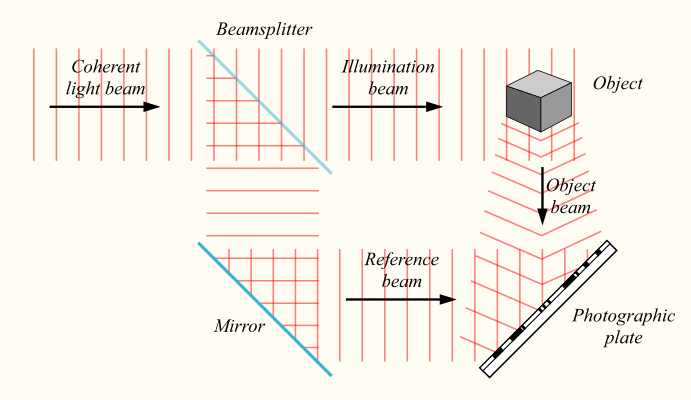
By DrBob at the English-language Wikipedia, CC BY-SA 3.0, https://commons.wikimedia.org/w/index.php?curid=18103931
Phil: So it’s the wave nature of light that allows that?
Dad: Yes. Waves can interfere and overlap, carrying information in distributed ways. That’s how the whole shows up in every part.
Phil: So… if monads are also wave-like, that could explain why they contain the whole!
Dad: Exactly! Monads are not fixed particles —they form dynamic waves of spiritual force. Like quantum waves, they can interfere, resonate, and reflect the whole.
Sophy: So the entire non-material universe is like a giant hologram?
Dad: Yes. Each monad is like a verse in the cosmic song. Alone, it’s just a note — but together, they make the universal harmony.
Phil: Then maybe… each of us is a verse, too?
Sophy: That makes me feel… connected. Like I’m part of something vast and beautiful.
Dad: And you are, Sophy. That’s what “matsuri” means in Shinto — to shine as an individual, while contributing to the harmony of the whole.
Sophy: The universe is dancing together, and we’re all part of the choreography!
Next time on Episode 37: If everything in the universe is made of monads and holons, how does it all fit together? What does the complete cosmology of Shinto look like? Join us as we take a step back and look at the universe as a whole — a living web of sacred resonance.
© Theory of Every Spiritual Thing / ToEST Project 2025. All rights reserved.
메타데이터
- post_id
- 4a2de2d93dea
- slug
- theory-of-every-spiritual-thing-episode-36-the-holographic-cosmos-how-every-part-holds-the-4a2de2d93dea
- url
- https://medium.otakupapa.net/theory-of-every-spiritual-thing-episode-36-the-holographic-cosmos-how-every-part-holds-the-4a2de2d93dea
- canonical_url
- https://medium.otakupapa.net/theory-of-every-spiritual-thing-episode-36-the-holographic-cosmos-how-every-part-holds-the-4a2de2d93dea
- author_url
- https://medium.com/@wotakupapa
- status
- ok
- fetched_at
- 2026-07-18 06:59:57