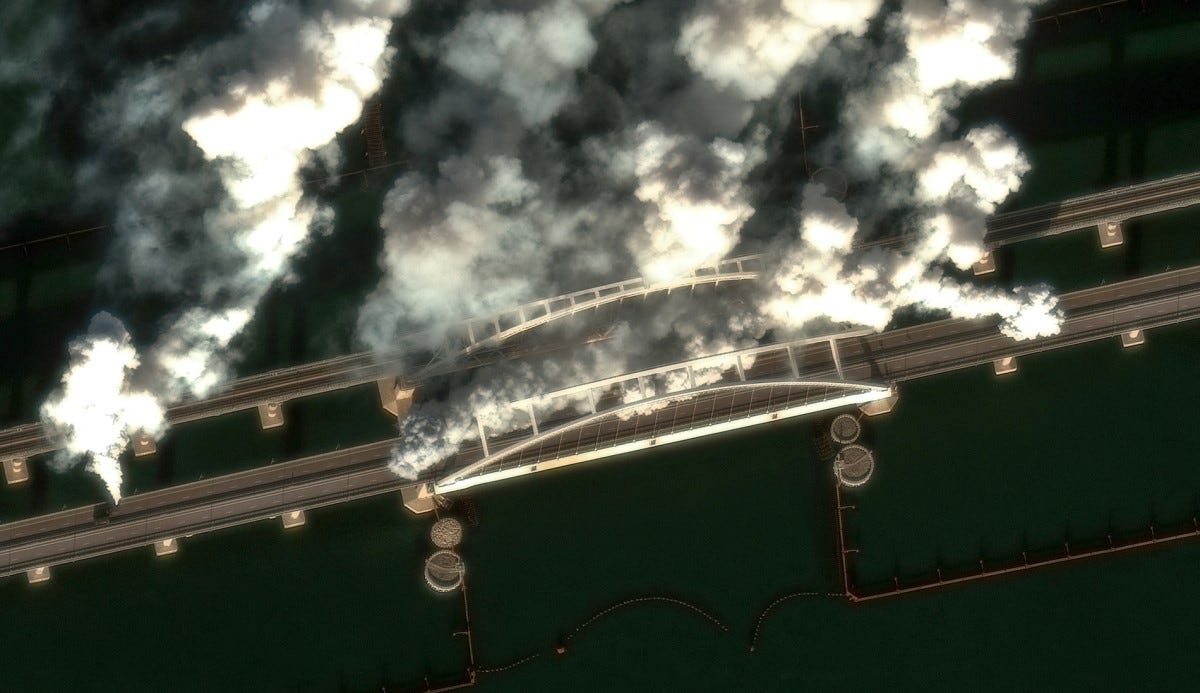
Russia’s Rear Lines Are No Longer Safe From Ukraine
You remember the old rules of this war, don’t you? For months, even years, the unspoken bargain was simple: Ukraine would fight for every…
Russia’s Rear Lines Are No Longer Safe From Ukraine
You remember the old rules of this war, don’t you? For months, even years, the unspoken bargain was simple: Ukraine would fight for every village in the east and south, while Russia would sit comfortably behind its own borders, launching missiles from Black Sea warships and refining oil in plants a thousand miles from the front. The Kremlin’s logic was as cynical as it was cold — that Ukraine’s Western partners would never allow their weapons to strike deep into Russian territory. That red line, you see, was supposed to protect everything from Belgorod to Bashkortostan.
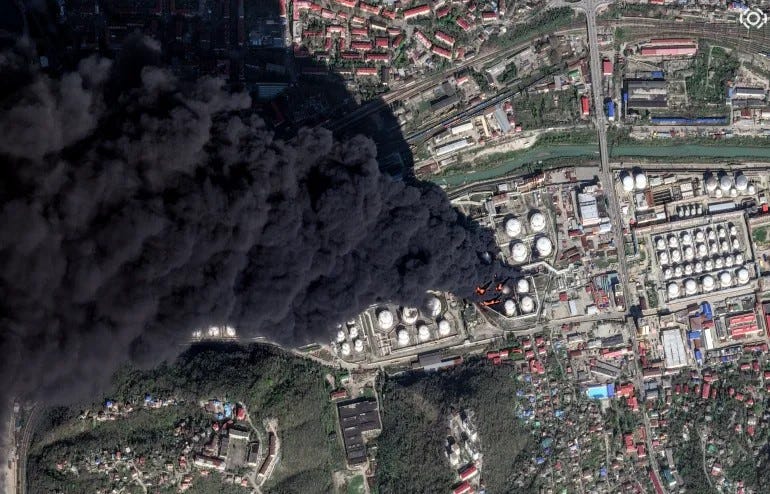
Well, that red line has been erased. Not with a single, dramatic strike, but with a relentless, systematic campaign that has turned Russia’s so-called “safe rear” into a landscape of burning storage tanks, shuttered terminals, and panicked officials. I have watched this transformation over the past three weeks with a mixture of awe and grim satisfaction. Ukraine has not just poked holes in Russia’s air defence umbrella — it has torn it wide open. And the message from President Volodymyr Zelenskyy and his commanders is now unmistakable: Your rear lines are no longer safe. Not tomorrow. Not ever again.
A Warning from Moscow That Sounds Like Panic
Let me take you inside the Kremlin’s response, because it tells you everything you need to know about who is winning this new phase of the war. On Wednesday of this week, the Russian defence ministry issued a statement that was so uncharacteristically defensive, so laden with the language of victimhood, that you would have thought Ukraine had bombed the outskirts of Moscow itself.
“We consider this decision to be a deliberate step leading to a sharp escalation of the military and political situation on the entire European continent,” the ministry declared. The “decision” they were screaming about was Ukraine’s new series of agreements with European defence companies — deals that will pump hundreds of millions of euros into Ukrainian long-range drone production. Russia went on to warn of “unpredictable consequences” and accused European leaders of “increasingly dragging these countries into the war with Russia.”
Now, I have read a lot of Russian propaganda over the last two years. Usually, it is full of bluster about nuclear threats and red lines. But this time, something felt different. This time, the Kremlin wasn’t threatening to escalate. It was admitting that it couldn’t stop what was already happening. To prove the point, the ministry published a list of addresses of European companies involved in joint weapons production with Ukraine. And then Dmitry Medvedev, the former president turned professional troll, clarified with a snarl: “This is a list of potential targets for the Russian armed forces.”
But here is what you need to understand, and I want you to sit with this for a moment: Medvedev can threaten all he wants. The reality is that Russia’s own intelligence services have consistently failed to protect its critical infrastructure inside its own borders. If they cannot stop a $500 commercial drone from hitting an oil depot in Tver, how exactly are they going to strike a factory in Germany or Norway? The threat is theatre. The burning oil terminals are not.
Germany and Norway Bet Big on Ukraine’s Long Arm
You might be wondering: where is all this Ukrainian strike power coming from? Is it American ATACMS? British Storm Shadows? The answer, increasingly, is no. The most exciting — and for Russia, the most terrifying — development is that Ukraine is building its own long-range arsenal. And Europe is now paying for the assembly line.
Consider what happened the day before Russia’s panicked statement. Germany agreed to invest 300 million euros ($355 million) directly into Ukraine’s long-range strike capability. That is not a loan for post-war reconstruction. That is cash for missiles and drones that will be flying toward Russian refineries next month. Separately, Berlin committed to financing 5,000 mid-range attack drones, specifically designed to tear apart Russian battlefield supply lines. Imagine you are a Russian logistics officer trying to move ammunition from a railhead in Rostov to the front near Kupiansk. You now have to look over your shoulder at the sky for a swarm of Ukrainian loitering munitions that a German cheque book helped produce.
Then there is Norway. The Norwegians signed an agreement with Kyiv for joint drone production and immediately donated 560 million euros ($661.5 million) to support Ukrainian front lines with unmanned systems. That is nearly a billion dollars between Berlin and Oslo in a single week, all dedicated to one purpose: making sure Russian territory is no longer a sanctuary.
I want you to appreciate the strategic brilliance of this move on Ukraine’s part. For over a year, the Biden administration and some European capitals dithered about “escalation management.” They feared that if Ukraine hit Russia proper, Putin might do something rash. So what did Ukraine do? It built its own domestic industry. As former Defence Minister Rustem Umerov — who was instrumental in ramping up drone production during 2025 — put it, “Since the beginning of the full-scale invasion, the capabilities of the Ukrainian defence industry have increased by more than 50 times.” Fifty times! And this week, Zelenskyy himself released a video showcasing 56 types of Ukrainian-built weapons, including 31 types of drones. He called it Arms Makers’ Day. I call it a middle finger to every Russian general who thought time was on their side.
The $23 Billion Bonanza That Russia Lost
Now let me explain why Russia is so furious. It’s not just about national pride or military doctrine. It is about money. Specifically, it is about a staggering $23 billion in windfall oil profits that Russia was supposed to pocket in March.
Here is the backstory, and you need to follow this because it explains the entire logic of Ukraine’s campaign. According to reports on global energy markets, the world’s 100 biggest oil companies — including Russia’s own Gazprom — made a collective $23 billion in extraordinary profit last month. Why? Because of the Iran war. That conflict has triggered a global oil supply crisis, sending crude prices soaring. For Russia, a petro-state that funds its war machine almost entirely through oil and gas exports, this should have been a moment of victory. A chance to fill the treasury, buy more missiles, and pay more soldiers.
But here is the twist that should make you smile. Reuters reported that Russia missed out on a full 40 percent of that potential bonanza. Forty percent. Why? Because Ukraine has systematically destroyed Russia’s ability to export at least 2 million barrels of oil per day. You cannot sell oil that you cannot pump. And you cannot pump oil when your pumping stations are on fire. You cannot export it when your terminals are smouldering ruins. You cannot ship it when your tankers are afraid to dock.
Think about the math of that for a second. Forty percent of a 23billionwindfallisover23billionwindfallisover9 billion. That is $9 billion in cash that Vladimir Putin was counting on to continue his invasion. It has gone up in smoke — literally. And the strikes are accelerating.
A Two-Week Blitzkrieg Against Russian Energy
Let me walk you through the past two weeks, because the sheer scale of Ukraine’s campaign is staggering. I want you to imagine a map of Russia. From the Caspian Sea in the south to the Baltic coast in the north, from the Black Sea ports to the Volga region deep in the interior, Ukraine has lit up targets like a pinball machine of destruction.
In the last week of March and the first week of April, the hammer fell hardest on Russia’s Baltic oil terminals at Primorsk and Ust-Luga. Satellite photography obtained by analysts showed that Primorsk had lost 40 percent of its storage facilities. Ust-Luga lost 30 percent. Market sources also confirmed that the Russian energy giant Novatek had been forced to suspend gas condensate processing and exports entirely at Ust-Luga. Finnish maritime officials told Reuters that shipments from the two ports had collapsed from a weekly average of 40 to 50 vessels to just “individual vessels” — if any at all.
Then came April 5. An Aframax tanker, the first ship in many days brave or foolish enough to attempt loading crude at Ust-Luga, pulled up to the terminal. That same night, Ukraine struck the port again. Three massive 20,000-cubic-metre storage tanks — each one the size of a city block — were set alight. On that same day, Ukraine also hit Primorsk and the Sheskharis oil terminal on the Black Sea, operated by Russian oil major Transneft. Geolocated footage showed fires raging at oil tanker berths. One industry source told me that at least $200 million worth of crude oil had simply burned to ash in Primorsk alone.
But Ukraine did not stop at oil. On April 8, it hit Russia’s largest oil terminal in occupied Crimea at the port of Feodosia. That terminal is a critical node for supplying Russian front-line troops in the south. In the first ten days of April, Ukrainian drones also struck refineries in Bashkortostan — get this: 1,200 kilometres, or 745 miles, from Ukraine’s own borders. That is deeper than any previous strike. They also hit the Nizhny Novgorod refinery. They struck two drilling platforms in the northern Caspian Sea, two oil pumping stations in Volgograd and Krasnodar Krai, an oil depot in the city of Tver northwest of Moscow, the Cherepovets Azot ammonia plant, and the Sterlitamak Petrochemical Plant. Every single one of these strikes has been confirmed by geolocated video footage or, in some cases, even by Russian officials themselves.
Why Russia Can’t Stop the Drones
You might be asking yourself: why isn’t Russia shooting these drones down? It is a fair question. The Russian military spends billions on air defence. It has the S-400, the Pantsir, and a host of other systems designed to create a protective dome over the Motherland. So what is going wrong?
The answer, according to a sharp new analysis from the Institute for the Study of War, a Washington-based think tank, is that Russia has no answer for the numbers and the dispersion. “Russia does not appear to have fully developed or deployed mobile fire teams, drone interceptors, or other low-cost distributable systems to defend against repeated massed Ukrainian drone strikes,” the ISW wrote. In plain English: Russia built its air defences to stop a handful of expensive cruise missiles or fighter jets. It never built a system to stop hundreds of cheap, slow, low-flying drones coming from every direction at once.
Ukraine’s deputy defence minister, Serhiy “Flash” Beskrestnov, drove this point home by posting photographs of Russia’s desperate improvisations. One image showed a truck-mounted R-77–1 air-to-air missile — a weapon designed to be fired from a fighter jet at another jet — jury-rigged to point vaguely skyward from the back of a lorry. That is not air defence. That is panic. Russia cannot produce enough S-400 launchers to cover the 17 million square kilometres of its own territory. It cannot even produce enough trained men with shoulder-launched missiles to patrol every oil depot. And Ukraine is exploiting that fatal weakness ruthlessly.
The New Reality: No Sanctuary, No Exceptions
I want you to understand what has changed permanently. For the first 18 months of the full-scale invasion, Ukrainians lived under the terror of Russian missiles fired from the Caspian Sea or from bombers over the Saratov region. Russia could strike Ukraine with impunity from its own rear lines. That asymmetry is over.
President Zelenskyy put it best this week. “Today, our deep strikes are no longer a sensation,” he said. Read that quote again. He is not bragging. He is stating a new fact of life — as routine as the weather. Ukraine can now reach deep inside Russia whenever it chooses. It can deny Russia windfall oil profits. It can turn the Kremlin’s strategic rear into a tactical liability. And it can do so with weapons that are designed, financed, and increasingly built by Ukrainian hands and European money.
Zelenskyy also justified the attacks with a moral clarity that I find unassailable. “Only significant financial losses force Russia to consider a scenario of abandoning this war,” he said. He is right. You cannot negotiate with a country that is making $23 billion a month from oil. You can only take that money away. You can only light it on fire, one storage tank at a time.
So here is where you and I stand today. Russia’s rear lines are no longer safe. The Primorsk terminal is still offline. The Admiral Makarov, a Kalibr missile-carrying frigate, was damaged in the same strike that hit Sheskharis. The Caspian drilling platforms are dark. And every night, Ukrainian drone operators are looking at maps of Russia and asking each other: “What shall we burn next?”
The Kremlin can threaten Europe all it wants. It can publish lists of “potential targets.” But you and I both know the truth. The initiative has shifted. The safe zone is gone. And the only question that remains is how much more of Russia’s war machine Ukraine will reduce to rubble before the men in the Kremlin finally understand that their own rear lines have become the front line.
메타데이터
- post_id
- 4a3b514a6aa6
- slug
- russias-rear-lines-are-no-longer-safe-from-ukraine-4a3b514a6aa6
- url
- https://medium.com/@18shubhampawar/russias-rear-lines-are-no-longer-safe-from-ukraine-4a3b514a6aa6
- canonical_url
- https://medium.com/@18shubhampawar/russias-rear-lines-are-no-longer-safe-from-ukraine-4a3b514a6aa6
- author_url
- https://medium.com/@18shubhampawar
- status
- ok
- fetched_at
- 2026-06-18 07:02:39