“Should Canberra Expand Its Water Supply Capacity?
Canberra is one of Australia’s fastest-growing cities. With a current population of around 482,000 people, official projections show it…
“Should Canberra Expand Its Water Supply Capacity? A Cost-Benefit Analysis of Infrastructure Investment to Meet Population Growth”
Canberra is one of Australia’s fastest-growing cities. With a current population of around 482,000 people, official projections show it could approach 700,000 by 2050. New suburbs are spreading across the valleys, families are moving in from interstate and overseas, and businesses are expanding in growing town centres. This growth is substantial, but it is also putting steady pressure on the city’s water supply — the quiet foundation that keeps Canberra green, livable, and planned.
For many residents, water security is something they only think about when restrictions hit. During past dry periods, Canberrans became familiar with shorter showers, brown lawns in summer, and temporary bans on watering gardens, washing cars, or filling swimming pools. These conservation measures helped in the short term. But as the population keeps growing year after year, simply asking everyone to use less water may no longer be enough. The central policy question facing the ACT Government is clear: should the city invest in expanding water supply capacity now, or wait until shortages become more frequent and severe?
Figure 1 shows how water demand is projected to grow over the next 30 years compared with Canberra’s estimated sustainable supply capacity.
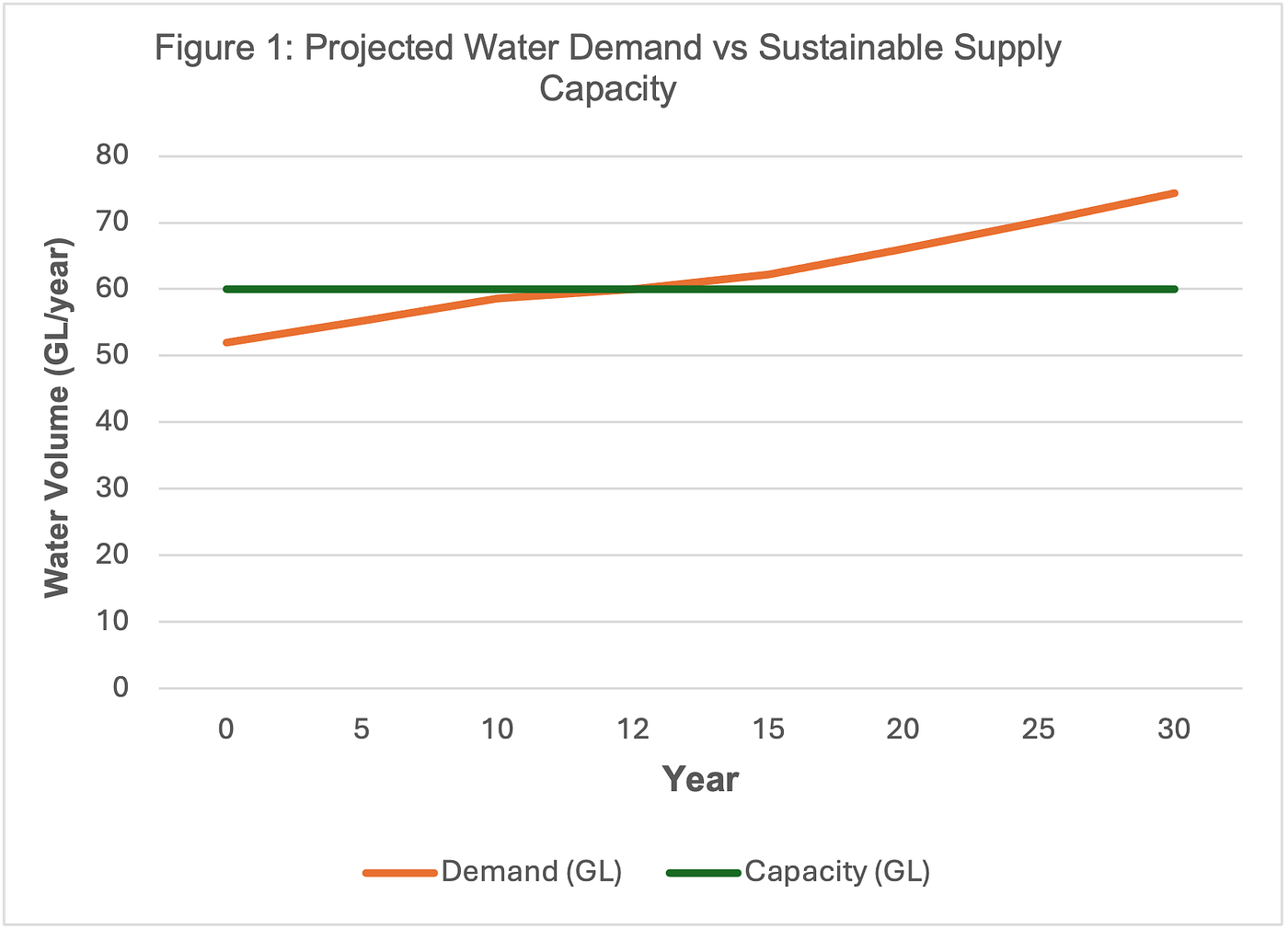
Current annual water consumption is approximately 52 gigalitres (GL). This study uses a straightforward approach to compare two possible futures. It projects how water demand will rise with population growth and weighs the economic costs of future shortages against the costs and benefits of building new infrastructure. The analysis assumes demand will grow by about 1.2% per year, consistent with recent ACT population trends.
Under these assumptions, the city’s effective supply capacity would be reached around year 12. Beyond that point, demand would regularly exceed what the existing system can reliably provide. Some households and businesses that are willing to pay for water would still be unable to get as much as they need. Figure 2 summarises the estimated economic outcomes of expanding supply now.

The modelling shows that the long-term costs of doing nothing would be substantial — roughly $185 million in today’s dollars over 30 years. By contrast, expanding capacity earlier is estimated to deliver a net economic benefit of around $42 million after accounting for construction and ongoing maintenance costs. These estimates come from comparing the upfront cost of expanding supply (e.g., new storage or enhanced recycling facilities) against the economic losses from future water shortages (e.g., household restrictions, business disruption) over 30 years. Future costs and benefits are converted to today’s dollars using a standard public-sector approach.
Timing is particularly important. If the government waits until water shortages become obvious and frequent, the costs rise quickly. Emergency restrictions are disruptive for families, more expensive for businesses, and politically difficult. Last-minute solutions during a drought — such as emergency trucking of water or sudden price increases — are usually far more costly and stressful than planned investment. Acting early allows infrastructure to be built gradually, gives households and businesses greater certainty about future water security, and reduces the risk of sudden shocks to the local economy and living standards.
Of course, expanding supply is not the only answer. Water recycling programs, rainwater tanks, efficiency rebates, and conservation campaigns all help reduce demand and should continue to be part of the city’s strategy. These measures are valuable, relatively low-cost, and environmentally beneficial. Many Canberrans already support them because they promote sustainability. However, as the city’s population continues to grow strongly, these demand-management policies on their own are unlikely to fully close the gap. They work best when combined with additional supply capacity.
Delaying expansion until shortages become severe would likely impose larger long-term costs on Canberra households and businesses. Early, well-planned investment provides reliability, supports economic growth, protects quality of life, and helps preserve Canberra’s identity as a green, planned, and livable capital. Reliable water is not just a technical issue — it is fundamental to the lifestyle and confidence that make people want to live, work, and invest here. It affects everything from weekend barbecues in the backyard and children playing in sprinklers to the success of local businesses and the overall attractiveness of Canberra as a place to raise a family. In a city designed to be a model of modern urban living, water security is part of what makes that vision possible.
This analysis does not explicitly model environmental impacts or future climate variability, which could affect the results. Overall, the results suggest that expanding Canberra’s water supply capacity now is economically justified under the assumptions used. It is a practical step to secure the city’s future as a growing, livable, and sustainable capital. By investing proactively, the ACT Government can protect households from future hardship, support continued economic development, and ensure that Canberra remains the green and prosperous city that residents and visitors value so highly.
References
Chu, L. (2026). Supplementary Note #3: Partial Equilibrium Analysis. IDEC8064: Advanced Applied Microeconomics, Australian National University.
Icon Water (2025). Annual Water Consumption Report 2024–25. Canberra: Icon Water.
ACT Government (2025). ACT Population Projections 2025–2050. Canberra: ACT Treasury.
메타데이터
- post_id
- 4a4c5c2cef5d
- slug
- should-canberra-expand-its-water-supply-capacity-4a4c5c2cef5d
- url
- https://medium.com/@zsheikhanu/should-canberra-expand-its-water-supply-capacity-4a4c5c2cef5d
- canonical_url
- https://medium.com/@zsheikhanu/should-canberra-expand-its-water-supply-capacity-4a4c5c2cef5d
- author_url
- https://medium.com/@zsheikhanu
- status
- ok
- fetched_at
- 2026-07-09 03:40:04