MCP is the New npm: The 10 Tools Rewriting How Developers Build with AI in 2026
In November 2024, Anthropic released a protocol. By June 2026, it had 97 million monthly downloads and was running inside GitHub, Figma…
MCP is the New npm: The 10 Tools Rewriting How Developers Build with AI in 2026
In November 2024, Anthropic released a protocol. By June 2026, it had 97 million monthly downloads and was running inside GitHub, Figma, Jira, Chrome DevTools, and 70+ other tools. Here’s what you need to know.
In December 2025, Anthropic donated the Model Context Protocol to the Linux Foundation’s Agentic AI Foundation. That moment didn’t make many headlines. It should have.
When a company open-sources the protocol underpinning its flagship product and hands governance to a neutral foundation, it’s not a PR move. It’s a signal that the technology has outgrown its creator — and that the industry has decided it’s infrastructure.
MCP is infrastructure now. And just like npm reshaped how JavaScript developers shared code, MCP is reshaping how AI agents connect to the tools that actually matter.
What MCP Actually Does (in 60 Seconds)
Before 2024, connecting an AI assistant to an external tool meant custom integrations — brittle, one-off, vendor-locked. Every AI client had its own plugin format. A tool built for ChatGPT didn’t work in Claude. One built for Claude didn’t work in Cursor.
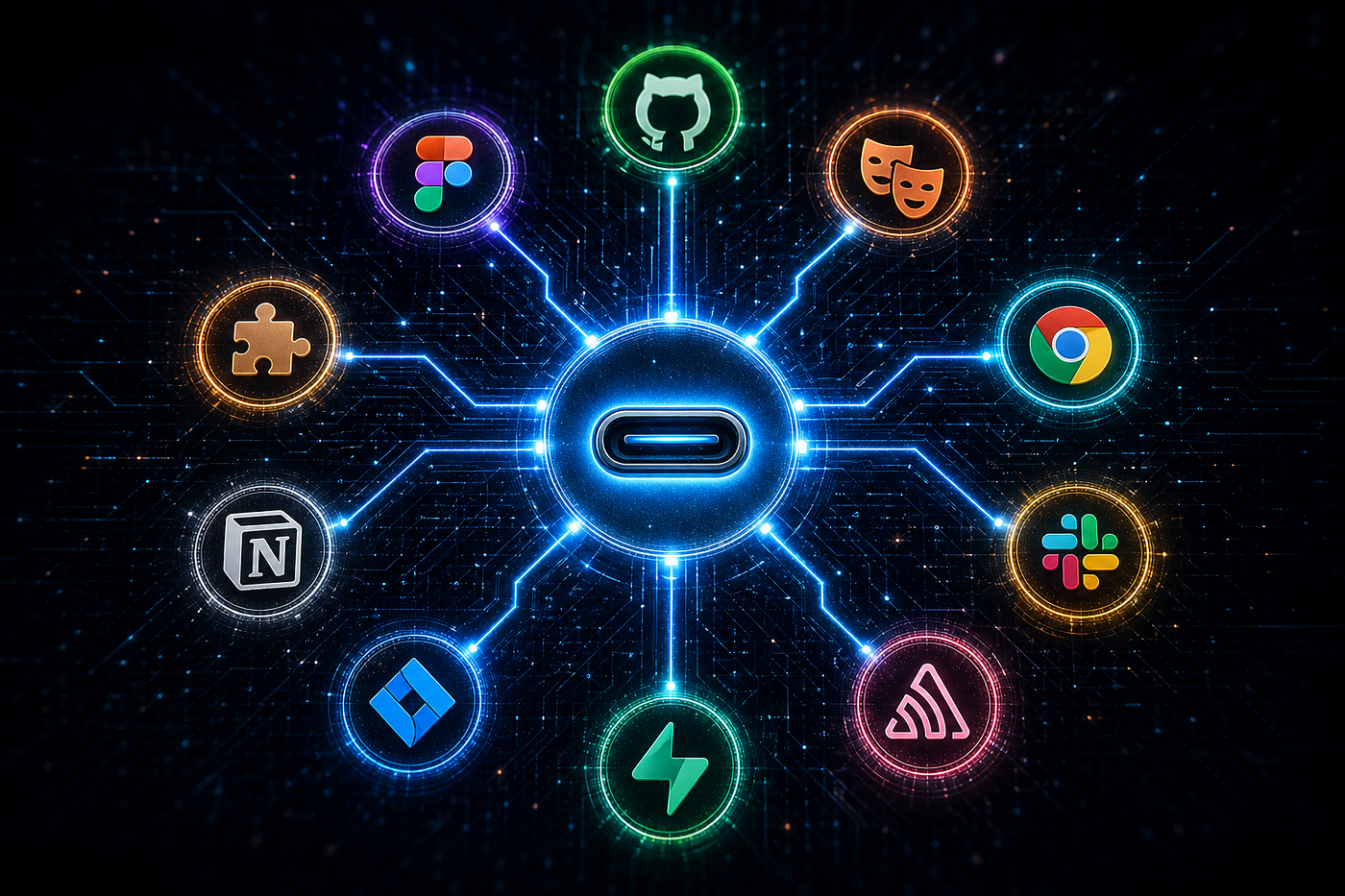
MCP changes this with a single, universal interface. Any MCP-compatible server works with any MCP-compatible client: Claude Desktop, Claude Code, Cursor, Windsurf, VS Code with GitHub Copilot, Zed, Cline — all of them. You build or configure a server once. Every AI tool you use can access it.
Think of it as USB-C for AI. One standard. Every device.
The adoption numbers reflect this. From OpenAI and Google DeepMind adopting MCP in early 2025, to the MCP SDK crossing 97 million monthly downloads by January 2026 — outpacing the early adoption curves of both REST and GraphQL. As of June 2026, the ecosystem counts 70+ production-ready servers across 11 categories, with remote HTTP endpoints replacing local STDIO-only configurations across every major platform.
The 10 MCP Servers You Need to Know Right Now
Here are the tools with the most traction, ranked by real-world developer search volume (March 2026, Ahrefs data):
- Playwright MCP — 82,000 monthly searches
The undisputed #1. Playwright MCP gives your AI agent full browser automation and end-to-end testing capabilities. Instead of writing Playwright scripts manually, you describe the test in natural language and the agent writes, runs, and debugs it. It’s used heavily for QA automation, web scraping pipelines, and UI regression testing. If you do any frontend work, this one is non-negotiable.
- Figma MCP — 74,000 monthly searches
Design-to-code just became real. Figma’s MCP server exposes design files, components, tokens, and layout specs directly to your coding agent. Cursor users are using it to go from a Figma frame to a working React component in one prompt. The gap between design and implementation — which has frustrated developers for a decade — is closing fast.
- GitHub MCP — 69,000 monthly searches | 30,415 GitHub stars
The official GitHub MCP server (built in Go, 140 contributors, 66 releases) is now the standard for AI-assisted repo management. It exposes issues, PRs, Actions workflows, code scanning, Dependabot, secret protection, and more — all queryable and actionable through natural language. Reviewing a PR, triaging issues, or triggering a CI/CD pipeline now happens inside your AI conversation, not by switching tabs.
- Jira / Atlassian / Confluence MCP — 40,000 monthly searches
Atlassian has gone all-in on MCP, migrating from Server-Sent Events (SSE) to Streamable HTTP endpoints (SSE deprecation date: June 30, 2026). The Atlassian MCP server connects your AI agent to Jira tickets, Confluence pages, and project boards — making it possible to create tickets from bug reports, update sprint status from standup notes, and search documentation without leaving your editor.
- Context7 MCP — 32,000 monthly searches
This one is underrated and growing fast. Context7 solves one of the most persistent problems with AI-assisted coding: hallucinated APIs. It injects version-accurate, up-to-date library documentation directly into your prompts. Ask Claude how to use a specific version of Next.js or LangChain, and Context7 ensures it answers with the current API — not a deprecated method from training data. For developers working with fast-moving libraries, this is a must-install.
- Chrome DevTools MCP — 42,699 GitHub stars | Updated June 3, 2026
The newest breakout hit. Google’s official Chrome DevTools MCP server (Apache 2.0 license) lets your coding agent control and inspect a live Chrome browser — not just navigate to URLs, but access the full power of DevTools: DOM inspection, network traces, console evaluation, CSS computation, performance profiling, and JavaScript execution. This is a step beyond Playwright-level automation. It’s what you reach for when debugging complex frontend issues or building AI agents that need to genuinely understand what’s happening inside a running page.
- Supabase MCP — 26,000 monthly searches
Supabase’s remote MCP server gives AI agents direct access to your Postgres database schema, rows, RLS policies, and edge functions — with proper auth and scoping. You can query your production data, generate migrations, and debug RLS issues through natural language. Supabase was one of the first to launch a hosted remote MCP endpoint with OAuth, making it production-safe without credential exposure.
- Slack MCP — 17,700 monthly searches
Now available as a remote HTTP endpoint. The Slack MCP server lets agents post messages, search conversation history, list channels, and trigger workflows — all from within your AI client. Enterprises are using this to build daily standup bots, incident notification agents, and knowledge-retrieval systems that pull relevant Slack threads into developer context.
- Sentry MCP — 4,700 monthly searches | Remote server launched 2026
Sentry launched its production remote MCP server in early 2026. The use case is powerful: an AI agent monitoring your codebase can now query Sentry directly for recent errors, stack traces, and affected users — and then attempt a fix, all in one loop. This is the closest thing currently available to a self-healing codebase.
- Composio MCP — 250+ integrations in one server
If you only want to configure one server, make it Composio. It acts as a meta-MCP that aggregates 250+ enterprise integrations — Gmail, Salesforce, HubSpot, Google Sheets, Asana, Airtable, and more — into a single connection. Instead of managing 20 separate MCP server configs, you add Composio once and your agent has access to your entire software stack.
The Big Shift: Remote MCP is Replacing Local MCP
Until recently, most MCP servers ran locally via STDIO — you installed a package, configured a path, and it ran on your machine. In 2026, the ecosystem is rapidly migrating to remote HTTP endpoints.
The numbers tell the story: remote MCP servers grew from 16 in January 2026 to 25+ by April 2026. Atlassian, HubSpot, Linear, Slack, Vercel, Sentry, and Neon have all launched hosted remote endpoints. The advantages are significant — no local installation, proper OAuth authentication, centralized credential management, and access from any device.
This migration matters because it unlocks a new class of use case: agents running in CI/CD pipelines, serverless environments, and cloud infrastructure — without requiring a local machine at all.
MCP Apps: The Next Frontier
On January 26, 2026, Anthropic quietly launched something called MCP Apps — an extension that lets MCP servers render interactive UIs (dashboards, forms, charts) directly inside Claude’s chat window. Launch partners included Amplitude, Asana, Canva, Figma, Hex, Monday.com, Salesforce, and Slack.
This is a significant inflection point. MCP started as a protocol for giving agents access to tools. MCP Apps turns Claude into an application platform — where you can build Amplitude charts, update Asana tasks, and collaborate on Figma files without ever leaving the conversation. The line between AI assistant and enterprise application is dissolving.
Setting Up Your First MCP Server in Cursor (5 Minutes)
For Cursor users, configuration is straightforward. Add to ~/.cursor/mcp.json (global) or .cursor/mcp.json (project-level):
{
“mcpServers”: {
“github”: {
“command”: “npx”,
“args”: [“-y”, “@modelcontextprotocol/server-github@latest”],
“env”: { “GITHUB_PERSONAL_ACCESS_TOKEN”: “your_token” }
},
“context7”: {
“command”: “npx”,
“args”: [“-y”, “@upstash/context7-mcp@latest”]
},
“playwright”: {
“command”: “npx”,
“args”: [“-y”, “@playwright/mcp@latest”]
}
}
}
Cursor’s January 2026 update now uses dynamic context across all MCP servers simultaneously, reducing total token usage by 46.9% when running multiple servers at once. You can stack 5–10 servers without meaningful performance degradation.
The Bottom Line
MCP crossed the threshold from “interesting experiment” to “foundational infrastructure” in less than 18 months. The Linux Foundation governance. The 97 million downloads. The 70+ production servers. The remote HTTP migration. The MCP Apps platform.
Each of these individually is a data point. Together they tell a story: the AI tool ecosystem is standardizing, and MCP is what it’s standardizing on.
For developers, the opportunity is clear. Every tool you use daily — your code repo, your design tool, your error tracker, your database, your project management suite — now has or will soon have an MCP server. The developers who learn to compose these into coherent agent workflows in 2026 will have a compounding productivity advantage that gets harder to close every month.
The question isn’t whether to add MCP to your stack. It’s which 10 servers to start with.
Building something interesting with MCP? Follow me for more on AI tooling, agent workflows, and the infrastructure shaping how developers work.
메타데이터
- post_id
- 4a500d054df4
- slug
- mcp-is-the-new-npm-the-10-tools-rewriting-how-developers-build-with-ai-in-2026-4a500d054df4
- url
- https://medium.com/@kmfdvxs/mcp-is-the-new-npm-the-10-tools-rewriting-how-developers-build-with-ai-in-2026-4a500d054df4
- canonical_url
- https://medium.com/@kmfdvxs/mcp-is-the-new-npm-the-10-tools-rewriting-how-developers-build-with-ai-in-2026-4a500d054df4
- author_url
- https://medium.com/@kmfdvxs
- status
- ok
- fetched_at
- 2026-06-09 15:37:30




