I Bought “The Johnny Sins of Hacking Gadgets”
Meet the Cardputer ADV: The Cyberdeck That Fits in Your Pocket
I Bought “The Johnny Sins of Hacking Gadgets”
Meet the Cardputer ADV: The Cyberdeck That Fits in Your Pocket
A few years ago, if someone told me I’d carry a computer smaller than my phone that could play Mario, run hacking tools, store custom firmware on an SD card, play MP3s through a built-in speaker, and eventually become part of my LoRa communication projects, I’d probably assume they were describing some overpriced Kickstarter gadget.
Turns out, it already exists.
It’s called the M5Stack Cardputer ADV.
And after spending some time with it, I realized this isn’t just another ESP32 development board with a keyboard glued onto it.
It’s weird.
In the best possible way.
FREE ACCESS TO THIS ARTICLE FOR NON _ MEDIUM MEMBERS
Who am I? I’m Satyam Pathania (0xdiddy), a cybersecurity researcher, technical writer, and hardware tinkerer who enjoys building weird things with ESP32s, RF modules, and open-source hardware. My work has been featured across cybersecurity publications and reaches thousands of security enthusiasts every month.
Youtube Video
[embed]
This is the review of cardputer adv, on my YouTube, make sure you subscribe
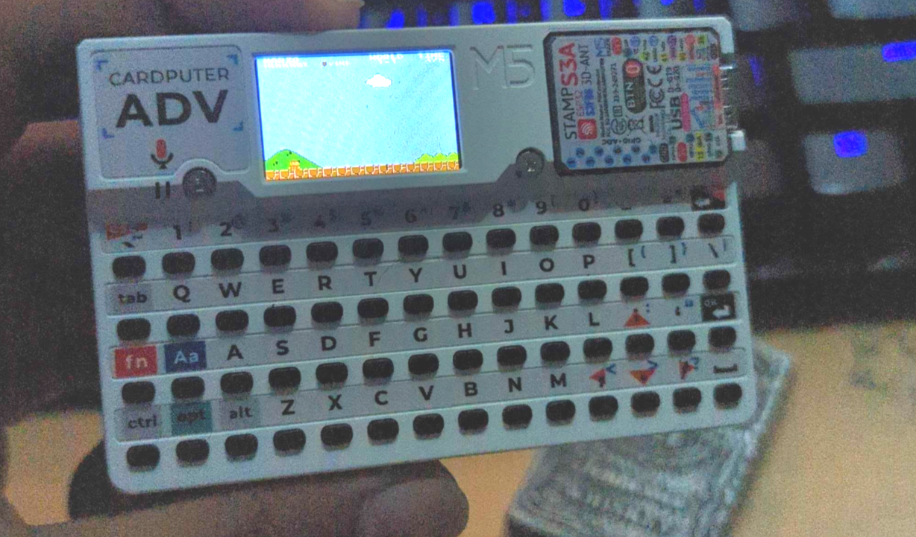
playing mario on this tiny device
Why I Care About Portable Hacking Hardware
One thing I’ve noticed in cybersecurity is that everyone loves talking about tools.
The problem is that most tools live on a laptop…….
A laptop is powerful, sure. But it isn’t exactly something you pull out in the middle of nowhere to experiment with wireless protocols, test an idea, or build something fun.
I’ve always been fascinated by portable devices.
Not because they make me look like a hacker in a movie.
Mostly because I enjoy devices that make me want to experiment.
The Cardputer ADV falls into that category immediately.
It’s the kind of gadget that makes you ask:
“What happens if I install this firmware?”
Five minutes later, you’re flashing random binaries from GitHub and wondering where your evening went.
First Impressions
The first thing that surprised me was the size.
Photos don’t really prepare you for how small this thing is.
It fits in your hand.
The keyboard is tiny.
The screen is tiny.
The entire device feels like someone shrunk a laptop in the washing machine.
Yet somehow it works.
And after a few minutes, you start adapting to it.
I wouldn’t write a novel on it.
But for launching apps, navigating menus, testing firmware, or sending commands, it’s surprisingly usable.
What’s Actually Inside?
Under the hood, the Cardputer ADV is powered by the ESP32-S3.
If you’ve spent any time around hardware hacking, IoT projects, or DIY electronics, you’ve probably encountered ESP32 devices before.
The ESP32-S3 is powerful enough to support:
- WiFi
- Bluetooth
- Portable applications
- Custom firmware
- Hardware projects
- Wireless experimentation
The important part isn’t the specifications.
It’s the ecosystem.
ESP32 projects are everywhere.
And the Cardputer ADV benefits from that massive ecosystem.
More Than a Cyberdeck
The funny thing is that I initially planned to use this purely for cybersecurity experiments.
That lasted about ten minutes.
I installed M5 Launcher. (You can see the yt video or Flash M5 launcher from the M5 firmware software)
Then I started loading different firmware binaries onto an SD card.
Then I discovered game launchers.
Then somehow I was playing Mario.
At that point, the cybersecurity plan temporarily disappeared.
My Cardputer had become a pocket-sized retro gaming console.
The Unexpected Walkman
One feature I didn’t expect to enjoy was audio.
The Cardputer ADV includes a DAC and speaker support.
So naturally, I copied some MP3 files onto the SD card.
Now I had:
- Games
- Music
- Firmware tools
- Utilities
All inside a device smaller than most power banks.
It feels less like a development board and more like carrying a tiny digital toolbox.
Or a very nerdy Walkman.
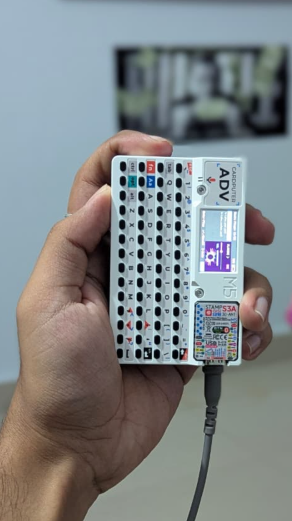
this was me listening music , my iems connected to the device
GPIO: Where Things Get Interesting
Most people will stop at games and firmware.
Cybersecurity researchers won’t.
The real magic starts when you look at the GPIO expansion options.
This is where the Cardputer stops being a gadget and starts becoming a platform.
You can connect:
- LoRa modules
- Sensors
- RFID hardware
- Wireless modules
- Custom peripherals
Which means the device you used to play Mario yesterday can become an RF experimentation platform tomorrow.
That’s a very dangerous sentence for your wallet.
Bruce Firmware and the Hacker Crowd
If you’ve spent time on cybersecurity Twitter, Reddit, or YouTube recently, you’ve probably seen Bruce firmware.
Bruce has become one of the biggest reasons researchers are interested in the Cardputer ecosystem.
What makes Bruce interesting isn’t that it turns the device into some magical hacking machine.
It’s that it lowers the barrier to experimentation.
People can learn.
They can explore.
They can understand how wireless technologies work.
And perhaps most importantly, they can break things in a lab environment and learn from it….
This is the review of Bruce firmare on stick cplus2
[embed]
Cardputer ADV vs M5StickC Plus2
Since I already own an M5StickC Plus2, comparison was unavoidable.
The M5StickC Plus2 feels like a compact multitool.
The Cardputer ADV feels like a tiny computer.
The keyboard alone changes how you interact with the device.
Typing commands, navigating menus, launching tools, and experimenting with firmware simply feels more natural.
If I wanted maximum portability, I’d grab the M5Stick.
If I wanted to build something serious, I’d grab the Cardputer ADV.
What Security Researchers Are Building
This is probably the most exciting part.
Researchers are building:
Portable cyberdecks
Wireless testing platforms
RF experimentation tools
ESP32-based utilities
Custom communication systems
Every week I discover another project that makes me think:
“Okay, that’s actually pretty cool.”
The ecosystem is growing fast.
And it feels like we’re still early.
What I’m Building Next
Slight chance of us ( Me and M5 Stack collab again on some of their other product lineup ) let's see
The Good
- Tiny and portable
- Huge ESP32 ecosystem
- Expandable hardware platform
- Active community
- Supports custom firmware
- SD card support
- Surprisingly fun to use
- Excellent platform for experimentation
The Not So Good
- Tiny keyboard takes practice
- Easy to spend hours flashing random firmware
- Battery life depends heavily on usage
- You’ll immediately want more accessories
The last one is probably the most dangerous.
Final Verdict
The Cardputer ADV isn’t trying to replace your laptop.
It isn’t trying to replace your phone.
And it definitely isn’t trying to be a gaming handheld.
Yet somehow it manages to be a little bit of all three.
For cybersecurity researchers, makers, tinkerers, and people who enjoy experimenting with weird hardware, it’s one of the most interesting devices I’ve used in a long time…
I started by testing firmware.
I ended up playing Mario, listening to music, and planning an off-grid communication system.
That’s probably the best review I can give it.
메타데이터
- post_id
- 4a516fa219c6
- slug
- i-bought-the-johnny-sins-of-hacking-gadgets-4a516fa219c6
- url
- https://radiohackers.com/i-bought-the-johnny-sins-of-hacking-gadgets-4a516fa219c6
- canonical_url
- https://radiohackers.com/i-bought-the-johnny-sins-of-hacking-gadgets-4a516fa219c6
- author_url
- https://medium.com/@SatyamPathania
- status
- ok
- fetched_at
- 2026-06-23 07:05:20