The Philosopher Who Deleted the Physical World
As part of starting a YouTube channel on philosophy, for my first video, I’ve been researching a question that sounds simple but isn’t: do…
The Philosopher Who Deleted the Physical World
As part of starting a YouTube channel on philosophy, for my first video, I’ve been researching a question that sounds simple but isn’t: do things exist? And what could be more core to this problem than the debate between realism and idealism, between mind-independence and mind-dependence, between the metaphysical and the perceived?
Calling something real rarely comes into question in our everyday lives. Typically, we employ a more empirical methodology of assigning ‘realness’ to anything. If it’s something we can interact with, we tend to call it real and move on with our day. However, like most philosophers, I want to be a little more pedantic with this line of thinking, and this leads me to the philosophy of mind-independent reality, more specifically, Berkeley’s idealism.
You’re most likely reading this on a screen that’s emitting photons for you to see these words, but in what sense are these words real? Can we even assign any ontological status to such things?
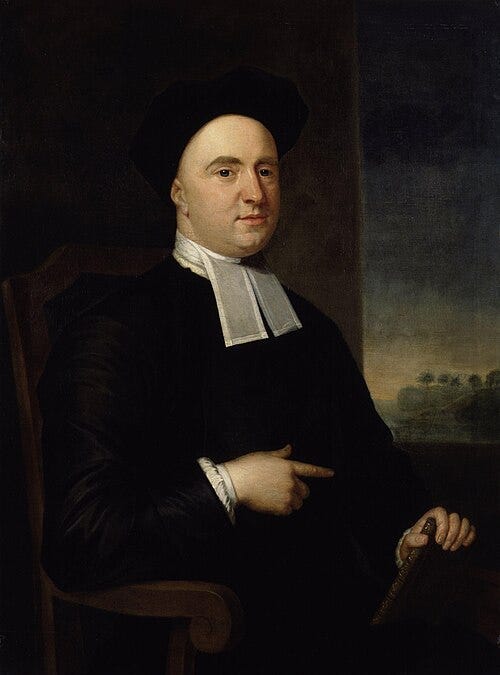
George Berkeley, a Bishop from 18th century Ireland, is known for his published philosophical works on idealism (specifically called subjective idealism or immaterialism).
Berkeley’s idealism is a view that holds that materiality does not exist in any real ontological capacity and that what exists is the mind and its mental contents. All that is interacted with empirically is actually impressions of mental content that is perceived by the mind. But how did we even get here in the first place?
This was a problem that Berkeley had with John Locke, who was a staunch empiricist. Locke firmly held the philosophy that we can explicitly get knowledge only from our sensory experience.
I do hold a lot of stock in the empirical position, as I feel as if this is a very intuitive view to hold, but metaphysically, it has its contentions. Firstly, Locke has to distinguish between the qualities an object has: primary qualities (extension, shape, what belongs to an object as it is) and secondary qualities (produced by sensory interactions). A mainstream view that Berkeley diverges from, as the secondary qualities themselves exist in the mind rather than the object, which pertain to primary qualities.
Now, what Berkeley saw is that Locke (the view of the empiricist) was willing to concede some qualities as mind-independent, but what about the other ones? This already seemed like a concession to the idealist position that most people just don’t notice at face value.
What independent reasoning do we have for placing one over the other? To Berkeley, this felt like some gap that had to be plugged, as to why we have this higher preferential status to only interactive qualities, a case of metaphysical special pleading.
…it to be impossible that any colour or extension or other perceptible quality should exist in an unthinking thing outside the mind, or indeed that there should be any such thing as an object outside the mind
(Berkeley, George. A Treatise Concerning the Principles of Human Knowledge, §15, p. 14. 1710. Free online via Early Modern Texts: https://www.earlymoderntexts.com/assets/pdfs/berkeley1710.pdf))
Locke needed something to explain how an object’s qualities hold together in one place. A single object can have many qualities, but in principle, why and how are they bound? To answer this question, Locke provides the “material substance”, an underlying concept that unifies all qualities.
Locke admitted to an inability to know what material substance actually is.
“Being again pressed to know what gave support to the broad-backed tortoise, replied — something, he knew not what.”
(Locke, John. An Essay Concerning Human Understanding, Book II, Chapter XXIII, §2. 1689.)
More directly, Locke concedes that we have no positive idea of substance at all:
“If any one will examine himself concerning his notion of pure substance in general, he will find he has no other idea of it at all, but only a supposition of he knows not what support of such qualities which are capable of producing simple ideas in us.”
(Locke, John. An Essay Concerning Human Understanding, Book II, Chapter XXIII, §2. 1689.)
Berkeley finds this overwhelmingly incoherent. What does support actually mean here? When Locke says material substance is supporting qualities, he can’t explain the relationship itself; he even admits to it. Berkeley’s rebuttal is that Locke is using support to explain something in which the supporting process, in and of itself, does not even have a definition. What are we supporting if we don’t even have a definition for support? You can’t explain qualities by appealing to a relationship you can’t define.
Berkeley was not denying that the world as you experience it is real. He was denying that behind your experience there exists some further, unknowable, non-mental stuff. The table you see and touch is perfectly real — it’s just that its reality consists in being perceived, not in secretly being made of imperceptible material goo.
“The only thing whose existence we deny, is that which philosophers call matter or corporeal substance.”
(Berkeley, George. A Treatise Concerning the Principles of Human Knowledge, §35. 1710.)
Though not supremely relevant to the topic of interest, Berkeley also pushed for the likeness principle, positing that an idea can only resemble another idea. I find this very interesting because it highlights a core limitation of human knowledge: we can never step outside our own experience to verify whether our perceptions match reality, because any attempt to do so is itself just another perception.
If our experience is predicated on mental representations, we have no basis for claiming that they resemble some non-mental original. We can’t step outside to compare it against a supposedly mind-independent reality, because any such comparison would itself be an experience.
If I claim my idea of an apple resembles the real apple, how would I check? I could look at the apple to verify, but that just gives me another idea. I never reach the non-mental thing itself. Verification is seemingly an infinite regress of ideas that require verification.
Perhaps Berkeley’s most famous single move is what scholars have come to call the Master Argument (a label coined by André Gallois in a 1974 paper in The Philosophical Review). An argument highlighting the impossibility of conceiving an object existing entirely unconceived.
It just can’t be done; you’re conceiving of the unconceived, which is a contradiction.
“When we do our utmost to conceive the existence of external bodies, we are all the while only contemplating our own ideas.”
(Berkeley, George. A Treatise Concerning the Principles of Human Knowledge, §22. 1710.)
This argument has been contested by Georges Dicker , arguing that Berkeley confuses:
conceiving of X existing while not conceiving X
which is contradictory, with
conceiving of X existing without X being conceived by anyone
which is not. I can coherently think about a world with no observers without that thought itself being an observation of that world.
This is a fair objection, for which I won’t go into too much detail here. The deeper point remains that we have no perceptual access to a mind-independent world. The assertion that such a world exists is, at minimum, epistemically unjustified. Whether it’s inconceivable or merely unsupported may matter for the argument’s formal validity.
How does everything continue to exist when no one is perceiving it?
Esse est percipi — to be is to be perceived. Reality itself is only possible if it is perceived. Berkeley is saying there’s no hidden object sitting behind your experience waiting to be discovered. Experience is the object.
Berkeley says God is the ultimate perceiver. Entailed by a quality of omniscience, God perceives everything at all times. Even our sensory ideas are maintained in the divine mind as God feeds every mind a consistent, orderly stream of experiences.
“There was a young man who said “God”Dear Sir, Your astonishment’s odd:I am always about in the Quad.And that’s why the treeWill continue to beSince observed by Yours faithfully, God.” Must think it exceedingly oddIf he finds that this treeContinues to beWhen there’s no one about in the Quad.”
Secular thinkers would find everything until this insertion of God from Berkeley, fairly understandable. If I could put my two cents in, God isn’t even strictly necessary to the argument. Berkeley’s demolition of material substance, his collapsing of the primary/secondary quality distinction, and his likeness principle can all be accepted in his idealist position without accepting his positive metaphysics. His theological bailout weakens the theory considerably as it now invites all the problems that natural theology has, and personally, convolutes the idealist argument.
I started with the broader idealist and realist literature, then went into Berkeley’s own works directly. Started with A Treatise Concerning the Principles of Human Knowledge into Three Dialogues Between Hylas and Philonous before diving into the secondary scholarship at a deeper level.
What drew me into this research wasn’t just the historical philosophy. It was how Berkeley’s ideas kept resonating with developments he couldn’t have anticipated.
What strikes me immediately as problematic is positing matter as an imperceptible, mind-independent substrate doing hidden causal work. However, what I also find philosophically fascinating is that Berkeley forces you to confront the fact that every claim made about “the external world” is mediated through experience.
The step from “I have experiences” to “there exists non-experiential stuff causing those experiences” is a substantial leap that can’t be justified (arguably) by experience itself.
Berkeley’s positive metaphysics leans heavily on theological commitments that don’t have independent philosophical support. The Master Argument, while provocative, may trade on an ambiguity between conceiving-of and conceiving-that.
A more secularly constructed argument from Berkeley may have convinced me more. As it stands, I find myself agreeing with all of his negative metaphysics, the demolition of material substance, the collapse of the primary/secondary distinction, and the likeness principle, which leaves me questioning: is Berkeley just better at tearing things down than building them back up?
That being said, it’s still a position worth taking seriously. It reminds us that “physical world” is itself an interpretive framework we impose on experience, not a transparent window onto things as they are in themselves. Kant (which I’m excited to cover next, despite the immense difficulty of his writing) would later develop this insight in a very different direction with his transcendental idealism, but the seed is in Berkeley.
Thanks for reading my first post! Also, immense respect for those who write these Substacks. I haven’t exercised my essay writing capacities in so long, and still undecided on format.
If you want to dig into this yourself, here’s where I’d start:
- Berkeley, George. A Treatise Concerning the Principles of Human Knowledge. 1710. Free online via Project Gutenberg and Jonathan Bennett’s Early Modern Texts (earlymoderntexts.com).
- Berkeley, George. Three Dialogues between Hylas and Philonous. 1713. More accessible and dramatic than the Principles.
- Downing, Lisa. “George Berkeley.” Stanford Encyclopedia of Philosophy. https://plato.stanford.edu/entries/berkeley/
- Dicker, Georges. Berkeley’s Idealism: A Critical Examination. Oxford University Press, 2011.
- Rickless, Samuel Charles. Berkeley’s Argument for Idealism. Oxford University Press, 2013.
- Gallois, André. “Berkeley’s Master Argument.” The Philosophical Review 83 (1974): 55–69.
메타데이터
- post_id
- 4a6ee0601f19
- slug
- the-philosopher-who-deleted-the-physical-world-4a6ee0601f19
- url
- https://medium.com/@imjbassi/the-philosopher-who-deleted-the-physical-world-4a6ee0601f19
- canonical_url
- https://medium.com/@imjbassi/the-philosopher-who-deleted-the-physical-world-4a6ee0601f19
- author_url
- https://medium.com/@imjbassi
- status
- ok
- fetched_at
- 2026-06-16 19:09:56