The Experience-To-KPI Model: How to Connect Outcomes to Measurable Impact (Part 1 of 4)
One of the most common mistakes I’ve noticed that teams make when building digital products is separating experience outcomes from business…
The Experience-To-KPI Model: How to Connect Outcomes to Measurable Impact (Part 1 of 4)

Subtle differences between failure and success. What direction will you take?
One of the most common mistakes I’ve noticed that teams make when building digital products is separating experience outcomes from business outcomes.
The dominant cause of product failure is not technology.
It’s misalignment between what customers need and what teams build.
Product teams talk about improving usability, reducing friction, or increasing engagement. Meanwhile, executives focus on revenue growth, customer retention, and operational efficiency. Both sides are trying to solve the same problem — but they’re often speaking different languages.
The result is predictable: product roadmaps that feel disconnected from business strategy, experience improvements that are hard to justify, and KPIs that fail to reflect the value great digital products create.
I’ve come to a conclusion that the solution is straightforward in concept but often overlooked in practice:
Tie every experience outcome directly to a measurable KPI.
When you do this well, experience becomes a driver of business performance rather than a design exercise.
The Experience-To-KPI Model
Great digital products connect customer experience improvements directly to measurable business results. A simple way to think about this is through what I call the…
Experience-To-KPI Model:
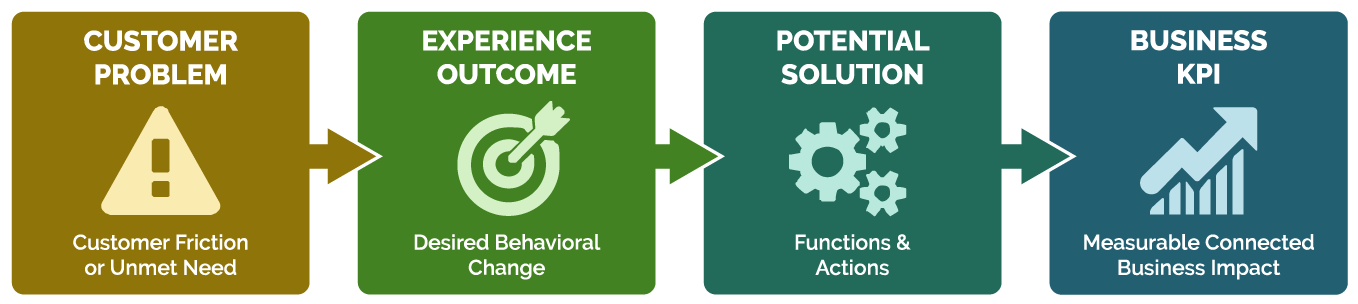
Customer Problem -> Experience Outcome -> Potential Solution -> Business KPI
Each step creates alignment between what customers need and what the business measures. Many organizations skip one of these steps, (usually the experience outcome) and move straight from problem to features. That shortcut is where product strategy begins to drift.
In other words:
- No market need → no meaningful behavioral change
- No behavioral change → no KPI movement
- No KPI movement → little to no funding and potential growth
Start With the Customer Problem
Every successful product initiative begins with identifying a real customer problem.
- Not a feature request.
- Not an internal assumption.
A real point of friction in the customer journey.
Examples include:
- Customers abandon checkout because the process is confusing
- New users struggle to understand the value of the product
- Customers cannot easily resolve support issues on their own
These problems represent experience gaps, and those gaps often translate directly into business impact.
For example:
- Checkout friction reduces conversion
- Poor onboarding lowers activation
- Inefficient support increases operational costs
Define the Experience Outcome
Once the problem is clear, the next step is defining the experience outcome. Experience outcomes describe the behavioral change you want to see from customers when the problem is solved.
Examples include:
- Customers complete checkout in under two minutes
- New users reach their first success moment during their first session
- Customers resolve support questions without contacting an agent
Notice what these are not.
They’re not features.
They’re behavioral outcomes that indicate the experience is working.
This distinction is critical.
- Features are potential solutions.
- Outcomes define success.
Connect the Outcome to a Business KPI
The final step is translating the experience outcome into a measurable business KPI. If customers complete checkout faster and with less confusion, the KPI might be:
- Conversion rate
- Revenue per visitor
- Cart abandonment rate
If onboarding helps users understand value faster, the KPI might be:
- Activation rate
- Trial-to-paid conversion
- Retention after 30 days
When experience outcomes are tied directly to KPIs, product teams gain something incredibly powerful: clarity of purpose. Every design decision and product investment has a measurable goal.
Why This Alignment Matters
When experience outcomes connect directly to business metrics, several things change inside an organization.
- Product conversations become more strategic. Teams stop debating design opinions and start focusing on measurable outcomes.
- UX becomes easier to justify. Experience improvements are no longer “nice to have.” They drive business performance.
- Roadmaps become more focused. Teams prioritize initiatives based on their ability to influence key metrics.
Most importantly, everyone begins solving the same problem.
The Data Is Clear: Most New Products Struggle to Succeed
Product teams often assume that failure happens because of poor execution, weak technology, or lack of innovation.
But the data tells a different story.
- McKinsey: 70% of digital transformation initiatives fail to meet their objectives
- 80% of digital products fail because of not meeting their commercial or usage objectives
- 80–95% of new products fail in the first year, tech and digital products being on the high end of that range
- Many startup-level digital product companies show around 90% of startups ultimately fail; 10% in year one and 70% by year five
- CB Insights: 42% fail due to misalignment of product market fit
In other words, teams are building products that customers don’t value enough to adopt.
Other major contributors included:
- Running out of cash due to slow growth or weak demand
- Stronger competitors delivering better experiences
- Pricing or business model challenges
- Gaps in product leadership or execution capability
While these causes may appear different on the surface, they often share a common root cause:
A disconnect between the customer experience being created and the business outcomes defined for success.
When customers don’t adopt, engage, convert, or return, key business metrics fail to move.
Revenue stalls.
Retention declines.
Funding becomes harder to secure.
What looks like a financial or operational problem frequently begins as an experience strategy problem.
This is why defining clear experience outcomes and tying them directly to measurable business KPIs is a survival discipline for digital products.
The Bottom Line
Digital products succeed when they solve real human problems. But inside organizations, success is measured through business performance. The role of product and experience leaders is to connect those two worlds.
When experience outcomes clearly drive business KPIs, the value of great digital products becomes obvious. And when that connection is clear, product strategy stops drifting, and starts delivering results. In the same vein, product teams have to get into a mindset of selling the outcome, not the solution!
Notice I didn’t mention anything about AI? This is on purpose.

Next in this series: Why defining the right experience outcomes is the most overlooked step in product strategy.
메타데이터
- post_id
- 4a8334da0f3a
- slug
- the-experience-to-kpi-model-how-to-connect-outcomes-to-measurable-impact-part-1-of-4-4a8334da0f3a
- url
- https://medium.com/@cbachman_86025/the-experience-to-kpi-model-how-to-connect-outcomes-to-measurable-impact-part-1-of-4-4a8334da0f3a
- canonical_url
- https://medium.com/@cbachman_86025/the-experience-to-kpi-model-how-to-connect-outcomes-to-measurable-impact-part-1-of-4-4a8334da0f3a
- author_url
- https://medium.com/@cbachman_86025
- status
- ok
- fetched_at
- 2026-07-09 01:49:10