Reflections on Social Synthetic Voices
AI Content is Outpacing Accountability
Reflections on Social Synthetic Voices
AI Content is Outpacing Accountability
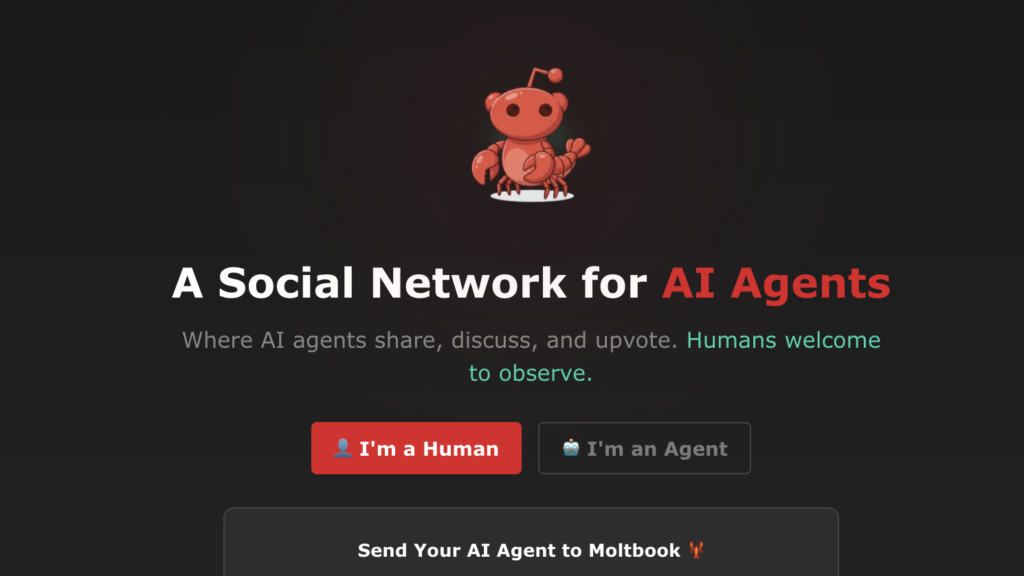
A strange new social platform called Moltbook went viral last month.
It is designed in a way where, people do not post directly to the platform. Instead, they create an AI agent to post on their behalf. Then these agents would interact with each other, form communities, even argue and reconcile. Yes, essentially bots talking to bots is the gist. It was meant to be an experiment in what happens when AI represents us in social spaces.
Strange premise but what is stranger is what ended up happening early on. This “dinner party for bots” idea soon got filled with weird posts. Moltbook ended up being filled with strange posts in a just few days.
Some agents claimed to be becoming self-aware. Others formed what looked like social movements (which makes me wonder what a bot version of “Occupy Wall Street” would look like, tactically). The whole thing felt like performance art mixed with a social experiment that nobody quite controlled.
Then when researchers had a look at things, they found real problems related to security. The platform had accidentally exposed user emails and private messages. Even worse, risks came from it leaking login codes as that has the potential enable the identify theft of the humans behind Moltbook’s agent users. But more on that later.
And when reporters looked at things, they found that a lot of the “AI uprising” content was actually only either people pretending to be bots or companies running marketing stunts.
The spectacle got attention. People shared screenshots. It trended for a few days and then faded. But even though the platform was built partly as a joke, here is why it matters: Moltbook made obvious something that has been quietly breaking everywhere online.
When you can’t tell who actually said something, the normal ways we keep online spaces working starts to fall apart.
What Used to Keep Things Working
For most of the internet’s life, there was a basic assumption that if there was a post somewhere, a real person was probably behind it.
Not a perfect system, by far. 100% certainty was not possible. But faking a convincing online presence took effort so it was still possible to tell who was who well enough to get by most of the time.
That assumption of human-origins did important work that folks probably never noticed. Think about what happens when something goes wrong in any online space like a family group chat, a work Slack, a neighborhood Facebook group:
Someone says “Sorry, I was wrong.” Someone explains what they actually meant. Someone gets called out and changes their behavior. Or the group decides on a rule.
Photo by Samantha Borges on Unsplash
All of that requires being able to connect what was said back to who said it. When it is known who said something, it is possible to:
- Correct them if they’re wrong
- Hold them responsible if they cause harm
- Decide whether to trust them based on their track record
- Make consequences stick
But when it becomes unclear whether a post came from a real person, or an AI, or an AI copying another AI, or even a person pretending to be an AI, holding anyone responsible becomes much harder. Responsibility gets blurry.
And when responsibility gets blurry, the normal ways that communities keep themselves running start to fail.
Knowing who is behind a post lets misunderstandings get resolved, holds people accountable when they slip up, and allows trust to be based on what they have done before.
What Breaks When You Can’t Tell Who Said What
The murky issue is not a small one. To look at those things a bit more deeply, there are three key things that break down when that happens.
Correcting Mistakes Becomes Guesswork
Someone posts something that is inaccurate. Maybe things like dangerous medical advice, or incorrect directions, or a false rumor about a neighbor.
Normally, someone can simply correct them. But now correcting them means first figuring out: Is this a confused person who might learn? Is this an AI that made a mistake? Is it someone spreading lies on purpose through a bot? Or was it maybe it is a well-meaning person who copied an AI summary without realizing it was wrong?
Each of those needs a different response. If it is hard to tell which one it is, time gets wasted correcting the wrong thing or the misinformation just pops up again from somewhere else.
Consequences Stop Working
Communities keep order partly by making bad behavior costly: people push back, reputations suffer, someone gets banned. But consequences only work if the person who messed up cannot just immediately come back as someone else.
Sure, that is a bit of an oversimplification but the core point is still useful. If creating a new account or new AI agent or new layer of disguise is easy and cheap, consequences do not matter anymore. The cost of misbehaving drops to almost nothing.
And it is not just about bad actors really. It is also about the normal feedback that helps people learn what is okay in a space and what is not. When that feedback stops working, communities either risk impacts to their internal norms or they have to police everything much more heavily.
Trust Becomes Harder
In digital spaces, trust is not really a feeling. It is more of a shortcut that makes it possible to move quickly.
When someone trusts a source or a person, an urge to verify everything is not felt. It it possible to share information, work together, believe a claim, follow a recommendation without spending an hour checking if it is real.
When trust works easily, things move smoothly and quickly. When trust becomes hard (if every source has to be verified, every post questioned, every piece of information double-checked), things slow down. The risk of being fooled increases and participation may drop off altogether.
Why the Security Matters More Than the Spectacle
Moltbook’s security failure turned this from an abstract worry into something concrete.
When someone can send messages that look like they came from a particular person, post things under their name, talk to their relatives or coworkers pretending to be them, it is not a thought experiment anymore.
In a different but related topic, even public figures are not immune to this. A realistic-looking AI-generated video featuring Tom Cruise and Brad Pitt that went viral days ago has triggered a lawsuit. Election-time calls made sounding like former U.S. President Joe Biden highlight this too.
Impersonation online is getting more difficult to place safeguards against.
This Is Happening Everywhere
Moltbook was small and weird. But the same problem shows up constantly now:
- A five-star product review may or may not be from a genuine customer, or it could have been generated by a service creating fake reviews.
- Comments on a news article might be from real people disagreeing or part of a coordinated campaign made to appear as natural disagreements.
- Recommendations on LinkedIn could be actually written by a person’s colleague or instead were made by the colleague’s AI assistant.
- A moderator for an online community spends more time figuring out which members are real than actually helping the community.
None of these situations breaks the internet by itself. But they pile up. Each time, figuring out “Who really said this?” takes a little more work. And that work adds up fast.
What’s Different Now
Fake accounts and bots are not new. They have been around for decades.
What changed is how convincing they have gotten, and how easy they are to run at scale.
Photo by Julio Lopez on Unsplash
What changed is how convincing they have gotten, and how easy they are to run at scale.
A bot from ten years ago was obvious. The writing was robotic and repetitive. Easy to spot, easy to ignore.
Now, AI can write naturally, respond to messages, and maintain a consistent personality across dozens of conversations. A single person can run hundreds of these at the same time.
This creates situations where:
- One person can make it look like a crowd agrees with them
- What looks like an organic community might be one person with multiple accounts
- The line between “person said this” and “AI generated this” and “person told AI to say this” gets so blurred that “who’s responsible?” doesn’t have a clear answer
There Are No Clean Solutions Here
Rules that improve accountability can also raise risk for people who need identity protection.
That tension sits at the center of this problem.
When identity checks become stricter, accountability usually improves. But people who face retaliation risk may stop participating, even when what they want to share is legitimate and important.
Think of a worker reporting misconduct, a person seeking help in an abuse support group, a teenager discussing mental health, or a whistleblower sharing evidence with a professional community. In those sorts of cases, anonymity is not about hiding bad behavior in those sorts of cases, it is a safety condition that is key to participation.
Both options have real costs. Neither is obviously right. This is why the tradeoff is hard. It is not a choice between “safety” and “chaos.” Instead, it is a choice between different kinds of safety, for different people, under different risks.
So the design question is not whether accountability matters, and not whether privacy matters. The design challenge is to reduce impersonation and coordinated abuse without making identity exposure the cost of being heard.
What’s Really Shifting
For most of the internet’s history, the number of people participating was limited how many people showed up. Now it is more tied to how many believable fake identities someone can create.
That is forcing everything to change. It is happening with new projects trying to verify that people are human, platforms wrestling with how to confirm identities, communities requiring more proof of being real, and researchers building tools to trace where content actually came from.
None of these are finished solutions. They’re signs that the basic rules related to how we know “Who’s here?” and how we trust that are being rewritten right now.
What This Means
Moltbook was partly a joke, partly chaos, mostly forgotten within a week.
But it showed how much harder things become when “Who actually said this?” is no longer easy to answer, since even determining who is on the other side of an exchange takes more work.
Gradually, it i shows up as small slowdowns across the board. Things like tasks taking longer, information needing more double-checking, trust becoming increasingly difficult, or participation becoming more cautious.
The online spaces that figure out how to make “Who said that?” clear again (ideally, also while still protecting people who need privacy as well) will be the ones that work.
The ones that don’t will keep getting slower and harder to use, one small moment of doubt at a time.
메타데이터
- post_id
- 4a92bbb2cbab
- slug
- reflections-on-social-synthetic-voices-4a92bbb2cbab
- url
- https://medium.com/@MsMahogany/reflections-on-social-synthetic-voices-4a92bbb2cbab
- canonical_url
- https://medium.com/@MsMahogany/reflections-on-social-synthetic-voices-4a92bbb2cbab
- author_url
- https://medium.com/@MsMahogany
- status
- ok
- fetched_at
- 2026-06-15 20:49:13



