Covert Narcissism and the Marketplace of Manufactured Guilt
They Don’t Sell You Products. They Sell You a Version of Yourself That Owes Them Something
Covert Narcissism and the Marketplace of Manufactured Guilt
They Don’t Sell You Products. They Sell You a Version of Yourself That Owes Them Something

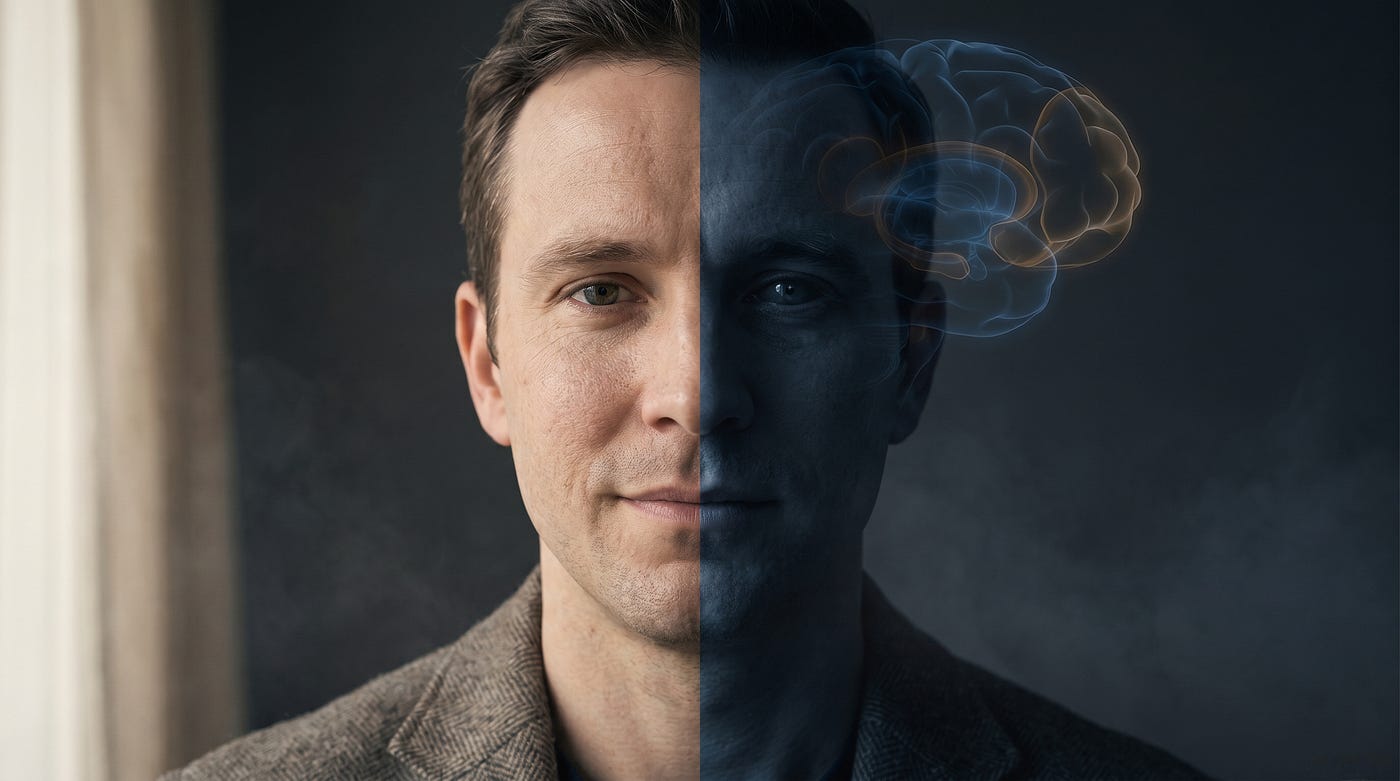
Image is generated via Chat Gpt 2.0 Model.
She didn’t yell. She never yelled.
She just stopped eating dinner at the table.
For three nights, she sat in the kitchen with her plate, alone, with the lights half-dimmed, scrolling her phone in a way that made sure I could see her shoulders curve inward. On the fourth night, when I finally asked what was wrong, she looked up with the softest, most wounded eyes I have ever seen on a human face, and said, “Nothing. I just didn’t want to be in the way.”
That sentence cost me four years of my life.
Not because of what it said. Because of what it installed. A small, invisible meter in my chest that I have been feeding ever since. A meter that measures, every single day, how much I might be in someone else’s way just by existing.
I am going to tell you something uncomfortable about the world we are living in right now, in 2026, and I am going to say it in the plainest way I can:
Guilt has become a product. It is manufactured, packaged, distributed, and sold — sometimes by people who love you, sometimes by people who only pretend to, sometimes by the loudest creators on your feed, and very often by the quietest person in your own home.
And the most efficient factory in that marketplace is a specific kind of person we still barely have language for. Not the loud narcissist. Not the obvious one. The other one. The one who never raises their voice. The one who sighs. The one who suffers at you.
The covert narcissist.
This is the story of how they built the factory, what they manufacture inside it, who is buying, and how a generation of unusually empathetic, unusually online, unusually exhausted people became their best customers without ever signing a contract.
The Quiet Ones Were Never the Safe Ones
For a long time, when people heard the word narcissist, they pictured a man in a tailored suit smashing a champagne flute. A boss. A bully. A loud voice in a small room.
That picture was a marketing campaign, and we believed it.
Because of that picture, an entire category of harm walked past us untouched, sometimes for decades, sometimes for generations. The covert narcissist does not enter a room and demand attention. They enter a room and withhold attention so precisely that the entire room reorganizes itself around the cold spot they create.
They are not grandiose. They are aggrieved.
They are not loud. They are long-suffering.
They are not the king demanding tribute. They are the martyr quietly counting how many tributes you forgot to bring.
And here is the part that took me the longest to understand, the part I am embarrassed it took me so long to feel in my bones: the covert narcissist is not less dangerous than the overt one. In a lot of cases, they are more.
The overt narcissist tells you what they want. The covert narcissist trains you to guess. And every wrong guess gets billed to your conscience.
That is the machinery I want to take apart in this article. Not to give you a label to throw at people, because the internet has more than enough of those already. But because once you see the machinery, you can never be its raw material again.
The First Time I Saw the Factory Floor
I am going to be honest with you, because the only useful thing I have ever written has come out of being honest, and I cannot afford another year of being polite about this.
I grew up in a house where love was metered.
Not withheld. Metered. Released in small, careful doses, with an invisible balance sheet always running underneath. Every kindness was a deposit. Every kindness was, eventually, called in.
I did not know this was unusual. Children never know what is unusual; they only know what is normal, and normal is whatever they were handed first.
So when, years later, I found myself in romantic relationships where my partner would go silent for two days because I had bought the wrong brand of bread, where any disagreement ended with me apologizing for the way I had disagreed rather than the thing we disagreed about, where my emotions kept somehow becoming weather systems that they had to weather — I did not see a pattern.
I saw myself. I saw a person who was clearly difficult to love.
That is the trick. That is the entire trick.
The factory does not look like a factory while you are working inside it. It looks like your personality.
What “Covert” Actually Means, Stripped of Internet Buzz
Let me put this in clean, non-clinical language, because the clinical language is part of how this thing survives.
A covert narcissist is someone whose self-image is fragile, grandiose, and shame-soaked all at once — and who manages that internal weather by quietly making other people responsible for it.
Their grandiosity is not on the surface. It lives underneath. They believe, often without realizing it, that they are uniquely sensitive, uniquely misunderstood, uniquely burdened, uniquely good. They do not need to say this out loud, because the world keeps failing to notice it, which is itself further proof.
So they spend their lives doing two things at the same time:
- Building a constant, low-grade case that they have been wronged.
- Recruiting other people — usually one or two specific people, sometimes a whole family — to agree.
You are not in a relationship with them. You are on a jury that never gets to vote, and the verdict is always the same.
The covert narcissist’s primary product is not love. It is not attention. It is not even control, exactly.
It is guilt — specifically, guilt that you generated yourself, on their behalf, using materials they handed you when you weren’t looking.
The Marketplace of Manufactured Guilt
I want you to imagine, just for a second, a small market square. Stalls. Vendors. The smell of bread and rain.
Most of what is sold there is real. Real fruit. Real shoes. Real grief. Real love.
But somewhere between the bread stall and the flower stall, there is one stall with no sign on it, and the vendor is very polite, and the vendor smiles in a way that is almost a smile, and the vendor sells one thing only:
A version of you that owes them something.
You walk past, distracted. You stop. You don’t know why. You pick up the small package they have wrapped for you. The vendor says, very softly, “You don’t have to take it. I just thought you might want to know how much I have done for you. But, you know, it’s fine. Really. It’s fine.”
You take the package.
You take it every single time.
That is the marketplace of manufactured guilt. It runs 24 hours. It is open in your kitchen, in your inbox, in your group chats, in your parents’ WhatsApp, in your partner’s silences, in the comment section of every post your favorite influencer writes about how nobody appreciates them.
It is the dominant emotional economy of the early 2020s, and we are only now starting to admit it.
Five Currencies the Factory Uses (and Why They Spend So Well)
The factory does not run on dollars. It runs on five much older currencies. If you can learn to spot them when they hit the table, you can stop spending them.
1. Fear
Not fear of violence, usually. Fear of withdrawal. Fear of the cold room. Fear of the next two-day silence. Fear of being recast in their internal story as the villain.
The covert narcissist rarely threatens you. They threaten the climate you live in. And because human beings will do almost anything to keep the weather familiar, you learn to anticipate the storms before they arrive. You become a meteorologist of someone else’s moods. You call it being thoughtful.
2. Obligation
Every kindness they ever did for you is on a shelf, dated, labeled, and waiting. The dinners. The favors. The one time they drove you to the airport. The years they “put up with” you.
In a healthy relationship, kindness is a gift. In the factory, kindness is an invoice with a long payment plan.
You never see the invoice. You just feel, somewhere around 11 p.m. on a Tuesday, that you owe.
3. Guilt
This is the headline currency. The one we name in the title. The one most people think they recognize.
But the guilt the factory manufactures is not normal guilt. Normal guilt is information. It says, I crossed a line. Repair it. Manufactured guilt is different. Manufactured guilt has no line. It just has a feeling. A heavy, low, ambient feeling that you are, in some unspecified way, the problem in the room.
You can’t apologize your way out of it because there is no specific thing to apologize for. There is only you, generally, being too much or not enough, and the vendor is too gracious to specify which.
4. Shame
Guilt says I did a bad thing. Shame says I am a bad thing.
The covert narcissist does not usually attack what you do. They attack who you are, but so gently it never registers as an attack. “You’ve always been like this.” “That’s just how you are.” “I knew you were going to take it that way.”
After enough of those sentences, you don’t need them in the room to feel the weight. The weight lives in you now. They installed it. They can leave.
5. Time
This is the one nobody talks about.
Every hour you spend managing their feelings is an hour you did not spend on your own life. The factory is not just emotional. It is temporal. It steals years. Sometimes decades.
You will look up one day and realize you have spent ten years carefully not setting them off, and you do not recognize the person you would have been with those ten years back.
That is the real bill. That is the one nobody warns you about.
Why 2026 Is the Year This Hit a Boiling Point
I want to zoom out for a second, because this is not just a relationship problem. This is a cultural moment.
We are living in the first year where almost every major institution in our lives — workplaces, families, dating apps, social platforms, even creators we follow — has adopted, sometimes without realizing it, a covert-narcissistic communication style.
Notice the pattern. Notice how often the loudest message you receive in a day is a message of grievance.
Your favorite creator is hurt that you didn’t share their last post. Your employer is hurt that you “aren’t bringing the same energy.” Your government is hurt that you don’t trust it more. Your parents are hurt that you don’t call. Your dating app is hurt that you haven’t paid for the premium tier.
Everybody is the wronged party. Nobody is the perpetrator. The aggrieved tone is now the default tone of public life.
And what does that aggrieved tone do, technically, mechanically?
It transfers responsibility from the speaker to the listener.
It manufactures guilt at industrial scale.
We have built an entire information economy that runs on this exact emotional fuel, because guilt is the cheapest emotion to monetize. Guilt buys. Guilt clicks. Guilt opens the wallet, the inbox, the door. Joy doesn’t. Curiosity doesn’t. Calm definitely doesn’t.
So we wake up every morning into a feed that has been pre-tuned to make us feel a little bit responsible for everyone else’s pain, and we go to bed every night wondering why we feel so tired without having done anything.
You did do something. You ran the factory all day, for free, for strangers.
The Eight Phrases That Should Make You Set Down Your Wallet Immediately
These are the sentences the factory uses most often. I’m not going to give you a lecture about them. I’m just going to lay them on the table.
If you hear any of these regularly from one specific person, you are not in a hard relationship. You are in a transaction you didn’t agree to.
- “It’s fine. Really. Don’t worry about me.” (Said while making sure you are worrying about them.)
- “I never said that. You’re remembering it wrong.” (The soft, smiling form of gaslighting. It does not slam the door. It just quietly moves the door.)
- “After everything I’ve done for you.” (Translation: I have been tracking. I have a ledger. Today’s bill is due.)
- “I just want you to be happy.” (Followed, within 48 hours, by an extended monologue about how your happiness is hurting them.)
- “You’re so sensitive.” (The single most effective sentence ever invented for converting another person’s wound into their own personality flaw.)
- “I would never do that to you.” (Said immediately after doing exactly that to you, and not as a lie, but as a genuine, sincere rewriting of the last ten minutes of reality.)
- “I’m not angry. I’m just disappointed.” (Anger you can defend yourself against. Disappointment is a fog. There is no doorway out.)
- “Forget it. You wouldn’t understand.” (The withdrawal. The cold room. The closing of the gate. Designed to make you chase, apologize, beg back in. Designed, specifically, to install a future tax.)
If you read those eight lines and felt a small, hot pulse in your chest, that is not a coincidence. That is your body remembering the receipts.
DARVO: The Move Behind the Move
There is one specific maneuver the covert narcissist uses more often than any other, and it has a name now, thanks to a psychologist named Jennifer Freyd. The name is DARVO.
It stands for:
- Deny the behavior.
- Attack the person who named the behavior.
- Reverse Victim and Offender.
In plain English: the person who hurt you says they didn’t, says you are the real problem for noticing, and then somehow becomes the one who needs comforting by the end of the conversation.
You walked into the room to talk about something they did. You walk out of the room apologizing.
That is not an accident. That is not a misunderstanding. That is not “communication styles.” That is a maneuver, and it works because it is built on a real psychological truth about you: your brain has a much stronger reflex to repair connection than to defend itself.
The covert narcissist knows this about you better than you know it about yourself. They have been studying it your whole relationship.
The good news is that once you can name DARVO out loud — even just in your own head, in the middle of the conversation — it stops working. It is one of those tricks that only functions in the dark. The light turns it back into what it always was: a small, sad, very tired performance by a person who cannot survive being held to account.
The Childhood Behind the Adult
Now I am going to do something the internet rarely does, because the internet has a lot of incentives to keep this conversation hot and very few to make it humane.
I am going to tell you where this comes from.
Not to excuse it. To understand it. Because you cannot leave something you do not understand. You can only flinch away from it, and the flinch never holds.
Almost every covert narcissist I have ever met or read about or sat across from in a quiet room was, at some point, a small child who learned that being a child was not safe.
Maybe they had a parent who was overtly narcissistic, and the only way to survive was to become invisible in a very specific, performative way — endlessly good, endlessly compliant, endlessly suffering, because suffering quietly was the only behavior that ever got rewarded.
Maybe they had a parent who praised them only for being exceptional, so they grew up convinced that ordinary was a death sentence, and any small failure now feels like falling off a cliff.
Maybe they had no language for emotion at all in their house, so they learned to express needs the only way a child can when needs are forbidden: through symptoms. Through sighs. Through illness. Through martyrdom.
What you see in front of you now, in your kitchen, on your phone, in your inbox, is a 40-year-old or a 60-year-old or sometimes a 25-year-old still using the survival strategy of a six-year-old who was never allowed to just be a six-year-old.
That is unbearably sad. It is also not your job to fix.
This is the line I had to learn, and I want to give it to you very directly:
You can have compassion for where someone’s wound came from and still refuse to be the bandage for the rest of your life.
Compassion is not the same as access. Empathy is not the same as employment. You do not owe anyone unlimited access to your nervous system because their childhood was painful. Yours was too. You did not become a factory.
The Empath Economy: Why You, Specifically, Got Targeted
I want to talk to you for a moment, because if you have read this far, I already know something about you.
You are the kind of person who reads psychology articles all the way through. Which means you are probably the kind of person who tries to understand people who have hurt you, instead of just being angry at them. Which means you are exactly the kind of person the factory was designed for.
The covert narcissist does not pick their victims at random. They pick a very specific profile, with a precision that would honestly be impressive if it weren’t horrifying.
They look for people who:
- Apologize quickly and easily, often pre-emptively.
- Feel responsible for the emotional temperature of a room.
- Have been praised, since childhood, for being “mature,” “wise beyond their years,” “such a good listener,” “so understanding.”
- Find conflict physically painful, not just inconvenient.
- Believe, at some level, that if they just love hard enough, the other person will eventually heal.
If you read that list and felt seen, you were not weak. You were useful. You were emotionally well-trained, and that training was monetized.
Here is the thing nobody told you: those traits are not flaws. Those traits are how human beings build civilizations. Empathy, patience, self-reflection — these are not bugs. These are some of the most expensive resources a person can have. The covert narcissist found a way to extract them from you without ever paying market rate.
Your job, going forward, is not to become less empathetic. Your job is to stop giving the empathy away to people who are running a factory on it.
The Quiet Catastrophe Inside Your Body
I want to tell you, plainly, what living inside the factory does to a human body.
Because we talk about manipulation like it’s a feeling, and it is, but it is also, very literally, a medical event repeated over months and years.
Your nervous system has two main modes — broadly speaking — connection and defense. It is supposed to spend most of its time in connection: with people you love, with your work, with your food, with the present moment.
In the factory, you spend most of your time in defense. Not the loud kind. The quiet kind. Hypervigilance. The constant, low-frequency scanning of someone else’s face for signs of the next withdrawal, the next sigh, the next “it’s fine.”
Your body cannot tell the difference between watching for a tiger and watching for a sigh. The hormones are the same. The wear and tear is the same. The damage is the same.
People who have lived inside the factory for a long time develop:
- A nervous, tight stomach for no obvious reason.
- A tendency to feel exhausted after specific phone calls.
- A startle response to certain ringtones, certain footsteps, certain silences.
- A weird flatness — not depression exactly, more like the system has turned the volume down because nothing else can be received right now.
- An inability to know what they themselves actually want for dinner. For their career. For their weekend. For their life.
That last one is the diagnostic one. If you genuinely cannot tell what you want, separate from what would keep someone else from being upset, you are not indecisive. You have been working at the factory so long you have forgotten you had your own taste.
This is recoverable. Almost completely. But not while the factory is still running on your shift.
How the Internet Industrialized the Whole Thing
Until about ten years ago, the marketplace of manufactured guilt was a cottage industry. Small. Local. One family. One couple. One toxic friendship.
Then the platforms came.
And the platforms, to be very direct with you, learned something dark very quickly: the emotional grammar of the covert narcissist is perfect content.
Aggrieved tone. Vague accusation. Implied moral superiority. A sense that the speaker has been wronged, by you, somehow, in ways too subtle to name. A request, never quite explicit, that you compensate them with attention, engagement, sympathy, and time.
That is not just narcissism. That is the modal post on every platform you opened today.
The platforms didn’t invent it. They just industrialized it. They built infrastructure for it. They optimized for it. They gave a megaphone to whoever was best at making strangers feel slightly bad without ever naming the offense.
This is why your feed is exhausting in a way you cannot quite explain. It is not the volume of information. It is not even the negativity. It is the specific flavor of negativity — that low, ambient you have failed me somehow tone, repeated thousands of times a day, by thousands of strangers, each of whom you owe nothing to and yet somehow, vaguely, feel that you do.
You are not a bad person for being tired. You are a person whose nervous system has been processing thousands of small guilt transactions per hour, all day, every day, for years.
Of course you are tired. The factory is running 24/7 and you forgot you could leave.
The Three Lies the Factory Trains You to Believe About Yourself
Before I talk about leaving, I have to name the three lies. Because you cannot leave a place if you still believe the things it taught you. You will just rebuild it somewhere else with a new vendor.
Lie #1: “I am too sensitive.”
You are not too sensitive. You are correctly calibrated for a situation that is, in fact, manipulative. Your sensitivity is a smoke detector. The factory has spent years trying to convince you the smoke detector is broken because, of course, the smoke detector is bad for business.
Throw away the lie. Keep the detector.
Lie #2: “If I were a better person, this wouldn’t be happening.”
The covert narcissist’s central, brilliant innovation is making their internal weather feel like your moral failure. They are unhappy, so you must have done something. They are disappointed, so you must be a disappointment.
This is not how reality works. Adults are responsible for their own emotional regulation. You can be kind, attentive, considerate, and even occasionally wrong, and still not be the cause of a 47-year-old’s bad mood at 9 p.m. on a Wednesday.
You are not the weather. You never were.
Lie #3: “It will get better if I just love them more.”
I want to say this softly, because I had to learn it slowly.
More love is not the missing ingredient. The factory does not run on a love shortage. It runs on a responsibility transfer. No matter how much love you pour in, the machine will keep producing the same product, because that is what it is built to produce.
Loving harder does not fix the factory. It just gives the factory more raw material.
The way out is not more love. It is more clarity.
How You Actually Leave
I am not going to give you a list of ten clever comebacks. The internet is full of those, and they don’t work, because the factory was never about words. It was about your nervous system. You don’t win it with a comeback. You win it by becoming a person whose nervous system is no longer for sale.
Here is what that actually looks like, in practice, in real life, in the kitchen at 9 p.m. on a Wednesday.
Step 1: Stop trying to win the argument. Start noticing the maneuver.
The next time you feel the slow, sinking, ambient guilt rolling in, do not engage with the content. Do not defend yourself. Do not explain. Do not justify.
Just, internally, name the move.
“Ah. That was DARVO.”
“Ah. That was a guilt invoice.”
“Ah. That was the silent treatment dressed up as ‘I’m fine.’”
You do not need to say it out loud. You just need to see it. The factory cannot run inside someone who can see the machinery.
Step 2: Stop arguing about what happened.
This is the trap most people stay in for years.
You will try to prove what they said. You will quote them back to themselves. You will keep receipts. You will replay the conversation. You will try, with every part of your being, to make them admit that the thing happened the way it happened.
They will never admit it. That is not a personal failure of yours. That is the structural design of the machine. The whole point of the machine is that nothing that happens inside it can be officially named.
Stop arguing about reality. Reality does not need their signature.
You know what happened. That is enough. That has always been enough.
Step 3: Start practicing the most powerful sentence in the English language.
The sentence is: “That doesn’t work for me.”
That’s it. No reason. No explanation. No justification. No paragraph of defense.
“That doesn’t work for me.”
It is the sentence the factory cannot metabolize. Because it does not give them an angle to attack. There is no logic to dismantle, no emotion to belittle, no claim to deny. You are not arguing. You are just declining.
Watch what happens the first time you say it. Watch the tiny, almost imperceptible flicker on their face. That flicker is the factory machinery trying to restart and not finding fuel.
That flicker is your life starting to come back.
Step 4: Stop attending the trial.
The covert narcissist puts you on trial, quietly, several times a week. They do not announce it. There is no robe, no judge, no opening statement. There is just a slow, simmering case being built against you — sometimes for years.
You have been spending your evenings being your own defense attorney in a court that has no jurisdiction over you.
Stop attending the trial.
You do not have to defend yourself against accusations that were never officially made. You do not have to explain yourself to someone who is not, in any meaningful sense, listening. You do not have to prove your goodness to a person whose business model requires you to feel bad.
When the trial starts in your head, you can just put it down. The way you put down a phone you don’t want to look at. You can simply stop holding it.
Step 5: Rebuild your sense of what is normal.
This is the slowest part, and the most important.
Spend time, deliberately, with people who do not run a factory. People who say what they mean. People who can hear no without falling apart. People who repair small things easily, without scorekeeping. People whose love feels like a warm room, not a long invoice.
At first, this will feel boring. I am being completely honest with you. After years inside the factory, calm feels like nothing. Honesty feels like silence. Healthy love feels weirdly low-stakes.
That is not a problem. That is your nervous system relearning what safety actually feels like. Safety is supposed to feel like nothing. The thrill of the factory was not love. It was cortisol. It was novelty. It was the high of escaping a small disaster every Wednesday.
You don’t need that high. You needed it because you grew up in the factory. You do not work there anymore.
What the People Who Leave Say
I have talked to a lot of people who got out. From marriages. From friendships. From jobs. From entire families. Different ages, different countries, different relationships, same factory.
They almost all say the same three things, in roughly the same order.
The first thing they say is: “I didn’t realize how loud my own head had been until it got quiet.”
They had not understood, until they were out, how much of their mental life had been occupied by predicting, managing, soothing, anticipating, apologizing in advance. Once that stopped, the silence was almost shocking. Some of them cried the first time they ate dinner without rehearsing a conversation in their head.
The second thing they say is: “I started liking things again that I didn’t know I had stopped liking.”
Old music. Old foods. Old hobbies. Whole personality features that had been very gently mocked out of them, sometimes over years, sometimes by people who had no idea they were doing it. Those features come back, slowly, like color returning to a room. You will find yourself, six months out, laughing at something stupid and realizing you have not laughed like that since you were nineteen.
The third thing they say is the one I want you to remember most:
“I stopped feeling guilty all the time, and I thought I would feel free. Instead, I felt sad. And then, finally, I felt like myself.”
Because here is the part nobody warns you about: when the factory shuts down, the first emotion that returns is not joy. It is grief. Grief for the years. Grief for the version of you that has been carrying this. Grief for the love you thought you were getting and were actually being billed for.
Let yourself feel that. Do not skip it. Do not productivity-hack your way past it. The grief is the price of admission to the rest of your life, and it is, I promise, a fair price.
After the grief, the other things come. Slowly. But they come.
A Note on Forgiveness, Because Someone Will Ask
Someone always asks.
You do not have to forgive them. Not on any timeline. Not on anyone’s terms. Not for any reason except that, eventually, you decide you would like to set the rock down.
Forgiveness is not a gift you owe the person who hurt you. It is not a moral achievement that proves you have evolved. It is not a public ceremony you have to perform for the comment section.
Forgiveness, if and when it comes, is a quiet, internal decision that you no longer want to spend your remaining years carrying the weight of someone who never paid the rent on the space they took up in your life.
It is for you. Always for you. And it does not require them to be present, sorry, dead, or alive. It does not require them at all.
Do not let anyone — especially not anyone in your family who is still attending the factory — guilt you into “forgiving” before you are ready. That is just the factory expanding into your healing.
You are allowed to be done before you are healed. You are allowed to be healed before you are forgiving. You are allowed to never forgive at all, and still live a whole, generous, beautiful life. The math works.
What This Means at Scale
I started this article by telling you about a person at a kitchen table. I want to end it by telling you about a culture.
Because if you only see the covert narcissist as one person you used to date or one parent you can’t talk to, you will miss the larger story.
The larger story is that guilt has become the dominant interpersonal currency of our age, and the people who learned to manufacture it most efficiently — in personal relationships, in workplaces, in politics, in content — are accumulating attention, money, power, and access at a scale that has no historical precedent.
We are living through a quiet inflation of moral debt. Everyone owes everyone something, and nobody can say what, and the bills keep coming.
If we do not name this — clearly, plainly, without flinching — we are going to spend the rest of this decade exhausted, confused, hypervigilant, and unable to figure out why a culture so wealthy feels so emotionally bankrupt.
This is the why. This is the entire why.
We have built our shared life around a small group of people, real and digital, who learned very early how to make other human beings feel slightly responsible for their pain. And we have rewarded those people with attention, money, intimacy, and influence, because we mistook their grievance for depth and their suffering for sensitivity.
It was never depth. It was a factory.
And the factory will keep running until we, the customers, stop showing up.
The Sentence I Wish Someone Had Said to Me
I am going to give you the line I needed and didn’t have. You can take it. You don’t have to credit me. You don’t have to credit anyone.
You are not responsible for the emotional state of an adult who refuses to take responsibility for it themselves. You never were. You never will be. The guilt you have been carrying was sold to you. You can give it back.
Read that twice. Maybe three times.
Then close this article. Don’t share it yet. Don’t clap yet. Don’t comment yet.
Walk into the kitchen. Pour yourself something to drink. Sit down at the table. Eat something. Do not eat it apologetically. Do not eat it while scanning a phone for who might be upset with you. Just sit down at the table and eat, like a person who lives in their own life.
This is what the rest looks like.
This is what was waiting for you on the other side of the factory.
You do not have to buy anything else from them. The market is closing. Walk out into the rain. Go home.
메타데이터
- post_id
- 4a962dde81b2
- slug
- covert-narcissism-and-the-marketplace-of-manufactured-guilt-4a962dde81b2
- url
- https://medium.com/psyche-pedia/covert-narcissism-and-the-marketplace-of-manufactured-guilt-4a962dde81b2
- canonical_url
- https://medium.com/psyche-pedia/covert-narcissism-and-the-marketplace-of-manufactured-guilt-4a962dde81b2
- author_url
- https://medium.com/@waheedahmedofficial
- status
- ok
- fetched_at
- 2026-06-23 03:48:11