From Phase IIa to Phase IIb: The Allocetra™ Clinical Roadmap for Knee Osteoarthritis
Two regulatory approvals. Three countries. One cell therapy aiming to change how the world treats age-related knee osteoarthritis.
From Phase IIa to Phase IIb: The Allocetra™ Clinical Roadmap for Knee Osteoarthritis
Two regulatory approvals. Three countries. One cell therapy aiming to change how the world treats age-related knee osteoarthritis.

Right now, more than 32 million Americans live with knee osteoarthritis. By 2040, that number is projected to reach 78 million, according to Enlivex.
And there is still no approved therapy that treats the disease itself, rather than just its symptoms.
That gap is why this roadmap matters.
In the first half of 2026, Enlivex (Nasdaq: ENLV) moved its lead cell therapy, Allocetra™, out of Phase IIa and into a global Phase IIb trial. It did not happen in one step. It happened as a sequence: two regulatory approvals, a three-country trial design, and the first patient dosed.
This is the story of how a Phase IIa signal became a late-stage program.
Why knee osteoarthritis is the right target
Knee osteoarthritis, or KOA, is one of the most common and disabling conditions on earth.
According to Enlivex, this form of knee osteoarthritis affects more than 32 million Americans today and is projected to reach 78 million by 2040.
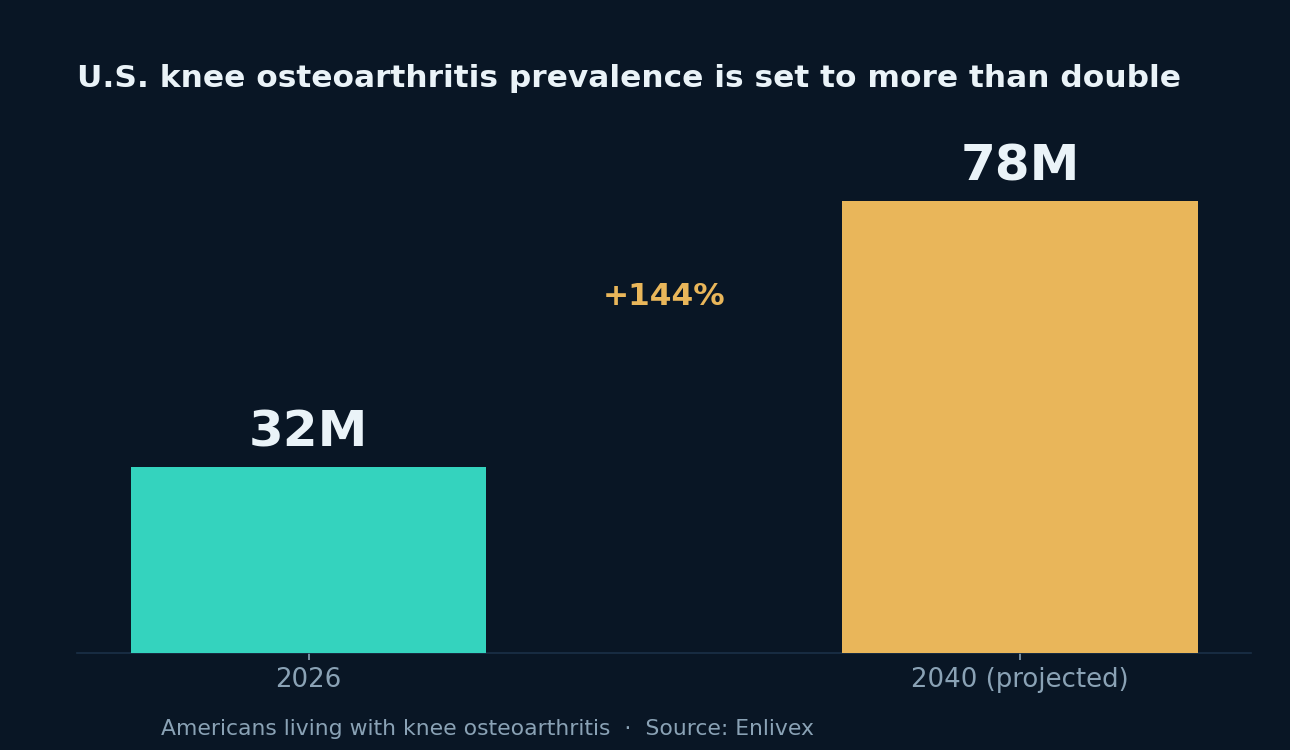
U.S. knee osteoarthritis prevalence is projected to more than double by 2040. Source: Enlivex.
The scale is global. According to Enlivex, osteoarthritis affects roughly 528 million people worldwide, around 15 percent of adults. And the surgical backstop keeps growing.
The number of U.S. knee replacement procedures is expected to rise from about 680,000 in 2014 to 1.28 million by 2030, according to Enlivex.
Now look at the treatment options. According to Enlivex, current care is mostly pain relief, intra-articular steroids, or surgery. There are no approved disease-modifying osteoarthritis therapies. Patients manage symptoms and wait.
The market reflects that gap. The global knee osteoarthritis market was valued at 5.9 billion dollars in 2022 and is projected to reach 13.14 billion dollars by 2031, according to Intellectual Market Insights Research.

A growing, underserved market. Source: Intellectual Market Insights Research.
So the need is large, underserved, and growing with an aging population. That is the core of the Enlivex quality longevity thesis: not simply adding years, but restoring mobility, independence, and functional life.
Inside Allocetra™: macrophage reprogramming
Allocetra™ is not a painkiller. It is a macrophage reprogramming immunotherapy.
Here is the plain version. Macrophages are immune cells that help regulate inflammation inside the joint. In osteoarthritis, that balance tips toward chronic inflammation. Allocetra™ is designed to help reset it.
The therapy is allogeneic. It is made from cells donated by healthy, unrelated donors, then prepared and cryogenically stored, ready for clinical use. It is given as a single intra-articular injection into the knee by a healthcare professional.
Because it is built from donor cells through a streamlined, standardized process, Allocetra™ is positioned as a cost-effective, off-the-shelf option rather than a bespoke one, according to Enlivex. For a chronic condition affecting tens of millions, that scalability is not a detail. It is part of the thesis.
That is a different idea from the steroids and NSAIDs that dominate care today. Instead of masking pain, this cell therapy for osteoarthritis targets the inflammatory drivers in the joint.
A painkiller manages the symptom. A macrophage-targeting therapy goes after the cause.
The Phase IIa signal that started it
Before a Phase IIb trial, there has to be a signal worth chasing. Phase IIa delivered one.
In the Phase IIa stage of its randomized Phase I/II clinical trial (NCT06233474), Allocetra™ showed clinically meaningful and statistically significant improvement in pain and function versus placebo, according to Enlivex.
The benefit was strongest in idiopathic age-related patients aged 60 and older, a group that represents more than half of the total KOA market.
The effect lasted. At six months, patients receiving Allocetra™ demonstrated an 80 percent improvement over placebo in composite endpoints, according to Enlivex. The safety profile stayed favorable.
Earlier interim figures pointed the same way. According to Enlivex, six-month results included a 51.2 percent reduction in WOMAC pain, a 46 percent improvement in WOMAC function, and a 40 percent improvement in WOMAC stiffness.
One detail stood out. According to Enlivex, the treatment effect increased in older patients. That is both unusual and strategic, because the age-related responder group it favors is also the largest slice of the knee osteoarthritis market.
Durability is the part that matters. A one-month effect is interesting. A six-month effect is a thesis.
The Phase IIa picture, per Enlivex:
- Statistically significant pain and function improvement versus placebo
- Strongest benefit in patients aged 60 and older
- An 80 percent improvement over placebo in composite endpoints at six months
- A favorable safety profile maintained through follow-up
Two approvals, three countries
This is where the roadmap turns from data into scale.
The first approval landed on March 23, 2026. According to Enlivex, the U.S. Food and Drug Administration cleared the company’s Investigational New Drug (IND) application for the Phase IIb trial of Allocetra™ in moderate-to-severe age-related primary knee osteoarthritis. It was the first regulatory clearance under the company’s dual-engine model.
The second followed about a month later. On April 21, 2026, Enlivex announced that the Danish Medicines Agency (DKMA) had granted Clinical Trial Application (CTA) approval for the same study.
Two clearances in two regions do more than expand the map. They spread regulatory risk and signal that the Phase IIa data held up under more than one set of reviewers.
Two regulators. Two jurisdictions. One unified late-stage program.
The Phase IIb clinical trial is designed as a global, multicenter, randomized, double-blind, placebo-controlled study, according to Enlivex. It is enrolling patients across the United States, Denmark, and Poland.
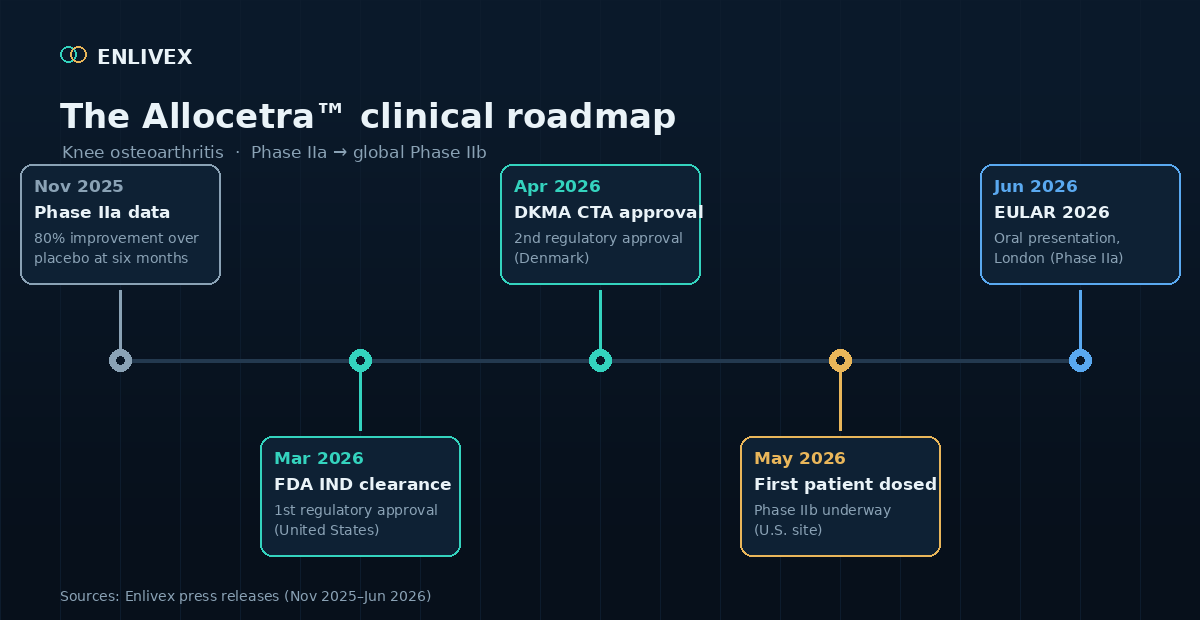
From a Phase IIa readout to a global Phase IIb now underway. Sources: Enlivex press releases, Nov 2025–Jun 2026.
How the trial is built
A late-stage trial lives or dies on its endpoints. This one is built to be measured cleanly.
According to Enlivex, the Phase IIb study is statistically powered around two primary measures: change from baseline in pain, and change in physical function, each compared with placebo at three and six months.
Additional endpoints include quality-of-life measures and functional mobility assessments.
In plain terms, the trial asks two questions. Does Allocetra™ reduce pain? And does it help people move and live better? Both, measured against placebo, over a meaningful window.
From planned to underway
Plans are easy to announce. Execution is harder.
On May 18, 2026, Enlivex announced that the first patient had been dosed at a U.S. clinical site in the Phase IIb trial. The roadmap moved from planned for the first half of 2026 to underway.
The science kept its momentum, too. In June 2026, Enlivex presented extended three- and six-month Phase IIa data in an oral session at the EULAR European Congress of Rheumatology in London, according to Enlivex. The same data had already featured at the OARSI 2026 World Congress in April.
CEO Oren Hershkovitz, Ph.D., described dosing the first patient as a significant step in executing the global Phase IIb strategy.
Chief Medical Officer Dr. Einat Galamidi said the Phase IIa results “directly supported” the move into the Phase IIb study.
One therapy, two engines
Allocetra™ is one engine. Enlivex runs two.
The company describes itself as The Quality Longevity Company, powered by a prediction markets treasury. The clinical pipeline is its biological floor.
The treasury anchors reserves in Rain, a prediction markets protocol on Arbitrum, with exposure linked to network activity rather than sentiment alone. Enlivex tracks both engines on its public market dashboard.
The point of this dual-engine structure is integration. The treasury and the clinical program are designed to work as one, meshing healthspan with wealthspan. The science advances. The structure is built to support it.
For a clinical roadmap, that matters. Late-stage trials are expensive. A company that can fund its mission while running it has more room to execute.
What to watch next
So where does this leave us?
The Allocetra™ roadmap now has a clear shape. Two approvals are secured. Three countries are enrolling. The first patient is dosed. The endpoints are set at three and six months. Enlivex shares each milestone through its investor press releases.
The signals to watch from here are simple: how fast enrollment moves, and whether the Phase IIa effect repeats at larger scale.
If it does, Allocetra™ would sit among the few candidates targeting the biology of knee osteoarthritis, not just its symptoms. In a market with no approved disease-modifying therapies and tens of millions of patients waiting, that is the entire opportunity.
The roadmap is no longer a plan. It is in motion.
메타데이터
- post_id
- 4acd14d30afb
- slug
- from-phase-iia-to-phase-iib-the-allocetra-clinical-roadmap-for-knee-osteoarthritis-4acd14d30afb
- url
- https://medium.com/@cryptooostar/from-phase-iia-to-phase-iib-the-allocetra-clinical-roadmap-for-knee-osteoarthritis-4acd14d30afb
- canonical_url
- https://medium.com/@cryptooostar/from-phase-iia-to-phase-iib-the-allocetra-clinical-roadmap-for-knee-osteoarthritis-4acd14d30afb
- author_url
- https://medium.com/@cryptooostar
- status
- ok
- fetched_at
- 2026-07-07 15:45:26