The Moral Gap: Ancient Wisdom for an AI World
Why upgrading your brain won’t upgrade your character.
The Moral Gap: Ancient Wisdom for a Transhuman Era
17 min read
You can implant a chip in your brain tomorrow. Your character still has to be built by hand, one choice at a time.
This post uses the 2,300-year-old story of the exiled Chinese poet Qu Yuan to show why moral character, not neural implants or AI tools, is what actually gives your life meaning.
A young engineer sits at her desk with two screens glowing in a quiet lab. On one, a half-finished research paper. On the other, an AI copilot spits out code faster than she can read it, while a headband tracks her focus and nudges her back whenever her mind drifts.
She’s built herself into a machine, ten times faster than the engineers who came before her. Still, staring at the blinking cursor, something feels off. She’s maximised her output. But has she become a better person?
That question sits at the centre of where we are right now. We’re moving from using tools to merging with them. Transhumanism promises bigger brains, longer lives, sharper focus. But more capacity doesn’t automatically add up to a good life. Meaning comes from character, judgement and emotional maturity, not from processing speed.
If we want to actually flourish as AI and biotech reshape what a human body can do, our moral growth needs to keep pace with our technical one. For that, it helps to borrow a compass from people who’ve been asking these questions for over two thousand years, long before anyone had a word for artificial intelligence, but not before anyone had to decide what kind of person they wanted to be under pressure.
From Using Tools to Becoming One
For most of history, technology stayed outside you. You picked up a hammer to build a wall. You put on glasses to see the board. You carried a phone to remember birthdays. The tool and the person stayed separate.
Transhumanism collapses that separation. It doesn’t just want to fix what’s broken. It wants to push healthy people past their natural limits.
This is already happening. Neural implants are restoring movement to paralysed patients, and researchers are testing versions that might boost memory or focus. Gene-editing tools like CRISPR can reduce inherited disease. In theory, they could also be used to select for traits parents simply prefer. Wearable AI already acts like an outboard memory.
Picture a job interview a decade from now, where half the candidates have memory-boosting implants. Or a classroom where some kids have genetically tuned attention spans and others don’t. The edge might stop coming from studying harder and start coming from what’s been installed in your body.
We’re not just using technology anymore. We’re becoming technological. The line between human and machine is getting blurry, and it’s not obvious it will hold.
Supporters call this the next stage of evolution, no different in kind from a vaccine or a pair of spectacles. Critics ask a harder question: is there a point where enhancement stops changing what we can do, and starts changing what we are?
That’s really the question underneath all of this. Not “can we enhance ourselves,” but “does getting more capable make us more human, or just more powerful?”
Self-Overcoming: Better Hardware or a Better Self?
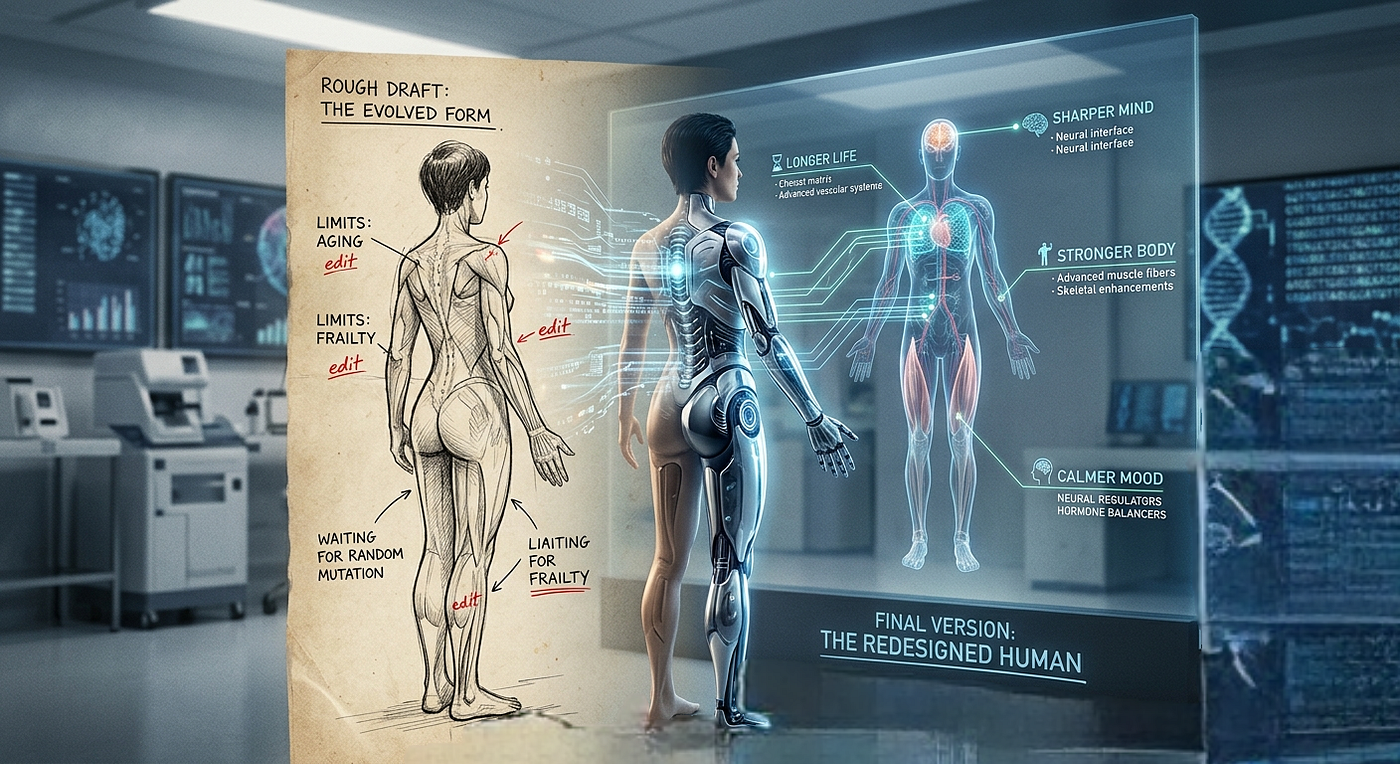
Many transhumanists treat the human body as a rough draft. Evolution, in their view, no longer has to wait around for random mutation. We can redesign ourselves on purpose.
This lines up with an old ideal: someone who refuses their limits and keeps outdoing their last version of themselves. Longer life. Sharper mind. Stronger body. Calmer mood. All treated as proof of progress.
You can see this mindset already, even without implants. You track your sleep with a ring on your finger. You wear a device that counts your heartbeat while you sleep. You lean on AI to get through your inbox faster. The next step, say the transhumanists, is wiring these tools directly into you.
But here’s the harder question: what actually counts as “better”?
If a chip let you recall every word of a conversation, would that make you wiser? If a gene edit boosted your IQ, would it also make you kinder? If a device switched off your anxiety, would it also grow your courage?
Mechanical improvement and human excellence are not the same thing. A sharper mind can serve generosity just as easily as it can serve manipulation. A stronger body can protect someone or bully them. More power just turns up the volume on whoever you already are.
Practically speaking, the real work of self-overcoming was never really about capacity. It’s about patience, humility, self-control, gratitude. None of these download in an update.
Technology can change what you’re capable of doing. It can’t do the harder job of deciding who you’re going to be.
The Moral Gap
Here’s the real risk with human enhancement. It’s not that the technology gets too strong. It’s that your character doesn’t grow to match it.
This has happened before, over and over. We built industrial machines before we worked out how to look after the planet they damaged. We built social media before anyone understood what it would do to attention spans and teenagers’ mental health. AI is advancing faster than our shared sense of how to use it responsibly.
Transhumanism could make this gap even wider.
Think about someone whose intelligence gets a serious upgrade, but whose empathy stays exactly where it was. They just get better at manipulating people. Someone with a perfect memory never forgets a grudge, either. Someone with more physical or mental horsepower can just as easily become more arrogant with it, or more impatient.
You already see a small version of this in daily life. Your phone puts almost all human knowledge in your pocket, and it hasn’t automatically made you more thoughtful. AI can help you finish a report in ten minutes. It can’t make that report honest.
This is the moral gap: the widening distance between how much power we have and how much wisdom we’ve grown to match it. Thinkers across very different traditions kept warning about exactly this. The more influence you’re handed, the more your restraint, honesty and judgement matter, not less.
If the next generation can edit genes, plug their minds into machines and add decades to a lifespan, these old virtues become more urgent, not less relevant. The real question of this century isn’t how enhanced a human can get. It’s whether our moral growth can keep pace with what we’re building.
You don’t need a lab or a headline invention to see this gap up close. It shows up whenever you catch yourself using a new tool to get an old shortcut. An AI that drafts your emails can also draft an excuse. A tracker that optimises your sleep can also become another number to obsess over at 2am. The tool isn’t the problem. The problem is that most of us reach for new capability long before we’ve done the slower work of building the judgement to use it well.
Qu Yuan: A Case Study in Integrity
To see what this actually looks like, it helps to go back about 2,300 years, to a poet and statesman named Qu Yuan (屈原).
Sima Qian, the great Han dynasty historian, tells his story in the Shiji (《史記》, Records of the Grand Historian), in a chapter called “Biography of Qu Yuan and Jia Sheng” (屈原賈生列傳).
Qu Yuan served King Huai of Chu (楚懷王) during the Warring States period, a brutal few centuries when the state of Qin was slowly swallowing its neighbours. He pushed for reform: promote officials on merit, tighten the laws, build alliances against Qin. That made him enemies among the aristocrats who benefited from the old system.
Sima Qian writes that these rivals slandered Qu Yuan to the king, again and again, until the king stopped listening to him at all:
屈平疾王聽之不聰也,讒諂之蔽明也,邪曲之害公也,方正之不容也。
“Qu Yuan grieved that the king did not listen wisely, that slander and flattery obscured clear judgement, that crooked men harmed the public good, and that upright people could not be tolerated.”
In real life, this is any organisation where flattery travels faster than the truth. A manager who only wants good news eventually stops hearing anything true at all. Chu didn’t fall because King Huai lacked resources or intelligence. It fell because he lost the ability to tell honest counsel from a well-timed compliment, a failure you can probably recognise from a bad boss, a toxic group chat, or a feed that only ever shows you what you already believe.
Purity in Exile
Even after being exiled more than once, Qu Yuan wouldn’t compromise. Sima Qian describes him like this:
其志潔,故其稱物芳;其行廉,故死而不容。
“His character was pure, so his descriptions were fragrant; his conduct was upright, and therefore he could not be tolerated.”
Out of that exile came his masterpiece, Li Sao (《離騷》, “Encountering Sorrow”), which Sima Qian says was born from “憂愁幽思” “deep sorrow and profound reflection”, grief for both his own fate and the moral rot spreading through his state.
Today, this means something for anyone who’s ever been punished at work for telling the truth. You don’t need a kingdom to lose. You just need to have said the uncomfortable thing in a meeting, watched it cost you a promotion, and had to decide whether you’d say it again anyway.
The Fisherman’s Advice
Qu Yuan’s most famous scene isn’t actually in the Shiji. It’s a separate poem in the Chu Ci (《楚辭》) called “The Fisherman” (《漁父》). Wandering the riverbank in exile, gaunt and dishevelled, Qu Yuan runs into a fisherman who asks why he’s ended up like this.
屈原曰:「舉世皆濁我獨清,眾人皆醉我獨醒,是以見放。」
“The whole world is muddy, and I alone am clean; all men are drunk, and I alone am sober. Therefore, I was banished.”
The fisherman pushes back:
漁父曰:「聖人不凝滯於物,而能與世推移⋯⋯何故懷瑾握瑜,而自令見放為?」
“The sage is not bound by material circumstances, but moves along with the changing times… Why clutch precious gems to your chest only to get yourself exiled?”
He’s basically telling Qu Yuan to read the room. Compromise a little. Survive.
Qu Yuan refuses:
屈原曰:「安能以皓皓之白,而蒙世俗之塵埃乎!」
“How can one allow his pure self to be soiled by the filth of external things?”
This plays out in our daily lives as the small, daily negotiation between fitting in and staying honest. You’ve had a version of this conversation yourself, maybe not with a fisherman, but with a friend telling you to just play along and stop making things awkward. Qu Yuan’s answer wasn’t about being difficult for its own sake. It was about deciding some things aren’t for sale.
Sima Qian’s verdict on him has survived for over two thousand years:
自疏濯淖污泥之中,蟬蛻於濁穢⋯⋯皭然泥而不滓者也。推此志也,雖與日月爭光可也。
“He cleansed himself from the mire of corruption, emerged from filth like a cicada shedding its shell… remaining pure though in the mud. If one carries such integrity to its fullest, it could indeed rival the brilliance of the sun and moon.”
What Qu Yuan Teaches Us About Character
Qu Yuan lived before Confucianism became China’s official political philosophy, but later scholars read his life through it anyway, because he happened to embody so much of it.
Righteousness (義, yi)
The Analects puts it plainly:
君子喻於義,小人喻於利。
Analects 4.16: “The junzi (the exemplary person) understands righteousness; the petty person understands profit.”
Qu Yuan chose righteousness over his own career, over and over. He could have flattered the king back into favour. He didn’t. In practice, this is the difference between the employee who tells their boss an uncomfortable truth and the one who just tells them what keeps them employed.
Loyalty (忠, zhong)
Confucian loyalty was never about blind obedience. Confucius says:
勿欺也,而犯之。
Analects 14.22: “Do not deceive your ruler, but respectfully remonstrate with him.”
Qu Yuan kept warning King Huai, even knowing it would cost him. That’s loyalty to the country, not to the man on the throne.
Moral courage
Confucius sets a high bar here too:
志士仁人,無求生以害仁,有殺身以成仁。
Analects 15.9: “The person of resolve and benevolence does not seek life at the expense of ren (humaneness); they may sacrifice life to fulfil ren.”
Traditions differ on how to read Qu Yuan’s death, but later Confucians admired that he’d lose everything rather than give up his convictions.
Humaneness (仁, ren)
Qu Yuan’s poems keep circling back to the suffering of ordinary people, not just his own bad luck. Confucius defines ren simply:
樊遲問仁。子曰:「愛人。」
Analects 12.22: “Fan Chi asked about ren. The Master said, ‘Love others.’”
We see this in action every time someone uses real influence to help people who can’t repay them for it, instead of just polishing their own reputation. That’s what separates a public figure people actually trust from one who’s just good at being seen.
Qu Yuan and the Moral Gap
Chu didn’t fall because it lacked talent. It had soldiers, administrators, diplomats. It fell because King Huai let flattery replace honest advice, let ambition replace justice, and let convenience outrank good judgement. Its outward strength couldn’t survive his inward weakness.
That’s the moral gap, showing up around 300 BC instead of on a laptop screen.
Modern AI hands ordinary people the ability to write essays, code, marketing copy and scientific papers at a speed nobody’s grandparents could have imagined. Gene editing might make us physically healthier. None of it guarantees you’ll be honest, humble or kind.
A manager can use AI to make a bad quarter look good on paper. A politician can use an algorithm to spread a lie faster than any fact-checker can catch it. A student can use a chatbot to get a good grade without learning the material behind it. Capability just amplifies whatever character was already there.
Qu Yuan had exceptional talent, and Sima Qian barely dwells on it. What he praises first is Qu Yuan’s integrity, his refusal to trade it for anything.
As gene editing, brain implants and life extension move from science fiction toward ordinary life, that example only gets more relevant. Enhanced intelligence without enhanced character just builds a faster, more efficient version of corruption. Bigger tools need a steadier hand, not a looser one.
Ancient Wisdom, Applied
- Practise telling flattery from truth. King Huai lost his kingdom because he couldn’t tell honest counsel from a well-aimed compliment. You face a version of this every day, except your court is your social feed and your group chat.
Next time an AI tool or an algorithm hands you an answer that feels a little too agreeable, pause and ask who benefits if you believe it without checking. In practical terms, this looks like reading one source that disagrees with you before you share the one that confirms what you already thought.
It also means noticing when a chatbot is simply telling you what you want to hear, because flattery from a machine is still flattery, and it’s arguably easier to fall for since it never seems to have an agenda.
- Don’t stir the mud just because it’s easier.
The fisherman told Qu Yuan to blend in, to eat the dregs and drink along with everyone else. Qu Yuan refused, and it cost him.
You’ll face smaller versions of this trade every week: whether to let an AI tool quietly pad a claim you can’t actually back up, or whether to cut a corner because nobody’s likely to notice. Holding the line here isn’t about being self-righteous.
It’s about deciding, in advance, which corners you won’t cut, so you’re not negotiating with yourself in the moment you’re most tempted.
- Point your capability outward, not just inward.
Qu Yuan’s grief was never really about himself. It was about what was happening to the people of Chu.
Enhanced tools, whether that’s a productivity app today or a neural implant eventually, will make you more capable of getting things done. The question worth asking regularly is who that capability actually serves.
Concretely: before you use a new AI tool to save yourself an hour, ask whether that hour is going toward something that helps anyone besides you, or just toward one more task ticked off a list nobody but you cares about.
- Say the uncomfortable thing anyway.
Qu Yuan kept warning his king, knowing it might get him exiled again. Most of us won’t face exile for speaking up at work, but we’ll face something smaller and more familiar: an awkward pause, a cold reply, a missed promotion.
Algorithms are built to reward agreement, so a plain, disagreeable truth is getting rarer precisely when it’s needed more.
Practically, this means picking one meeting this month where you say the thing you’d normally leave unsaid, and seeing what actually happens.
- Treat your character like a skill, not a setting.
No implant teaches patience. No gene edit installs humility. These come from repetition, the boring, unglamorous kind: apologising when you’re wrong, sitting with a hard feeling instead of numbing it, finishing something you don’t feel like finishing.
In everyday terms, this could be as small as putting your phone in another room for one meal a day, not because it will change your life on its own, but because it’s a rep, and reps are the only way character actually gets built.
Think of it this way: nobody expects to get stronger from owning a gym membership they never use, yet plenty of us quietly hope moral strength will arrive just by owning better tools.
Final Thoughts
The real challenge of this moment isn’t whether we can push past our physical or mental limits. We probably can, and in some ways we already have. The harder question is whether we’ve got the wisdom to handle what we build.
As the line between human and machine keeps blurring, technology will keep changing what’s possible for us. It won’t decide who we become. That part is still on us.
Qu Yuan is remembered not because he held onto power, but because he wouldn’t hold onto it at the cost of his integrity. As we head into a more automated, more enhanced future, the goal was never mechanical perfection.
Pair the new tools with the old discipline of self-cultivation, and you might actually close the moral gap, rather than widen it faster than ever.
메타데이터
- post_id
- 4b0f563c1ad2
- slug
- the-moral-gap-ancient-wisdom-for-an-ai-world-4b0f563c1ad2
- url
- https://medium.com/@charlenetan2020/the-moral-gap-ancient-wisdom-for-an-ai-world-4b0f563c1ad2
- canonical_url
- https://medium.com/@charlenetan2020/the-moral-gap-ancient-wisdom-for-an-ai-world-4b0f563c1ad2
- author_url
- https://medium.com/@charlenetan2020
- status
- ok
- fetched_at
- 2026-07-31 17:40:33