Most Indians think they have to choose between NPS and mutual funds.
One of the questions I’m asked most often during financial wellbeing sessions is surprisingly simple.
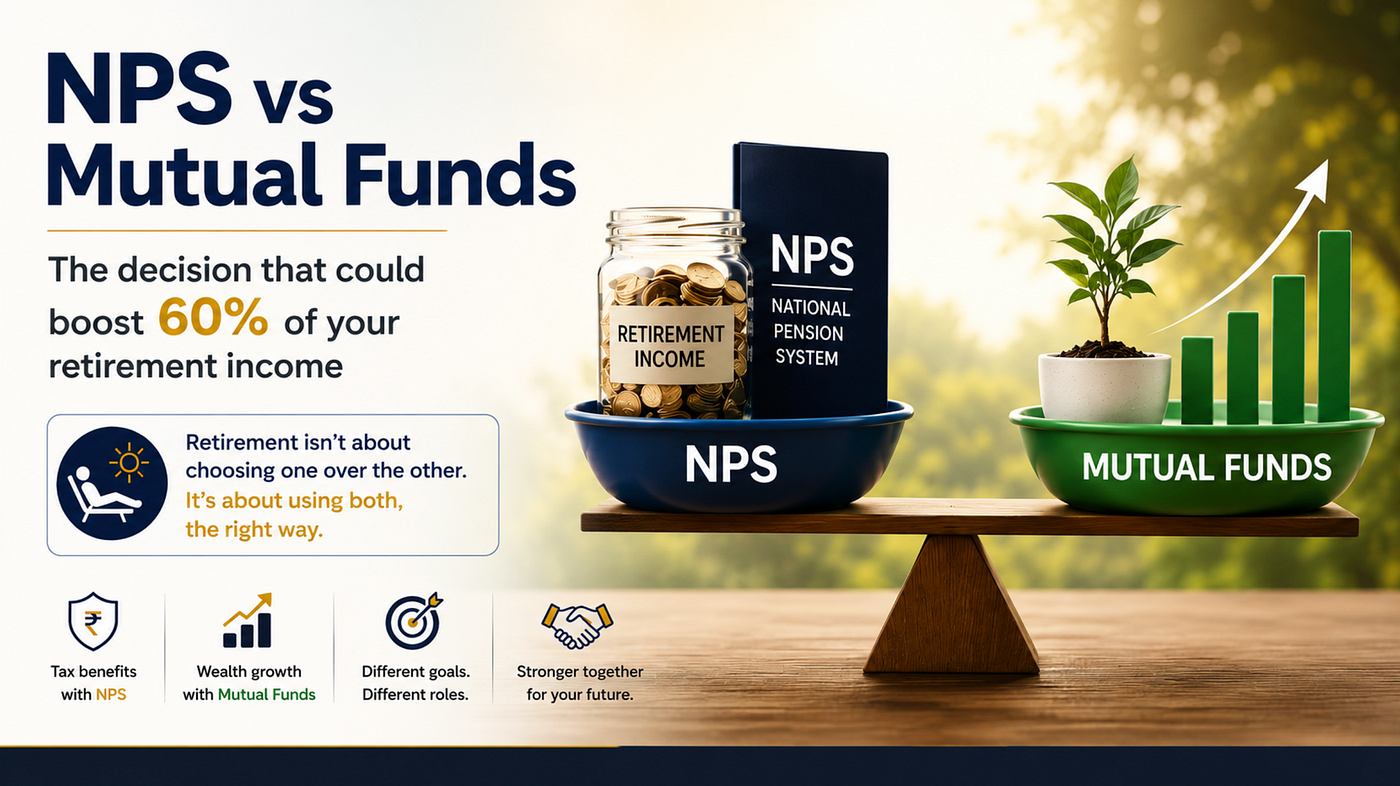
How do you plan your retirement with NPS or Mutual Funds?
Most Indians think they have to choose between NPS and mutual funds. They’re asking the wrong question.
One of the questions I’m asked most often during financial wellbeing sessions is surprisingly simple.
Should I invest in NPS or Mutual Funds?
Most people expect a straightforward answer.
Choose one.
Ignore the other.
Move on.
But after speaking to hundreds of salaried professionals over the years, I’ve realised the question itself is flawed.
The real question isn’t which investment is better.
It’s what job is each investment meant to do?
This is where most retirement planning goes wrong.
Mutual funds have rightly become one of India’s favourite investment vehicles. They offer flexibility, liquidity and the opportunity to build long-term wealth through disciplined SIPs.
NPS, however, was never designed to compete with mutual funds.
It was designed to create retirement income.
That distinction changes the entire conversation.
Instead of comparing returns alone, investors should think about how different products solve different financial problems.
A well-designed retirement portfolio doesn’t rely on a single investment.
It combines growth, discipline, tax efficiency and long-term income planning.
This is exactly why I believe organisations should start thinking beyond individual investment products and embrace the broader concept of Payroll-Linked Investing.
When investing becomes part of the salary cycle instead of an afterthought at the end of the month, employees are far more likely to stay invested consistently.
Among the various payroll-linked benefits available today, Corporate NPS has emerged as one of the strongest retirement benefits employers can offer. It combines disciplined investing with attractive tax advantages while requiring very little effort from employees once contributions become part of payroll.
At the same time, I believe we’ll increasingly see organisations introducing Corporate Mutual Funds as another payroll-linked benefit. Salary-linked SIPs have the potential to make long-term wealth creation just as effortless as retirement investing.
The debate therefore shouldn’t be NPS vs Mutual Funds.
It should be:
How should NPS and Mutual Funds work together over the next 30 years?
Retirement Planning isn’t done by finding the “best” product.
It’s built by combining the right products for the right objectives.
Mutual funds can help create wealth.
NPS can help convert years of disciplined investing into retirement income.
Together, they often create a stronger retirement strategy than either product can deliver on its own.
That’s why every long-term financial plan should begin with one question:
What am I trying to achieve?
Only then should you decide which products deserve a place in your portfolio.
If you’re beginning your retirement journey, understanding the role each investment plays is far more important than comparing one-year returns. A structured Retirement Planning approach almost always outperforms chasing whichever product happens to be performing best today.
Continue Reading
I explore this topic in much greater detail on Moneycontrol, including real examples of how combining NPS and Mutual Funds can significantly improve long-term retirement outcomes.
Read the complete article Moneycontrol:
**NPS vs Mutual Funds: The Decision That Could Boost 60% of Your Retirement Income**
메타데이터
- post_id
- 4b13bb2c8296
- slug
- most-indians-think-they-have-to-choose-between-nps-and-mutual-funds-4b13bb2c8296
- url
- https://medium.com/@marketing_71313/most-indians-think-they-have-to-choose-between-nps-and-mutual-funds-4b13bb2c8296
- canonical_url
- https://medium.com/@marketing_71313/most-indians-think-they-have-to-choose-between-nps-and-mutual-funds-4b13bb2c8296
- author_url
- https://medium.com/@marketing_71313
- status
- ok
- fetched_at
- 2026-07-08 15:11:24



