Node.js Event Loop Architecture — How a Single-Threaded Runtime Handles Massive Concurrency
When I first started working with Node.js, one thing didn’t sit right with me:
Node.js Event Loop Architecture — How a Single-Threaded Runtime Handles Massive Concurrency
When I first started working with Node.js, one thing didn’t sit right with me:
How can a single-threaded system handle thousands of requests at the same time?
It sounds contradictory. But once I understood the event loop properly (especially from the official docs), everything clicked. This blog is my attempt to explain it in the simplest way possible, without losing depth.
What “Single-Threaded” Actually Means
Node.js is often called single-threaded, but that statement is incomplete.
- JavaScript execution runs on one main thread
- But Node.js itself is not limited to one operation at a time
- It uses:
— OS kernel
— Background threads (libuv)
— Async I/O
→ So the correct statement is:
Node.js is single-threaded for JavaScript execution, but multi-system for handling I/O
This distinction is everything.
The Core Idea: Event-Driven, Non-Blocking Architecture
Node.js does not wait for tasks to complete.
Instead, it follows this pattern:
- Receive request
- Start the task (DB call, file read, API call)
- Do not wait
- Move to the next request
- Come back later when result is ready
This is called non-blocking I/O.
→ From official docs: Node.js offloads operations to the system whenever possible, so the main thread stays free.
Think of It Like This (Simple Analogy)
Imagine:
- You are a waiter (event loop)
- Kitchen = OS / background workers
You:
- Take orders
- Pass them to kitchen
- Serve completed dishes
You don’t:
- Cook yourself
- Wait idle for one order
That’s exactly how Node.js scales.
Deep Dive: Event Loop Phases
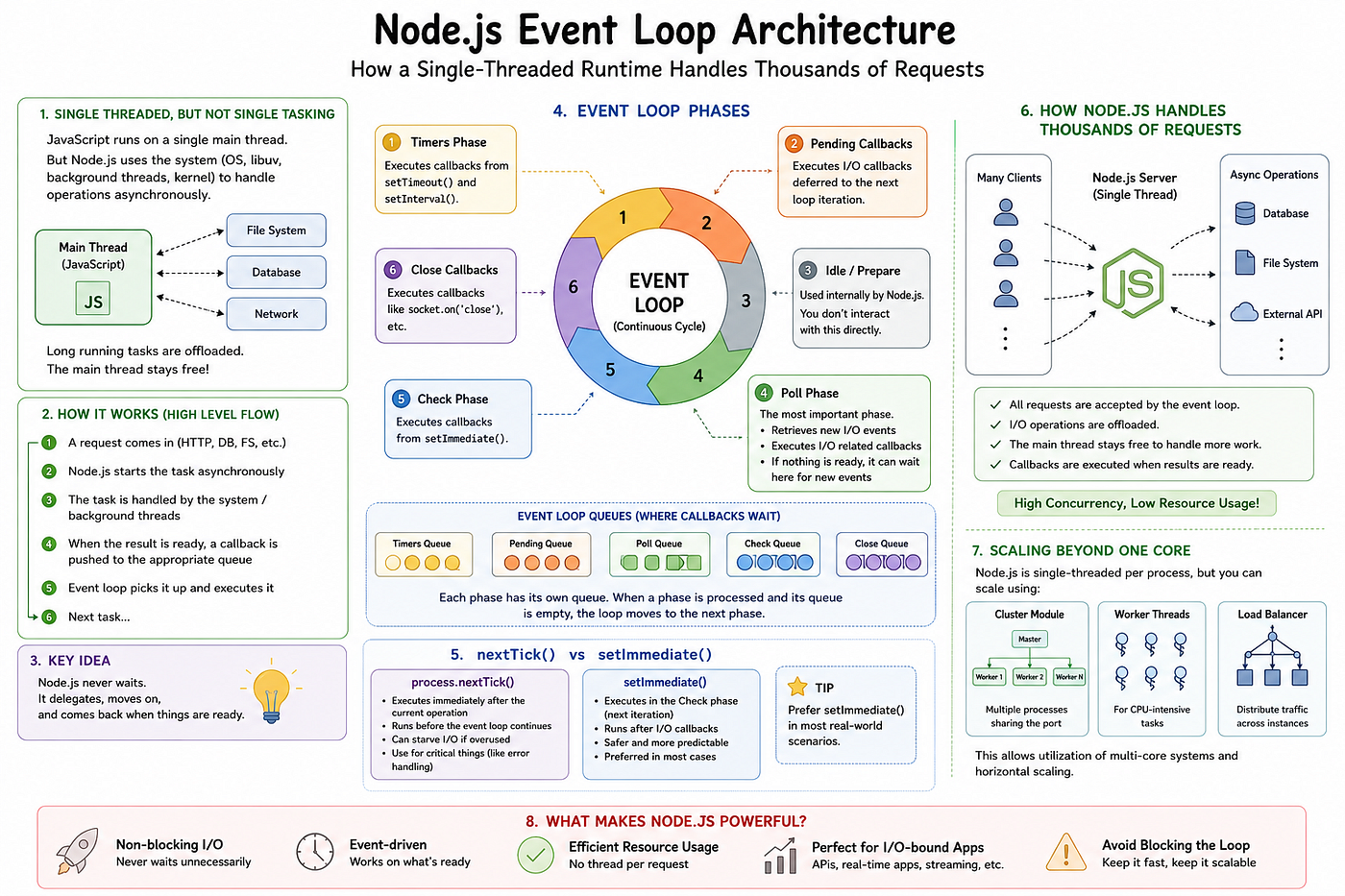
The event loop is not just a queue. It runs in phases, each handling specific types of callbacks.
Architecture:
Main Phases:
1. Timers
- Executes callbacks from
setTimeoutandsetInterval
2. Pending Callbacks
- Handles system-level callbacks (like TCP errors)
3. Idle / Prepare
- Internal use (not something we deal with)
4. Poll Phase (Most Important)
- Retrieves new I/O events
- Executes I/O callback
- Waits if nothing to do
5. Check Phase
- Executes
\setImmediatecallbacks
6. Close Callbacks
- Runs cleanup callbacks (like
socket.on(‘close’)

→ The loop cycles through these continuously.
Why Poll Phase is the Heart
This is where the magic happens.
- Incoming requests get processed here
- Completed async tasks return here
- If nothing is pending → Node waits efficiently
→ This is why Node.js doesn’t waste CPU cycles and stays highly scalable.
process.nextTick() vs setImmediate()
This is a small but important detail most people ignore.
process.nextTick():
- Executes immediately after current function
- Runs before event loop continues
- Can block I/O if abused
setImmediate():
- Executes in next iteration (check phase)
- Safer and more predictable
→ Official docs suggest:
Prefer setImmediate() in most real-world scenarios
How Node.js Handles Thousands of Requests
Now the real question.
Traditional Server (Thread-per-request):
- Each request = new thread
- Memory heavy
- Context switching overhead
Node.js Approach:
- Single thread handles all requests
- No thread creation per request
- Uses async callbacks instead
What Actually Happens:
- 1000 users hit server
- Node.js:
— Registers all requests — Starts async operations — Keeps event loop free
- As responses come back:
— Callbacks are queued — Event loop executes them
→ Result: High concurrency with low resource usage
Important Insight: Node.js is Best for I/O-bound Work
Node.js shines when:
- DB queries
- API calls
- File system operations
- Streaming
- Real-time apps (chat, sockets)
But…
Not ideal for:
- Heavy CPU computations
- Large synchronous loops
Because:
Blocking the event loop = blocking everything
Common Mistakes That Kill Performance
1. Blocking Code
***while(true) {}***
→ Freezes entire server
2. Misusing process.nextTick
- Can starve the event loop
- Prevents I/O execution
3. Writing Sync Code in APIs
***fs.readFileSync()***
→ Avoid in production
If You Need More Power (Scaling Beyond One Core)
Node.js is single-threaded per process, but you can scale using:
- Cluster module
- Worker threads
- Load balancers
→ This allows:
- Multi-core utilization
- Horizontal scaling
My Final Understanding
After going through the official Node.js docs and actually building apps, this is how I think about it:
- Node.js is not trying to do everything at once
- It is trying to never block
The event loop is just a smart coordinator:
- It runs what is ready
- Skips what is waiting
- Keeps the system moving
→ That’s why:
Node.js can handle thousands of concurrent requests — not by parallel execution, but by efficient scheduling and non-blocking design
Conclusion
If I had to summarize in one line:
Node.js scales not because it is fast at doing work, but because it is excellent at not waiting unnecessarily
Once this mindset clicks, everything about Node.js architecture starts making sense.
메타데이터
- post_id
- 4b13f37ce4aa
- slug
- node-js-event-loop-architecture-how-a-single-threaded-runtime-handles-massive-concurrency-4b13f37ce4aa
- url
- https://medium.com/@duttabipul927/node-js-event-loop-architecture-how-a-single-threaded-runtime-handles-massive-concurrency-4b13f37ce4aa
- canonical_url
- https://medium.com/@duttabipul927/node-js-event-loop-architecture-how-a-single-threaded-runtime-handles-massive-concurrency-4b13f37ce4aa
- author_url
- https://medium.com/@duttabipul927
- status
- ok
- fetched_at
- 2026-06-09 15:37:30